Shipwreck: Robinson Crusoe and the Andrea Doria

by Steve Rockwell

Published in 1719, Daniel Defoe’s The Life and Strange Surprising Adventures of Robinson Crusoe of York, Mariner, is generally regarded as the first English novel. Its immediate success might be attributed to its documentary, confessional style of narration. The receptivity by the general public to tales of shipwreck already had the Alexander Selkirk account as a classic example. Lack of lighthouses and the accurate mapping of shoals made naval disasters inevitable in this age.

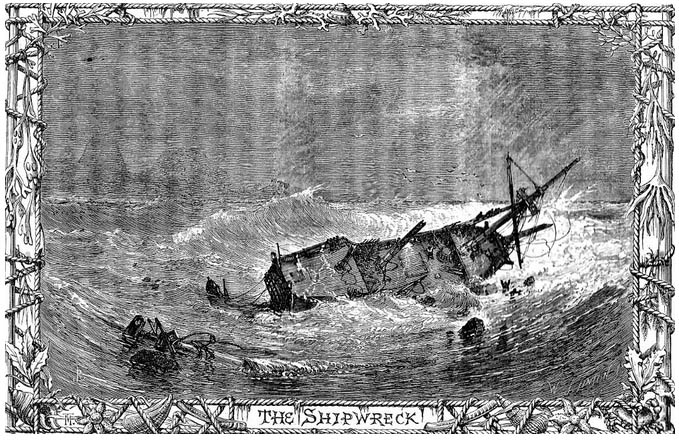
Scanned image by Philip V. Allingham. The illustrator presents a convincing panorama of the wrecked merchantman off the coast of a remote island off the South American coast (left), with several small figures (presumably, one of them Crusoe). London publisher: Cassell, Petter, and Galpin, 1863-64

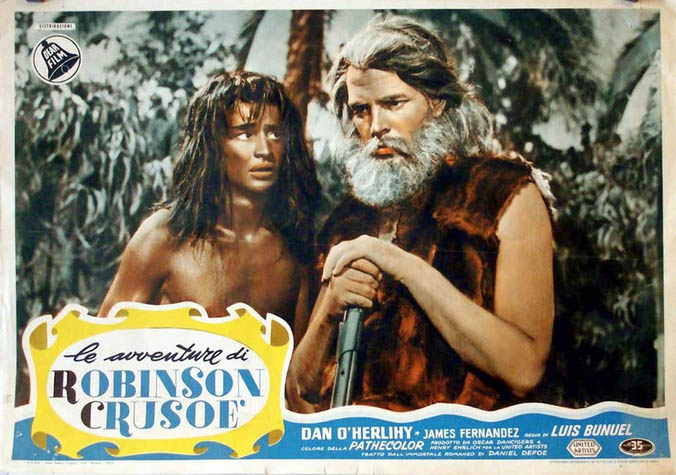
To a young Jouko Salomaa living in Grangesberg, Sweden, Defoe’s classic left a deep impression. To him, when screened at Cassels, the local theater, Luis Bunuel’s 1954 Robinson Crusoe was a disappointment. What the film was unable to convey adequately in his mind, and which the book described in intricate detail, was Crusoe’s gradual conversion of his island wilderness into something of a solitary paradise.

Movie poster for Luis Bunel's 1954 Adventures of Robinson Crusoe. It was screened a year or so before the 1957 Atlantic crossing by Jouko Salomaa
Movie poster for Luis Bunel’s 1954 Adventures of Robinson Crusoe. It was screened a year or so before the 1957 Atlantic crossing by Jouko Salomaa at Cassels movie theater in Grangesberg, Sweden

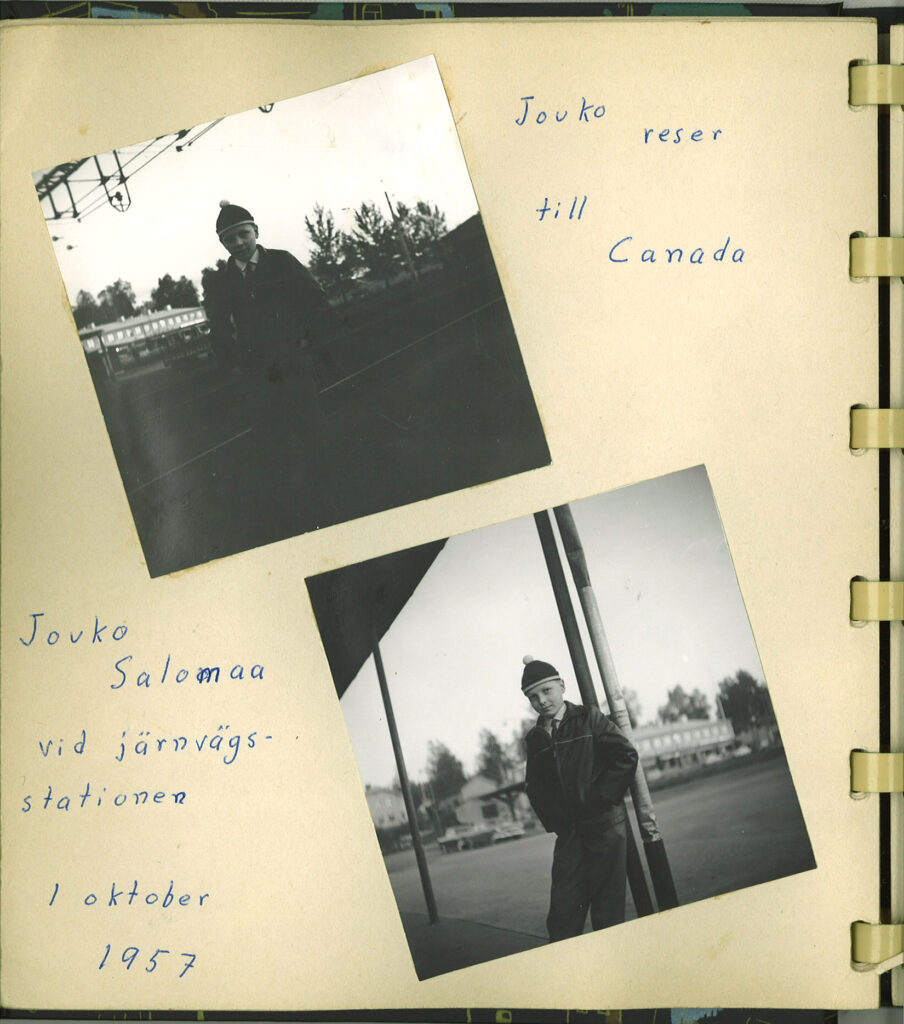
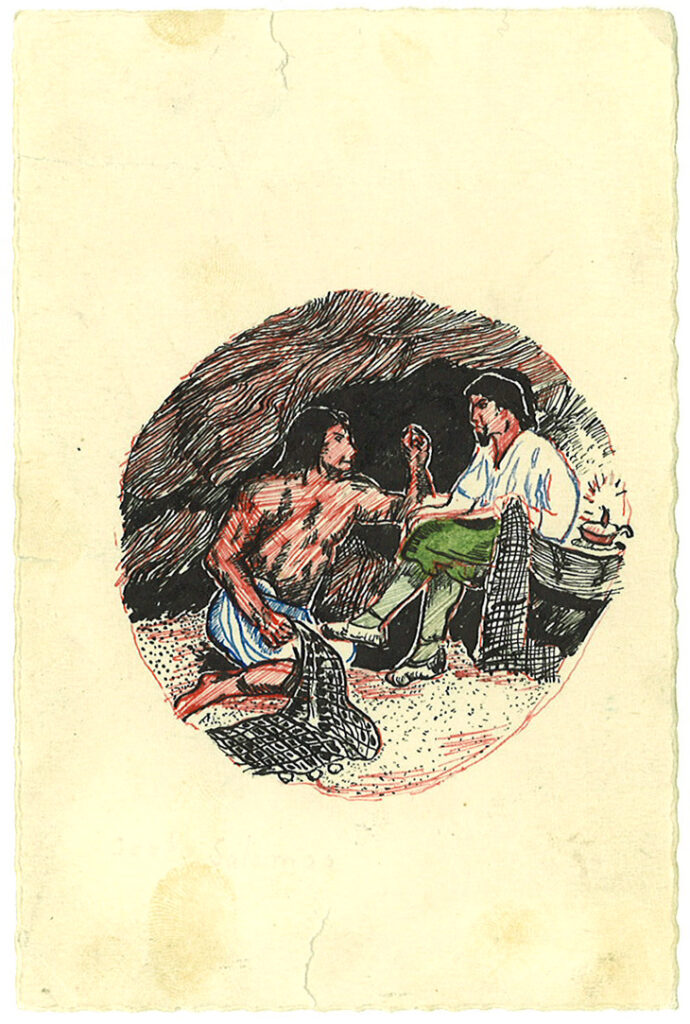
Jouko used one of the illustrations from the book as a basis for his 1957 colored ink drawing of Crusoe and Friday, which he gave as gift to classmate Lennart Hansson. On Jouko’s departure to Canada from Sweden on October 1, 1957, Lennart photographed him at the railway station, the images of which were later emailed to Canada along with one of the Crusoe drawing.

Jouko reser till Canada, October 1, 1957, Lennart Hansson scrap book page with two of his photos of Jouko Salomaa at the train station in Grangesberg, Sweden, taken the day before Jouko boarded the SAL ocean liner Stockholm in the Copenhagen to Halifax, Canada Atlantic crossing
Jouko reser till Canada (Jouko travels to Canada), October 1, 1957, Lennart Hansson scrap book page with two of his photos of Jouko Salomaa at the train station in Grangesberg, Sweden, taken the day before Jouko boarded the SAL ocean liner Stockholm in the Copenhagen to Halifax, Canada Atlantic crossing
Jouko Salomaa, Robinson Crusoe and Friday, 1957, ink on paper. Gifted by Jouko to classmate Lennart Hansson before Jouko's ocean departure
Jouko Salomaa, Robinson Crusoe and Friday, 1957, colored inks on paper. Gifted by Jouko to classmate Lennart Hansson before Jouko’s ocean departure

On his departure, twelve-year-old Jouko and ocean liner passengers endured a storm that produced waves the height of the ship. Seasickness had trapped the lad to his cabin for all but the last day of the voyage. The joy at the release from his confinement came with a boundless excitement to explore the ship. Finding himself at the prow of the liner, on an ill-advised impulse he clasped the jack staff tightly with both hands, hoisting himself up with a quick jerk, legs dangling over the tip of the prow. Looking down, the keel cleaved the relative calm Atlantic waters producing little rainbows. A nervous twist of the head at the fear of discovery, however, brought a quick end to the prank.

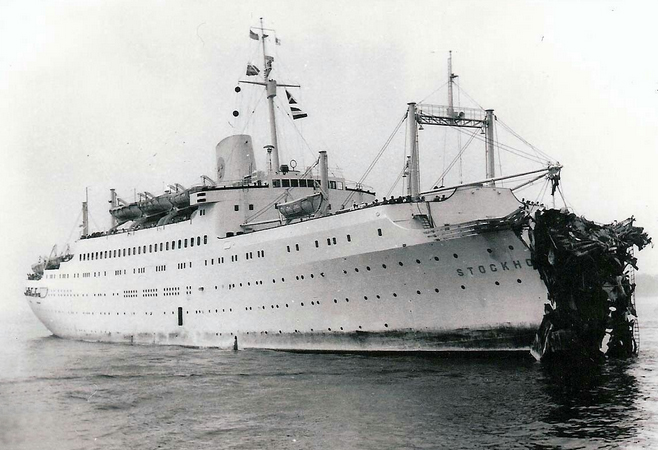
The Swedish American Line ship The Stockholm photographed after its 1956 collision with the Andrea Doria in Nantucket Sound

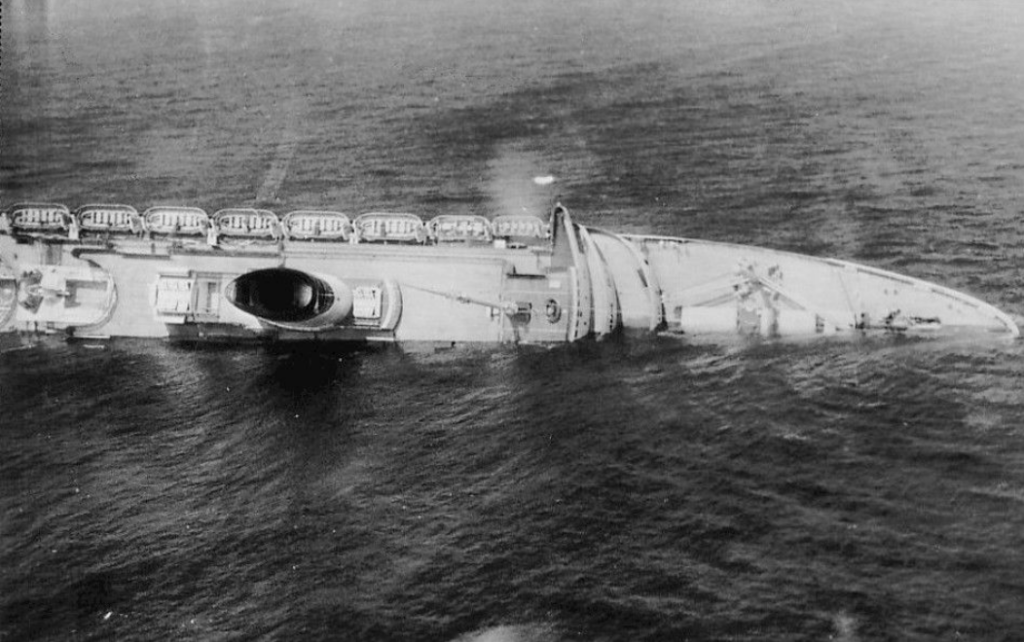
Unknown to the young passenger at the time but common knowledge to crew and many of its passengers, was the ocean liner tragic history. Just a year before on July 25, 1956, in a collision with the SS Andrea Doria, the prow of the MS Stockholm had sunk to the bottom of the sea off the coast of Nantucket in heavy fog. The 75-foot section was repaired within four months at Bethlehem Steel Shipyard in Sunset Park Shipyard, Brooklyn. While the Andrea Doria sunk after eleven hours most of its passengers were rescued.

The ‘Andrea Doria’ in its last hours Harry Trask/Wikimedia Commons

At the moment of impact, 14-year-old Linda Morgan on the Andrea Doria had been asleep. It seems that her cabin, stateroom 52 on the upper deck of the luxury liner had been pierced by the prow of the Stockholm, it somehow sliding under her mattress and catapulting her onto the deck of the Stockholm. Swedish crew heard a girl asking in Spanish, “Where am I?” Puzzled, they realized quickly that she was not part of the Stockholm passenger list.

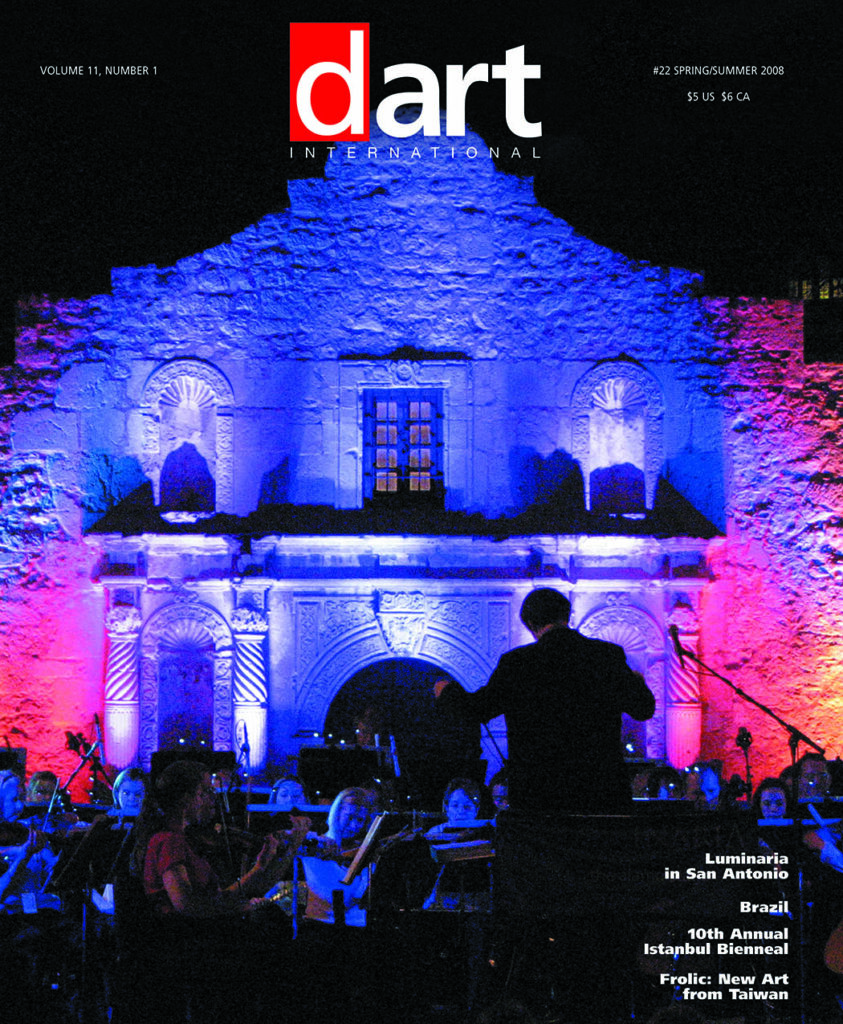
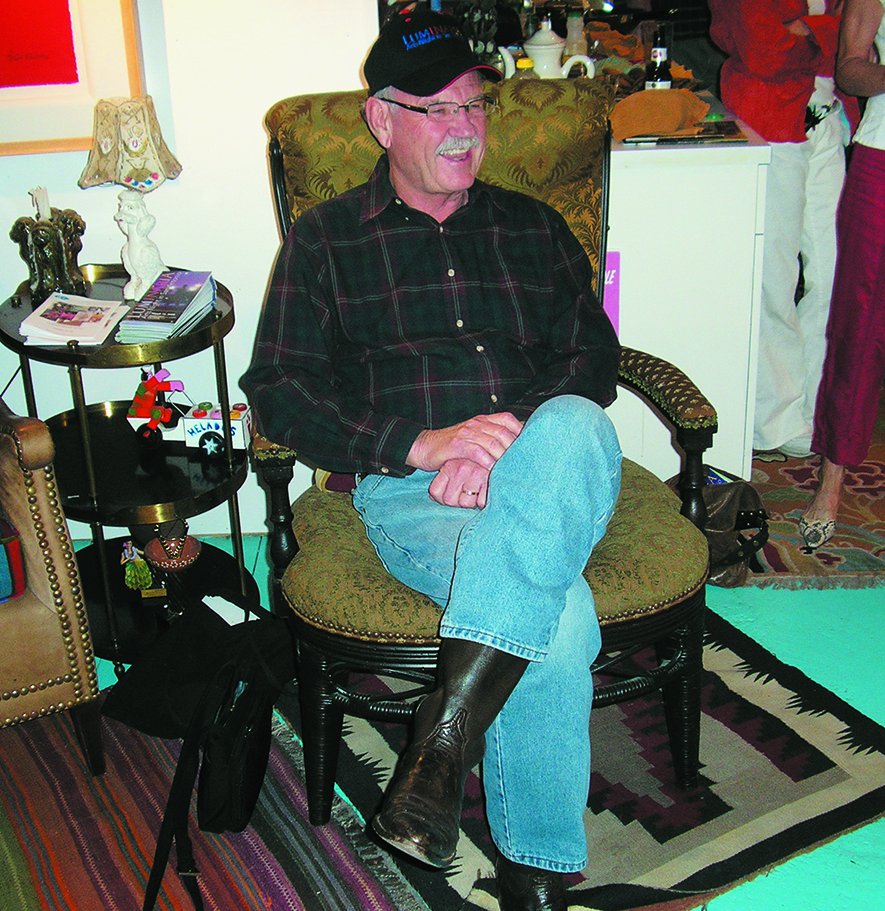
It is at this point that a dot needs to be connected. Both Linda and Jouko became part of the art world as adults. Linda served as curator at the McNay Museum in San Antonio, Texas. She had married Phil Hardberger in 1968, who served as mayor from 2005 to 2009. Jouko created the art persona Steve Rockwell in 1987 in Toronto, eventually published dArt International magazine, which the city of San Antonio invited to cover their 2008 Luminaria arts festival. I took the photo of Mayor Hardberger, not realizing at the time that his wife and I were curiously connected to the Andrea Doria collision and tragedy. The “miracle girl” after recovery from a broken leg, and fractures, was reluctant in later life to talk about an event where she and her mother survived, while her sister and step-father perished.

The Luminaria in San Antonio edition of dArt International Magazine (2008), featuring the Bill Fitzgibbons light art illumination of the Alamo
Then San Antonio Mayor Phil Hardberger photographed at a 2008 Luminaria event by Steve Rockwell. The Mayor married Linda Morgan in 1968. She had been the "miracle girl" survivor of the Andrea Doria
Then San Antonio Mayor Phil Hardberger photographed at a 2008 Luminaria event by Steve Rockwell. The Mayor married Linda Morgan in 1968. She had been the “miracle girl” survivor of the Andrea Doria

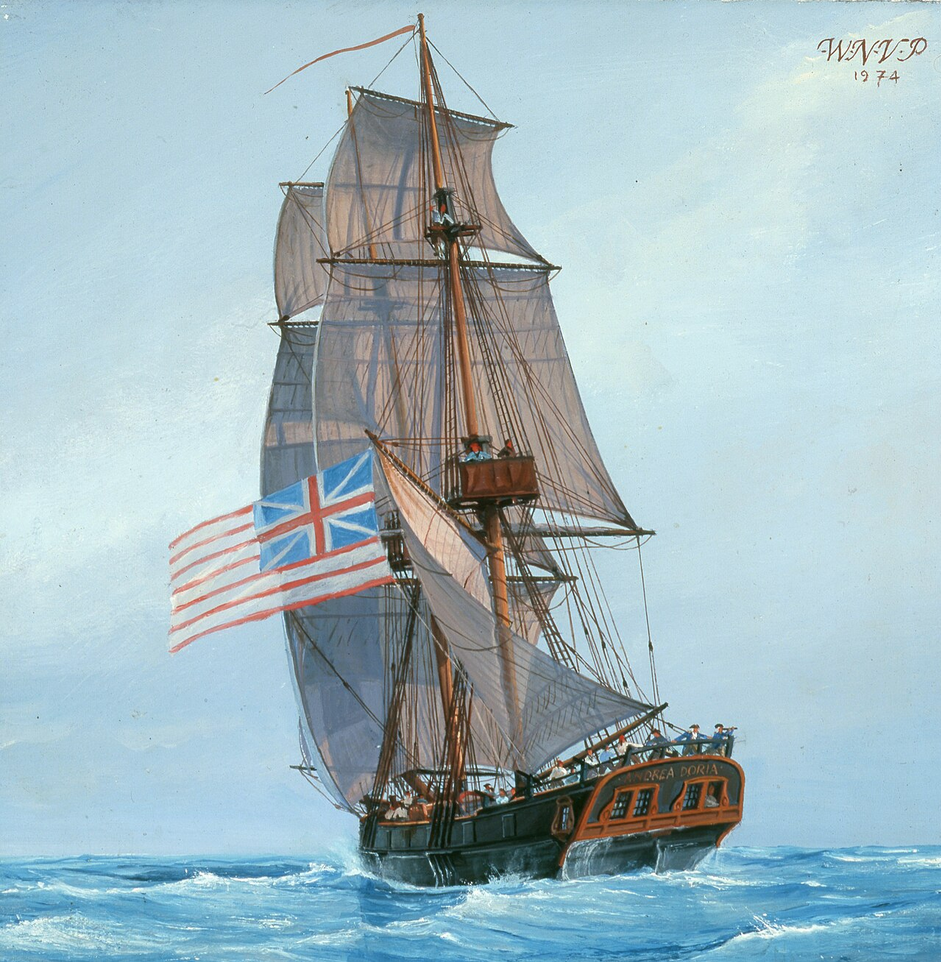
A necessary footnote to the sinking of the Italian luxury ocean liner SS Andrea Doria is the intentional burning and sinking of its American namesake, the USS Andrew Doria on November 21, 1777. The geographical distance between the two wrecks is approximately 277 miles, one about 50 miles south of Nantucket, Massachusetts, the other at the bottom of the Delaware River near Petty’s Island, near Philadelphia. During the American Revolutionary War, rather than surrendering the valuable asset to the advancing British fleet, Captain Isaiah Robinson had the ship packed with combustibles, and watched it burn to the waterline and sink beneath the waterbed. The USS Andrew Doria is historically famous as the first American warship to receive an official salute from a foreign power at Sint Eustatius in 1776. The painting by Phillips Melville depicts the Continental Navy Brig flying the Grand Union flag, the first national flag of the United States.

Phillips Melville (Colonel, USMC, Retired), Continental Brig Andrew Doria depicts the warship receiving its historic first official salute from the Dutch at St. Eustatius on November 16, 1776. Courtesy of the U.S. Navy Art Collction, Naval History and Heritage Command (NHHC), Washington,D.C. Gift of Colonel Phillips Melville, 1977. Public Domain (as a work of the U.S. federal government/U.S. Navy
Phillips Melville (Colonel, USMC, Retired), a 1974 depiction of the Continental Brig Andrew Doria warship receiving its historic first official salute from the Dutch at St. Eustatius on November 16, 1776. Courtesy of the U.S. Navy Art Collection, Naval History and Heritage Command (NHHC), Washington,D.C. Gift of Colonel Phillips Melville, 1977. Public Domain (as a work of the U.S. federal government/U.S. Navy)

dArt Magazine Curated Content #4

by Steve Rockwell

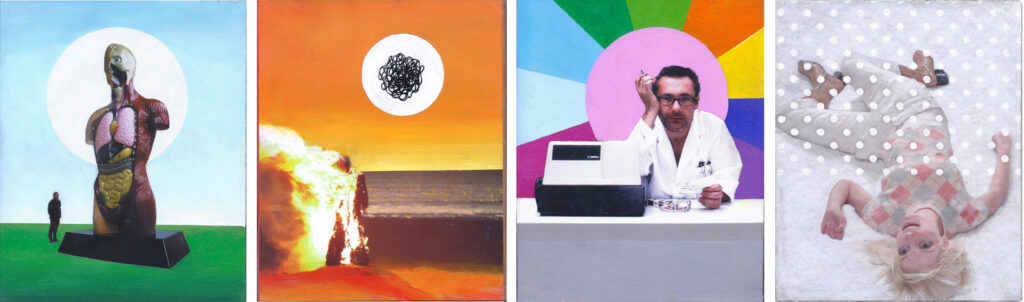
Hirst's Anatomy, Burning Man, The Pharmacist and Miami Flurry. 2024, dArt magazine pulp and paper, variously mounted on canvas, 8.5 x 7 inches. Citing the work of Damian Hirst, Matthew Ritchie, Micah Lexier, and Chris Scarborough.
Hirst’s Anatomy, Burning Man, The Pharmacist and Miami Flurry, 2024, dArt magazine pulp and paper, variously mounted on canvas, 8.5 x 7 inches. Citing the work of Damian Hirst, Matthew Ritchie, Micah Lexier, and Chris Scarborough.

Panel One in dArt Magazine Curated Content #4 depicts a tiny figure gazing up to a 20-foot colossus. Though Damien Hirst’s Hymn sculpture appears here with green grass and blue sky, it is in fact an installation view of Damien Hirst’s 2000 exhibition at Gagosian’s New York Chelsea gallery, the white disk and colors having here been added in oils. The full exhibition title was on the wordy side: Damien Hirst: Theories, Models, Methods, Approaches, Assumptions, Results and Findings. The review of the exhibition was covered for dArt by Clayton Campbell.

dArt Magazine Curated Content #3

by Steve Rockwell

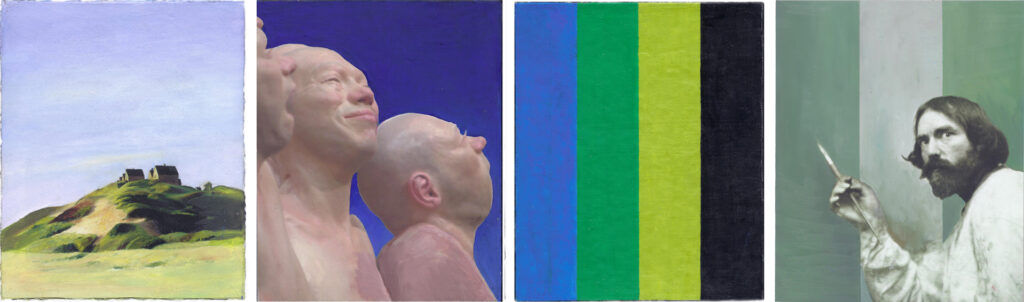
Hopper's Corn Hill, Stipl Squint, Jaan's Divide, and Johns Paint Tip. Citing the work of Edward Hopper, Richard Stipl, Jaan Poldaas, Barnett Newman, and Malcolm Arbuthnot (of Augustus Johns).
Steve Rockwell, Hopper’s Corn Hill, Stipl Squint, Jaan’s Divide, and John’s Paint Tip. 2024, dArt magazine pulp and paper, variously mounted on canvas, 8.5 x 7 inches. Citing the work of Edward Hopper, Richard Stipl, Jaan Poldaas, Barnett Newman, and Malcolm Arbuthnot (of Augustus John).

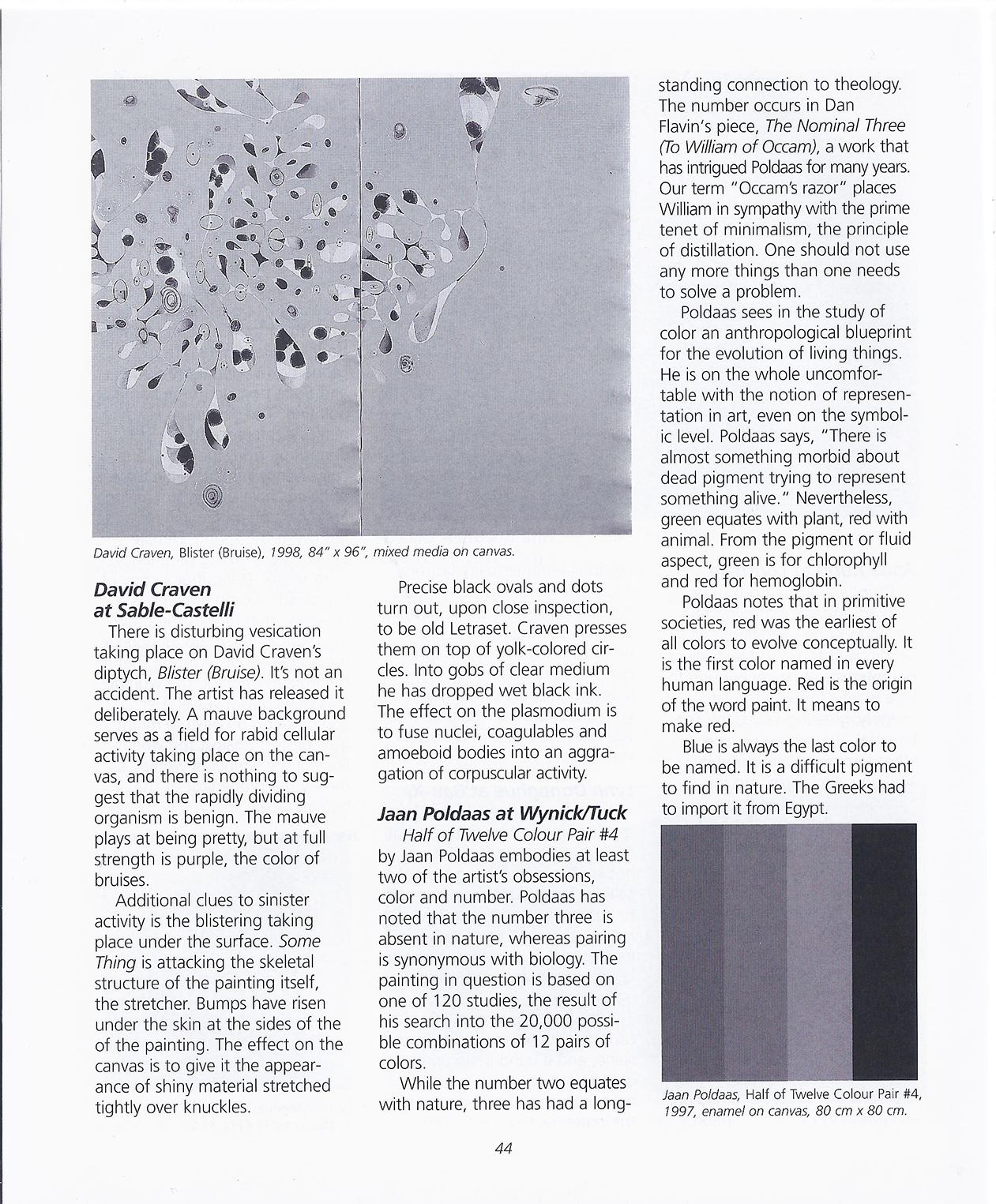
Hopper’s Corn Hill in the first panel makes use of an 1930 Edward Hopper oil that is part of the McNay Art Museum collection in San Antonio, Texas, of which I had a tour in 2005. The reproduction of the Truro, Cape Cod subject had occupied roughly the bottom half of the 8.5 x 7 inch page in dArt, which I had here expanded to the edges of the page in oils. It functions as an imaginary “framing” of what Hopper might have seen. The same device was used in the third panel, Jaan’s Divide, the original work by Jaan Poldaas, having been square, his stripes here extended to fill the rectangle. It was an adaptation to which the artist and I agreed for a dArt magazine back page to advertise his 1998 exhibition, Colours and Concepts.

The three stripes behind the image of Augustus John holding a brush allude to Barnett Newman’s 1967 Voice of Fire. The eighteen-foot acrylic on canvas had been a commission for Expo 67 in Montréal, Canada, and was part of the U.S. pavilion exhibition, American Painting Now, housed in a geodesic dome designed by Buckminster Fuller. It is not known to what extent Newman incorporated the aspect of three in Voice of Fire, aware that the work would figure prominently within a dome constructed of triangles. On principle, Jaan Poldaas would have objected this employment of the “three,” as he revealed in a discussion that contributed to a review about his Colours and Concepts work.

The image of Richard Stipl‘s sculpted self-portrait heads (panel 2), was used for advertisement of the artist’s work in the Fall 2002 edition of dArt. With the title, The Sleep of Reason, Stipl references the Goya series of aquatints, The Sleep of Reason Produces Monsters, an attribution generally read as Goya’s acceptance of Enlightenment values, that the absence of reason invites the monstrous to proliferate. Franz Xaver Messerschmidt, a German-Austrian sculptor most famous for his “character heads” was a contemporary of Goya, who produced a series of busts with contorted facial expressions, tapping into paranoid ideas and hallucinations from which he allegedly began to suffer. Messerschmidt and Stipl, it seems, would make for a formidable art history tag team.

Five artist temperaments are featured in Curated Content #3. Though an obvious correspondence could be made between the sculpted contortions of the faces by Stipl and Messerschmidt, an unlikely pairing would be Edward Hopper and Barnett Newman. Ralph Waldo Emerson had served as life-long touchstone to Hopper, his painting output imbued with an aura of the “transcendental.” In Peter Halley’s 1982 essay Ross Bleckner: Painting at the End of History, Halley ascribes the transcendentalist wing of modernism as having its roots in French Symbolism and Emerson, informing the work of Pollock, Rothko, and Newman.

With Malcolm Arbuthnot’s image of Augustus John, on the other hand, we have a stereotype of the typical “bohemian.” It is suggested that the character of eccentric painter Gully Jimson in the 1958 Alec Guiness film The Horse’s Mouth was modelled on John.

The Fine Art of Grinding

by Steve Rockwell

The impulse to shred back issues of dArt magazine to make pulp and paper had yielded dozens of 21 x 16 inch sheets some five years after the 2011 dArt Burger exhibition at De Luca Fine Art in Toronto. The show co-producer Ben Marshall had insisted that we install an actual meat grinder in the show, its function having been symbolic. Practically speaking, neither grinding nor shredding paper is possible with it. A basic office shredder and a uniquely-designed blender are the sole equipment requirements for dArt magazine paper production. For James Cooper’s video on the collage potential of dArt click: Dart Onion.

Steve Rockwell, Minced dArt, 2011, meat grinder with shredded dArt magazine pages and cropped magazine

Steve Rockwell, Minced dArt, 2011, meat grinder with shredded dArt magazine pages and cropped magazine

A lingering colloquialism since the horse and buggy days has been the tale of glue factories killing old horses and grinding up their bones to make glue. The bubbling up of the saying, of course, arises generally in response to some human inkling of its own mortality. I sense that it might be into this very psychic cranny that San Antonio artist Hills Snyder casts his Dickensian shadow. Here is my account of meeting the artist at the 2005 Artpace Chalk It Up event in San Antonio:

Hills Snyder, Misery Shoppe Repairman

“Hills Snyder arrived in undertaker black to set up his Misery Repair Shoppe, comprised of a chair and a desk with a meat grinder with which to pulverize his chalk one stick at a time. He set up shop on the Houston bridge above the banks of the San Antonio River, in itself a bit chalky from limestone, I suppose. Grinding chalk is a dry, dusty job, as is purging despair. Snyder was making a connection with the white cliffs of Dover, specifically Shakespeare Cliff, where the Earl of Gloucester, blinded for his loyalty to King Lear, took his imaginary fall, demonstrating to the ages the cathartic power of tragedy.”

More can be said about the pulverizing of chalk over the centuries. Lessons have been sown and inculcated into the fertile cranial soil of blinking pupils facing dusty blackboards, generation upon generation, stick upon stick, scratched by the stern “chalk grinders” of yesteryear.

In the French city of Rouen in 1913, a young Marcel Duchamp chanced upon a chocolate grinder displayed in a confectioner’s window. The machine became the subject of two paintings, precise in the style of an engineering diagram with flattened planes, eschewing the artist’s hand. To the artist, however, its operational churning suggested something auto-erotic. Duchamp made it the subject of a major work, The Bride Stripped Bare by Her Bachelors (1915-1923), its mechanical subject matter conversing in the language of the sexes. Frequently the artist would sign his art with his alter ego, Rrose Sélavy, or “Eros, that’s life,” as he had done with his 1919 L.H.O.O.Q. work, signifying the extent to which sexuality was at the heart of his philosophy of life.

I selected Duchamp’s L.H.O.O.Q. as the “meat” for my own grinder, understanding that the gesture was consistent with at least one principle of Dada, the cycle of breaking and making – a shadow cast by Snyder’s chalk grinder. We all go to the same place. We all come from dust, and to dust we all return.

Above: Front cover dArt International #19 Fall 2006, : L.H.O.O.Q by Marcel Duchamp, 1919, rectified readymade of da Vinci’s Mona Lisa. Courtesy Private Collection. ©2006 Marcel Duchamp /Artists Rights (ARS), New York / ADAGP, Paris

dArt Magazine Curated Content #5

by Steve Rockwell

Good Gordo, Casual Observer, In the Black, and Hard Edge. Citing the work of Steve Rockwell, Hills Snyder, Eugene Lemay, Lorser Feitelman, and Otto Preminger's Anatomy of a Murder (with Lee Remick).
Steve Rockwell, Good Gordo, Casual Observer, In the Black, and Hard Edge, 2024. Citing the work of Steve Rockwell, Hills Snyder, Lorser Feitelson (1963 painting), and Otto Preminger’s “Anatomy of a Murder” (with Lee Remick).
Hills Snyder, Casual Observer/Causal Observer, 2010, Blue Star Contemporary, San Antonio, Texas, installation view

Curated Content #5 is a four panel image sentence that clusters pictures into paragraphs. As we read, a story may unfold. Dog observes a periscope rising out of the sea that breaks into light from something hidden – the “submarine.” Although Hills Snyder employed its image to advertise his 2010 exhibition at Blue Star Contemporary in San Antonio, Texas, the original periscope image was created by Andrea Danti for Shutterstock.com. Snyder’s employment of the periscope becomes a key that breaks the seal to his container of objects and experiences – now accessible to even the casual viewer. To get the “full” picture, however, further observation is necessary. A documentation of the work that went into mounting Snyder’s elaborate installation can be accessed by clicking Casual Observer.

Hills Snyder, Casual Observer/Causal Observer, 2010, Blue Star Contemporary, San Antonio, Texas, installation view

An attentive Gordo in the first panel mimes the periscope, having been obedient to his master’s voice (Stuart Regen) in posing for my photograph – a captured moment that merited the cover of the premier edition of dArt magazine in January 1998. By sheer coincidence, the dog’s front paws in the Good Gordo image cover a crack in the concrete floor, echoing the one in the Snyder submarine photo. In that respect, as the dArt genesis account unfolds, Gordo’s paw bruises the wriggling serpent crack on the floor of the Regen Projects gallery.

The third panel of a woman contemplating a black rectangle is derived from dArt‘s 1998 second edition and was provided ACME gallery in Los Angeles to accompany More Shifts in the LA Gallery Landscape, an article by Michael Darling. Two years earlier ACME had consented to take part in my Storage installation project by storing a 32 by 32 inch acrylic on panel painting showing my hand holding a black card. The project served as the visual component for the book work Meditations on Space, An Artist’s Odyssey through Art Galleries in Europe and North America, published in 1996. My earlier visit to ACME in Santa Monica on January 3, 1996 had taken a geometric bent, “I walked in a straight line from the door to the back of the gallery where someone was installing work. He pointed me towards the desk corner. I made a 40 degree turn and walked over to speak to Randy Sommer, and then a 70 degree turn for the door. That completed the triangle.”

Left: Steve Rockwell, Storage Project, 1996, ACME gallery, Los Angeles, installation view. Right: In the Black, 2024, oil and mixed media on dArt magazine page, 8.5 x 7 inches

The fourth panel, Hard Edge features Lorser Feitelson’s 1963 Untitled painting, managing a further echo, this time, of the red facade of Snyder’s installation exterior. If a connection were to be be made between the peephole in Snyder’s Casual Observer/Causal Observer to ones in the Spanish door of Marcel Duchamp’s Étant donnés installation at the Philadelphia Museum of Art, an intriguing possibility is introduced – a murder of the mythic art kind. Lorser Feitelson’s red lozenge shape in Hard Edge is interrupted in its right corner by a film still crop of Lee Remick testifying in Otto Preminger’s courtroom drama, Anatomy of a Murder.

Historically, artist Lorser Feitelson has a tie to the emergence of “hard edge painting.” He was featured in the 1999 dArt magazine article Testing the Fabric of the New Color Field by Michael Duncan. Duncan had been critical of this group of primarily Los Angeles-based artists writing, “For me a lack of ambition and conviction is the problem with the most hyped members of the so-called New Color Field movement.” Duncan preferred works of several older LA artists, “whose explosive and inventive use of color and abstract design provide quirky and fruitful contexts for the works of the younger experimenters.” A dip into the trove of art world narratives about Paris, New York, and Los Angeles from a century ago, should not disappoint those truly interested. Simply click the Lorser Feitelson Interviews for a brouse.