by Emese Krunák-Hajagos
Visiting Budapest in May after almost 40 years, I was impressed with the richness of the Hungarian visual art scene. A friend introduced me to the founder and owner of Várfok Gallery Károly Szalóky, who is also a major collector of contemporary Hungarian art. The gallery itself is as large as a museum and the quality of the exhibited work is excellent. This art could be shown in any international museum.
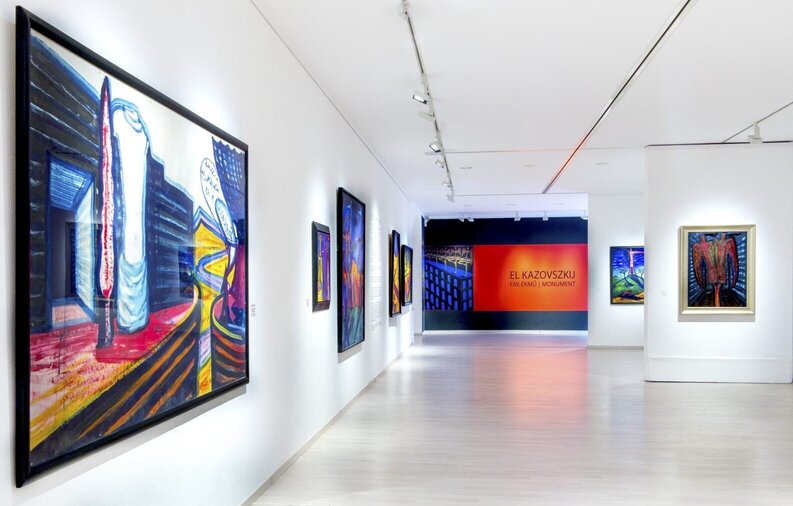
Károly introduced me to one of his outstanding artists, László Győrffy, with whom I had an interesting conversation about his latest collages. When I came home and looked at his previous catalogues and started my research of his oeuvre, I recognized how important his persona and artwork is in contemporary Hungarian art. A new territory opened up to me, that started with the new millennium: the Posthuman Art Movement. I was familiar with some of its predecessors, like Goya, the surrealist, Dada among them, but wasn’t aware that there it is also a contemporary movement, that has taken shape over the last ten years as Budapest Horror and Győrffy is one of the leading artists of the group.
It is a very serious, well documented movement including philosophers like Márk Horváth and Ádám Lovász, writers and theorists, like Márió Z. Nemes and Imre Bartók among others with numerous publications to their names. Horror, as a visual language, is perhaps most consistently represented in this group by the works of László Győrffy, Géza Szöllősi and Csaba Kis Róka. Nemes questions “In an age that has (apparently) done away with the ideal of anthropomorphé, what remains, or more accurately, is there anything left at all in the ‘place’ of humans, and if so, does it still hold any aesthetic significance?” He concludes that the art “which recreates man from his fragments in such a way that it also makes the artificiality and risk of this creation part of the artistic effect.” The improvement of biotechnology, the development of gene editing, AI and mechanization affect the human image, or more precisely, what we know as human nature. The depicted bodies are often artificial, shapeless without organs, deformed or mutilated; the artists literally dissect and then ‘deform and reform’ them.
Győrffy starts his doctorate dissertation, Posthuman strategies, Transgressive ethics and aesthetics in contemporary body representation, referring to the end of humankind “the end is the right beginning for the birth of posthuman strategies.” His paintings are apocalyptic narratives where everything that we, consider human – the mind, the spririt, the intellectual and the body as matter – is decomposed. Many of his motifs are connected to what happens to the body after death. Maggots and flies are recurring elements in his compositions; for them the dead body is just a search for meat. Győrffy loves horror movies, David Cronenberg’s and other’s that address body horror, showing the body becoming alien, unfathomable, even threatening. The human body loses its regular contours and is dismantled or rewritten.
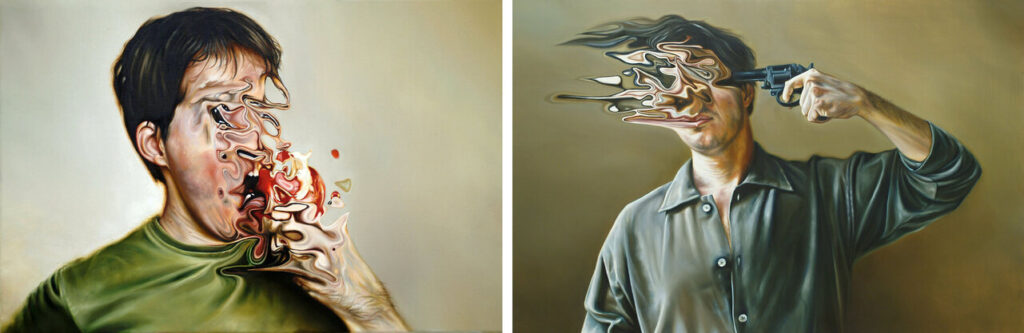
Some of the paintings are literally mind-blowing, like The Anatomy of the Grotesque (2005). The face of the figure disorientates – it is uncertain what shape it will take after this
experience and even unknown that it will take any shape at all or evaporate into thin air like the body of the young man in Wreck (2003). There is no certainty.
The painting, Virus (The Fall of Adam, 2005) brings up another danger, contamination by unknown viruses occupying the food we eat, the air we breathe. It is a self-portrait of the artist eating an apple. The title hints at the biblical story of Adam eating the apple of knowledge but this image has nothing to do with the Bible, since for the posthuman artists God doesn’t exist. However, the danger of losing everything does. From the apple a life-changing virus enters the body and starts changing it immediately. The uncontrollable virus creates a hybrid, mutant, chimera-face.
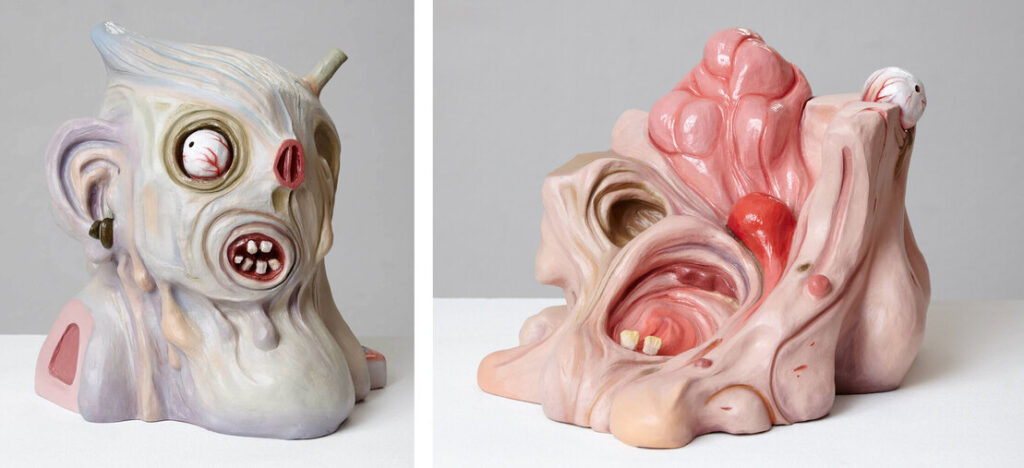
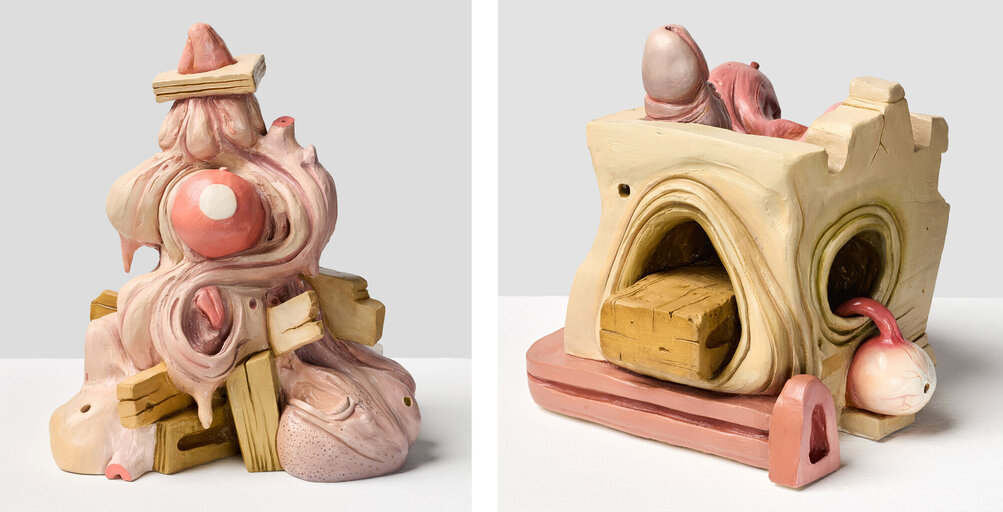
Describing his method in depicting the human body Győrffy wrote, “The gesture of crossing a border always means rewriting the humanist body, as if we had never been humans to begin with and will never be fully posthuman. It’s the swinging between these two that interests me.” The ‘portraits’ of Facefuck precisely embody this idea. These awkward ceramics have an almost childish playfulness to them. The heads don’t follow the anatomical rules but rather create a ‘private biology,’ partly human, partly alien unpredictable structures. The circular build-up enriches them with a possibility of multiple variations, another organ, protrusion, growth, or even a hole can unexpectedly appear in a state of continuous transformation. It is a Saturday picnic of fragmentation and mutations.
Facefuck VII. is a monster with a horn, one bloody eye and ugly, scarry teeth. Cronenberg’s eXistenZ horror movie came to mind, where a character, played by Jude Law, devours the greasy meat of a mechanical like thing that produces a big tooth when the meat is removed from the bones. Very detailed and extremely disgusting. Then he recognizes that he can use the tooth as a bullet. Facefuck X. has nothing to do with any kind of face. It is an overflowing, amorphous ruin of flesh. “The artist’s brain needs eye-teeth, a spirit that is ready to devour itself”, wrote Nemes in the catalogue’s foreword.
The influence of Hieronymus Bosch plays an important role in Győrffy’s art. As a young man he looked at Bosch’s works in books that occupied the family’s bookshelf. Just reading the title of the painting Exquisite Corpse III (The Delayed Last Minute Summer Holiday Of Léo-Karl d’Orfer On the Ninth Day After the Death of Ozone Layer) we know that we are facing a morbid composition. Bosch’s Hell comes to mind; some motifs are even borrowed from him. It is an extremely busy, crowded and layered piece. It follows the panels of medieval depictions of hell. We enter hell after death. For Győrffy, “hell is repetition and not the end; hell is the starting point of poetry, a kind of mechanism in which the overproduction of death and negativity never ends.” In this pseudo-medieval chaos violence and suffering walk hand in hand and for the vomiting figure at the bottom (Léo-Karl?) become even enjoyable. It involves sexual intercourse at the side of the tower, surrounded by a group of heads on sticks, body parts, tumors and unrecognizable body masses. From a tunnel dirty water flows toward a woman giving birth to an unrecognizable pile of flesh. A mechanical human hand opens a bag full of organs. Near a dried-out world tree, a skeleton makes a brain from minced meat (human?). Looking at this never-ending abundance of corpses, mutilated bodies and mechanical monsters, we experience the horrible and the unimaginable. There are endless possible narratives. In Győrffy’s world there is no paradise.
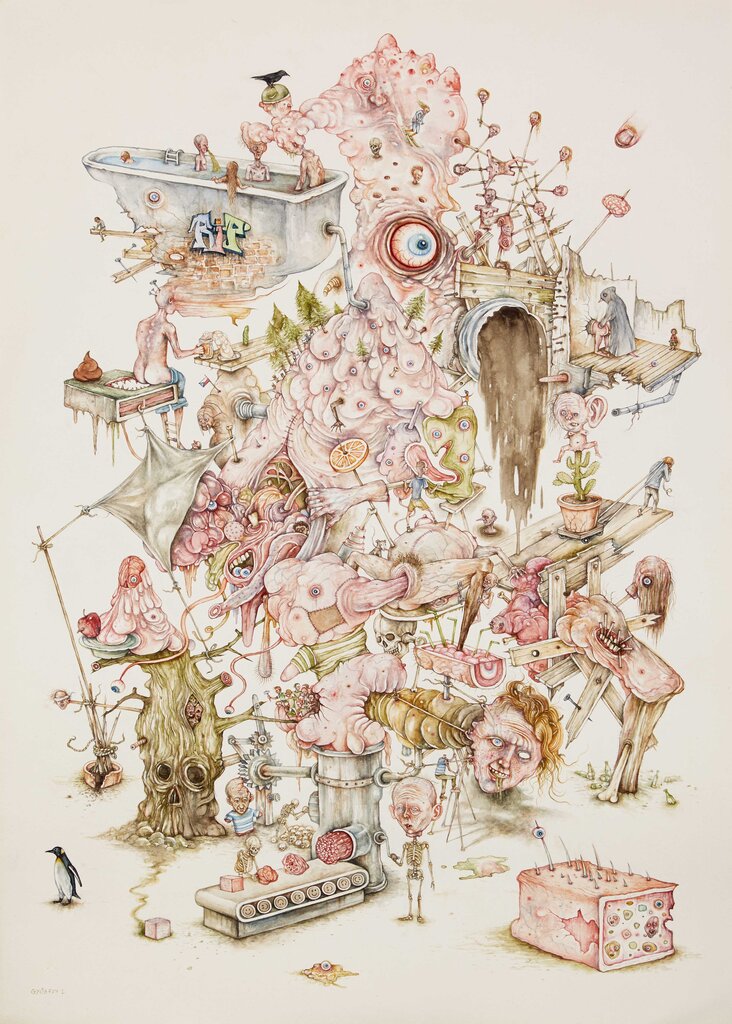
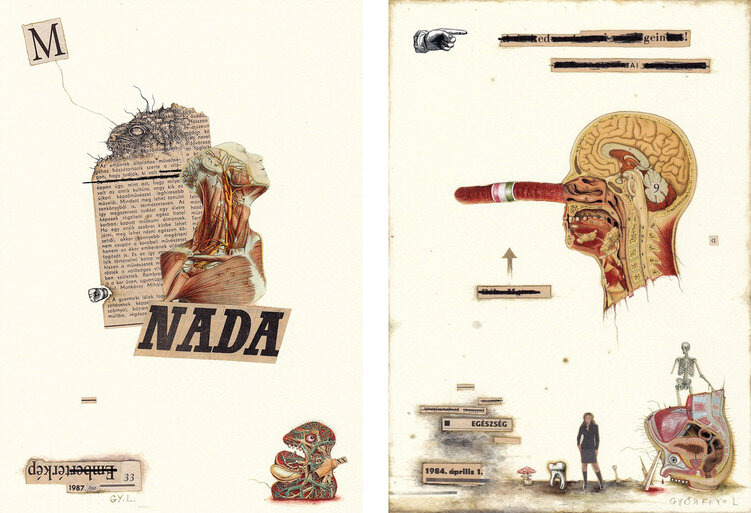
2+2=5, an exhibition in Várfok Gallery in 2024, showcased László Győrffy’s collages. In his artistic practice, the human body is dismantled or rewritten. Collage fits this well, as the artist can cut things up and put them back together, giving them a different meaning. Győrffy has been creating collages for the last ten years.
All the works are numbered and have individual titles. Their narrative is not linear, but fragmented. Their surface is interesting; it is hard to recognize where the glued parts end and the drawing begin. The title of the show is Waste Calendar / Sausage Journal. The idea was inspired by Orwell’s doublethink, an existence in constant uncertainty, or of self-censorship; making it impossible to decide which one is real. The sausage seemed like a good framework metaphor because it also has different ingredients that come together, and on top of that, you can portion it and slice it. The themes of the collages are various and interesting, sometimes humorous. The possible interpretation of the writings can be challenging, as certain parts of the words are covered with ink making it hard to find the message. The newspaper clippings come from many years of Népszabadság articles, where Győrffy’s grandfather was a copy editor.
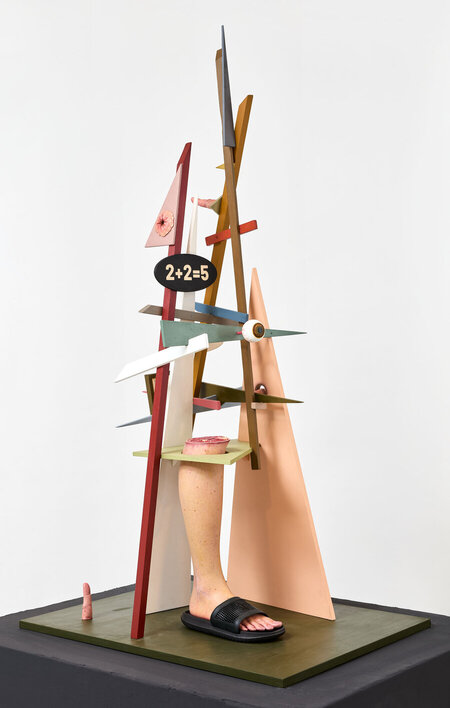
While most of the pieces are two-dimensional, House curse / Kathedrale des erotischen Elends II. is sculptural. It was inspired by German artist Kurt Schwitters’ Merzbau or The
Cathedral of Erotic Misery, a combination of collage, sculpture, and architecture, in a corner of his studio in 1920s Hannover, Germany. Soon it filled the entire space. House curse is composed of the interplay of unique, static and dynamic forces, creating a futuristic sculpture. A tower-like structure is built using geometrical elements that interact with each other. They are accompanied by imitations of human body parts: a lower leg, fingers, and other ugly, fragmented elements, juxtaposing the tower’s mathematical beauty.
The sculptures of Body-Farm remind us of the imagery of Facefuck. It is an installation that evokes a community garden, cemeteries, bloody slaughterhouses, inhabited by worms and rotting humans. The original Body Farm was built for observing and studying the decomposition process of dead bodies. The first one was created by an American forensic anthropologist William M. Bass in 1981, because crime experts didn’t know enough about how the human body decomposes.
The main idea behind the installation is that flesh is never truly lost, just changing its form. This cemetery guides us into the unknown, making us nervous. It becomes home for posthuman creatures; plants, worms, human body parts, organs and unknown beings reborn from pots and fertile ground. Natural and supernatural become one; the creatures created are worldly and unworldly at the same time. Organic, even humanoid elements are mixed with wood crosses, boxes and unrecognizable shapes in this dark, ghostly 21st century universe. Missing item from the Budapest Abstract Bank collection looks like a kneeling monk in meditation. His head ends up in fingernails, his midsection is a big ball, that can be a symbol of the earth or the universe, and underneath it is a human tongue, his knees are rich fabrics or organic masses. He sits on a wooden frame, that also reminds us of the cross. There is no certainty in this world, but somehow, it is not disturbing.
“In the fine texture of Győrffy’s works, there is a stirring parable even in their simplicity: we don’t need to change, but to be different.” (Imre Bartók)
Images are courtesy of the artist.