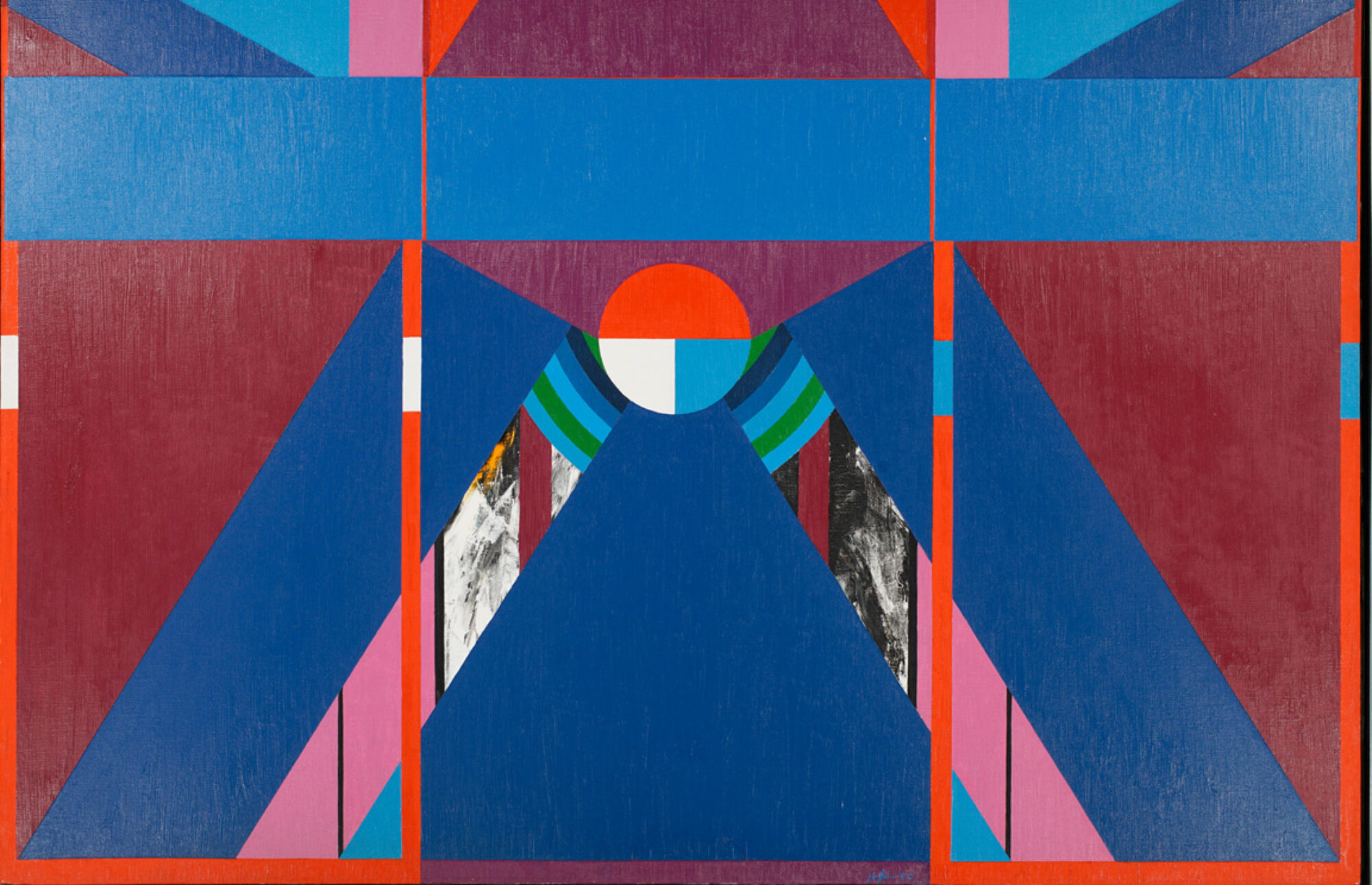
Hunterdon Art Museum, Clinton, New Jersey, September 27, 2026-January 10, 2027
Joanne Mattera, curatorial essay
We are the children and grandchildren of Italian immigrants. We are American by birth, culture, and education, but by heritage and home life we are Italian. We grew up navigating between identities in the languages we spoke, the foods we ate, the references we understood, and the often vastly different expectations each culture held for us (especially for women). This bifurcated identity was normal, simply the way it was. As in many Italian American families, there is room around the table for others. At the metaphorical table of A Legacy of Making, there are places for those born in Italy or elsewhere but living American lives here, and those whose parents or grandparents emigrated to countries other than the United States, such as Argentina, Australia, and Canada, where so many Italians established homes for themselves and their descendants. The artists in A Legacy of Making draw from the past—from the generations, the journey over, the, the traditions—translating ideas from the original Italian into contemporary art.
The Journey Over
“We carry the history of our families and our cultures in our psyches as well as our genes,” says B. Amore. In her assemblage, Following the Thread IV: Concettina De Iorio, we see a photograph of Amore’s maternal grandmother, surrounded by the objects and artifacts of her life, telling a story of emigration, hardship, and a husband’s betrayal. The filo rosso—red thread—that runs through the work represents a Neapolitan tradition of departure. The person boarding ship carried a ball of yarn, while the person at the dock held fast to the loose end. As the ship pulled away, the ball unwound in an attenuated goodbye. Symbolically, of course, it connects the generations from one time and place to another.
The ocean figures prominently in the work of Angelica Bergamini. Her small watercolors and prints are poetic evocations of what she calls “the immense blue.” The Tuscan-born artist is thinking cosmically, but for many the blue is a reminder of the difficult voyage taken by our forebears. Karen Guancione, whose Neapolitan and Sicilian grandparents came to America by boat, is a maker of unique and limited-edition books. One of them, Il Mare is a leporello, an accordion book, that extends to view after view of the sea.
Maps are the foundation of the work of Diana González Gandolfi and Gianluca Bianchino. For Bianchino, who flew multiple times as a child between the Italy of his birth and the country where he would grow up to live and work, the aerial landscape viewed without borders reflects his interest in “geography, geology, and geopolitics.” González Gandolf was born Buenos Aires into an Italian family, whose patriarch, Gaetano Gandolfi, fought side by side with Garibaldi in Italy’s Wars of Independence. Her father moved the family for his diplomatic work from Argentina to Indonesia, to Colombia, and eventually to the United States. The artist’s monotypes literally map where she has been.
Italian and Italian American References
John Avelluto and Claudia DeMonte draw from Southern Italian and Sicilian tropes to create art that embraces the very symbols that signify ethnicity. For Avelluto it is pasta and pastries fashioned with acrylic paint. Woven into the iconography is a familiar physical expression: thumb and fingers brought together in what Italians call la mano a borsa (hand purse), an outsize and familiar gesture whose meaning ranges from “What do you mean?” to “WTF!” depending on the force with which the gesture is made. DeMonte taps into Italian folklore with her Corno sculpture, embellished with symbolic elements from her life. The corno, or horn, usually worn as a talisman on a chain around the neck, is meant to ward off the mal’occhio, or Evil Eye, a curse leveled at you by someone who is angry with you or jealous of what you have. In the 21st-century this may seem laughable, but Southern Italians—those from Napoli and farther south—hold fast to their beliefs. Hey, a little protection can’t hurt, right?
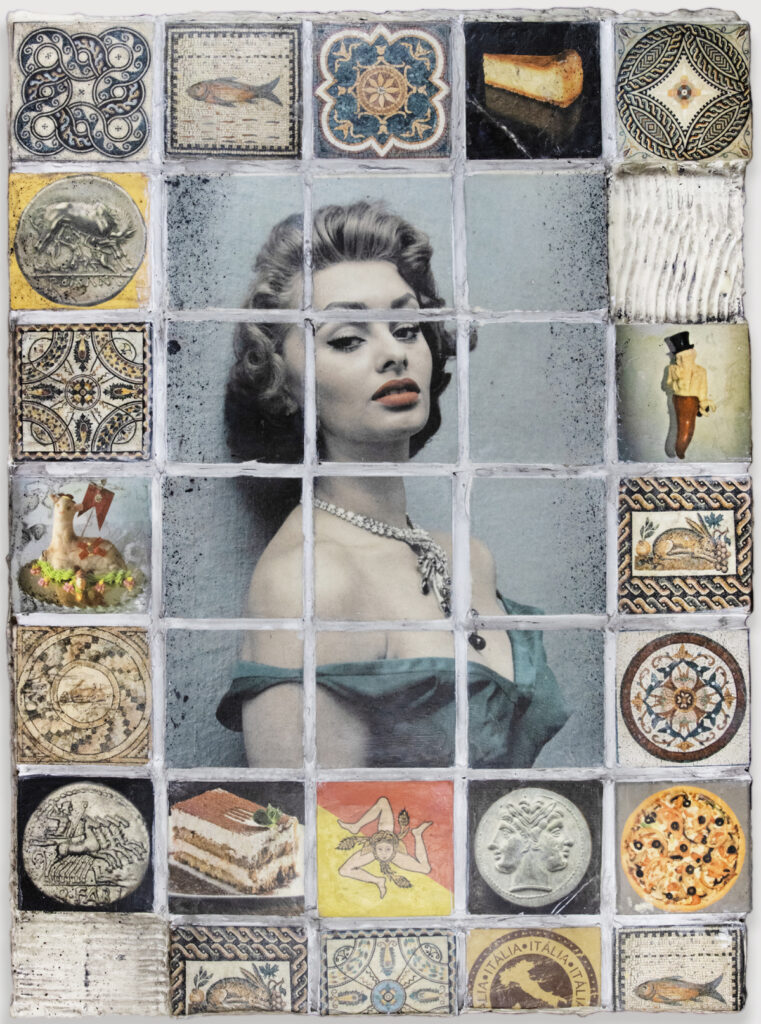
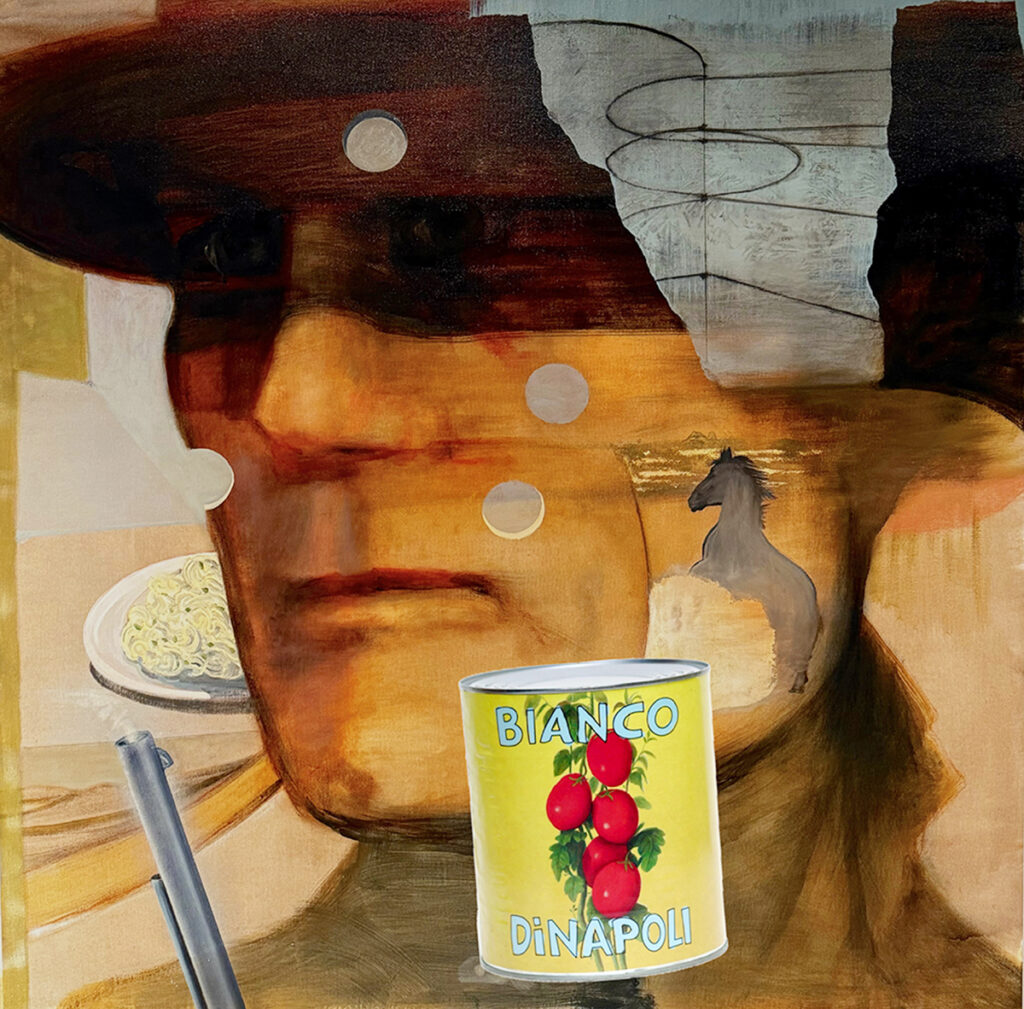
Wayne Montecalvo, Timothy Mc Dowell, and Thomas Micchelli draw from Italian culture and politics. Montecalvo gives us Napoli’s most famous daughter, Sofia Costanza Brigida Villani Scicolone, known to the world as Sophia Loren, in an image from her heyday. The image appears to be part of an artifact wall replete with ethnic icons and decorative tiles, but look closer. These “artifacts” are thoroughly modern: digital images mounted on Styrofoam with a mix of materials, like cardboard and wax. McDowell‘s Spaghetti Western folds together food and film tropes. Despite his Scottish surname, McDowell has had a lifetime of extended periods in Northern Italy among the members of his mother’s educated and accomplished family, the Macellari. Micchelli will tell you that the social fabric of his early life was more Italian than American, so it is not surprising that his powerful monochrome heads draw from an Italian sculptural tradition, albeit with contemporary sculptural materials: “No matter how widely I cast my net, I always find myself circling back to the Italians and the Italianate when I need to find my bearings.”
The Textile Tradition
Jennifer Cecere describes it: “Until a generation ago, everyone worked with their hands. Women, especially, knitted, crocheted, and embroidered, and girls learned by example. All of us had a connection to these traditions.” Cecere makes public art: large-scale renditions of lace in materials as diverse as ripstop nylon and brushed aluminum, which she has laser cut, bringing together the modesty of handwork with the ambition of the professional artist she is. Here she is represented by one enormous “doily.”
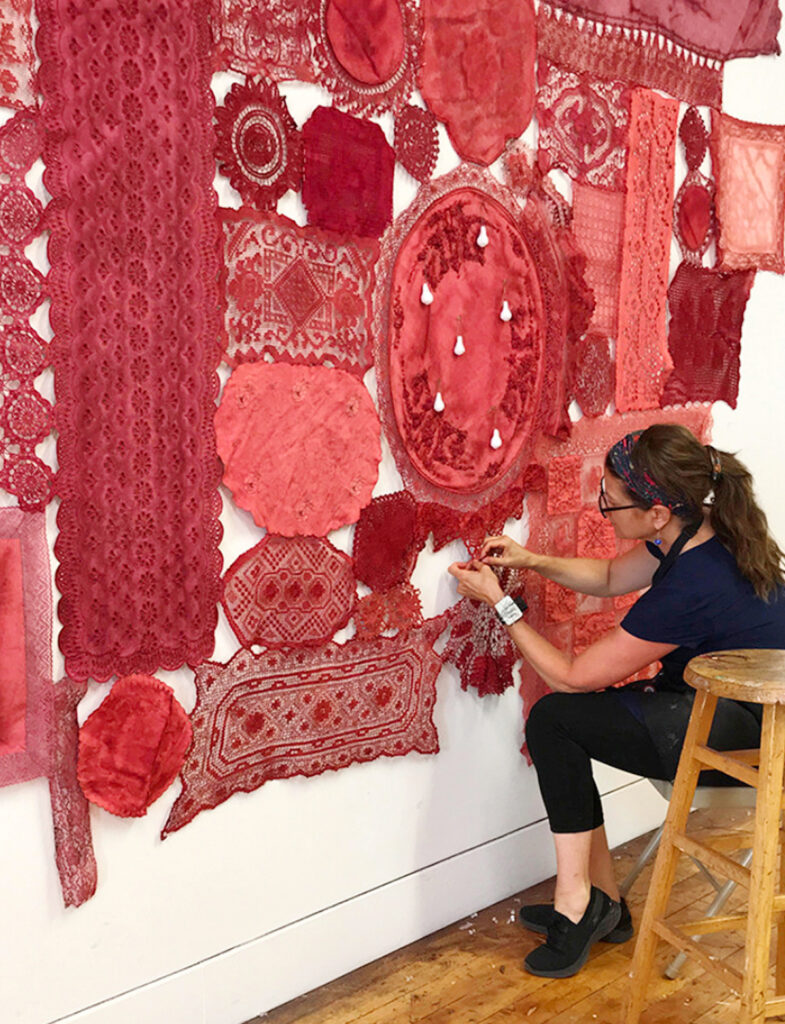
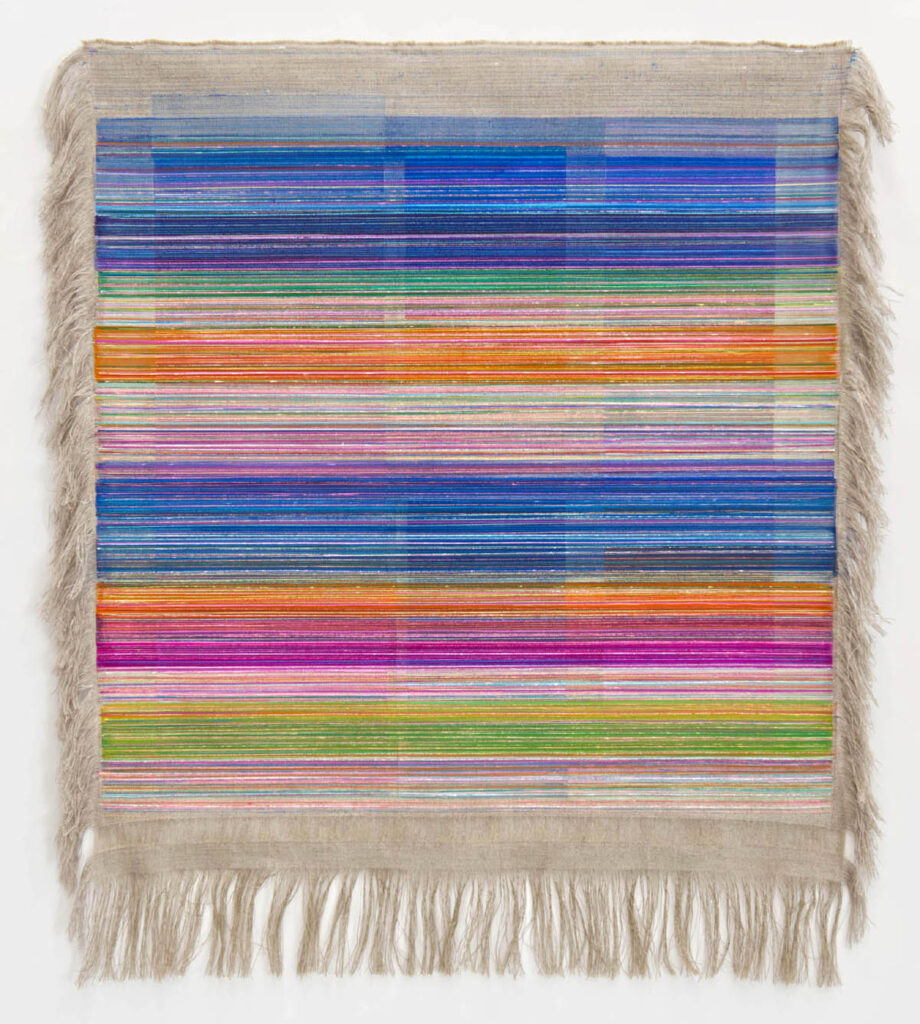
Antonietta Grassi, Patricia Miranda. Chris Costan, and Lorenza Sannai draw from the tradition of handwork as well. Grassi, whose parents settled in Montreal at mid-century, learned from her mother, who was a garment worker. In A Legacy of Making, Grassi’s “weaving” is in fact a painting, the melding of culture with art training. Miranda takes handmade lace, dyes it red, and pieces it into room-size installations that pay homage to her grandmothers, Ermenegilda and Rebecca. Miranda began with the laces her grandmothers had made, but given the large scale of the works she soon ran out. Thus began donations of lace from family, friends, and other artists eager to support her project, which now brings together the work of many immigrant hands and histories. Costan, whose day job for some years was as the color designer for a ready-to-wear fashion company, gathers the threads and notions of dressmaking into her work. Sannai brings together embroidery and contemporary geometric abstraction, a suturing of genre and culture. She exhibits and curates both here and throughout Europe.
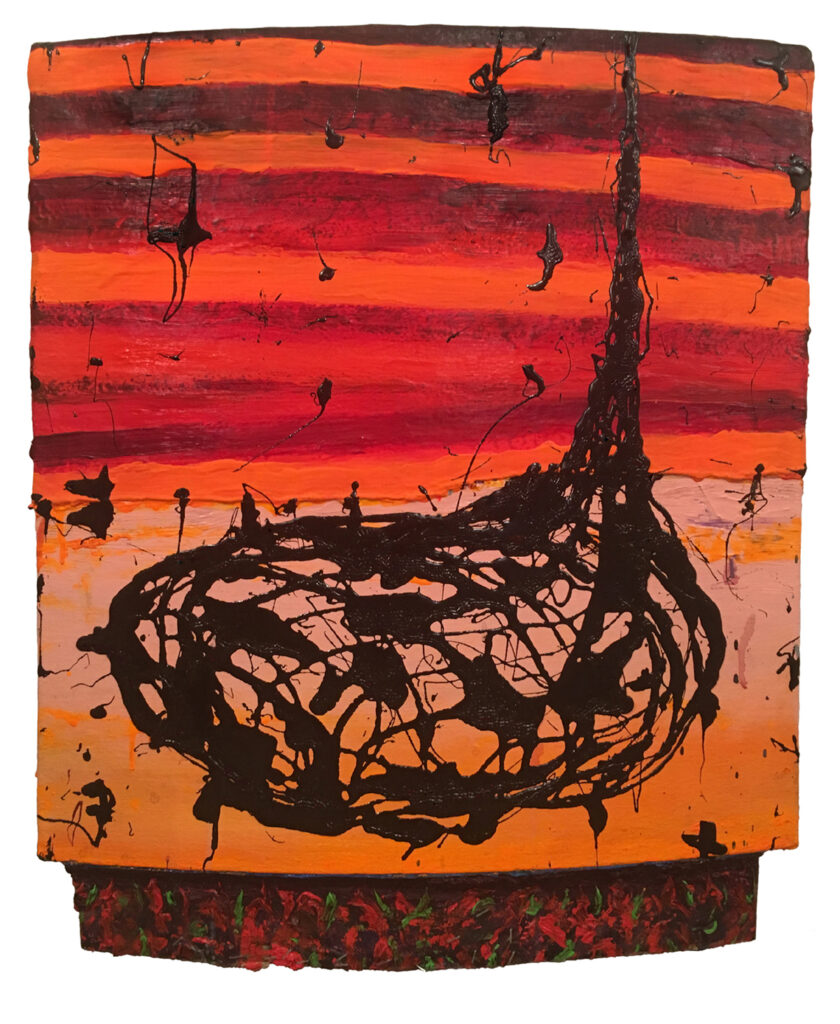
While neither is immersed in textiles, both Lucio Pozzi and Len Bellinger have referenced them in their paintings for A Legacy of Making. Pozzi, a dual citizen, has drawn from the humble rag rug—a tradition more American than Italian–for an eponymous series of paintings. Bellinger, known for dense and vigorous abstractions that integrate all manner of materials, has here referenced a fishing net. When you know that his mother’s side of the family comes from Positano, a fishing village in the time of his forebears, his painting, bignet, fits comfortably within a grouping that includes a brawny oversize doily, an ambitious lace installation, and paintings inspired by rag rugs and loom weaving.
Sculpture
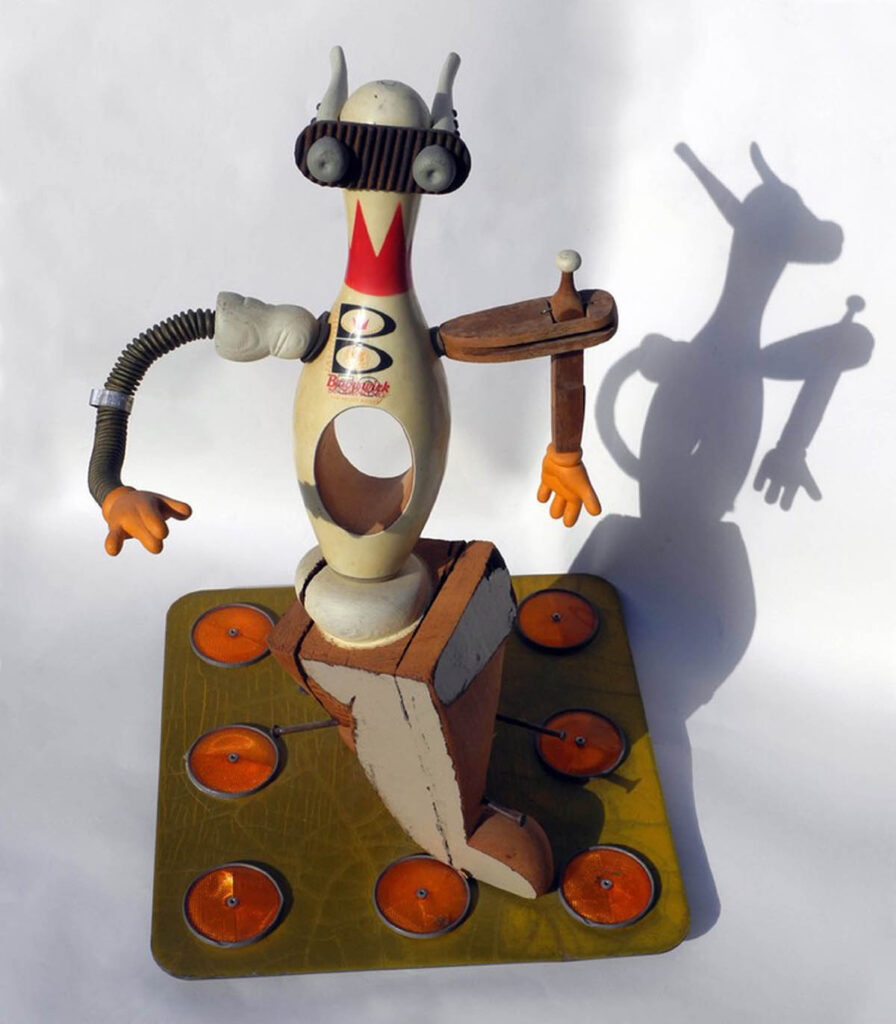
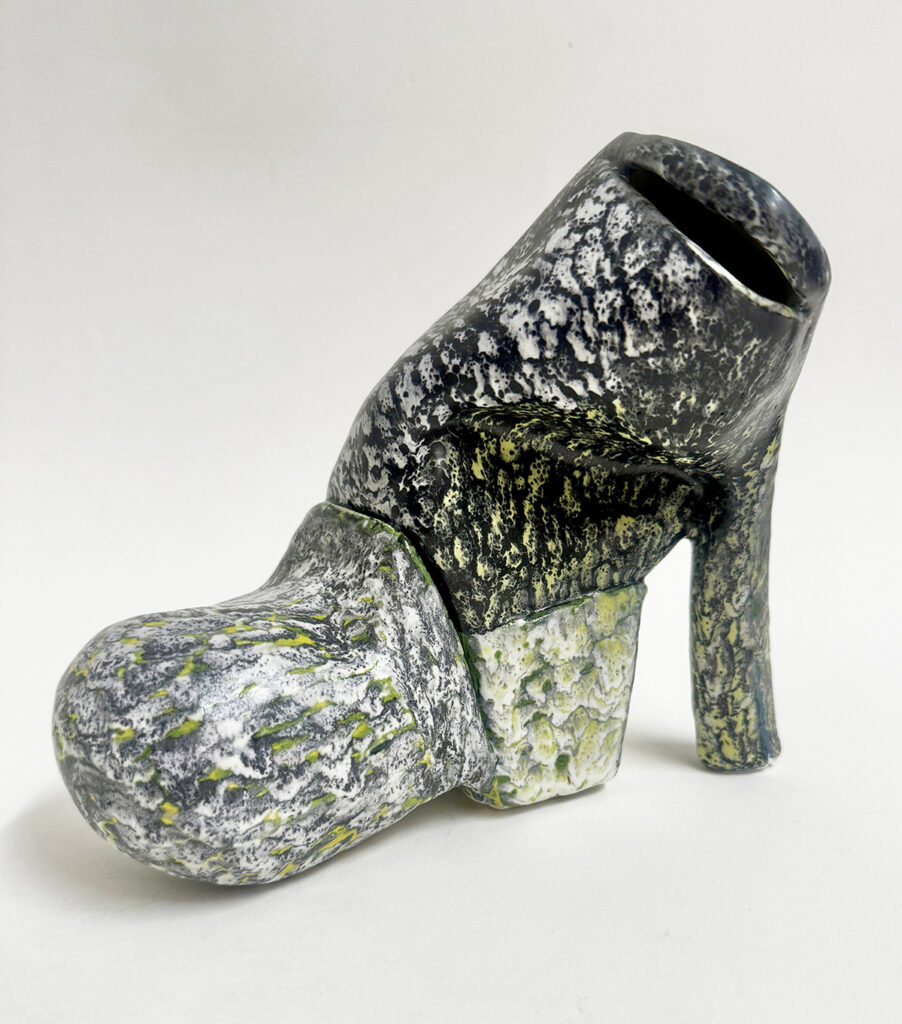
The influence of grandparents has inspired sculptors D. Dominick Lombardi, Elisa D’Arrigo, and Laura Moriarty. Lombardi learned to use the hammer, saw, and chisel as a boy at the elbow of his grandfather and father, both master carpenters. He employs those tools with a contemporary sensibility, but the Old Country skills remain. Lombardi cites “high and low” aesthetic influences, from Picasso at one end to comic books at the other. Another feature of his personal legacy is a waste-not-want-not mentality that reflects immigrant frugality and resourcefulness. D’Arrigo cites among her influences the wooden forms used by her Sicilian grandfather, a shoemaker. Indeed, the shoe shape turns up in Going Gray, one of the artist’s three glazed clay sculptures in this exhibition, while Moriarty acknowledges the “kitchen culture” of her grandmother, Anna Policella, with its process and improvisation. In this exhibition, Moriarty’s three wax sculptures reference the family unit, an essential feature of Italian and Italian American life.
The larger-than-life sculpture that beckons from the terrace of the museum is Talisman #4, a totemic marble and limestone piece by Don Porcaro, who says that an early-in-life visit to a relative’s stone yard sparked something in him. A college sculpture course ignited that spark. Cutting stone “felt right,” he says. “It fed a driving need to work with a material that speaks to tradition, and I knew that the tradition belonged to my culture.”
Drawing from Nature
Gardening is evident in the work of Margaret Lanzetta, Denise Sfraga, Patti Russotti, and Brian Alterio. Lanzetta spent girlhood hours in her grandfather’s garden, drawing his plants and flowers and learning from him the dialect names for each. She maintains a garden at her studio in Long Island City—with some perennials transplanted from her grandfather’s own garden—finding in it inspiration for her paintings, in which she combines plant forms and the geometric patterns of many cultures. Sfraga will tell you that her grandfather’s Brooklyn apartment overlooked the lush and sprawling Green-Wood Cemetery and as a child she was captivated by the plants and flowers there. Her botanical abstractions, some in otherworldly hues, burst with germination and growth and the passage of seeds back to the earth.
Patti Russotti scans and photographs ferns, flowers, and fungi, the world of beauty in her yard. She is taken with the society of plant life, often combining her photographs with what she learned from the society inside her home: the women who taught her handwork when she was a girl. Her photographs, sometimes printed directly onto fabric, are often embellished with embroidery and hung from rods. Brian Alterio photographs nature in all its aspects, from the human form to landscape to plant life. His Garlic Scapes connects culturally and horticulturally to one of the most notable elements of Italian cuisine.
John Monti has come to see the connection between his Italian American identity and the emotion of Italian Baroque, which is laden with floral motifs. You need only to think of the gorgeous excess of Neapolitan churches to understand the aesthetic. Monti considers himself a “cultural Catholic,” drawing inspiration from ornamentation rather than religion or ritual. His floor installation of lily-like forms, Tipped, may suggest to you, as it does to me, the poetic denouement of a garden at the end of the season.
Conversations
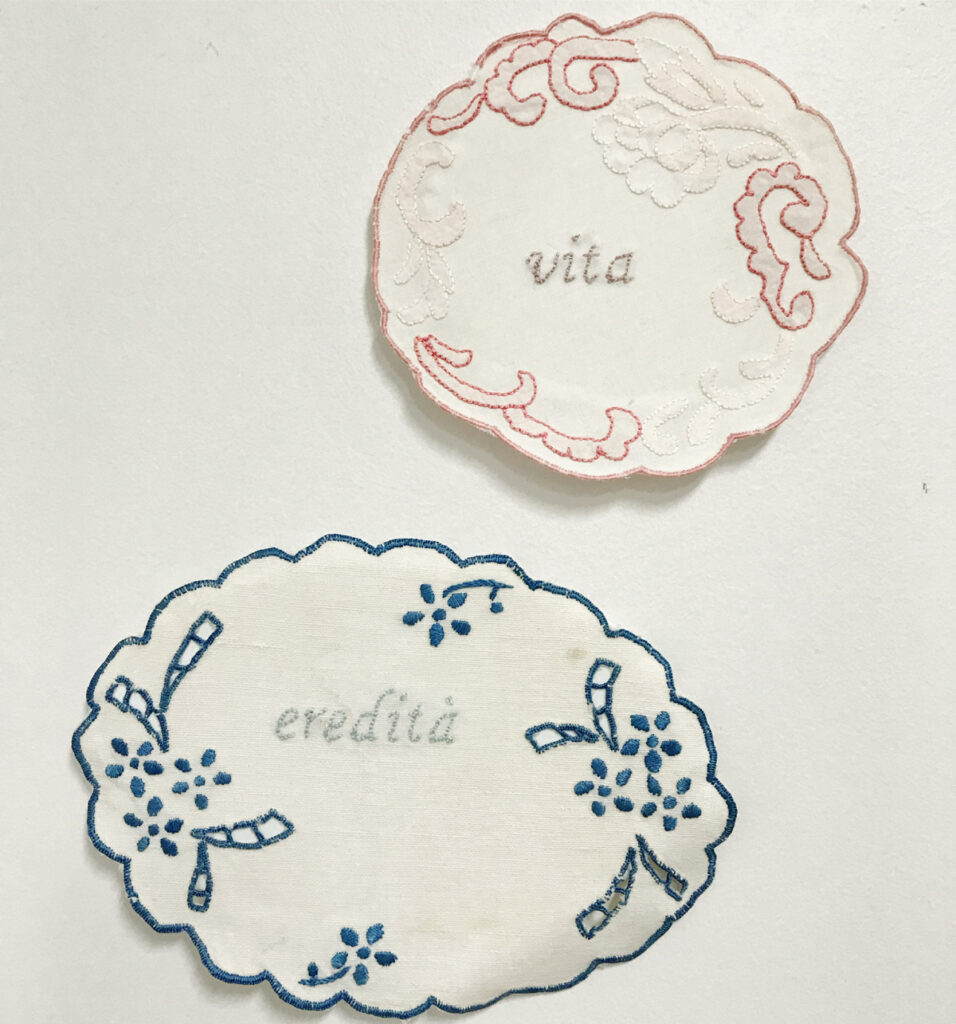
Here the legacy of making is more reciprocal. In a series of recent embroideries on linen napkins, Milisa Galazzi stitched an eight-panel narrative that recalls a childhood conversation with her grandmother. “Good girls should always be sewing,” said Grammy. “Ugh” responded the young artist at the end of a frustrating exchange. But nonna prevailed. Much of Galazzi’s work as a mature artist involves stitching. Luci Callipari-Marcuzzo’s embroidered doilies are the physical dialog between mother and daughter. In the Sixties, the artist’s mother, Anna Callipari, newly arrived to Australia, embroidered some linens for family use. Half a century later, Callipari-Marcuzzo added words to the well-worn linens: Vita (Life) and Eredità (Heritage). Says the artist, “The threads, my own and my mother’s, link us to Calabria and North West Victoria, reinstating the chain of tradition passed from mother to daughter.” Serena Bocchino’s lyrical poured painting is accompanied by several paintings on transparent panels, a reference to her grandmother’s textile work, a skill the Roman nonna took with her from Italy and put to use here.
In Somma, In Conclusion
We are Italian and American. We are artists, and we embrace both of the cultures that nurtured us. But we are not “Italian American artists.” Even those of us who are fully immersed in our immigrant Italianità see it filtered through art training and our involvement in a contemporary art mainstream that is ever more international. The duality that merges into the single identity of artist is shared by our colleagues throughout the Italian diaspora. However, like the filo rosso that connected the departing Italian from the one who remained on shore, a legacy of making—both concept and exhibition—joins us inextricably to the country our progenitors left behind. They shared with us the skills they brought over. I know they would be proud of us, although they surely would be surprised at how we have put those skills to use.
Joanne Mattera is a widely exhibited painter who also writes and curates. She is the author of Italianità: Contemporary Art Inspired by the Italian Immigrant Experience (Well Fed Artist Press, 2023), which grew into a series of exhibitions titled A Legacy of Making, the fifth of which took place at the Hunterdon Art Museum in Clinton, New Jersey. You can learn more at www.italianita-art.com. Special thanks to Hunterdon director Jeanne Brasile for the invitation to exhibit A Legacy of Making there.