by Kun Sok
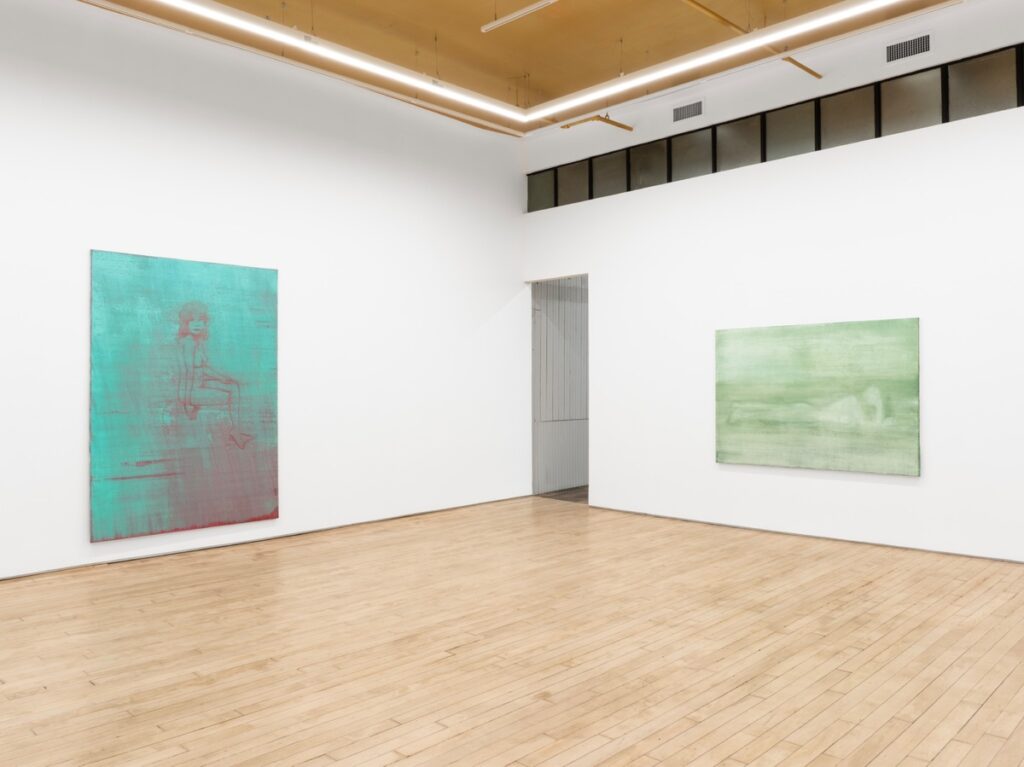
I kept returning to the turquoise table in Anna-Maria Škroba’s Nazar. A seated figure occupies the center, but the table holds my attention. Its saturated color and sharply angled edge give it a force the sitter never acquires. The face has been reduced to a gray oval, while the black clothing breaks apart against the open weave of the jute. Though porous in places, the table seems to push forward. The person recedes.
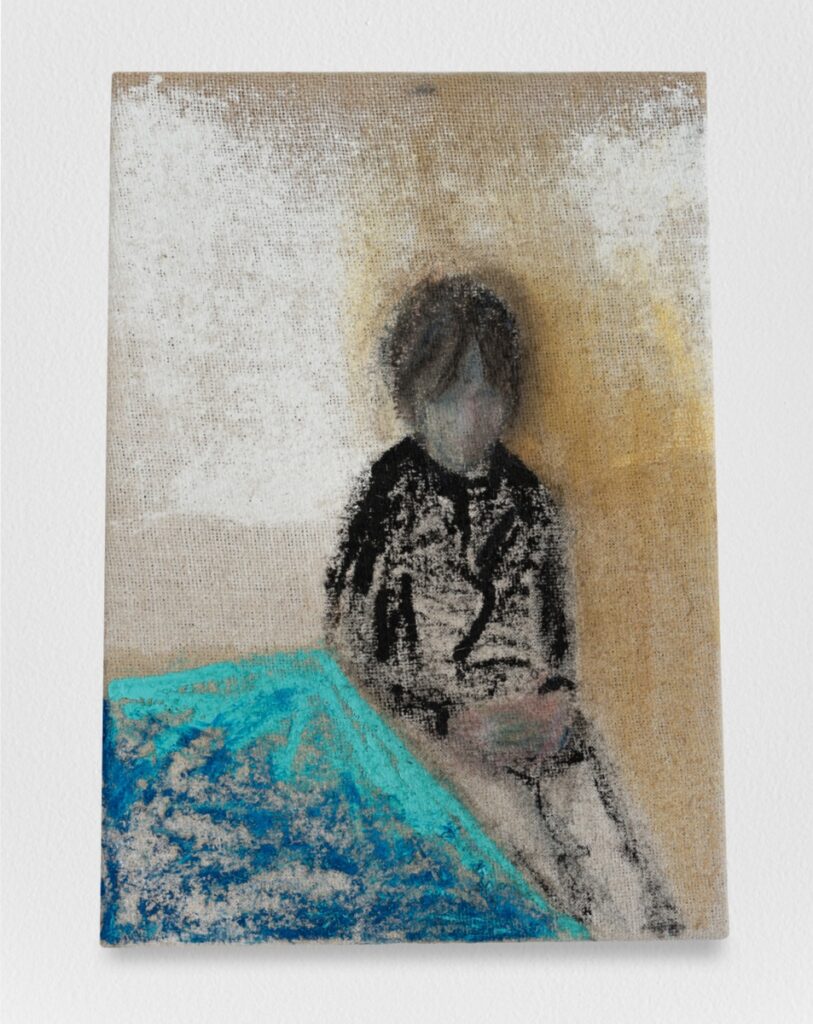
That reversal raises a question that follows Škroba’s solo exhibition, I’m raining before the rain, at YveYANG: Why does she continue to paint the human figure while allowing other elements to overpower it?
Her figures are rarely absent. They sit, recline, walk, or occupy the middle of a field, yet they seldom govern the picture. Tables, roads, expanses of color, and the exposed fabric beneath the paint exert competing pressures. Škroba treats the figure less as a commanding subject than as something vulnerable to its surroundings. The body gives those surroundings something to act upon.
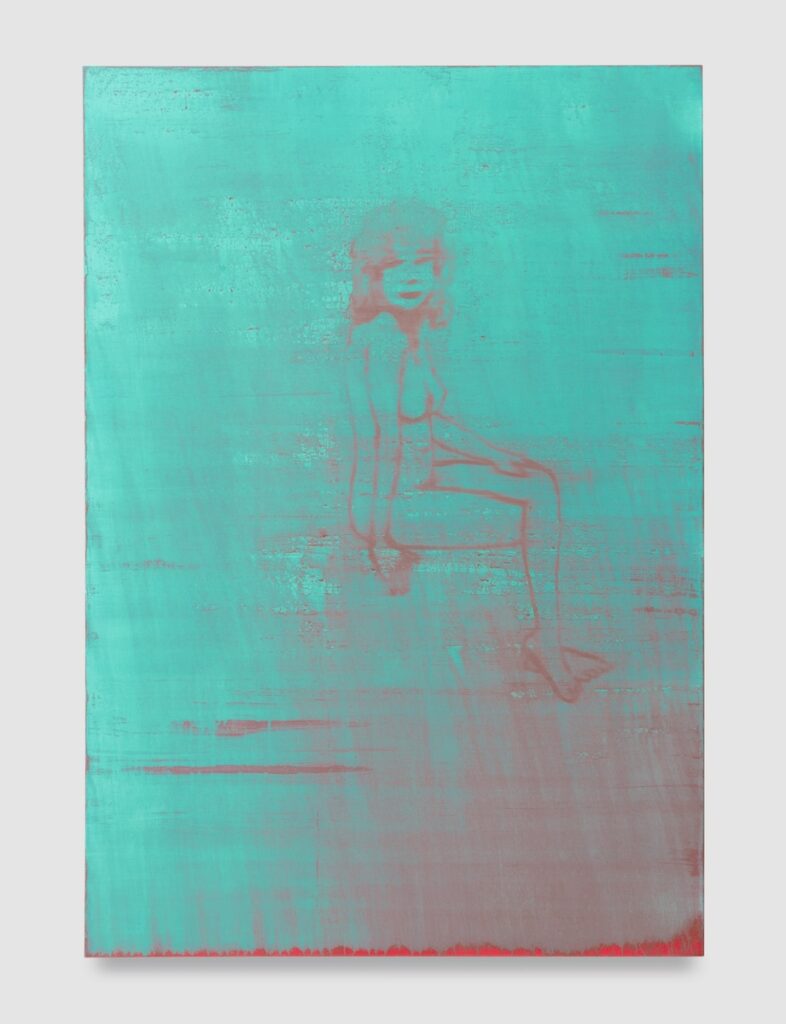
This is especially clear in Neither-Nor (Bolshaya). A seated woman appears within a monumental turquoise field, indicated by thin reddish-gray lines describing her head, torso, and bent legs. The figure is large, but scale does not translate into authority. The surrounding color carries greater visual weight, while the rough weave remains visible across body and ground. The woman never separates cleanly from the surface. She appears held within the field and partially undone by it.
Without the figure, the turquoise expanse might read primarily as a formal event—a field of color interrupted by paint and fabric. The body changes the stakes. It allows the field to feel enveloping, resistant, perhaps indifferent. The figure does not explain the space, but makes its force perceptible.
Škroba’s handling of paint intensifies this relation. On jute, pigment settles into translucent passages, accumulates in thicker patches, or catches unevenly on the raised weave. At times the fabric appears more definite than the image painted over it. A shoulder or knee may gather into recognizable form, while surrounding marks remain closer to abrasion, stain, or drag. The support does not simply carry the image; it interferes with its coherence.
In space, a reclining figure stretches across a muted green field. The body is pale and elongated, but the weave beneath it remains insistently present. The person seems less placed upon the fabric than absorbed into it. Here the figure gives material tension a bodily consequence. The jute’s resistance becomes more than texture because a body is attempting to distinguish itself from it.
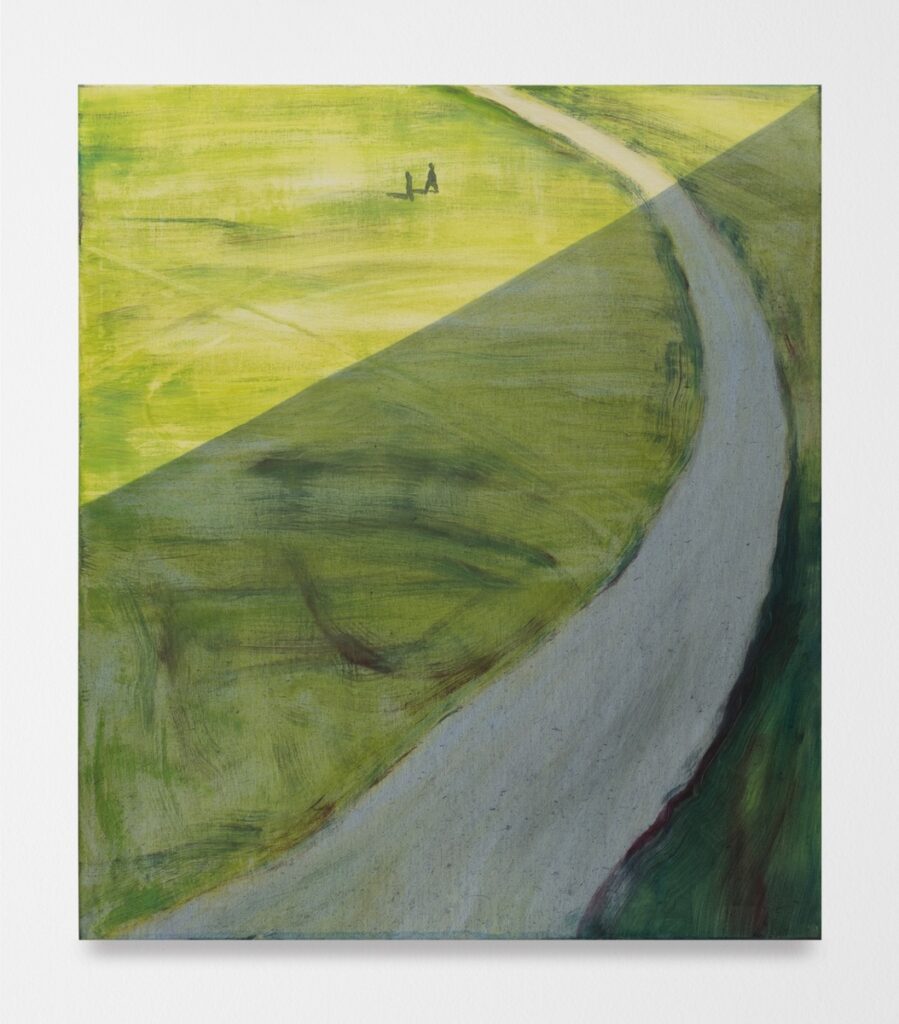
High perspective approaches the question differently. Painted on canvas, it presents a curving gray road, a green slope, a broad diagonal shadow, and two small figures in the distance. The people are nearly reduced to punctuation marks. The road and shadow organize the picture, directing the eye and establishing scale. Still, the figures turn an arrangement of directional forms into a traversed space. Their smallness makes the landscape feel expansive, while their movement gives the road purpose.
This may be why Škroba keeps returning to the figure. Her paintings need a human presence, though not necessarily a human center. The body provides scale, fragility, and consequence. It allows a table to dominate, a field to engulf, or a road to exceed the person crossing it. The figure remains so that its loss of control can be seen.
The exhibition’s title, I’m raining before the rain, folds weather into the speaker. The self becomes a condition rather than a stable center. Škroba’s figures occupy a comparable position: they register the pressures of color, texture, and scale without mastering any of them.
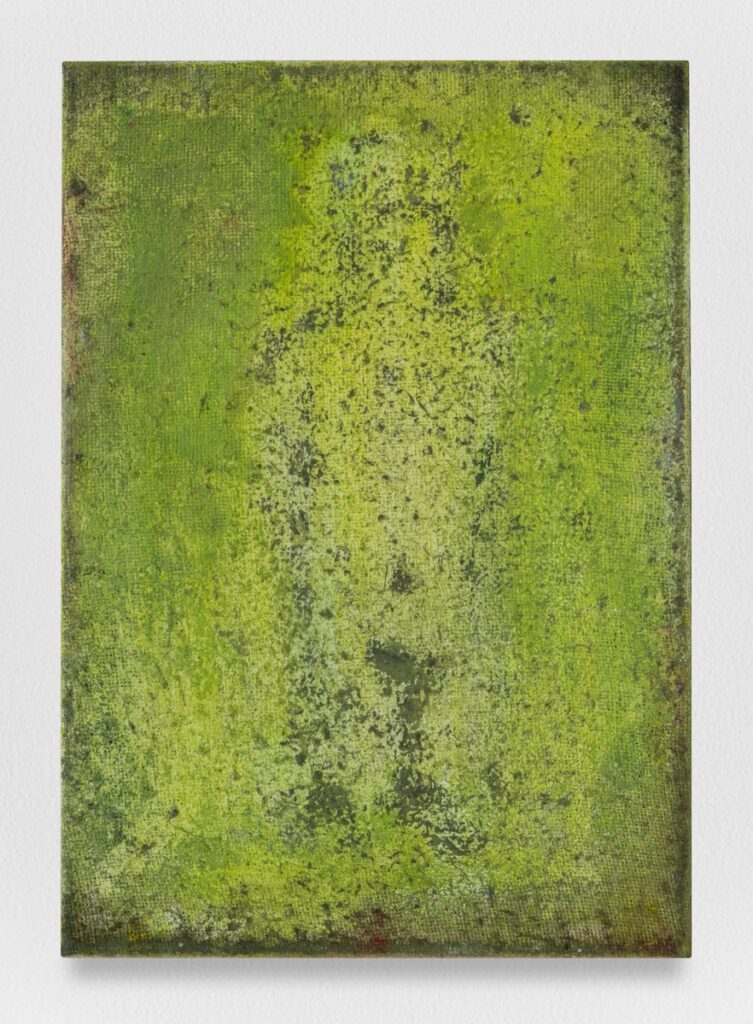
There are limits to this approach. In May, a pale vertical form occupies a mottled yellow-green surface, but it is difficult to determine whether the shape is a person, an architectural fragment, or an accumulation of lighter paint. The uncertainty produces little friction because too little distinction remains to place under pressure. Exposed weave and blurred form begin to supply a generalized atmosphere rather than a specific pictorial relation.
This is the risk of Škroba’s recognizable vocabulary. Blurred faces, muted fields, fragmented silhouettes, and visible jute are familiar features of contemporary figurative painting. Her strongest works move beyond that familiarity by establishing a precise conflict between the figure and what surrounds it. The weaker ones rely on material roughness to generate mood.
Škroba’s figures matter most when they remain necessary without becoming sovereign. They do not dominate the paintings, yet their presence prevents color, fabric, and space from becoming purely formal. A body sits, reclines, or walks through the picture, and the world around it acquires force. The figure stays so that we can watch it lose control.
Anna-Maria Škroba: I’m raining before the rain July 9 – August 21, 2026 at YveYANG, 12 Wooster St., New York, NY 10013