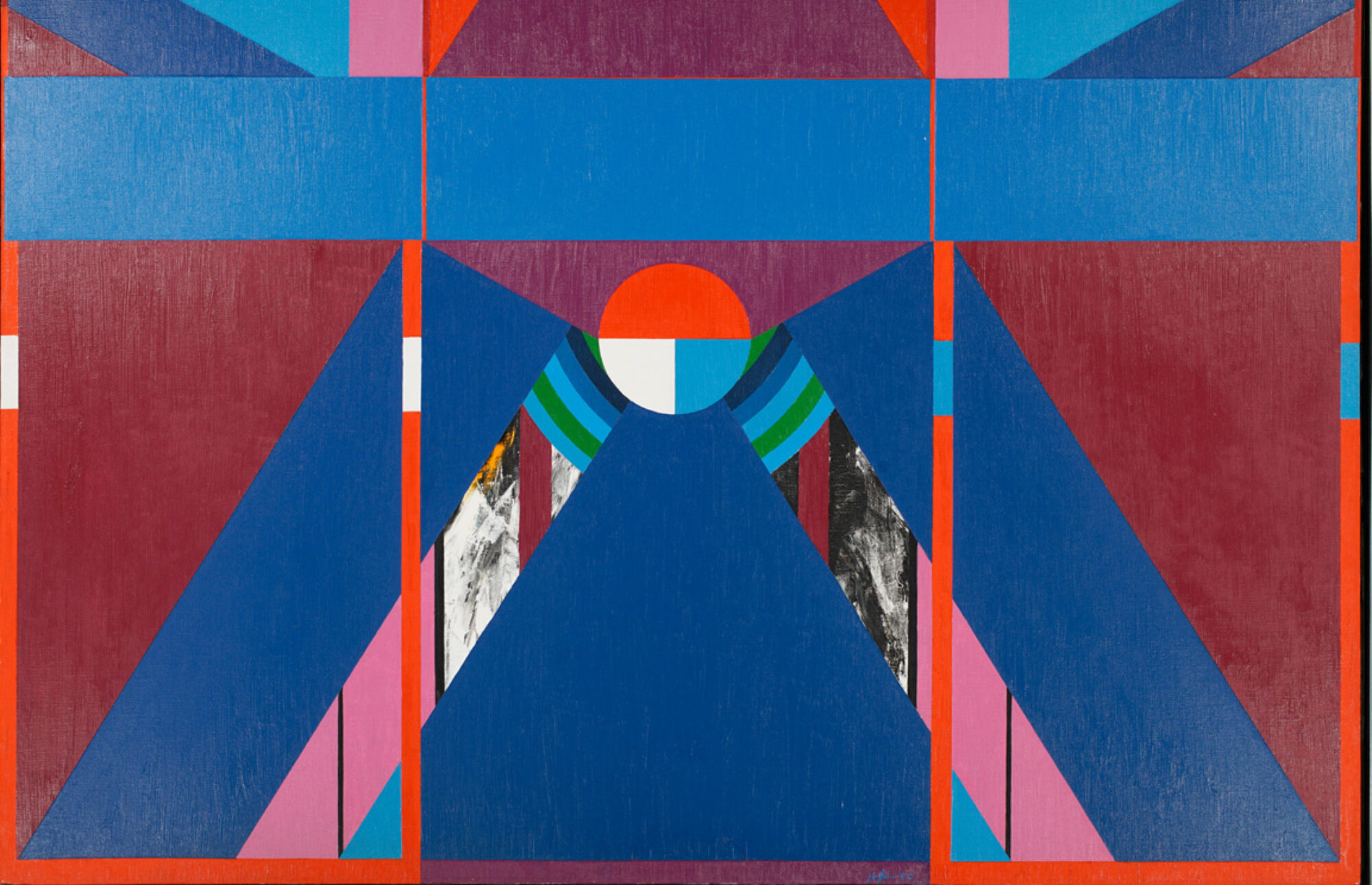
by Steve Rockwell
In the dArtles column of the Winter 1999 edition of dArt magazine, I wrote, “At the preview bash of Charles Ray’s mid-career retro at MOCA in Los Angeles, Charles himself stood on the patio roof looking down over the party. He didn’t cut through the party vortex and into the show until artist and teacher Roland Brenner arrived.” From that point in my article it became a list of “who’s who” of the LA art world. Some credit for Ray’s success has to go to the Los Angeles art dealer Burnett Miller, who passed away in 2001.
In her December 13, 2001 obituary for the LA Times, Suzanne Muchnic wrote, “An energetic and insightful entrepreneur who had an eye for quality and a finger on the pulse of contemporary art, Miller is credited with introducing the work of young artists who later achieved international renown. Sculptor Charles Ray – whose travelling retrospective exhibition appeared at Los Angeles’ Museum of Contemporary Art in 1998 – made a breakthrough at Miller’s gallery in 1987 with Ink Box, a giant black-lacquered metal cube filled with 200 gallons of black printer’s ink.”
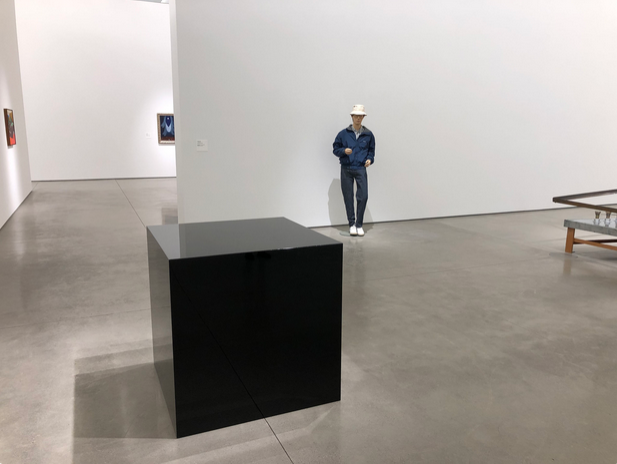
Muchnic quotes the Times art critic Christopher Knight, who wrote of its 1990 showing at Newport Harbor Art Museum, “The quivering meniscus of ink that is the top plane of this menacing black cube forms a threatening surface just begging to be touched, even in the face of disaster.”
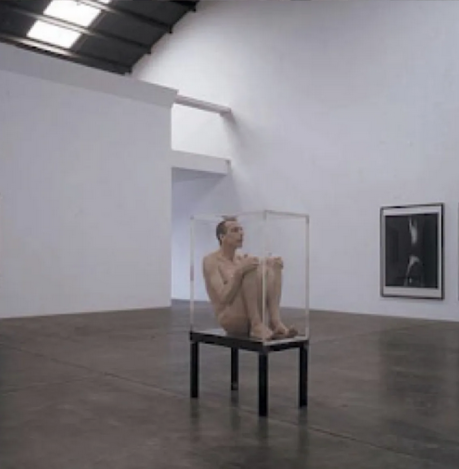
In his 1995, performance at the Burnett Miller gallery, artist Skip Arnold delivers an obvious homage to Ray’s Ink Box by replacing its “quivering meniscus of ink” with his own quivering flesh. The image featured here was used in an article by Craig Stephens in the Fall 2002 edition of dArt International titled Pollock to Punk: A Conversation with Skip Arnold.
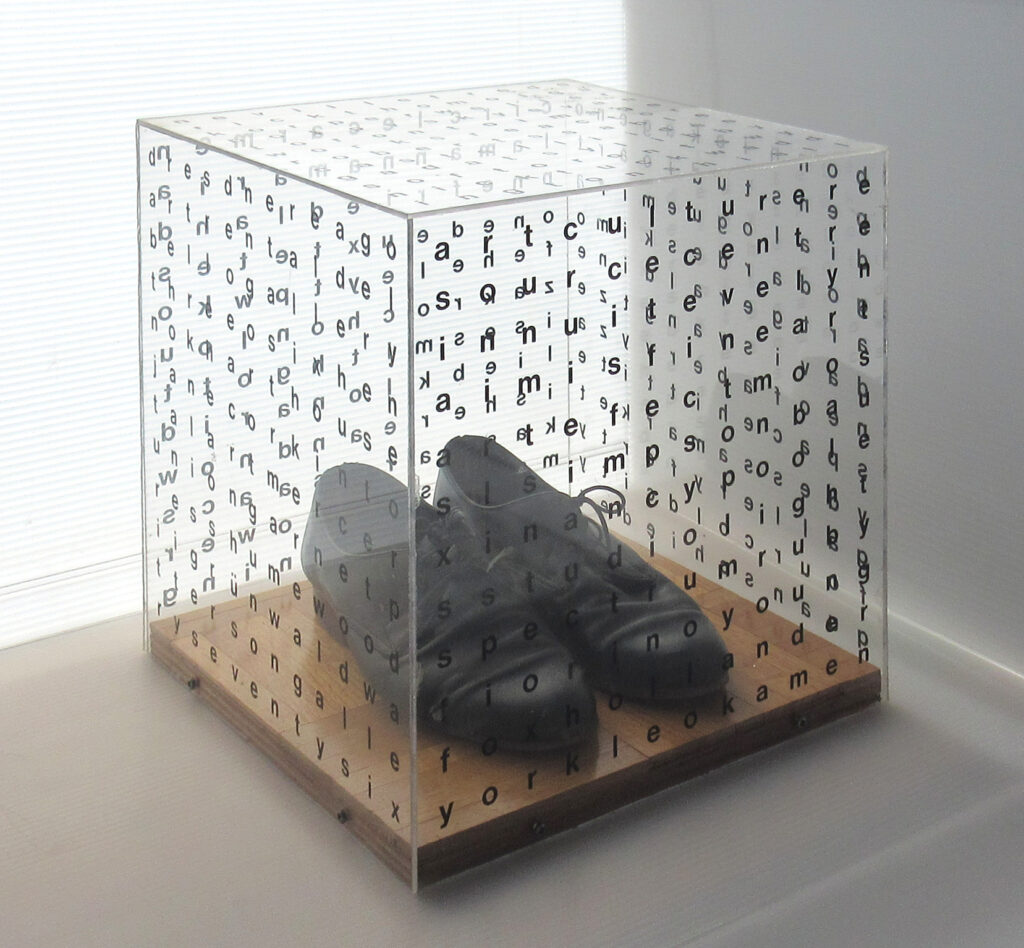
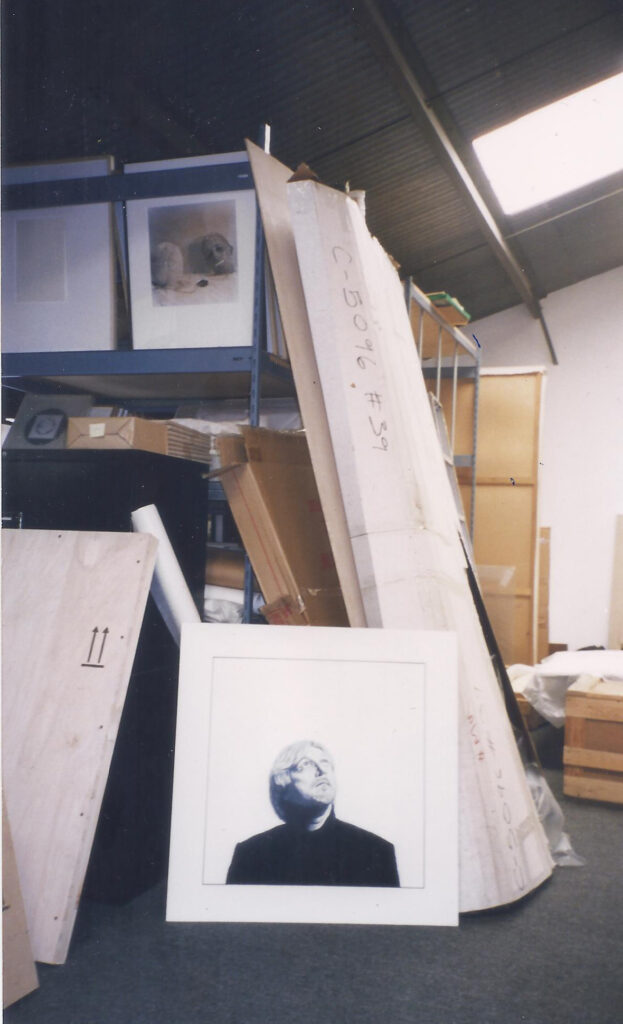
My own synthesis of Ray’s Ink Box and Arnold’s 1995 On Display piece is the sculpture Shoes. It was made in 1988, a year after the Burnett Miller exhibition of Ray’s ground-breaking piece. With the Shoes, Ray’s ink and Arnold’s body evaporate, leaving the residual imprint of black shoes overlaid by black print on plexiglass. In 1997 Burnett Miller consented to be included in my Storage project. A unique feature of the gallery’s Bergamot Station building in Santa Monica was its spectacularly convenient second floor skylight, clearly visible in the top left-hand corner of the Skip Arnold photo, and neatly matched in the top right-hand of Steve Rockwell’s Storage photo.
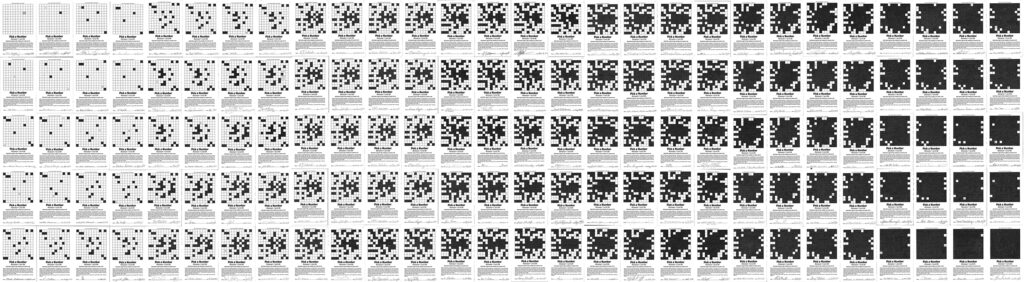
Unaware of the Charles Ray Ink Box until a couple of decades ago, I had produced the progressive “inking” of a six-by-six-inch square in 1987, the year Ray displayed his “inky box” at Burnett Miller. My square was subsequently cubed as the Shoes sculpture the following year in 1988. It took a hundred and thirty-nine people over a period of nine months to complete the “inky” square, the Pick a Number project eventually leading to the publication of dArt International magazine in 1998.
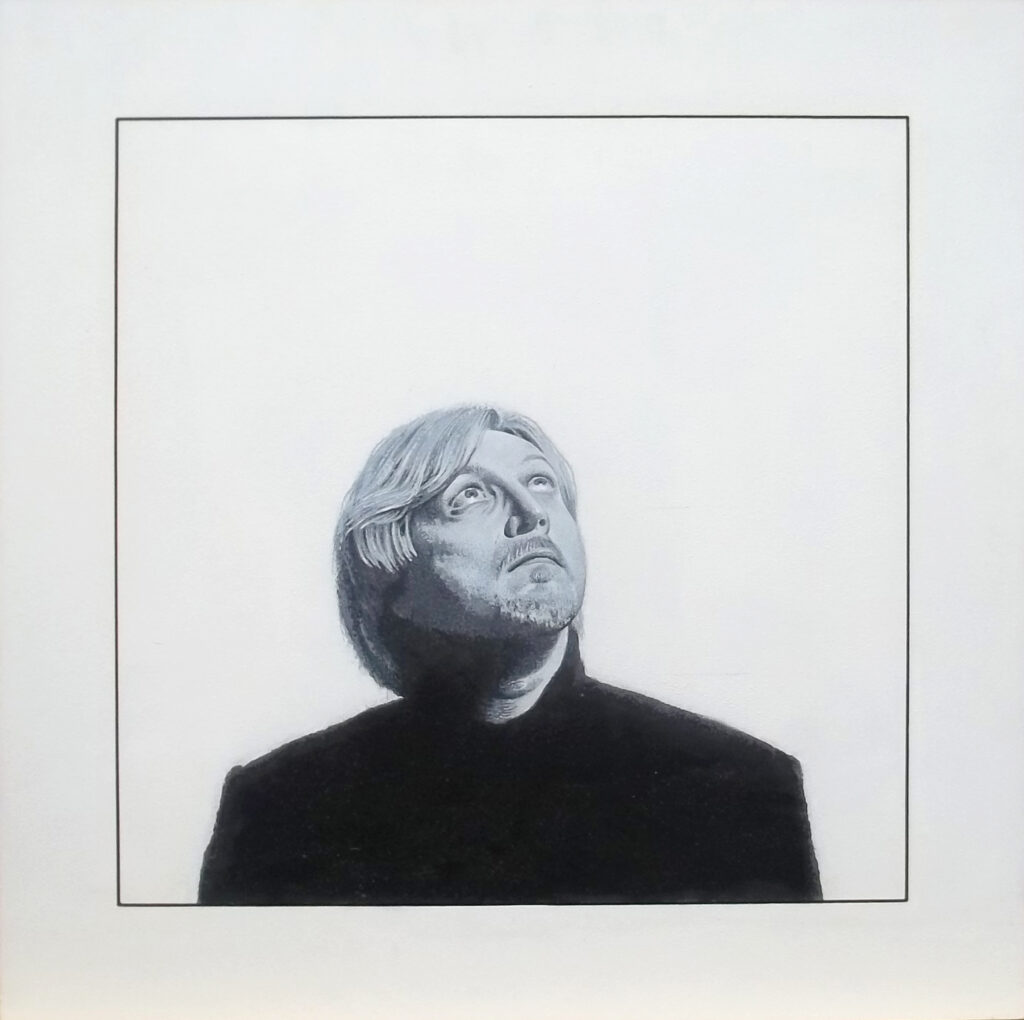
As part of the Meditations on Space project on December 1, 1995, my 36th gallery stop was Mary Boone, then in Soho. The account in the published book work read, “Someone must have been adjusting the lights or changing them. An enormous yellow step ladder rose toward the skylight in the center of the gallery. It made me think of the white ladder in Paris at Galerie Lucien Durand. Ron was busy at the desk by the door wielding a letter opener.” My black and white acrylic portrait staring up at the light suggested layered and cocooned gallery spaces from Paris, New York, and finally Los Angeles.
Only more recently, having reflected on the sources of my inspiration, did it land on a “dream vision” that I had in 1970. In it, an angel appeared with a shining solidity that shattered my flesh self to the extent that I presumed it to be the “Angel of Death,” were it not for its kind radiant beauty. Absent of spiritual grounding from my family, I was open to its interpretation. In form and perfection, it exceeded anything by Raphael. To a Catholic, it could clearly have been Mary. Pairing the vision with a definition of “boon,” made it a timely benefit, blessing, or something incredibly helpful and advantageous.