by Emese Krunák-Hajagos
When I walked into Zsolt Ferenczy’s large studio in Miskolc (Hungary) I was surrounded by large paintings and drawings that caught my attention with their vivid colours and unique figurative. I fell in love with It’s time (Itt az idő, 2020) at first sight. A very challenging work, with many layers of meaning, that invites endless possible narratives. I think this painting encompasses all of Ferenczy’s painterly symbolism and creative methods.
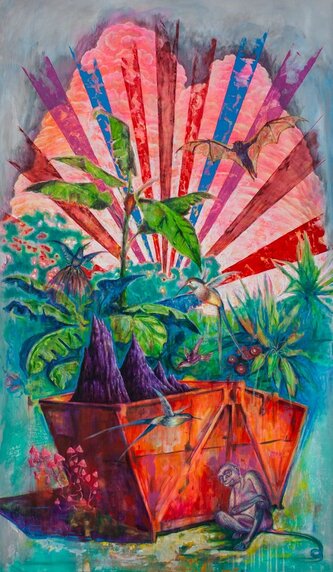
Let’s start with the animals that appear in his works. The monkey is an important one, recurring in many of his paintings. The one in Dark Material (Sötét anyag, 2020) refers to Frans Jansz Post’s painting View of Olinda (1662). It takes us to the Dutch colonies of Brazil. Post depicts a beautiful landscape with exotic animals. Ferenczy’s starting point is also a landscape but a very different one that is urban and imaginary at the same time. The monkey from Post’s painting is leaning against a red metal dumpster. His body is almost human with a sarcastic smile on its face. Exotic birds fly over palm trees and rich vegetation. The purple material—the ‘dark material’—seems to be solid and porous at the same time. The purple shapes remind us of mountains. But what are they really? Are they man-made or did they come from somewhere else? Are they nuclear and dangerous or just a byproduct of some digging?
The sky is also mystical. The layered pink cloud-shapes seem to move upward. It could easily be the smoke from a nuclear explosion. The colored stripes in front of it might be ‘fences’ trying to separate the two worlds to protect us. There is an idyllic forest in the middle of the composition contrasted by the red dumpster with the dark material and the pink clouds. A weird, foreboding environment.
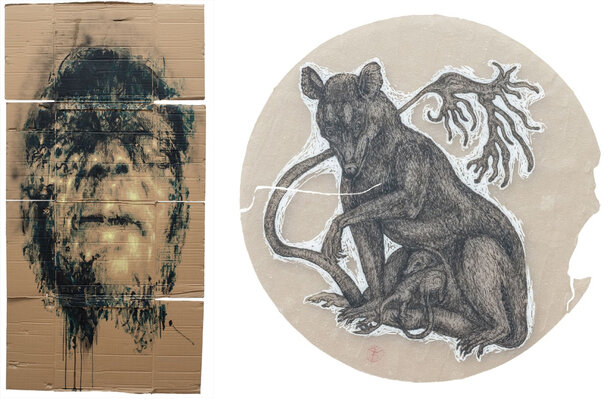
Figures are central elements in Ferenczy’s paintings. His research for his paintings is very sophisticated. He has wide and varied interests that seemingly don’t relate; deep, updated knowledge in anthropology, history (both natural and human), art history, stories of animal and human mutations, among many other fields. The series called Bestiary (2019–2020) include pieces containing images of human evolution and mixed races (casta) entitled The Burden of the Past. Iceman (Jégember, 2019–2020) is a reconstruction of the face of a creature we know as a Yeti or Bigfoot. A very tall and large-footed being, who reportedly has been seen in various places on Earth. The portrait is very dramatic, the black ink flows over the surface, the dark eyes, hair and beard suggest the hidden nature of the creature. What makes this series even more interesting is the cardboard base. Cardboard boxes are used in the transport of goods. Ferenczy “considers the box to be an important symbol of global trade.” Then, after they fulfilled their duty, they get discarded. The artist pinpoints the similarities between the fate of those boxed and creatures that are extinct or on the verge of extinction. He reconstructs some of them, like the Tasmanian Wolf, among other mutated animals, like a two headed sheep.
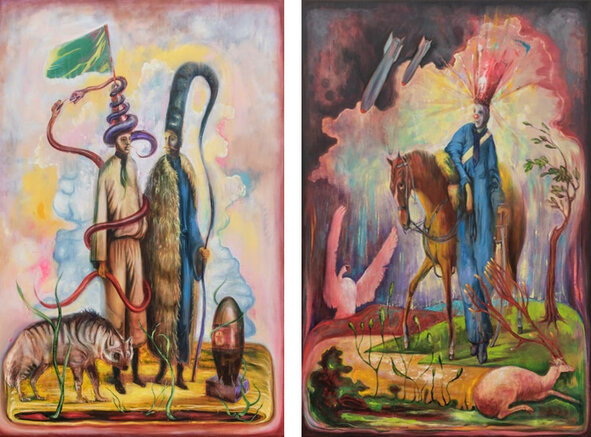
History, especially Hungarian history, is challenging to comment on, especially when it comes to—and it always does— talking about the fight for freedom. In the 19th century the Habsburg Monarchy ruled Hungary. Their high taxation interfered with the developments of Hungarian agriculture, animal breeding and industry. To show their resistance, Hungarians dressed in the traditional outfits of mounted horse-herdsman (csikós), including baggy pants (bő gatya), long coats ofter lined with fur, fur hats (kucsma), peaky hats (csákó), and carried a sword and spoke Hungarian. It was meant to show their resistance. The figures in Horsemen gathering bombs and The Rebel wore those traditional clothes and actively engaged in the rebellion that came to a conclusion in the war of 1848 against the Habsburgs. They are forboding images. We can feel that death is at the gate. The compositions are almost fairy-tale-like. In both paintings, the figures are elongated, giving them some eerie, magical appearance, wearing traditional Hungarian clothes as symbols of their political stand. The landscape is the great Hungarian Plain but we can’t really recognize it as it is modified to tell the story. There is a hyena who feeds on carcases, at the feet of one of the horsemen in The horsemen gathering bombs, snakes are fighting at the top of a flag. The bomb (that didn’t exist at that time) is on the ground. The Rebel is mounted on his horse, holding a sword, ready to fight. There are both peaceful (the resting deer) and worrisome (the agitated swan) animals around him. We face the dangerous pink clouds again and bombs are falling from the sky to destroy this budding rebellion. Pink/red light radiates from the rebel’s head, giving him the status of a hero.
As I mentioned earlier, I saw It’s time as a conclusion of Ferenczy painterly symbolism. Beside a Tisza-type boat (Tisza is a large river in Hungary) a boy in a peaky hat stands. There are animals around the boats, rabbits jumping playfully, a lizard, a deer looking into the distance, and a seagull flying above. In our world of environmental issues like global warming, forest fires and floods as well as political uncertainties, we never know what’s coming. We don’t know where the issues are coming from, what or who caused them, but disasters are coming for sure. This boy, like a “New Noah” is waiting for it to happen, possibly a flood, but there is no water rising yet. Everyone is waiting and ready. The animals are nearby, the two monkeys, like sailors are waiting. It is the quiet moment before the storm. The sky behind reminds us of the sky in Dark Material. Ferenczy wrote: “The sky always shows a different formation than the sphere below, but there is always something that connects the two. I borrowed the floating shape from astrophysical models that illustrate the motion of the black holes or galaxies. The danger, the sign of times, always appear in the sky …” Indeed, it does. The red shapes might be fires burning with dark smoke, while the blue, like exploding splashes of water that will rise and endanger everything. When it happens, the birdhouse is the only hope, the symbol of home, a way to escape from danger, and a chance for survival.
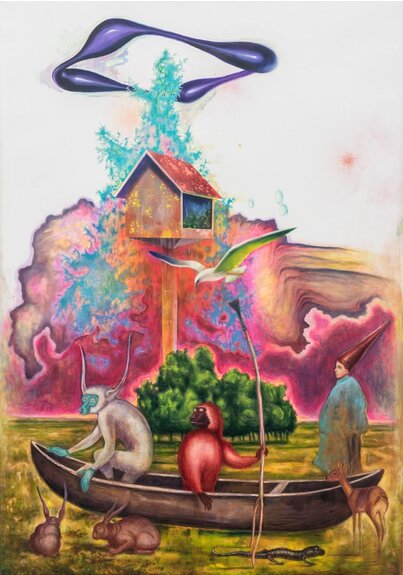
Like a crown, there is a purple atomic shape hovering at the very top of the composition, inviting the future into the upcoming catastrophe. Is it only observing? Or is it there to help or give us some hope? We don’t know. It’s like a poem. You don’t have to understand every motif to relate to the story and enjoy the vision.