by Taylor Bielecki
He Spoke To The Birds, a group exhibition curated by Fanfan Yuxuan Fan at the AAIE Center for Contemporary Art in Rome, is a journey into intricacies, interactions, and lingering conversations. Featuring Jeremias Rumpl, Diego Azzola, and Huang Zhe, the exhibition brings together practices with such disparate registers that, at first glance, they might seem incompatible. Yet curator Fan has woven them together skilfully, allowing each voice to be heard while the collective voice resonates just as strongly.
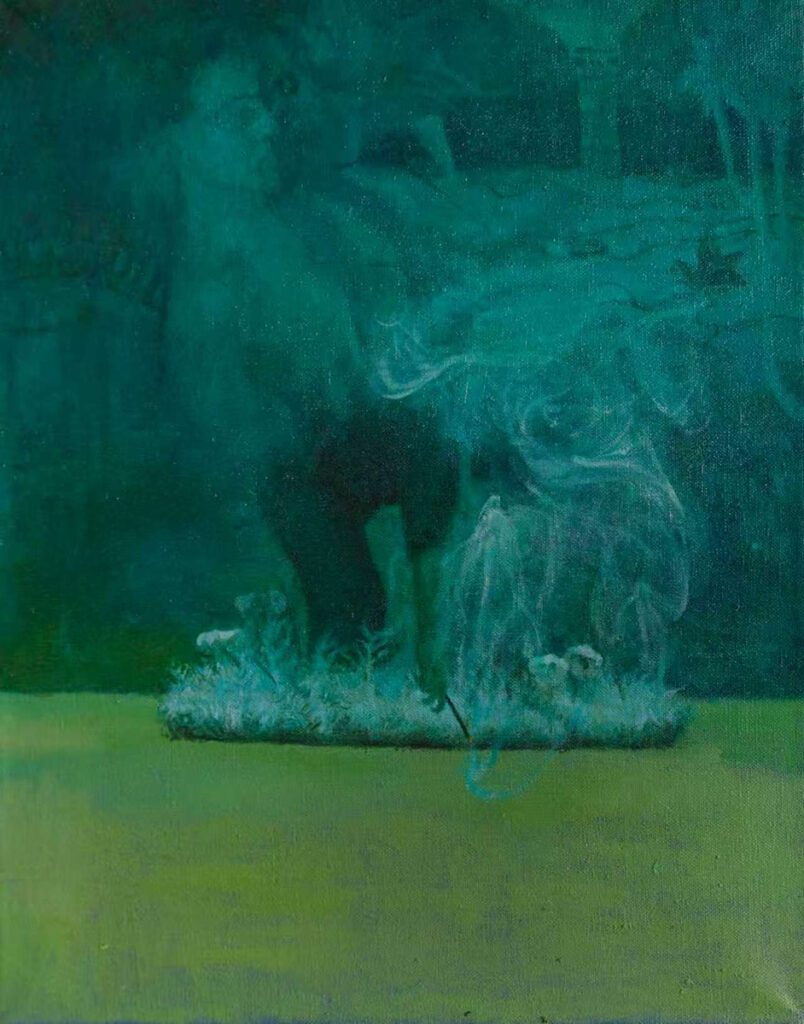
In Huang Zhe’s The Thinking of a Small Cluster of White Plants (2026), Fan introduces terms such as corroding, remembering, drifting, and dissolving. Words that feel light, airy, and weightless, yet suggest flow, connection, growth, and a steady presence through change. Each starts with an object, an element of nature, or a memory; through these actions, its point of departure shifts, much as the histories surrounding us do.
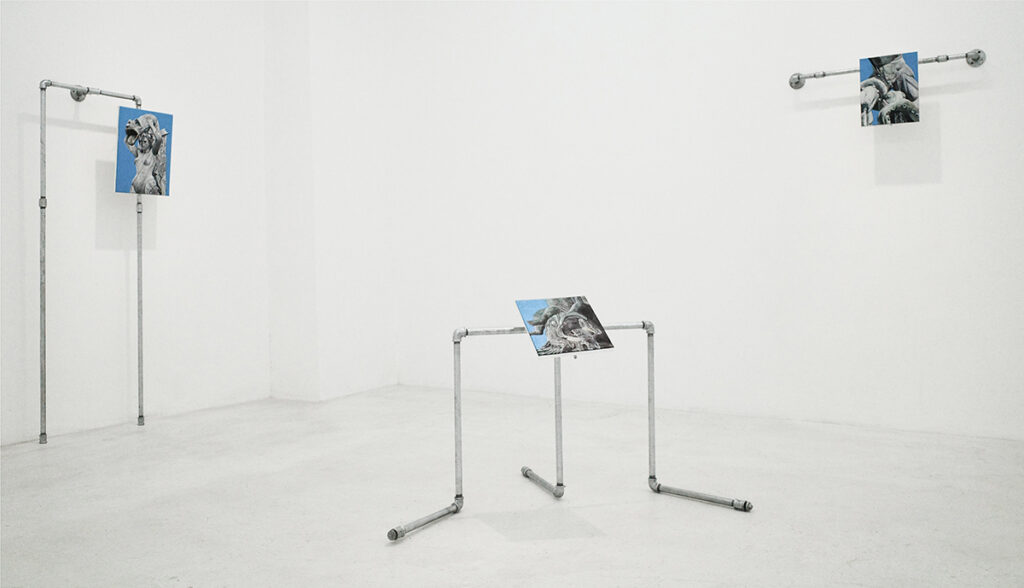
Standing in the midst of Rome’s everlasting history, this exhibition adds to its deep and ever-growing presence. Many works extend beyond themselves, allowing forms to grow while their lines still connect. A striking example that made an impact on me is Diego Azzola’s works, whose galvanized pipes emerge from his paintings as physical extensions of the image. In their original function, pipes carry water from one place to another; here, they do the same, linking works to the gallery and neighboring pieces. Rome has long been expanding and intertwining with new history, and its water systems still exist throughout the city, hidden, underground, lying at its edges, leaving a quiet but lasting imprint. Azzola’s pipes function metaphorically as fragments of a system that never entirely stopped functioning. He seems interested in what happens at the edges, where things cease to carry one singular meaning and instead become more complex and layered.
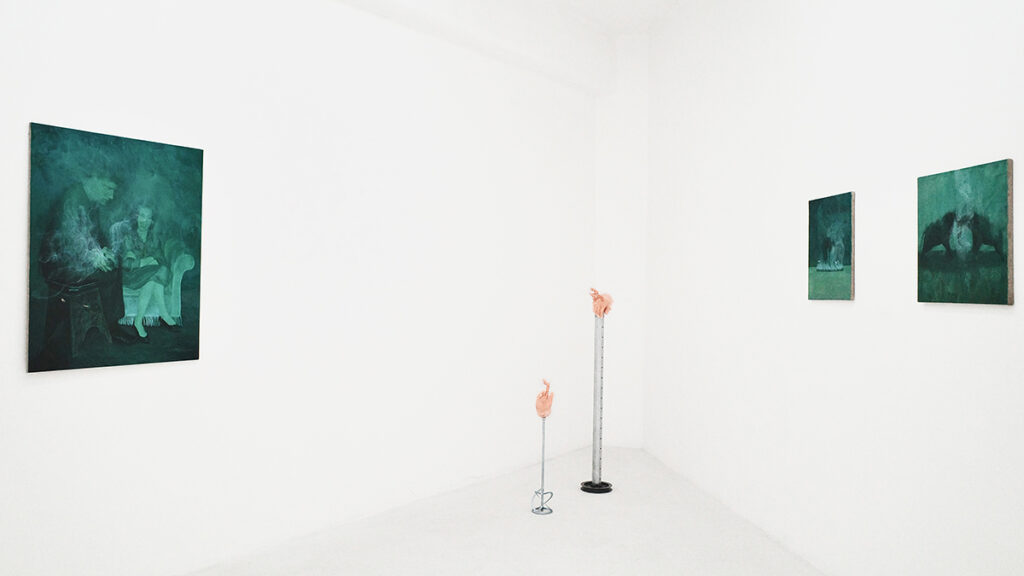
Fanfan Yuxuan Fan utilizes the space exceptionally well. Hung in clusters, the work develops their own conversations, guiding viewers through the gallery’s interestingly shaped architecture. Drawing on the spirit of Arte Povera, Fan enriches the curatorial framework by allowing the objects and materials to find their own voices — pipes, zinc plates, and smoke becoming not merely media, but interlocutors. This exhibition invites closer attention to details, connections, and intricacies. Interviewing Fan was immensely enlightening, offering insight into the process behind it, from engaging with the space to shaping relationships between works.
TB: What drew you to choose these artists, and how did you work with them to choose the works for this particular space?
FYF: Diego Azzola and Huang Zhe have already built relations with AAlE. During my conversation with the gallery founder, I proposed inviting Jeremias Rumpl, based in Germany, to join. From the outset, I envisioned the project around materiality and the spirit of Arte Povera while remaining grounded in each artist’s practices that treat materials as active participants in the creative process.
TB: What interested AAIE in collaborating with you on the exhibition He Spoke to the Birds, especially in relation to supporting younger curatorial voices and international artists in Rome?
FYF: There was strong alignment from the start. AAlE has never been focused exclusively on or limited to local artists; its programs have always had an international vision and encouraged dialogue across cultural contexts. I was mindful that this exhibition would take place in Rome, a city where Arte Povera was not simply an art-historical reference, but a way of engaging with a history that originated in a living context for rethinking materiality. That shared vision made the collaboration feel natural and meaningful.
TB: How did you consider the exhibition as a space where different forms of time and material presence coexist beyond physical presence? How did you decide on placement and installation heights?
FYF: The AAlE space is very different from a conventional white cube. Its triangular corners and irregular geometry, characteristic of Roman architecture, opened up possibilities that a standard space would not. I grouped Diego’s installations by color and series within one corner, while positioning sculptures of different forms and tones in dialogue with Huang Zhe’s paintings. Throughout, I was thinking about spatial narrative, how to create a sequence that feels coherent while remaining visually engaging and full of unexpected encounters.
TB: Given the deep history of Rome, what kinds of conversations or connections were you hoping might enter the gallery as viewers experience the work?
FYF: Rome made this exhibition possible in a particular way. There is something about a city where history is never abstract, where ancient infrastructure, ruins, and contemporary life coexist, that invites a return to what is most essential. For me, the exhibition also returns to one of the fundamental ideas behind Arte Povera: not a style or historical movement, but an attitude toward the world. He Spoke To The Birds suggests a way of relating to nature and all living things with equality and attentiveness. In today’s uncertain world, I hope it offers a quieter space to reconsider our relationships, with one another, with materials, and with the natural world — to slow down, to listen, and to reconnect with what is most essential.
TB: At what point does the material stop being a surface and become a collaborator? Is the metal seen as an extension of the work? Perhaps acting as a drawn line?
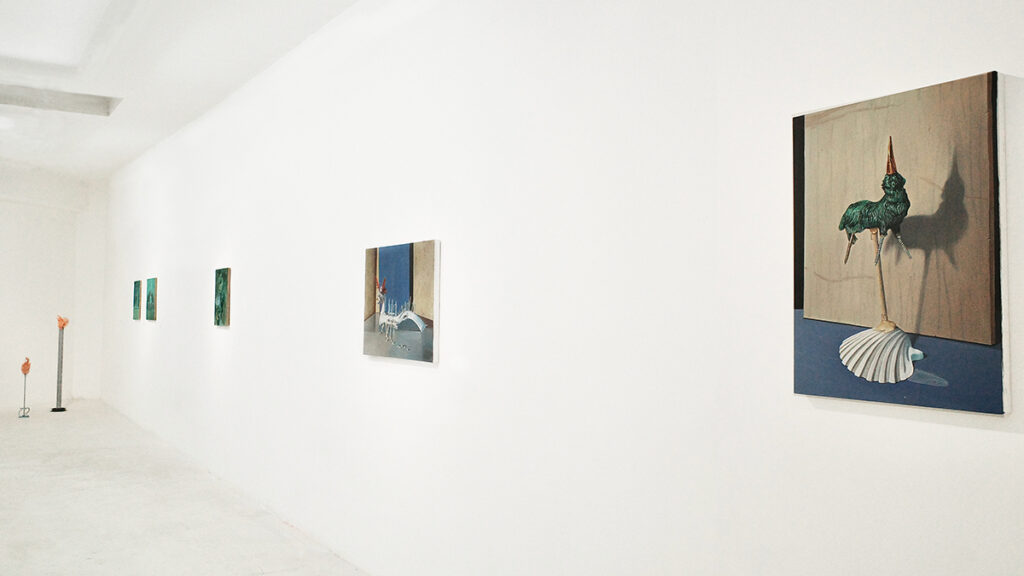
FYF: I think that’s a very apt reading of Diego Azzola’s work. The galvanized pipes are not simply structural elements; they become active collaborators in shaping the composition and the viewer’s movement through space. Extending beyond the pictorial surface, they function like drawn lines that have escaped the canvas and unfolded into three dimensions. They also carry a historical resonance in Rome, deeply embedded in the city’s architectural infrastructure, so when Diego brings them into dialogue with painting, the material responds to the image, the space, and history surrounding it.
TB: The show title evokes a foundational ethos of Arte Povera: a world in which human and non-human exist on the same level. How do you feel this theme fits the works? How does each artist embody this ethos?
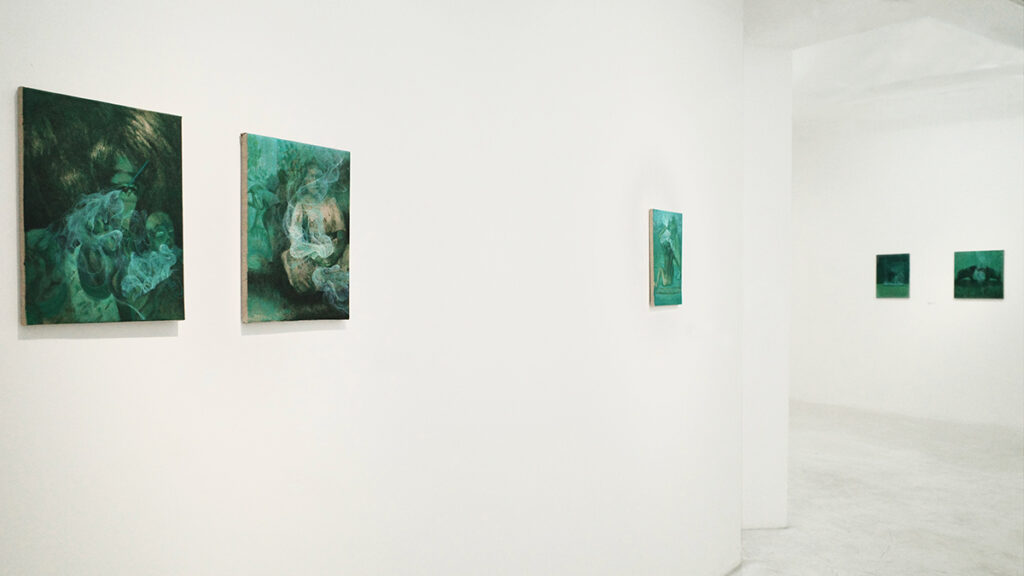
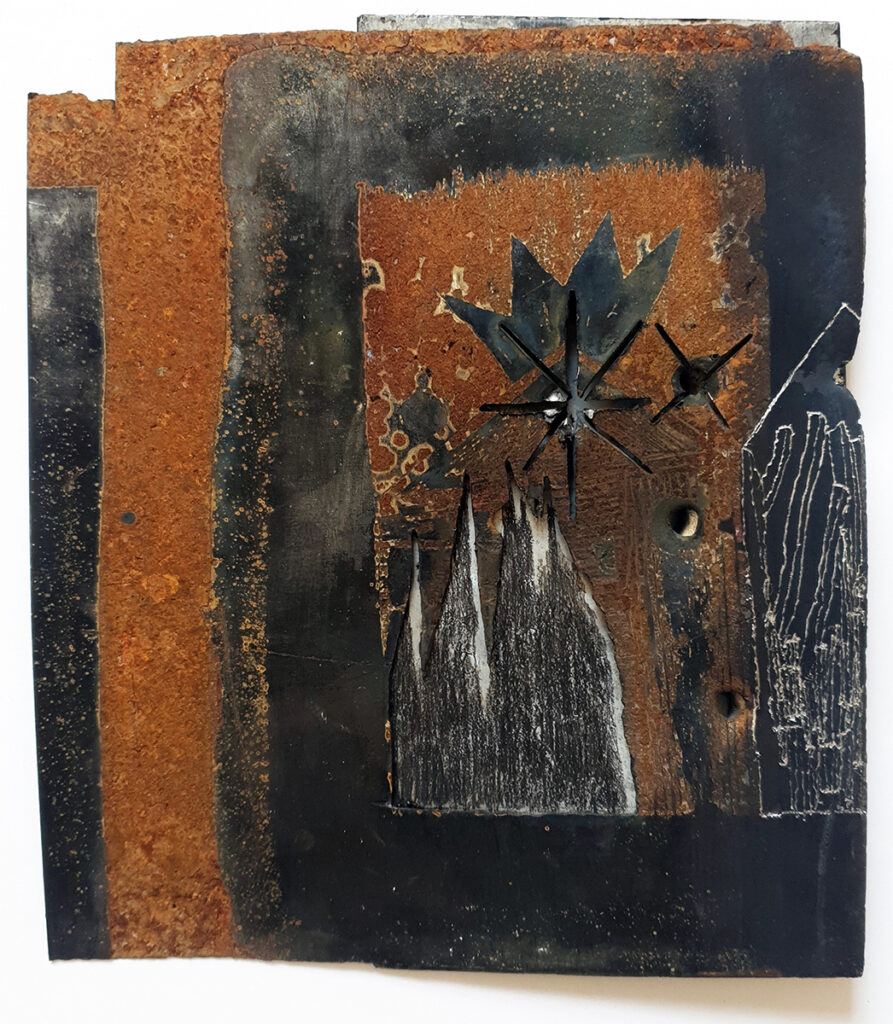
FYF: I think each artist embodies this ethos differently, but all approach materials as something with agency. That openness lies at the heart of the spirit of Arte Povera and this exhibition. Jeremias Rumpl relinquishes part of the creative process to acid, weather, and time, allowing the material to shape the final work. Diego Azzola places industrial pipes, painting, and marine forms on equal terms, without hierarchy, dissolving boundaries between the natural, the built, and the imagined. Huang Zhe transforms smoke into a painted presence, allowing memory and atmosphere to emerge through a material that is almost impossible to grasp. None of them impose meaning on their materials; instead, they enter into a dialogue. That willingness to listen, to materials, to time, and to the more-than-human world, is what most deeply connects their practices to Arte Povera and the title He Spoke To The Birds.
TB: Elements within the pieces vary in weight and presence; how did you negotiate those differences while maintaining the coherence of the whole show?
FYF: I didn’t begin by thinking about contrast or balance between materials. Each artist had already developed their own material language: zinc, pipes, and smoke were not choices I imposed, but vocabularies already in motion. What I noticed was that these materials also carried a particular resonance in Rome: a city built on stone, water systems, and accumulated time. The differences in weight and presence emerged naturally from bringing these three practices together. My role was less about negotiation and more about creating the right spatial conditions for each to exist on its own terms, while allowing connections to emerge across the exhibition.
Installation view of He Spoke To The Birds, Rome. Artists: Diego Azzola, Huang Zhe. Curated by Fanfan Yuxuan Fan. Courtesy of AAIE and FanFlus.
About the Writer:
Taylor Bielecki lives in Gowanus, where her studio is, and works at Pratt Institute, where she earned her MFA. She also studied at Penn State, where she earned a BA in English and a BFA in Fine Arts. She finished as a finalist in the Kennedy Center’s VSA National Emerging Young Artist program for 2017, where she earned an award of Excellence. She has shown prints internationally in a print exchange in Australia and exhibitions in Dubai, India, and the Glasgow School of Art. She has also shown paintings internationally in Gallery 24N, PhilaMOCA’s juried exhibitions in Philadelphia, Pa., Perry Lawson Fine Art in Nyack, NY, BWAC in Red Hook, and IW Gallery in Brooklyn. Taylor works for Two Coats of Paint, TUSSLE Magazine, and has joined Art Spiel as a contributing writer. @Taylor.Bielecki