by Chunbum Park
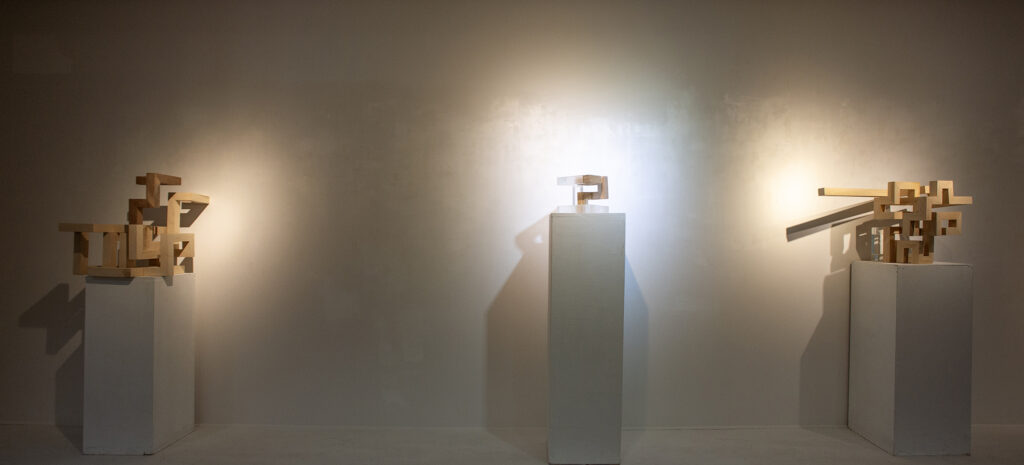
At Keunhee Park’s solo exhibition, MAZE, at the Riverside Gallery in Hackensack, NJ, sculptures that alternate between the modes of transparent glass and opaque wood manifest themselves in succinct metaphors about the nature of identity and being. While Park’s work appears purely abstract with only formal concerns on the surface, it is totally concerned with the real world and, in particular, the human world and the questions of identity.
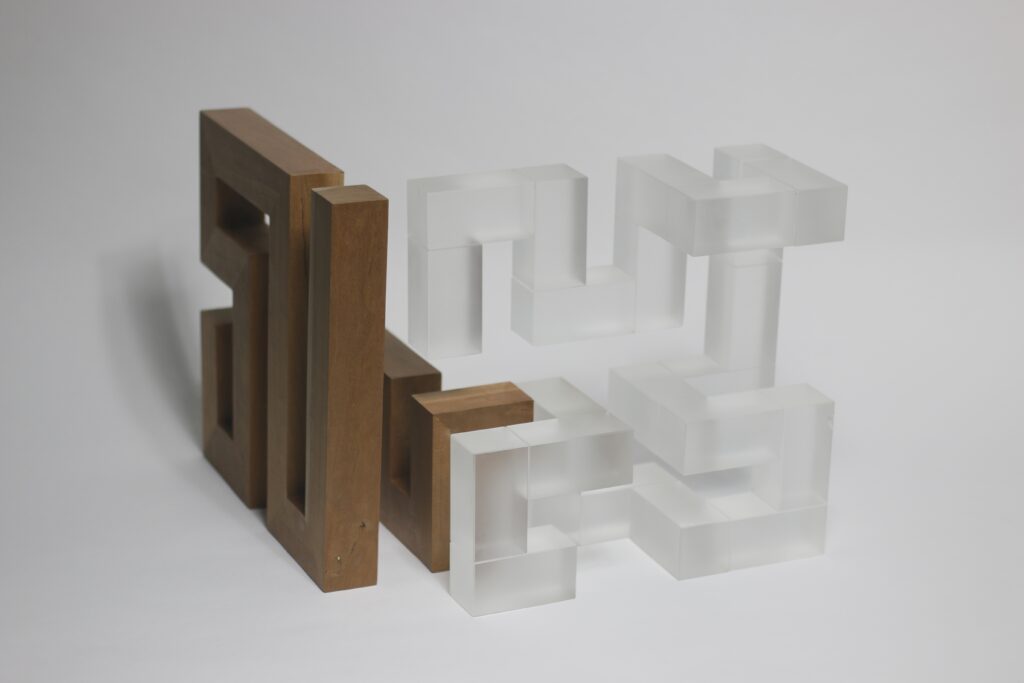
These sculptures contain forms that turn in rectilinear fashion like a literal 3-dimensional maze or snake game that maps out the possible pathways of movement and/or communication link. They carry the vestiges of certain conceptual and instruction-based works by the likes of Sol Lewitt, whose work including Floor-Wall Grid (1966) would stand as an example of the grid that Rosalind Krauss would write about in her seminal 1979 essay describing the use of grid as a powerful motif to bring about a new vocabulary that did not exist prior and as a language of the abstract realm that distinguishes itself from the “real” world.
The rectilinear geometry would manifest itself throughout history, whether the perspectival space or the windows in modern painting like Matisse’s masterpieces, as Krauss would point out in her writing. The grid as a window acknowledges the “frame” that exists outside or within the inner dimensions of the artwork. In Park’s grid-like constructions, the spatial dynamics is highly organized and curated with a specific set of rules and conventions in which the spatial dynamics come together. These underlying codes of spatial turns and projections suggest a fundamental language or building block as we see in the form of pixels on a computer display or the bricks of a virtual world.
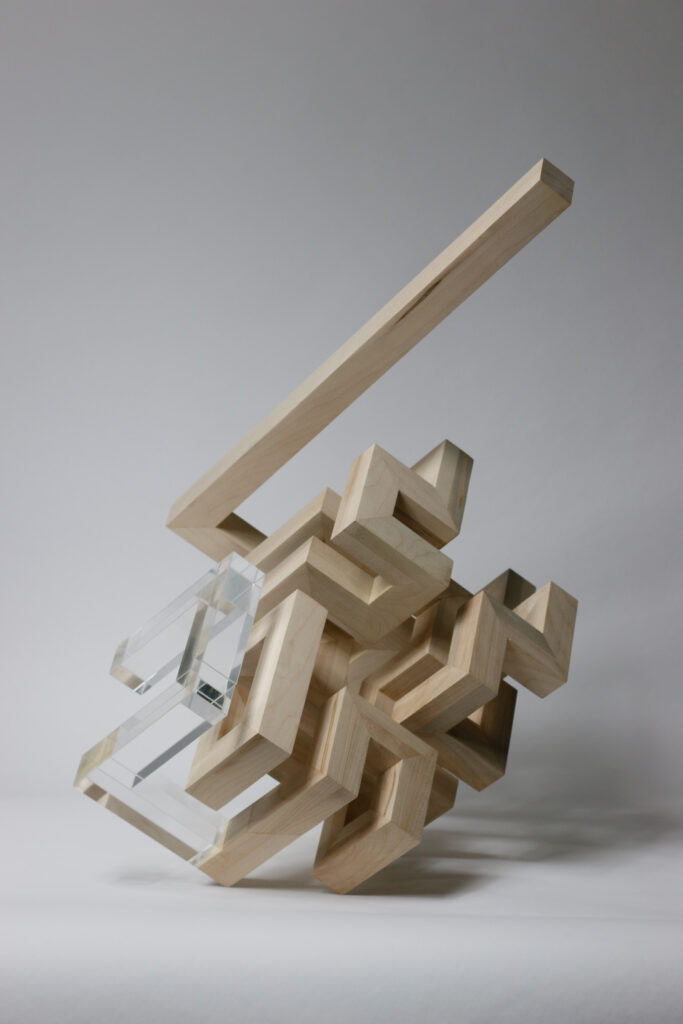
Why does a pathway suddenly change direction as if it were being stopped by something and were seeking an alternate path? Why does it continue to move uninterrupted in a straight line from certain positions?
Park’s sculptures represent the self and how we navigate the world or the environment in which the self exists, which is ultimately in relation to the other selves that occupy different positions in space time. Very interesting theories abound in physics that may inform our understanding of existence and the cosmos, including the fact that the electrons are virtually indistinguishable from one another. What if we were the electrons, but we were the same person, just spread out across various points in the space time continuum?
Particular portions of the sculptures alternate between the materials of wood and glass, as if to equate transparency with honesty and opacity with secrecy of the inner self. It is important to identify the difference between the surface and the core in relation to the question of identity, and Park’s sculptures in part reflect this binary relationship. Were the core of the self to become more visible, it must become more transparent and honest, yet the being or the object becomes less clearly defined, more susceptible to the influence of the surrounding elements (such as light and reflections), and more vulnerable. The opposite is true of opacity; with secrecy, the being or the object becomes less honest, yet it is also more protected and less vulnerable.
This is the contradictory and ironic condition of the universe and existence. Why do humans value honesty and integrity so much in a world where one must pay more to uphold such noble ideals?
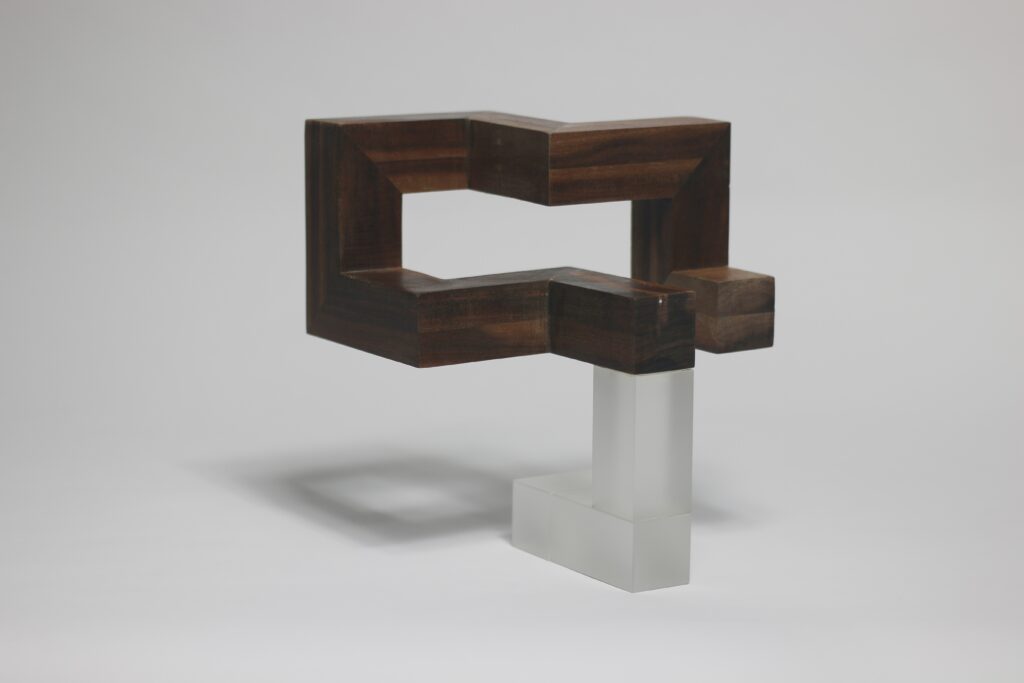
In another reading of Park’s sculptures, the transparent glass portions may suggest the imaginary or the imagined decisions and outcomes, whereas the opaque wooden parts may suggest what is real in the status quo, prior to the event of imagination that spawns subsequent actions. Park’s works may also reflect on human existence as a mix of the imaginary and the real structures. The imaginary and the real differentiate into the realm of social and political structures, economic structures, and so on in the imaginary, and the physical structures in the real.
Human structures are not only made of tangible objects but also the symbolic and aesthetic objects, to which Park’s Maze series belongs in reality. Ultimately, it is important to consider the alternate histories of what could have happened had we taken the other path. This is because alternative history and imagination allow us to critique and to reform the sociopolitical and economic structures, as well as the individual being (in terms of one’s condition and circumstances), in the status quo. Park’s sculptures may have begun as the artist’s reflection of a life lived, in which he had to struggle numerous times throughout life, only to become an artist, which in and of itself is a path of multiple struggles. However, the Maze series also carries a universal value and meaning because it is a human nature and condition to struggle and to seek out a decision at the crossroads.
Keunhee Park: MAZE, June 19 – July 6, 2026, 1 Riverside Square, Suite 201, Hackensack, NJ 07601