Slater Memorial Museum, Norwich, CT
by D. Dominick Lombardi
Alexey von Schlippe (1915-1988) left his title as a Russian Baron in the court of Tsar Nicholas II behind when he became a citizen of the United States in 1960. What emerged in his art during and after this transition, was a unique sort of social realism, not unlike the immediacy and empathy in the egg tempera paintings of Ben Shahn, but with more intimacy and isolation.
As part of the introduction to the exhibit, a descriptive wall panel mentions Von Schlippe’s inspiration from Giotto and Piero Della Francesca, which is clear in his dry brush technique common in the ancient art of egg tempera painting, an approach Von Schlippe manages even when he paints with oils. The text also mentions the influence of West African art that shows up in various ways including subject matter featuring a black woman with an exposed upper body ala mid-century National Geographic magazine, abrupt perspective in terms of the stylized masks and adornments, and anatomical simplification of the same. Beyond these influences, the content presented in Von Schlippe’s paintings has many psychological traits that break through. Additionally, and Like Andrew Wyeth who also masterfully worked with egg tempera capturing the distinctive souls of his subjects that he knew well, Von Schlippe’s way with egg tempera finds a less individual representation of a specific soul. Von Schlippe takes a more universal approach to the harm imposed on an oppressed group longing to be treated with the respect they deserve in an age of drastic social change.
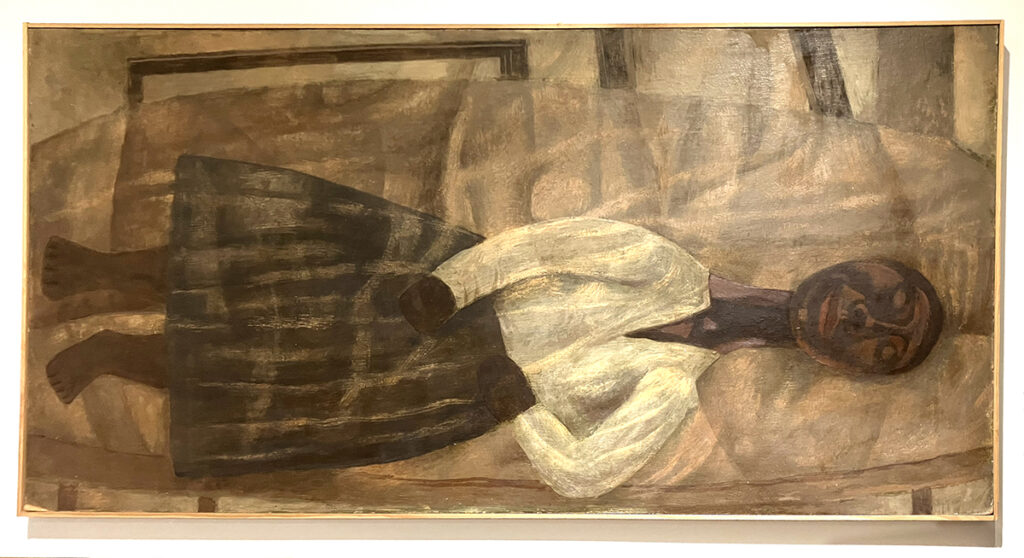
The paintings in this exhibition were created between the late 1950’s to the early 1980’s when America went through much social unrest and change. A fact that you can feel emanating from his female subjects in particular, which are often people of color seemingly exhausted by the burdens that come with living through troubled times. In Reclining Figure with White Blouse (undated, mid twentieth century) you get a sense of temporary peace as a compositional chrysalis forms around the figure. In this dream state, the harshness of the outside world is quietly absorbed in waves of harmless cleansing transitions within that subtle enclosure. And despite the metaphorical cushioning, there remains tension in the bent arms and fisted hands as they respond to indelible memories of repressive circumstances.
Exhibited directly below Reclining Figure with White Blouse is Reclining Figure (1980), which features a middle aged woman who still wears her simple black shoes – a detail that does not appear in any of the other paintings that all feature bare footed subjects. Reclining Figure also has more clarity of the figure that includes more realistic facial features, sharp pleats in a long skirt, a formal couch and hands set in a classic sleep, prayer-like pose giving this particular person a feeling of security and personal importance. Perhaps it’s someone who is related to the artist.

Conversely, the figure in Reclining Nude (Half Nude, Hands Raised) (1958) offers great import due to its overtly spiritual component and attention to detail in the sinuous, interconnected folds of fabric. The uplifted arms also add power and presence to the figure that none of the other paintings share. In the subject’s face, the relatively blank eyes give off a mask-like presence that brings us back to Von Schlippe’s interest in West African sculpture in all of its ritualistic or ceremonial forms.
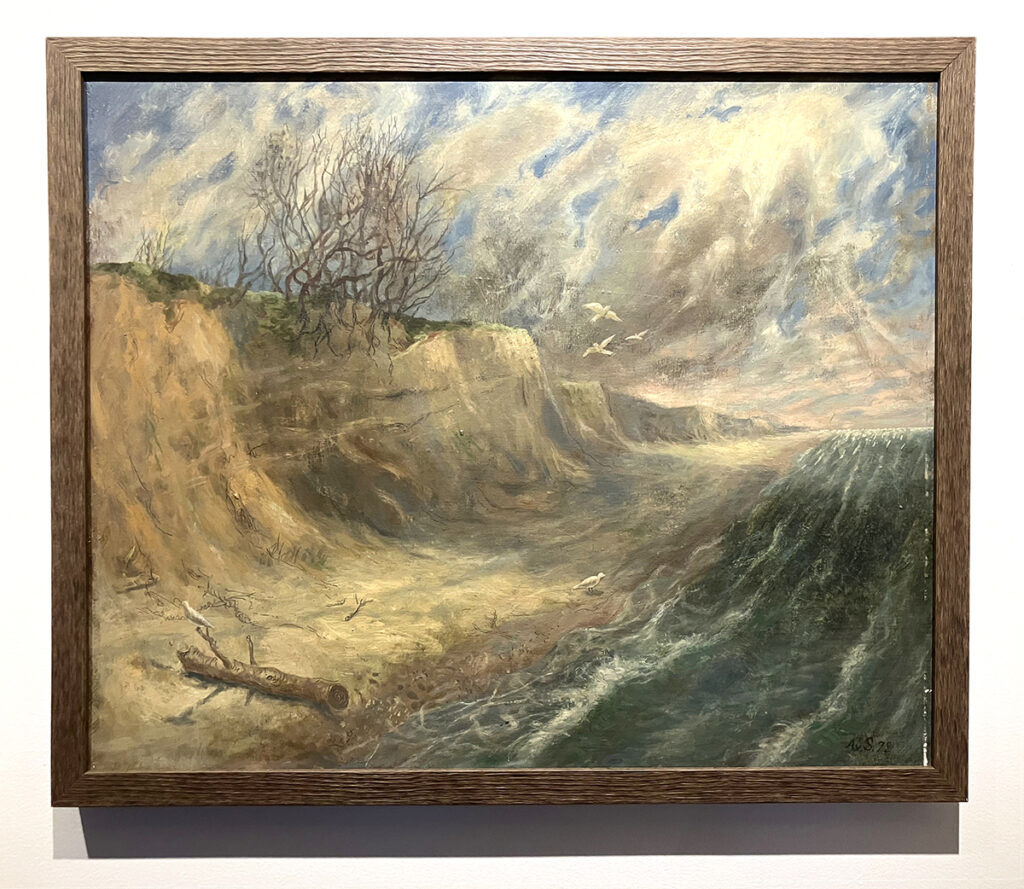
Seascape (1978), which is solely painted in oil, ventures the furthest into the Surrealist realm. The composition has a sort of rocking motion, as if we are viewing the scene from a boat in choppy seas, as the looming sandy cliffs and flood of ocean water that shimmers in the distant horizon strain to gain their individual heights in the picture plane. Then you have the Houston to Boston leaning clouds above that create a clockwise rotation in the composition, giving the scene all of its endless movement. Ignoring all this upheaval is a seagull perched atop a small branch of a large piece of driftwood on the lower left of the painting. Facing outward and away from the center, the bird gives the narrative a bit of doubt to its truth, telling the viewer that all this commotion is imagined, pieced together from bits of memory and preconceptions.
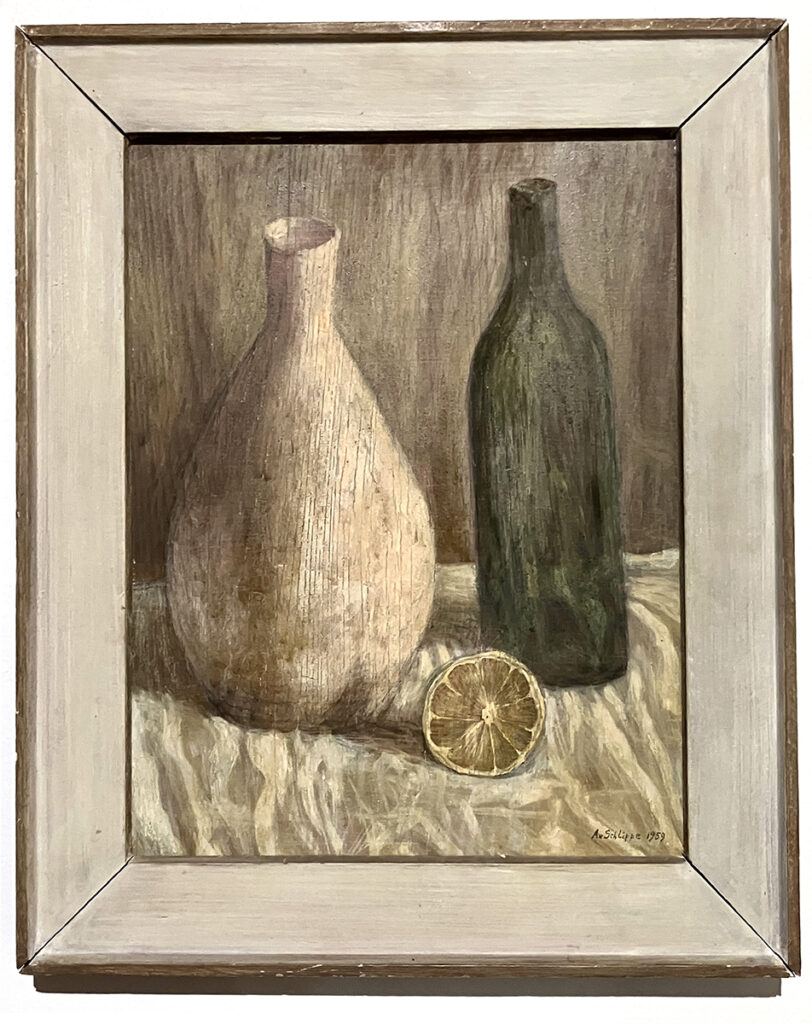
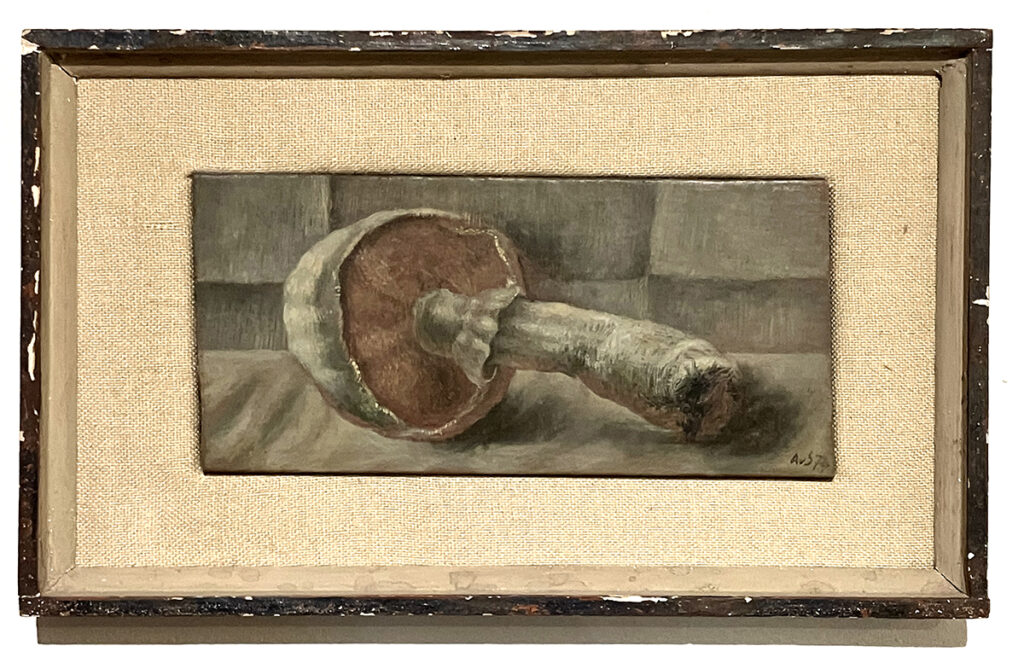
As a still life painter, Von Schlippe is equally skilled. Still Life with Mushroom (1974) has that George Grosz, Otto Dix brand of intensity, while Two Bottles (1958) leans a bit more toward the softened and shimmering – closer to Giorgio Morandi, only with lots of detail in the reflective surfaces. All in all, a striking exhibition in one of the most distinctive and magnificent buildings in New England that is best known for its extensive collection of world class plaster casts such as Michelangelo’s Pietà and Moses, Donatello’s David and the Laocoön and His Sons by Baccio Bandinelli. A destination that is well worth the visit any time you are in Norwich, Connecticut.