by John Mendelsohn
Writing about Murray Hochman’s paintings is, for me, an act of time travel. I am in the present, in his current exhibition of very large, visually mysteriously canvases that have a raw, open spirit. There is my memory of Murray, many decades ago when I first met him, a daunting guy in a dim loft in Lower Manhattan, full of his art and saturated with the odor of spray paint.
And there is the man himself now, whose journey of 91 years has been a constant painter’s progress, with all the satisfactions and vagaries that that implies. Lately, Murray’s work has received well-deserved recognition in group shows and in solo exhibitions at KinoSaito and the current one at Gallery AP Space.
In writing about painting, I usually focus exclusively on the work – what it does to me, and all that it might suggest – hoping to speak for art that speaks for itself. But here I want to see how the painter’s story and the paintings merge in my thoughts.
Murray is half a generation older than me, having grown up on New York’s Lower East Side in the 1930s and 1940s. He served in the military in the aftermath of the Korean War. His deployment was in Germany, permitting him to travel in Europe, and work in ceramics in an army base crafts class. The GI bill allowed him to earn a degree in art history from New York University, and an MFA in ceramics from Alfred University.
Returning to New York in the mid-1960s, Murray’s early work drew collectors and exhibition opportunities in the burgeoning downtown scene. The influences that Murray was drawn to included Abstract Expressionism, minimalist music, and Japanese culture. Buddhism became a life-long practice for him, whose presence in his paintings is implicit in a kind of acceptance of what is, and how that can manifest itself in a kind of hard-won spaciousness.
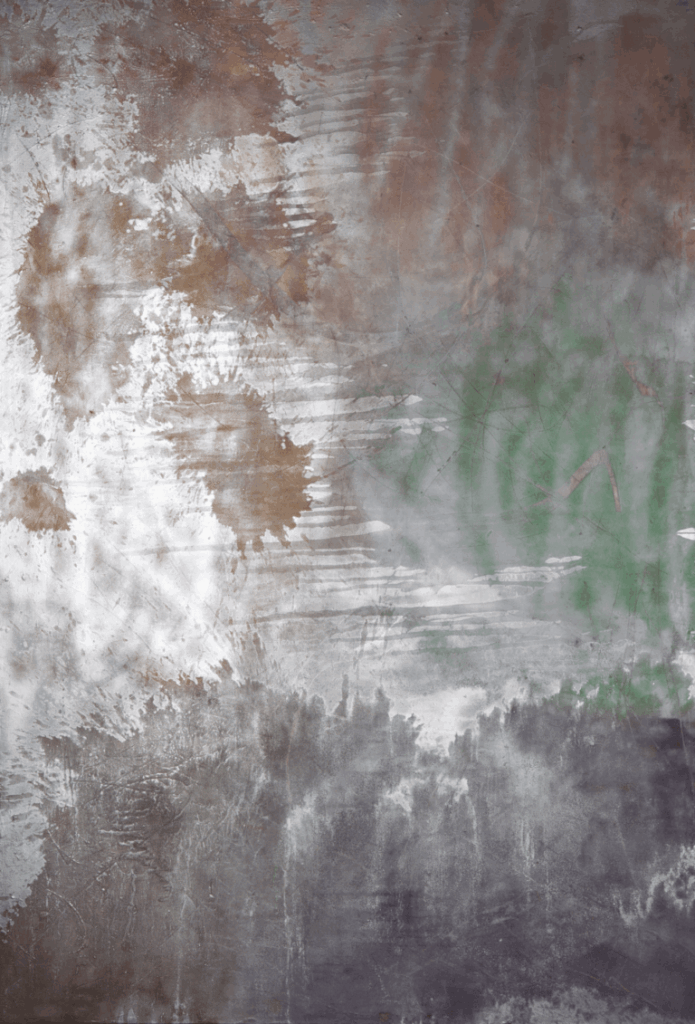
All writing about the essence of paintings is speculative, but Murray’s move with his spouse Lois to the Berkshires in Massachusetts two decades ago seems central to the work in the exhibition. In this rural setting, the painter has a barn to work in, and the chance to produce large-scale canvasses, some of which are 10 feet in height. But beyond size, the Large Polychrome paintings have an expansiveness, toughness, and lyricism in which I intuit the presence of the natural world.
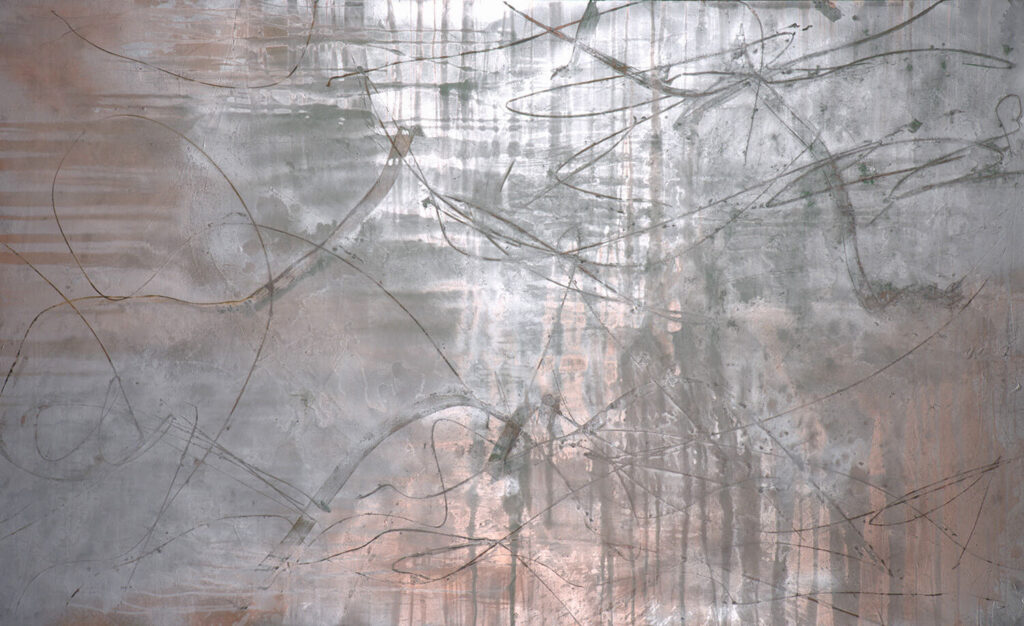
I sense in the painting Silver and Copper Abstraction, that that the metallic surface seems to evoke an iced-over pond, with a calligraphy of whipping, inscribed lines. In Stormy Polychrome, we feel the presence of gathering clouds and dying, persisting light. In Large Polychrome No. 6, the golden illumination of dawn or dusk fills the canvas, marked allover with a rapid sgrafitto.
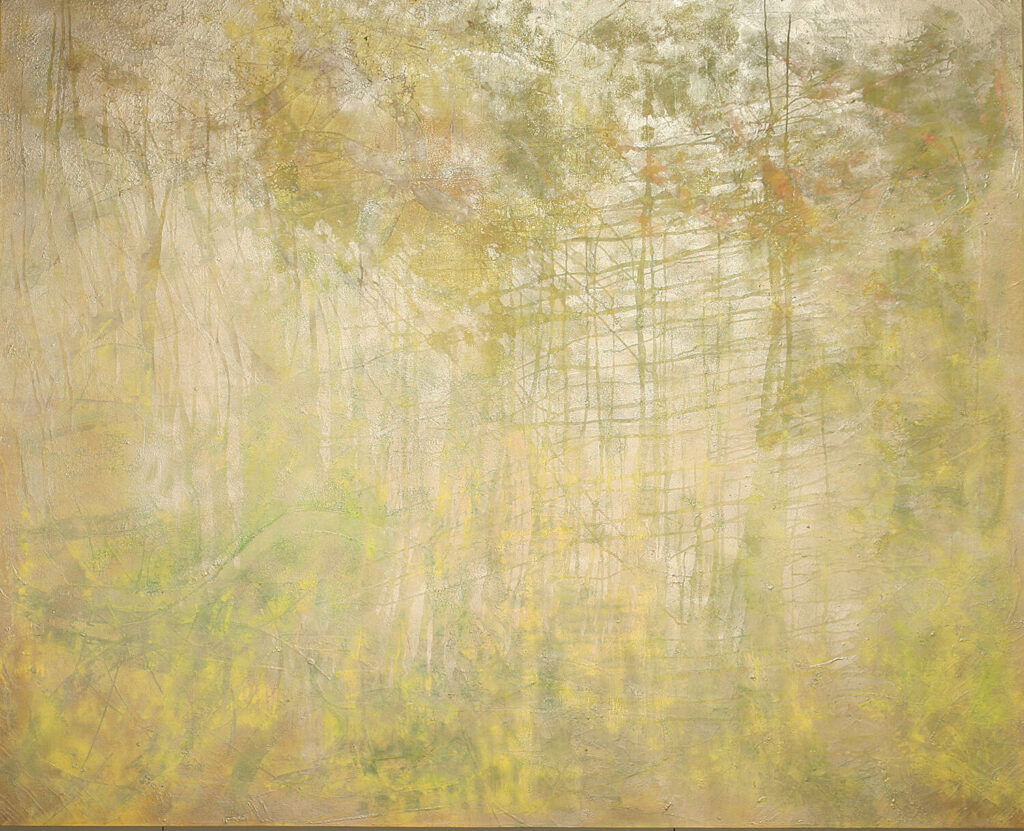
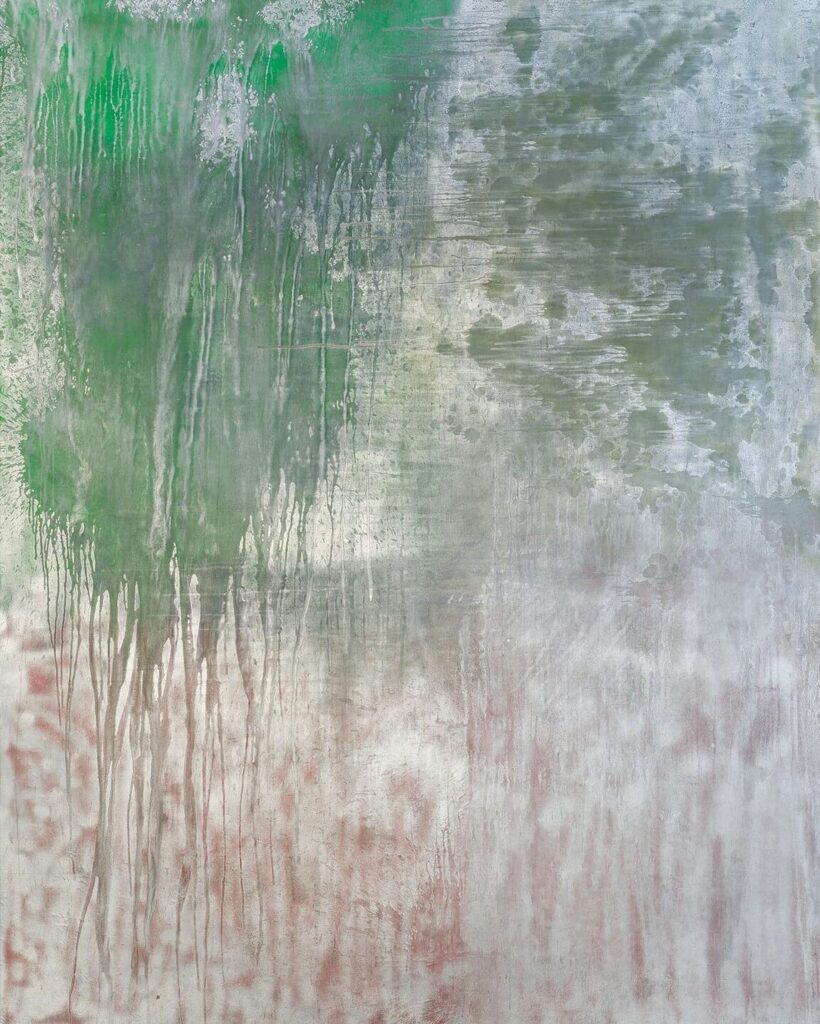
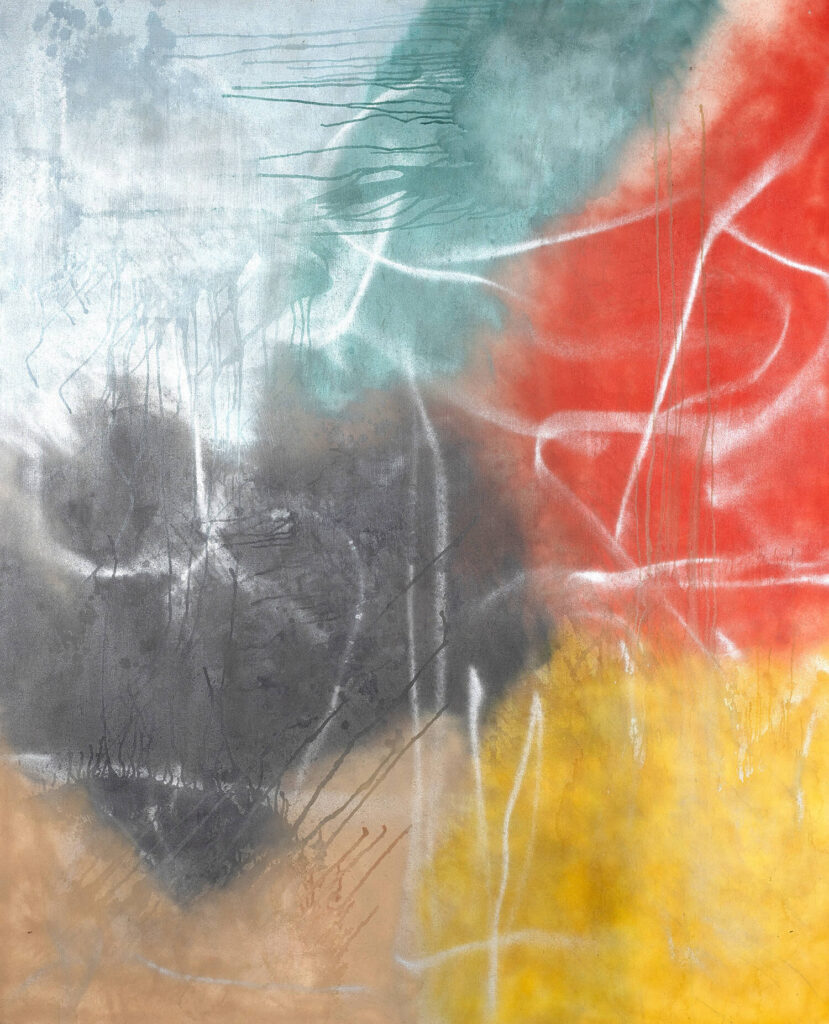
In a number of paintings, we are in a watery realm, with thinned-out pigment becoming rivulets in a broken field. Here the exhibition’s title, Dissolution / Resolution comes into play most evidently. Murray uses solvents to open up stained or sprayed paint, resulting in droplets or flows in the shifting atmosphere. Large Polychrome No. 2 is a prime example of this painterly process almost creating the painting by itself. In contrast is the more vividly colored Large Polychrome No. 5, with its zones of red, yellow, aqua, white, black, and tan, animated by airborne, graffiti-like sprays.
In the gallery’s lower level is Murray’s Inner Spaces series, small-scale works on paper, elegantly mounted on silver grounds. These intimate works show the artist exploring a range of flows where pigment and solvents mix in surprisingly expressive ways. Also, on the lower level is a single sculpture, Camo Tower, representing a whole other body of Murray’s work. Found detritus from consumer culture is assembled into a cubic form, painted in a range of moody greens. In concert with this work is Murray Hochman, A Labyrinth, a sound piece by Fior Daniela, with an original score and Murray’s spoken reflections on his
work.
Murray’s work is resolutely abstract, but full of emotion, turmoil, light, and hints of transcendence. Constructive and destructive forces are both always present, playing out the performance of an existential drama. The painter allows paint to become a practice and path, a way of losing and finding oneself.
Murray Hochman Dissolution / Resolution at Gallery AP Space, New York, April 2 – May 10, 2026