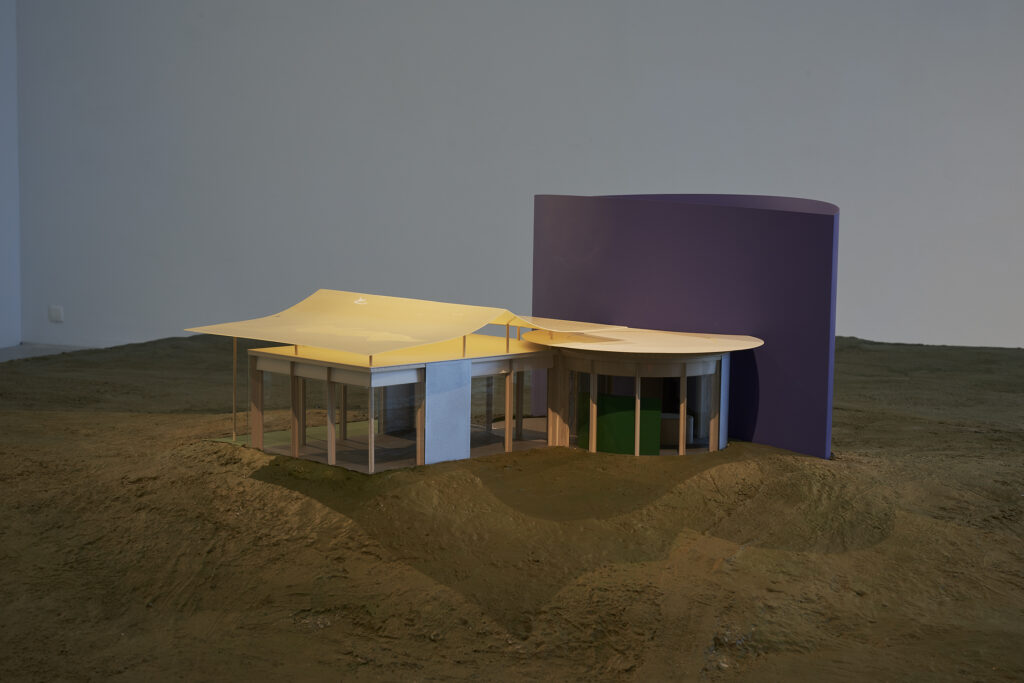
Thomas Demand’s practice of building models and photographing them has produced a child in “The Triple Folly,” a baby that has grown into an actual building in Denmark. By the artist’s own admission, it may turn out to be an only child. It’s a genesis story that gave Demand an opportunity to explore a tent-to-pavilion aspect of human habitation through postcards, prints, and publications in the wall vitrine facing “The Triple Folly” model on the second floor at Toronto’s Museum of Modern Art. The model was realized through the London firm, Caruso St John Architects with their client, Danish textile firm Kvadrat, as a “breakout” space from the company’s nearby headquarters, suitable for house meetings, seminars, or even a concert, but light on heavy, practical use – a folly, in other words.
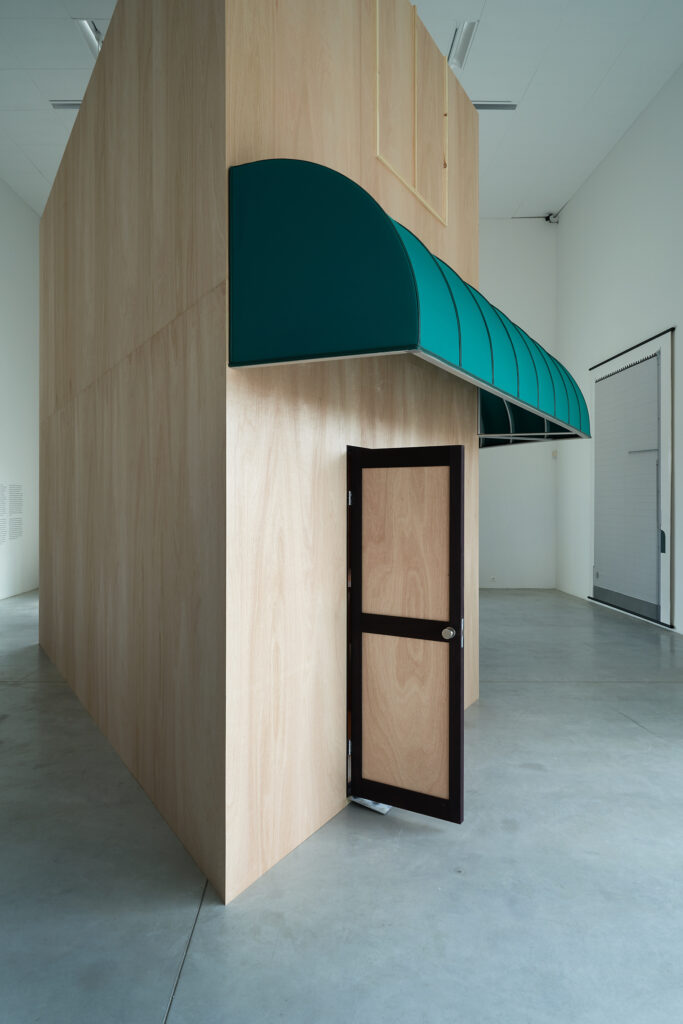
Thomas Demand, installation view, House of Card, M Museum, Leuven, 2020
This collaborative interface aspect of Demand’s work is a dominant feature of his “House of Card” exhibition at MOCA, beginning with Rirkrit Tiravanija’s 2013 “Thomas Demand’s Here” on the main floor, a life-size model of the karaoke bar Black Label in Kitakaushi, Japan, the exterior of which Demand repeats on the third floor in flimsier board and digital output in paper. The Black Label homage to the artist arose from Demand’s discovery and rendering of the bar at a 2008 residency at Kitakushu’s Centre for Contemporary Art. Tiravanija’s model imbues “life” to an otherwise empty shell, offering karaoke and social ambiance to participating museum attendees.
Thomas Demand, towhee, 2020 Framed Pigment Print, 135 x 172 cm
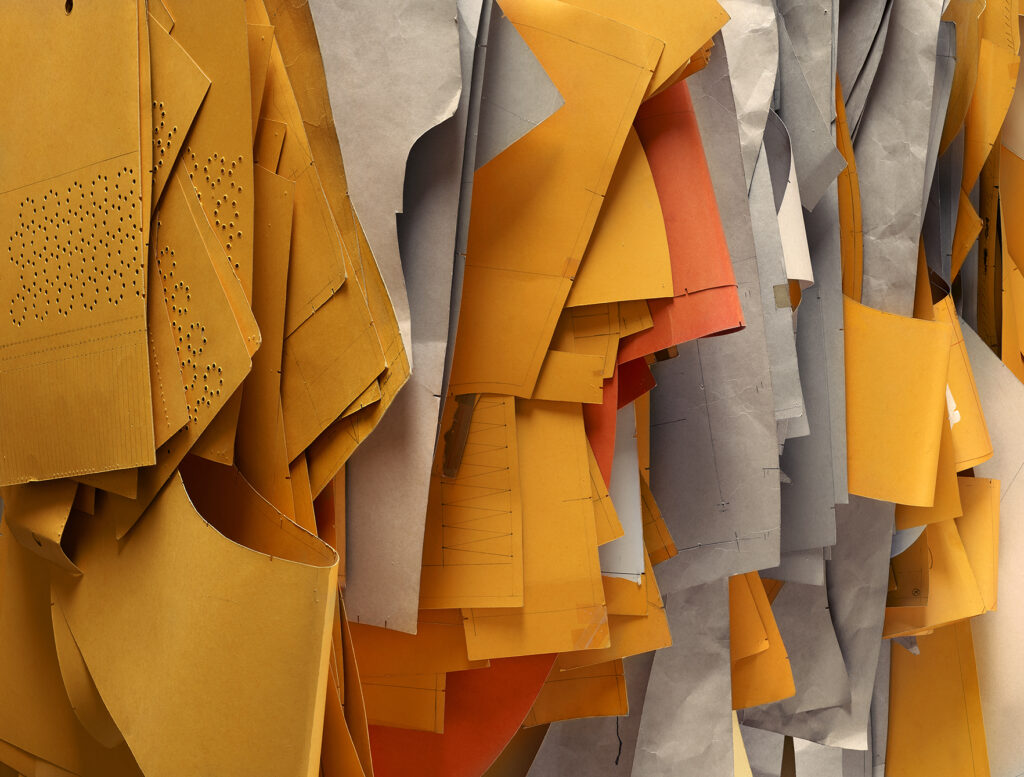
The model as a latent force that delineates our lived environment is given expression by Demand’s photographs of model details by architects SANAA (Kasuyo Seijma and Ryue Nishizawa) and John Lautner. In Demand’s photos, the pattern template files of the late fashion designer Assedine Alaïa come across as magnified strands of DNA, worn down by years of use. Alaïa’s runway creations and the flesh and blood mannequins that inhabited them may only be inferred in the photos, as are the string of celebrities that came to champion them. SANAA’s contribution to the architectural skins that clothe the art of significant galleries and museums across the globe typifies this crossing of the aesthetic from one discipline to another. Very likely, the inconspicuous site-specific ceiling installation by Martin Boyce on the second floor plays interference on the acoustics of the exhibition space. Its vane-like shapes in muffling the echoes of MOCA’s concrete architecture are a further interface of disciplines.
Thomas Demand, Refuge V, 2021, C-Print / Diasec, 160 x 200 cm
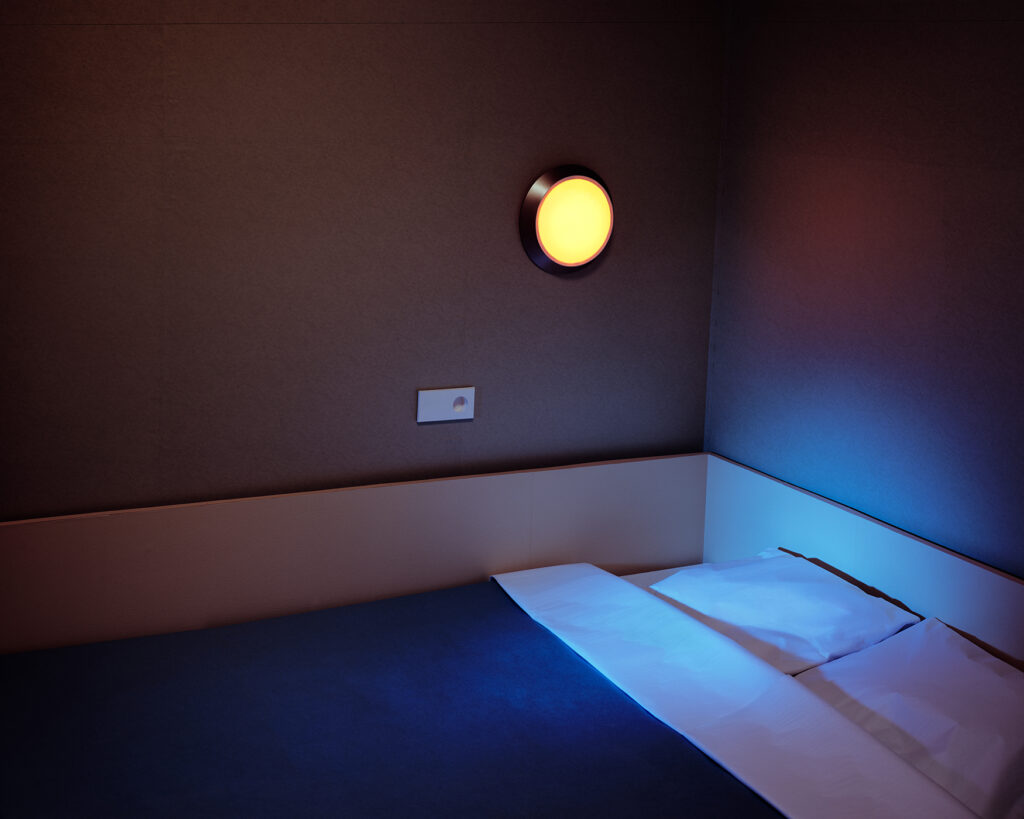
Viewers of Demand’s 2021 “Refuge” installation on the third floor at MOCA are afforded a taste of the confinement that NSA whistle-blower Edward Snowden is likely to have experienced in his Sheremetyevo hotel room in Russia as an exile from US authorities. The artist, it seems, had obtained detailed, firsthand experience of Snowden’s presumed room in Russia, upon which his paper and card version of it was based. The journalistic narratives constructed around the whistle-blower as either traitor or patriot exemplify just one front in our current war of information. The re-constructed details of Demand’s “Refuge” series provide an eerie simulation of the “cell” of its protagonist as casualty of this conflict, and his five weeks of isolation.
The subject of Demand’s minute-and-a-half 2001 film, “Yard,” is Serbian leader Slobodan Milošević and his arrest on charges of war crimes against humanity. In the video, the staccato click of paparazzi camera shutters illuminate a wall behind a chainlink fence as the prisoner is handed over to authorities at the International Criminal Court at The Hague. Since Milošević isn’t visible in the film, we are left to imagine, not only his presence, but any details of the arrest itself.
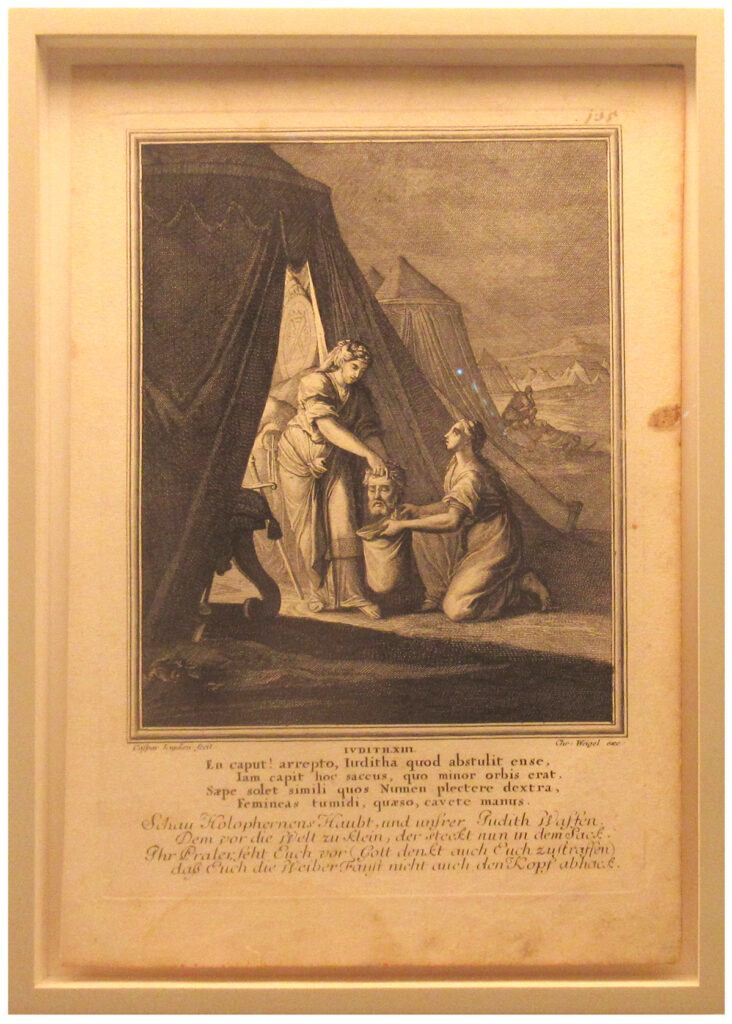
Rudolph Weigel’s Judith and Holofernes
In the wall vitrine above his postcard display, Demand hung a print of Rudolph Weigel’s “Judith and Holofernes.” The subject of numerous depictions through art history, Weigel has Judith standing in the doorway of a tent, calmly dropping the head of Holofernes into a sack after her decapitation of the Assyrian general. Implicit in the Biblical story is seduction coupled with its fatal deception. The roof of Demand’s “Triple Folly” model was inspired by a creased legal size paper, a nod to the laws and regulations governing the realization of any actual building. As they say, “All is fair in love and war.” Yet as Demand has demonstrated in numerous past works, “folly” arrives in three dimensions, and who is to account for what happens inside the things we build?
HOUSE OF CARD: Thomas Demand & Martin Boyce, Rirkit Tiravanija, Caruso St John at MOCA, Toronto, Canada September 16, 2022 – January 8, 2023
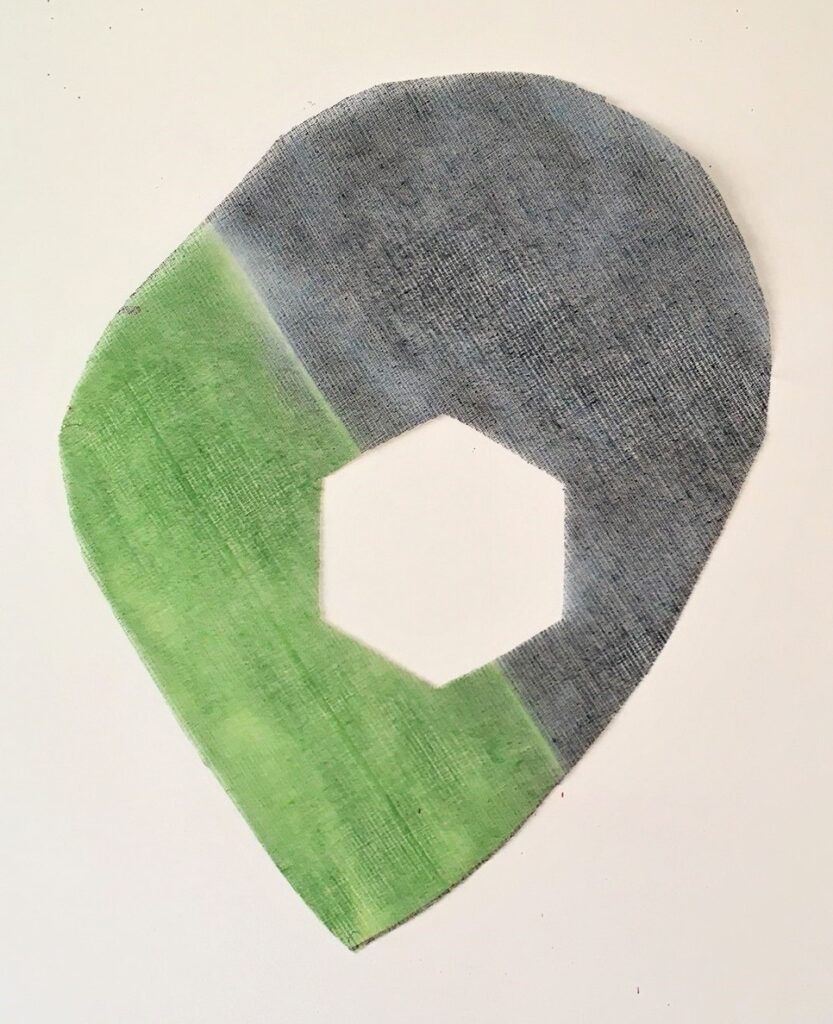
Daniel Dezeuze, Untitled, 1981, acrylic on gauze cut-out, 22-1/2” x 18-1/4”
In the intriguing exhibition, “Framing the Stretcher: Adventures and Misadventures of an Idea”, the curator Gwenaël Kerlidou has assembled pieces by a variety of European and American artists that use the painting stretcher as an independent, visible element. In thirteen works by eleven artists, this show traces how artists have deconstructed the received form of the stretched canvas, exposing and transfiguring its constituent parts. In the process they have reconceived painting itself, as both a physical presence in the world and a mysterious medium of shared awareness.
Kerlidou writes in an essay for the exhibition that he sees in this work, “the stretcher as a formal device on equal footing with the painted surface.” Not only does the stretcher become a self-sufficient entity, but the support for painting undergoes a promiscuous metamorphosis into netting, transparent film, translucent plastic, and other materials. The result is both a questioning of the viability of the painted image, and a transformation of painting that opens it up to new expressive possibilities.
The curator sees this tendency as a process in time that has among its origins the Supports/Surfaces movement in France in the 1960s whose artists took the elements of painting and created work that was without precedent, materially and conceptually. In the exhibition, the earliest work by two French artists represent this movement: Christian Bonnefoi’s hazy gestures in black graphite and gray acrylic floating on stretched gauze, from 1981, and Daniel Dezeuze’s irregular teardrop of gauze, whose zones of charcoal and green zones are pierced by a hexagonal opening, from 1979.
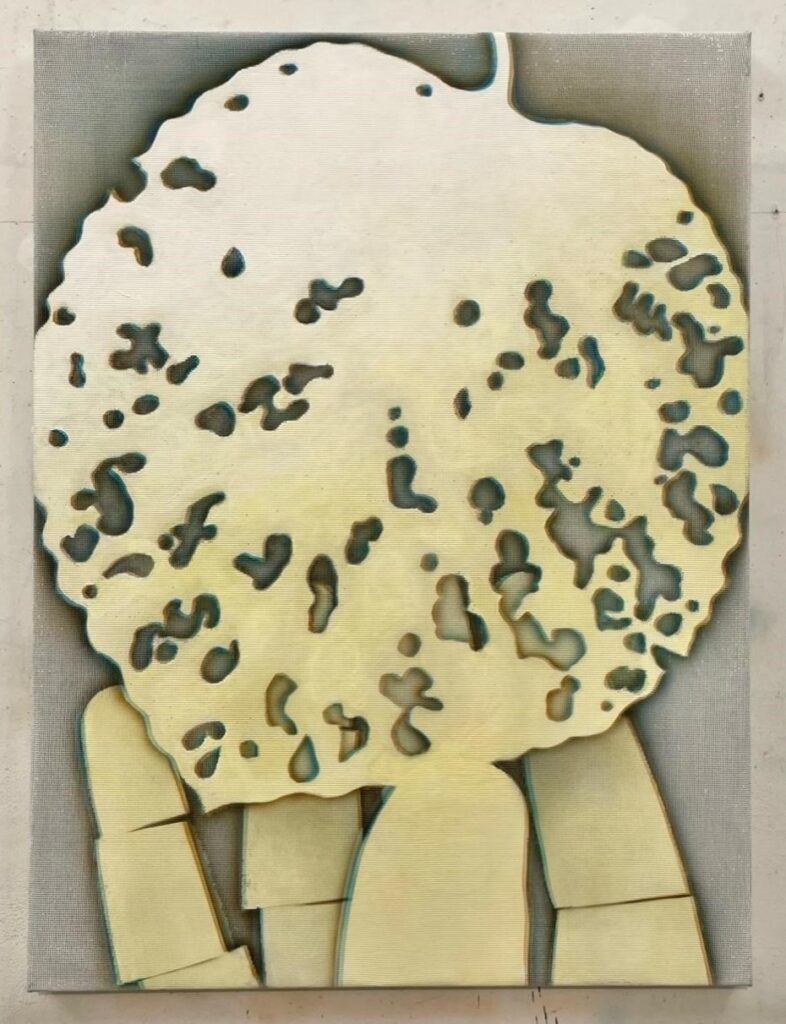
Alexi Worth, Yellow Leaf, 2022, mixed media on mesh, 36″ x 27″. Courtesy of DC Moore Gallery, NY
In the exhibition’s opening sequence, these works find kindred spirits in works by Pierre Louaver (1954-2019), architectonic painted cut-outs suspended on polyester and plexiglass, and Alexi Worth’s painting of fingers reaching for a yellow, mottled leaf, rendered in pigment on layers of mesh.
In the gallery’s larger space, the full range of novel stretcher/support possibilities become apparent. And we see how contemporary artists combine a deconstructive energy with minimalist, optical, and imagistic impulses.
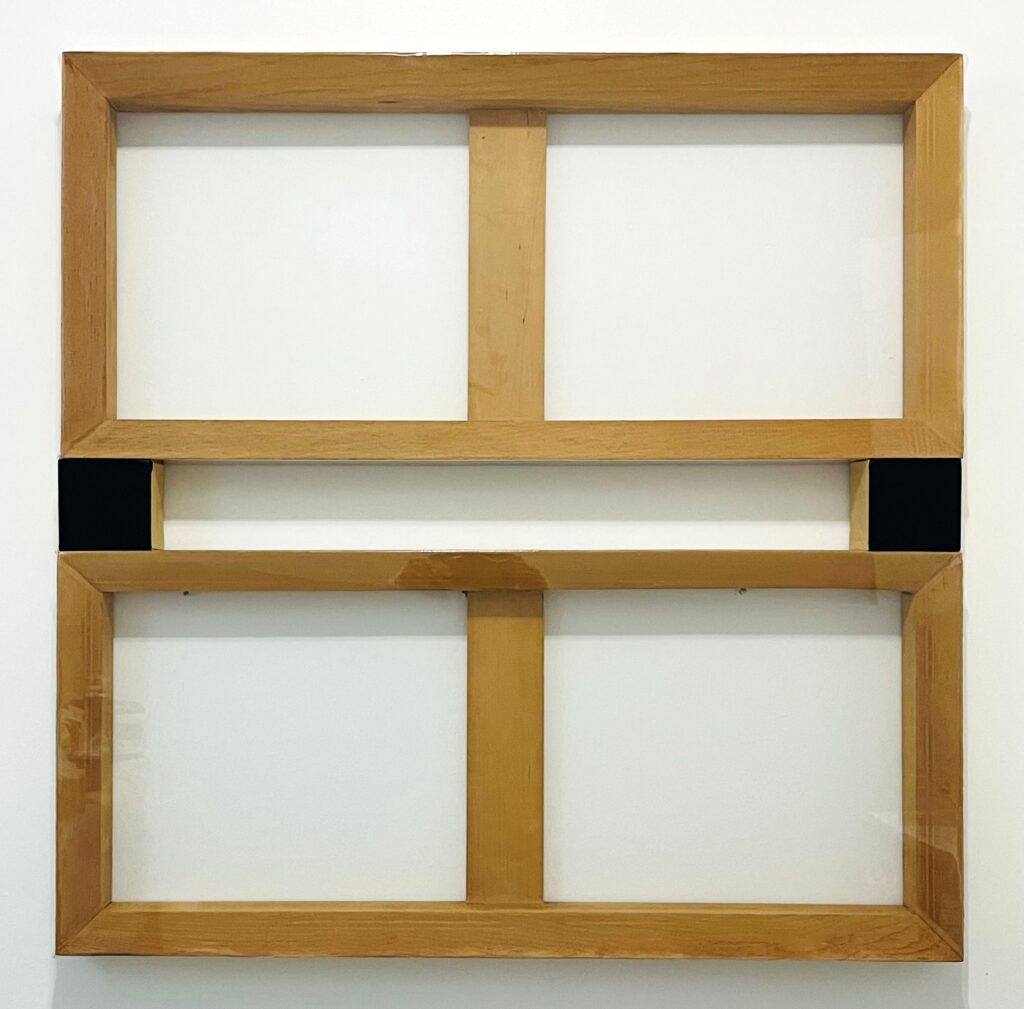
Max Estenger, Black See-Through Painting, 1990, clear vinyl on wood, acrylic on canvas, 40″ x 40″
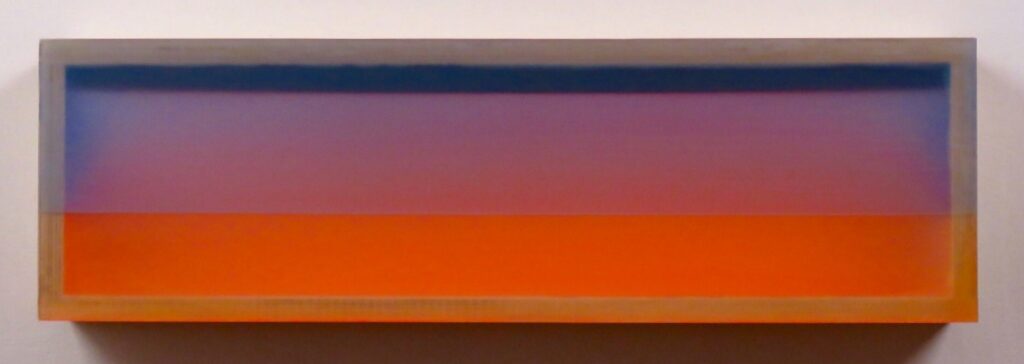
On the minimal end of the exhibition’s spectrum is Max Estenger’s painting with its sculptural evocation of stretcher bars in wood. Replete with clear vinyl stretched over it, and insets of small canvases painted black, it recalls the deadpan meta-objects of Richard Artschwager. Heather Hutchison’s two box-like paintings both have open faces of translucent color made with layered plexiglass, pigment, and beeswax. The works’ structure is like a theater proscenium, enveloped by a scrim that is lit to evoke the effulgent light of the natural world.
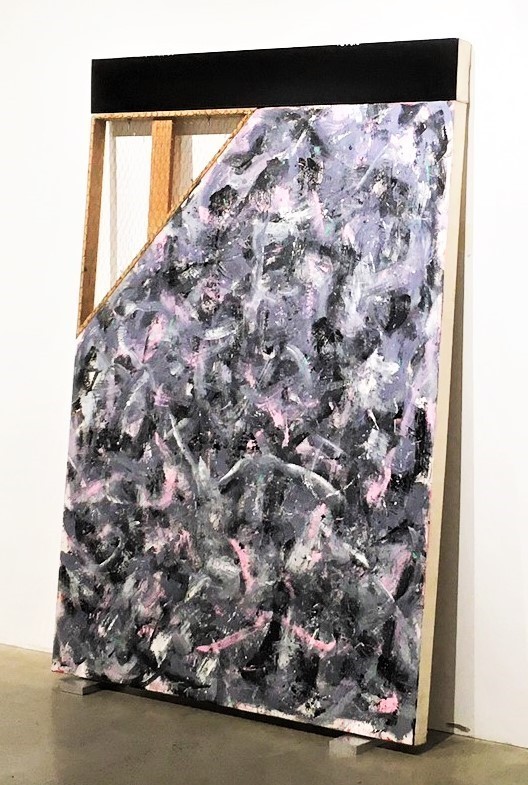
Heather Hutchison, Camp Fire, 2019, Plexiglas, birch, beeswax, pigment, tape, 8-3/8″ x 27-7/8″ x 3-3/4″Mark Dagley, Untitled, 1991, oil, acrylic, polymer resin on canvas, steel, wood construction, 80″ x 60” x 2-1/2”
The emotionally fraught notion of exposing the anatomy of a painting, with its skin stripped from the skeleton of the stretcher is embodied in two works. Mark Dagley’s turbulent atmosphere of painterly gestures in pink, black, and gray are on a canvas support that abruptly ends in one corner, revealing the bare reality of the stretcher bar, chicken wire, and the wall behind it. Fabian Marcaccio similarly has an exposed corner of a 3D printed stretcher that has yet to be overtaken by a multi-colored profusion of organic growth that reads as nature’s revenge on exhausted culture.
In the work of Laurence Grave, a canvas turned to the wall and then painted in low saturation colors on the reverse side suggests both refusal and renunciation, and a declaration of artistic and personal independence. Similarly charged with contained yet erupting feeling is Chris Watts’s painting with raw clouds of black and blue-purple on transparent, resin coated mesh.
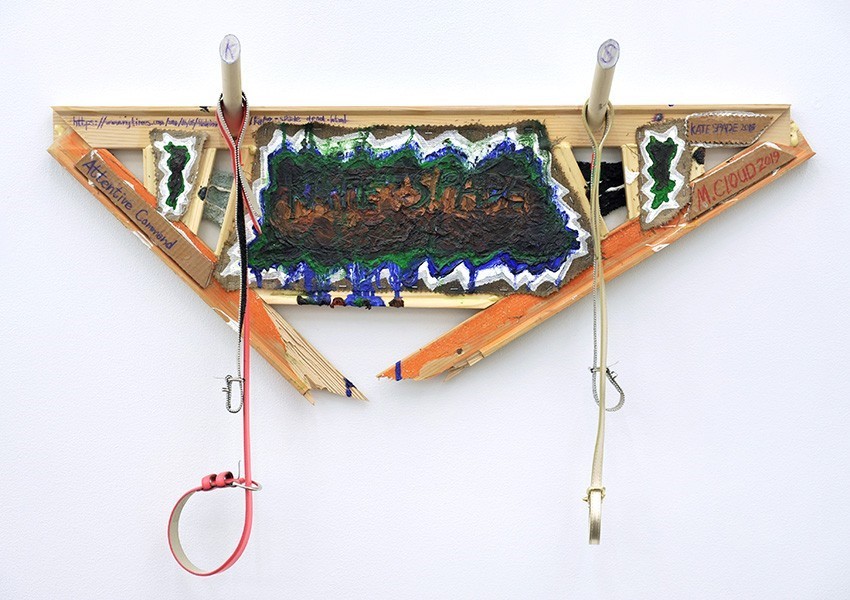
Mike Cloud, Spade, 2018-19, oil on canvas with mixed media, 42” x 16”. Courtesy of Thomas Erben Gallery, NY
Mike Cloud’s triangle of stretcher bars – partially broken apart – hold within them three agitated passages of painting in impasto. The whole work has a sense of emotional extremity, with two dog leashes that hang from the bars, upon which is inscribed a link to a website that recounts the suicide in 2018 of the fashion designer Kate Spade.
The exhibition’s relatively modest scope suggests much larger possibilities for exploring the art of the past decades through its historical lens. In his essay, Kerlidou points to European artists to consider in this light, including Lucio Fontana, Carla Acardi, and Imi Knoebel, and others who were discovering, as he writes, “a sort of ‘zero-degree’ approach to painting”. American artists who relate to this radical reexamination of the physical means and psychic ends of painting might include artists as varied as Robert Rauschenberg, Alan Shields, Steven Parrino, Meg Lipke, and many others.
Framing the Stretcher: Adventures and Misadventures of an Idea: October 12-30, 2022 at Mizuma & Kips Gallery, 324 Grand Street, New York, NY
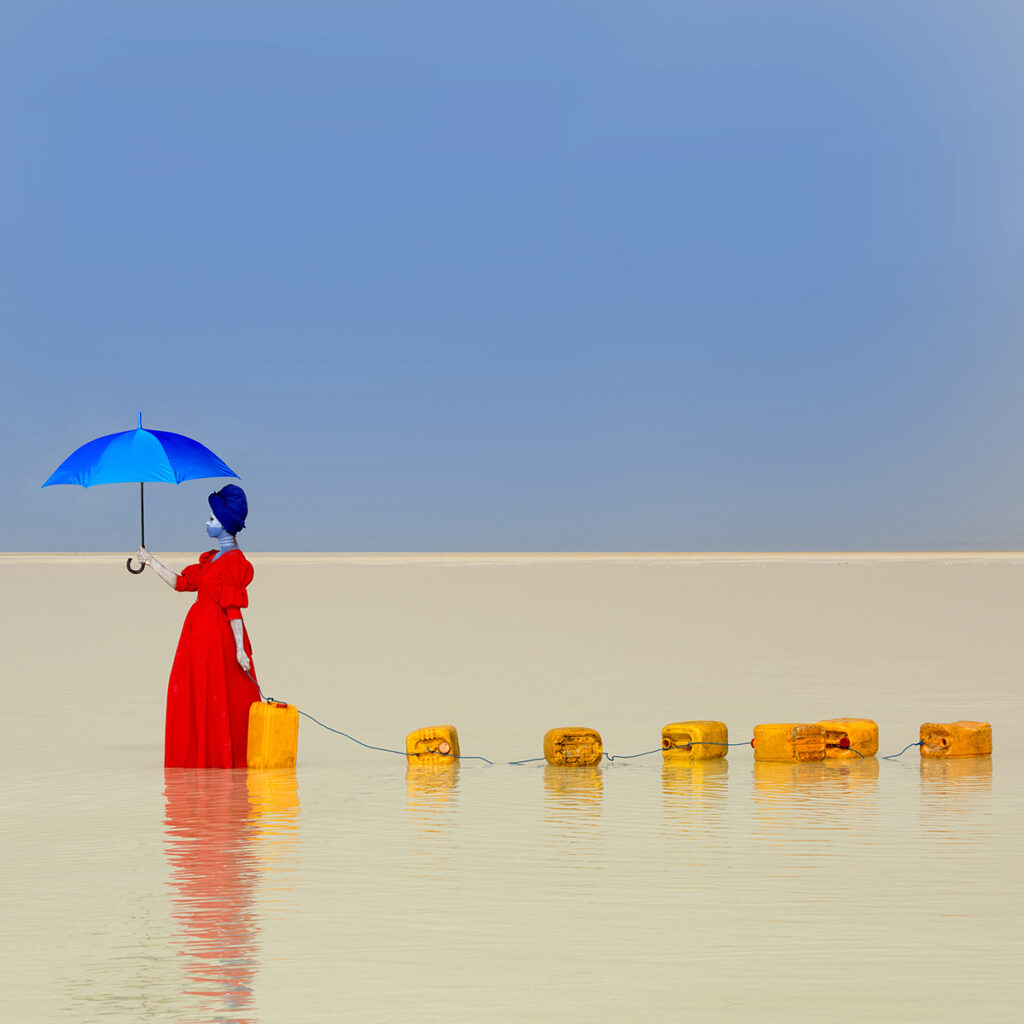
The Shackles of Limitations, 2018, Digital photograph
Water is life. For those of us who have clean water in abundance, it is hard to imagine what life would mean without it. The lack of clean water overshadows the entire life of women living in countries without it, as it is their responsibility to provide water for the household.
Ethiopian born Aïda Muluneh chose water as the theme for her exhibition at the Textile Museum of Canada, capturing many aspects about the lack of it and how it determines the lives of women and girls, both ecologically and socially, even limiting their access to education and, as an outcome, their chance for a better future.
All the images in the exhibition are focused on the search for water. We are immediately mesmerized by the strong colors and dramatic atmosphere of The Shackles of Limitations. It is the largest image in the exhibition, mounted directly on the wall. It was photographed on the salt lakes of Dallol, so the water the woman walks in is useless. It is a terrible fact that Ethiopia, a country with a great underground water reserve, doesn’t have access to it because of the lack of irrigation – such a sad paradox.
This photograph has so many layers. It is beautiful but dramatic, colorful, realistic and surrealistic at the same time. The beauty is almost idyllic. The woman walking in ankle deep water holding a striped umbrella could be seen at any beach. The sky is cloudless. It must be terribly hot there. The water is so dirty that it doesn’t even reflect the sky. The lines of jerrycans she pulls after herself are not part of a child’s toy but part of her job, as she is supposed to fill them with clean water. All of the cans are empty as she looks and moves ahead. The idyll suddenly turns into a drama.
The colors are outstanding. Muluneh said that she found photography in the darkroom of her high school in Calgary. Eventually she added the primary colours: red, blue and yellow to black and white. The woman’s red dress, the blue sky and the yellow cans create a contrasted composition. The parallel horizontal blocks of the sky, the water and the cans are broken by the standing figure, emphasising her loneliness and the difficulty of her task.
Muluneh describes photojournalism as a specific language. There are realistic elements in this image: the water, the sky, the jerrycans—even the woman. However, through the process of her image-making all her photographs become surrealistic, opening an imaginary gate to another, more spiritual world.
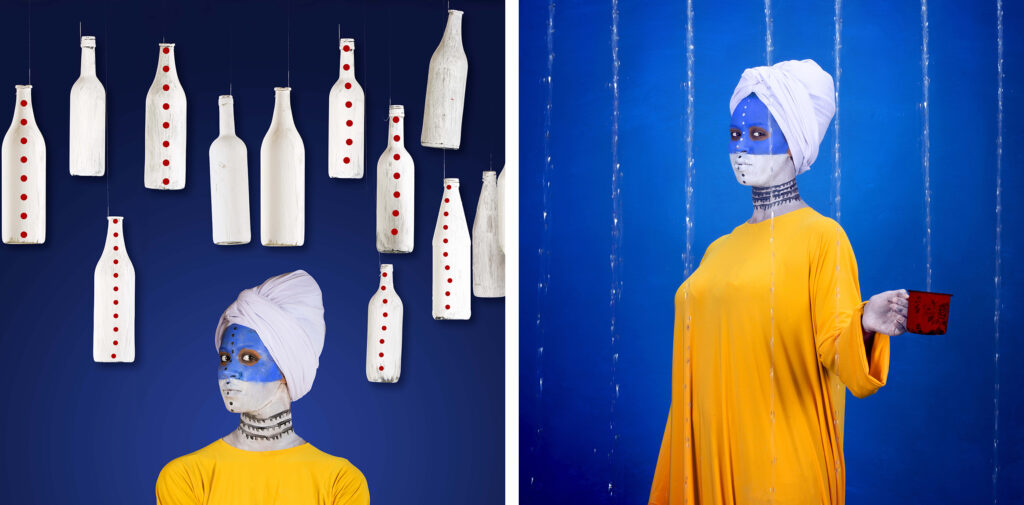
In the cities in Africa, access to clean water is the norm, as Mirage of Privilege shows. White bottles filled with water occupy the background around a woman’s head. The reds dots on the bottles symbolize blood, pointing at the close relationship between water and blood, as we can’t live without both. In the rural areas people are less fortunate. Unfilled Promises depicts the same woman holding a tin cup in the rain. I remember having a very similar, painted and rusty cup in my hand, running in the rain as a child. It would overflow in a few minutes as we had plenty of rain. It may be that in Africa, after long periods of drought people will be full of hope when rain finally arrives. But will this weak rain ever fill that cup?
Mirage of Privilege (left) and Unfilled Promises (right), both 2018, Digital photograph
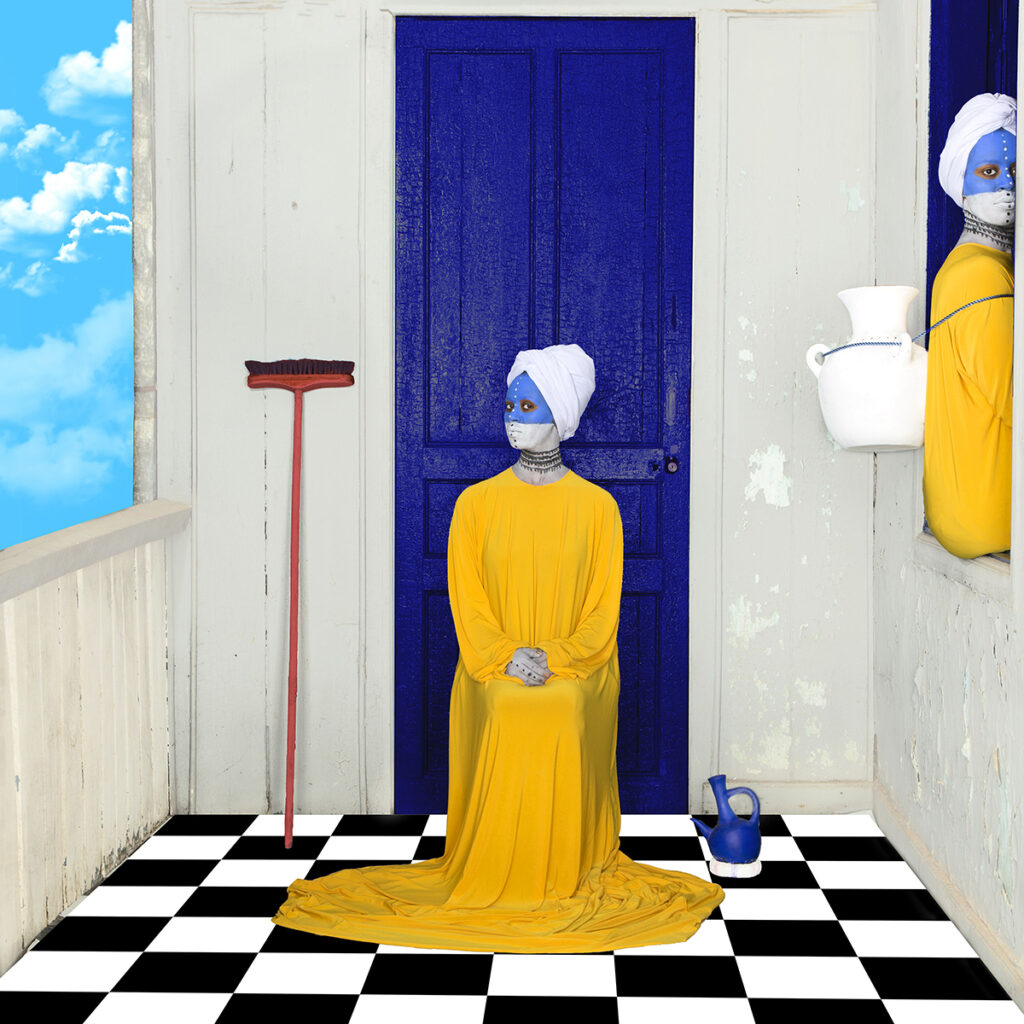
Inside a house, in front of a blue door a woman sits. The composition reminds me of paintings of the virgin Mary in churches. The woman sits in a Madonna-like pose but there is no child. Her lap is empty. And instead of iconic Christian symbols, cleaning tools surround her, in this piece titled, A woman’s work. The jebena, the Ethiopian coffee pot on the ground represents the woman’s traditional role. The broom shows her responsibility to keep the house clean. In the window on the right sits another version of her, turning our attention to the outside, that also has to be taken care of by women. She looks longingly through a window that opens to the sky on the left side with a promise of a better future. We can only hope that it won’t be another unfulfilled promise.
A woman’s work, 2018, Digital photograph
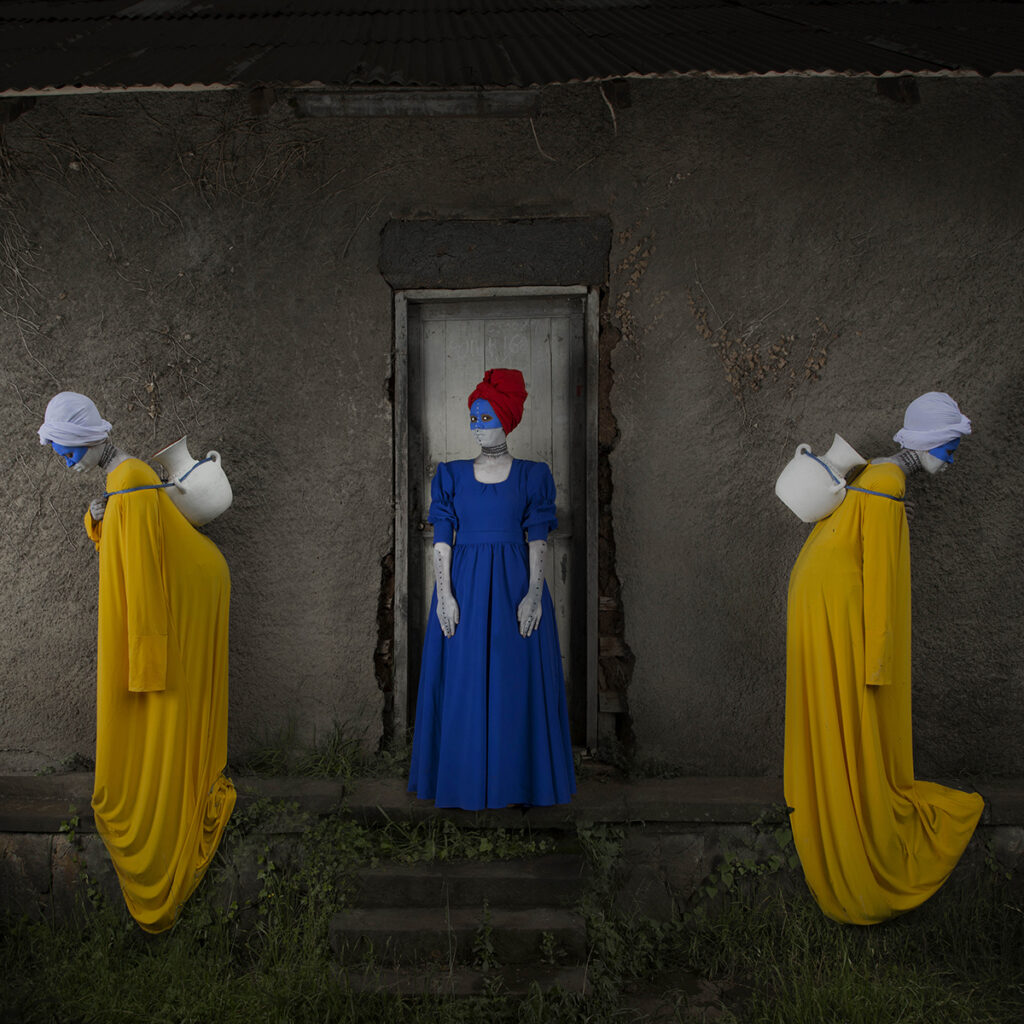
The woman from the window with the clay water pot (an insera) tied to her back reappears in Beside the door. A better dressed woman with some authority stands in front of the door watching the two women carrying clay water pots, their backs arched, and exhausted, they must make their way back and forth to the water source so many times – and it is not over yet. It hits us strongly that these women work very hard, and their work requires lots of strength and sacrifice; the last being strongly encouraged by religion. Muluneh, as part of a family of mixed religions that include both Christian and Muslim, stated that for her, religion is not a practice, it is a culture and a way of life. She uses imagery from both religions as her photographs are heavily influenced by both cultures. Her colours and some compositions are inspired by paintings in orthodox Christian churches, while the landscapes, customs and most of the motifs comes from her Ethiopian Muslim background.
Beside the door, 2018, Digital photograph
We are amazed by the rich and beautiful garments the women wear in the photographs. The inspiration comes from traditional regional Ethiopian dresses. They are all bright coloured: red, blue or yellow but differ slightly depending on the social status of the women who wear them. It seems that women having higher status can leave their necks and arms uncovered, while poorer, rural women are covered from neck to toe. All their heads are covered. Their bodies are painted but I see a little more in those colours than just traditional ornamentation. Many women have painted the top half of their faces in dark blue with white in the remaining area. I see two worlds combined in it, as Muluneh was born in Africa and grew up in Canada; a meeting of black and North American cultures; building a bridge between them. As the artist stated in her tour, that being an African means that there are complex layers in them, different interpretations, but at the same time at the core their roots and heritage and their culture are really deep in them and that is what she really wants to celebrate. It doesn’t mean that she focuses on the past. She considers cultures as evolving entities, having an open window into the future as well. Afro-futurism, a hope for a better future is always an important element in her work.
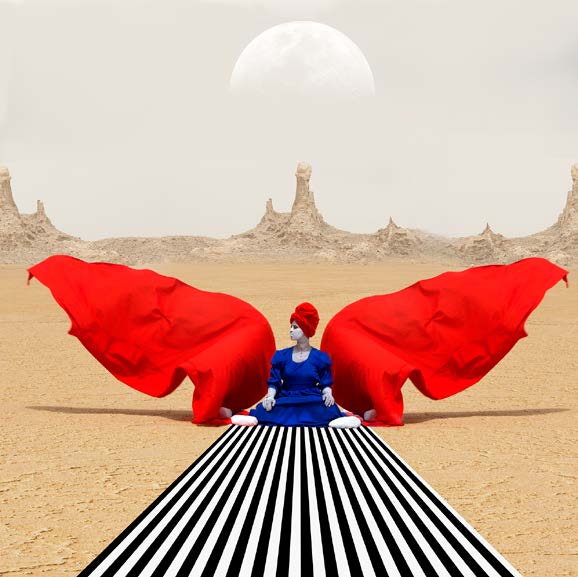
I was glued to the ground in front of the radiant, decorative qualities of another beautiful, staged photograph, Star Shine, Moon Glow. I found it challenging to understand its many layers, the universal and the actual, region related meanings. Like all the others, it is an illusionary composition. The landscape is a desert one with rocks and sand covering everything, a place not suitable for humans. Still a young girl sits in the middle of it. She is looking to the left, into an unseen far distance that I interpreted as her wish to be somewhere else. The white stripes on the road in front of her, that almost hurt my eyes, are leading in a different direction. Still, she sits. There is a huge full moon above the sand and rock in the middle of the background, a scary one, too close to the Earth. She sits there with an extremely strong presence that comes mainly from the bright primary colors with which she has been depicted. The blue of her dress is contrasted by the red wings. Those wings are huge and I connect with them easily. When I was a young teenager, we wanted to fly, high up over the mountains, up into the sky, so, along with my cousins, we started to construct wings, following Leonardo da Vinci’s drawings. We’d steal the metal wires and canvases we needed to accomplish making them, but we were discovered and stopped before attempting flight, so after a good beating our wings were taken away, both literally and symbolically. So, looking at those wings, I thought, I understand this. This is her way out. Then, after taking a second look, I recognized how light those wings were, being made of red fabric – no way they can lift anything. They seem more like decorative elements, like butterfly wings. But still, I knew I had missed important elements of this narrative, so I started over. Being a woman, I knew a full moon can represent our monthly cycle, so the red colour might bring blood into the picture. So, this is a girl at the beginning of her womanhood stuck in the middle of a desert. That was the point, confirmed when I decided to read Muluneh’s comment on the work in order to discover the whole story. I learned that girls can’t attend school in Ethiopia when they are menstruating because of the lack of water in bathrooms. The days they miss every month affects their education. So, instead of flying, this girl is a caged bird. She has little chance to walk the striped road either, as she is trapped by the limits of her natural cycle.
Star Shine, Moon Glow, 2018, Digital photograph
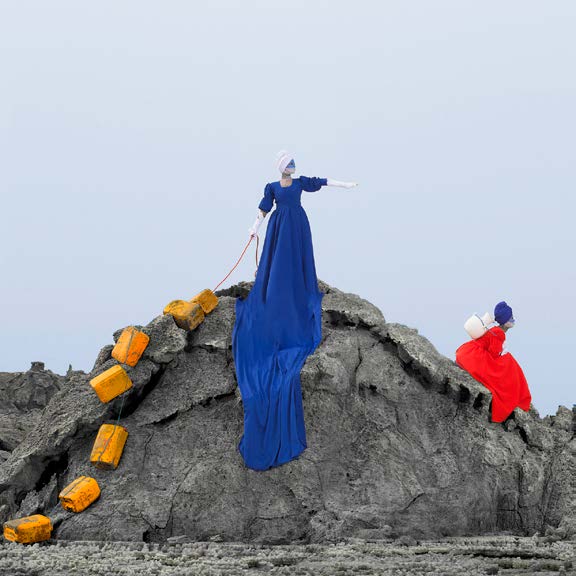
Knowing the way to tomorrow feels to me like a conclusion to the exhibition. The women are still searching for water. In some areas they need to travel a long way to find any. The landscape is a cruel one. The woman in red, carrying the insera, sits on the rock, exhausted. The other woman with the jerrycans stands on the top of the rock and indicates something in the distance — a water well or a better future or both. As Muluneh said about this work, “I assume there must be a glimpse of a thought that she has in the hopes that a better tomorrow will come for those she is caring for.”
Knowing the way to tomorrow, 2018, Digital photograph
Let’s hope that the road will carry them into new worlds of possibilities. Into a better future, to places with social justice, gender equity and above all – access to water.
Images are courtesy of the artist and the Textile Museum of Canada. The exhibition is open till the end of September, 2022 at the Textile Museum of Canada, 55 Centre Ave, Toronto
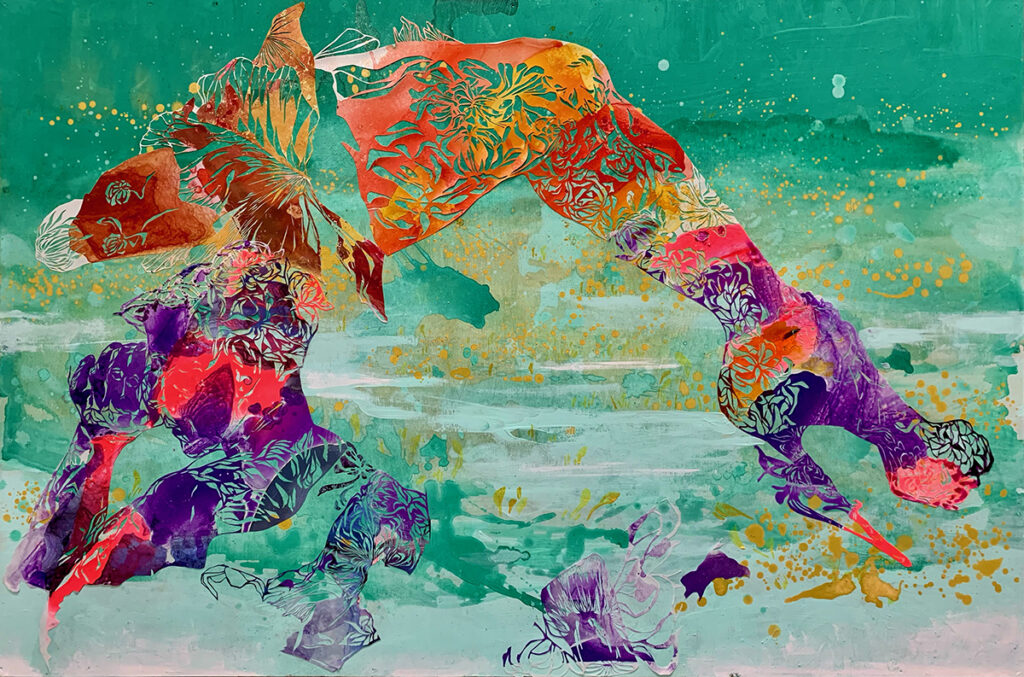
YoAhn Han, Merman’s Dream (2022), acryla gouache, watercolor, yupo paper collage and resin on panel (all images courtesy of the artist)
The exhibition title, Hyperphantasia, refers to the capability of experiencing vivid mental pictures. Opening on September 1st at Artego gallery in Queens, NY, artists YoAhn Han and D. Dominick Lombardi will present works that feature some of those visual flashes that often occur during the creative process, where subconscious elements can end up on a painting, drawing or sculpture. YoAhn Han has many sources of imagery, most notably his fluctuating health issues, homosexuality compared with his strict Catholic upbringing, and the fact that he has roots in two very different cultures: South Korea and the US. For most of D. Dominick Lombardi’s career, he has relied on the collective unconscious for guidance and inspiration, resulting in loosely wound drawings, various responses to materials and colors, and visual alternatives received when working. Together, they bring a broad spectrum of what can result with such conditioning, from the powerful and poetic paintings of Han, to the darkly comedic socio-political observations of Lombardi.
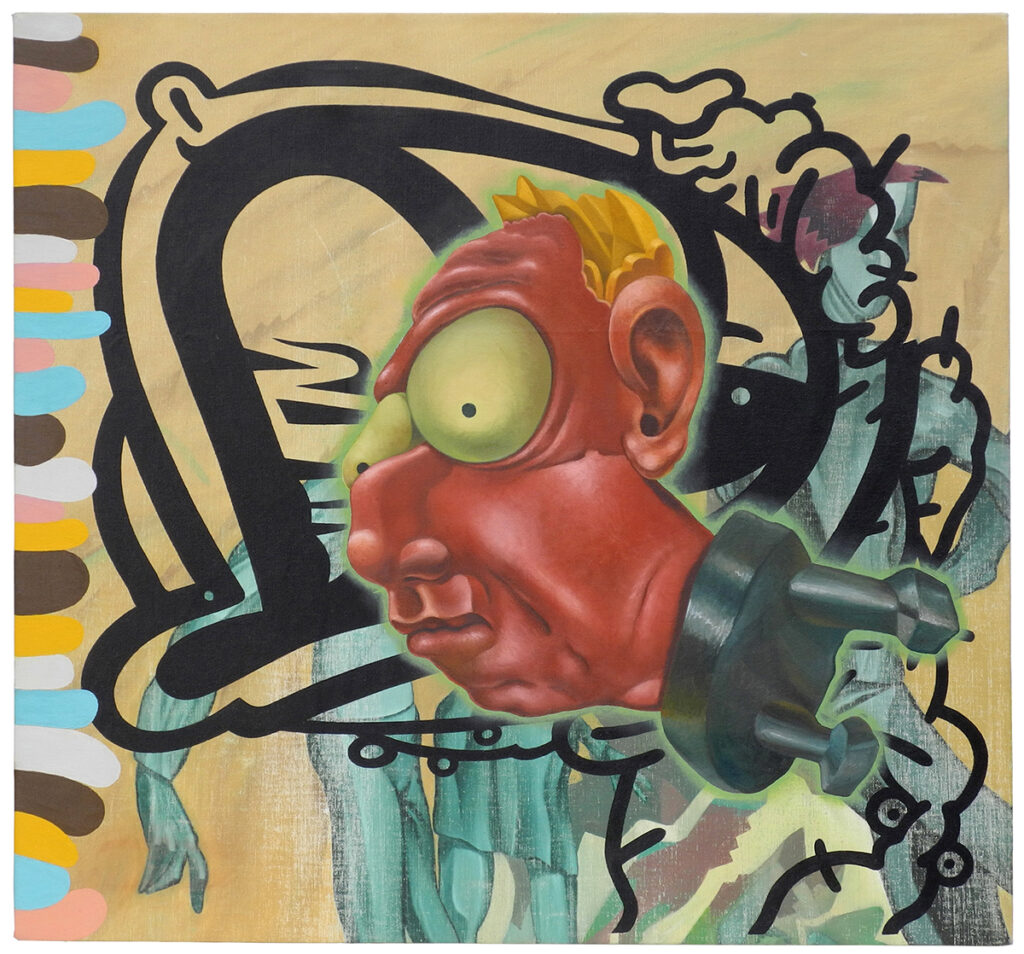
D. Dominick Lombardi, CCWSI 126 (2022), alkyd and oil on linen previously painted in 1981 and 2007, 25″ x 26″
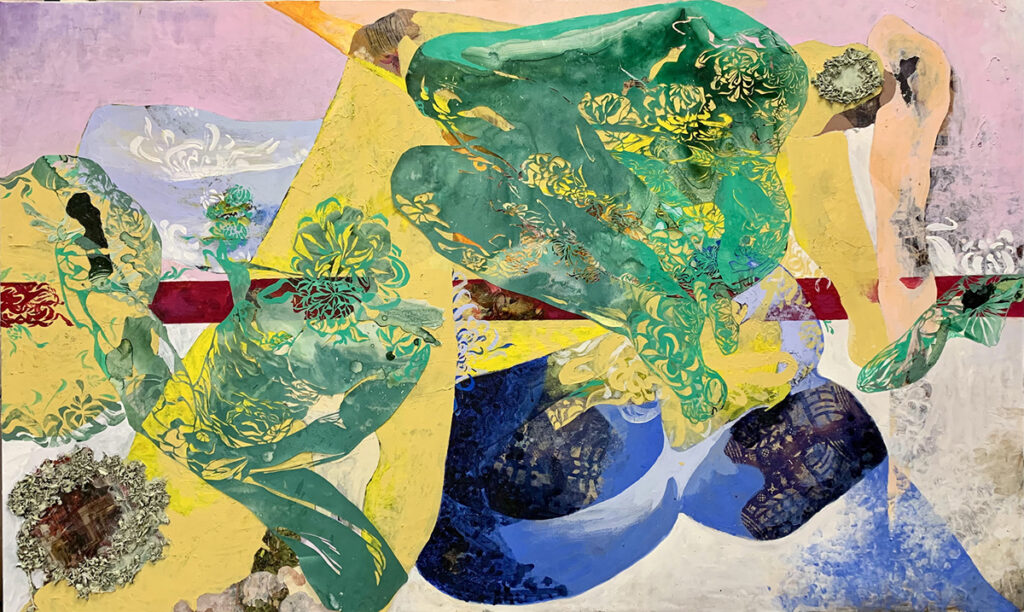
With Han and Lombardi, the swings in the content of their narratives are multi-layered and visually complex, wound around a strong pull from the past. Han refers to his paintings, which are composed of a variety of painting media, cut paper and resin as an “intersection of the imagery of my homeland Korea, together with Boston, in my own aesthetical conversion.” Han grew up in Chuncheon, South Korea, and maintains a strong bond with that culture. This results in a tendency to fold into his art, representations of the landscape and architecture, mixed with sexual references such as flowers, phallic symbols and the female praying mantis that consumes its male partner after mating – haunting elements that give his art its otherworldly, dreamy feel. In addition, his medical condition, which often causes temporary paralysis, has prompted Han’s obsession with the limitations of being. As a result of all these prompts, Han is clearly reaching for truth, enlightenment and a place where all of the aspects of his life can coalesce in a beautiful and brilliant dreamscape.
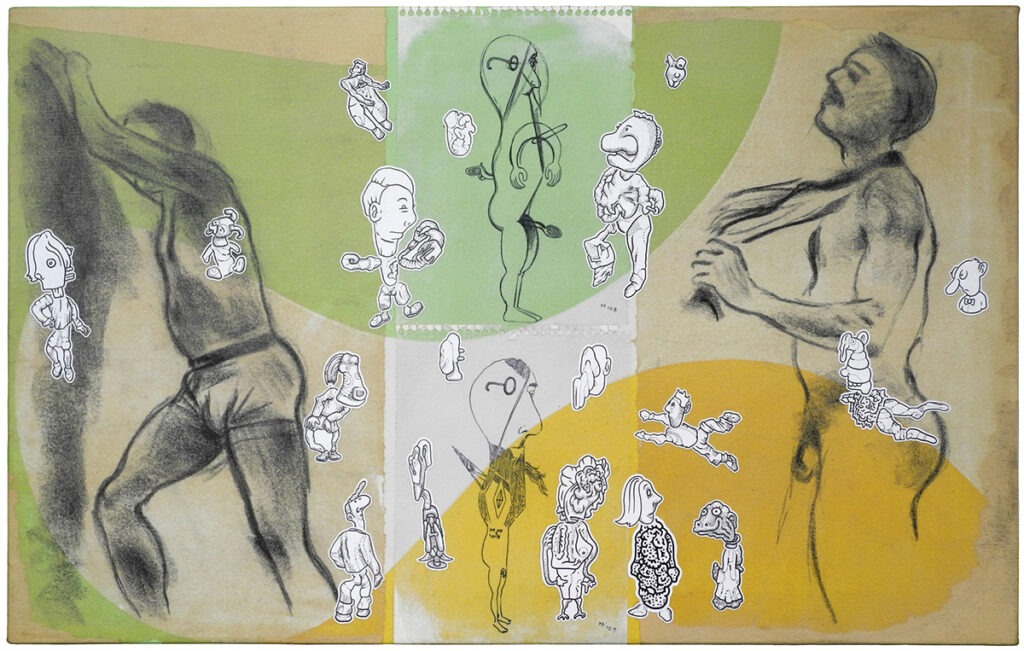
D. Dominick Lombardi, CCWS 99 (2020), acrylic, ink and charcoal on paper on canvas, 24″ x 38″
Lombardi utilizes past prompts too, but in a more physical sense, as he often repurposes old paintings and drawings to create his multi-layered narratives. His process includes past life drawings done as classroom demonstrations, subconscious thoughts that inspire the lines of his ‘stickers’, old studies for paintings and sculptures, and previously painted canvases to help him to resolve or reimagine his past. Working often with flashes of shape suggestions, colors and compositional changes, Lombardi is also driven by the fleetness of life. However, what triggers most of Lombardi’s art is reliving past thoughts and experiences through repurposing, the utilization of input from the collective unconscious, and the sway of creative editing. Repurposing also occurs in his sculptures, as all of the objects in his work are found. However, subject to gravity, the structure and result of each sculpture is a bit more preplanned.
Yoahn Han, Taboo (2021), mica, Acryla gouache, watercolor, paper pulp, yupo paper and resin on panel, 36” x 60”
The exhibition dates for Hyperphantasia are September 1 – September 30, with an artist reception on Saturday, September, 10. Artego is located at 32-88 48Th Street, Queens, NY 11103.
Shirin Neshat, Land of Dreams, 2019, video still. Copyright Shirin Neshat. Courtesy the artist, Gladstone Gallery, New York and Brussels, and Courtesy Goodman Gallery, Johannesburg, Cape Town and London
Shirin Neshat has super-powers, not unlike those of the DC Comics super hero who fell to earth in a rocket launched from the ill-fated planet Krypton. Like Jor-El, the father in the Superman story, Shirin’s father “saved” his seventeen-year-old daughter by catapulting her to America from the failing regime of the Shah of Iran before it imploded. With the Ayatollah Khomeini subsequently in power, everything changed for Neshat. Cut off from her family and roots, she was made an alien in a strange land.
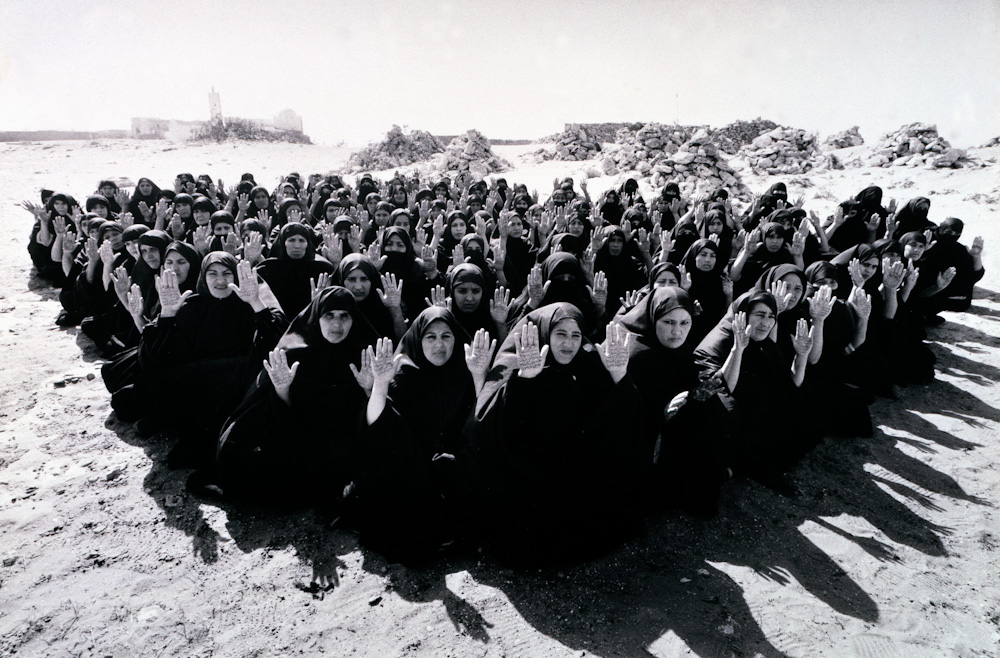
The changes that Neshat observed of Iran’s political and religious upheaval upon her return in 1990, were both “shocking and exciting.” This new ideology had transformed the country’s culture in both appearance and habit. Her 1993-97 series “Women of Allah” gave expression to the inherent militancy that had infused Iran’s Islamic fundamentalism. This work signified the breaking of the dam of emotion built up from childhood of an inner dichotomy between her non-religious upbringing amid a conservatively religious Iranian town. She recalls having had tea in her garden as a child, and bursting into tears at the sound of quranic chanting.
Shirin Neshat, Rapture, 1999, video still. Copyright Shirin Neshat. Courtesy the artist, Gladstone Gallery, New York and Brussels, and Galerie Jérôme de Noirmont, Paris
“Women of Allah,” infused Neshat’s work with a power that generated immediate success. At the same time the artist faced a flood of criticism from many sides. To the Islamic Republic it was anti-revolutionary, while the people of Iran thought it supported the revolution. Western critics felt it sensationalized violence, and took advantage of the controversy surrounding Islam. Feeling misunderstood, “Women of Allah” became a turning point for Neshat. It began her journey from an overtly political or religious art to the mythic and allegorical. While retaining its Iranian themes, “The Land of Dreams” exhibition signifies a completion of the transformation of Neshat into an American artist, reflecting her own displacement with those of other cultural minorities and disenfranchised at the country’s margins.
Shirin Neshat, Land of Dreams, 2019, video still. Copyright Shirin Neshat. Courtesy the artist, Gladstone Gallery, New York and Brussels, and Courtesy Goodman Gallery, Johannesburg, Cape Town and London
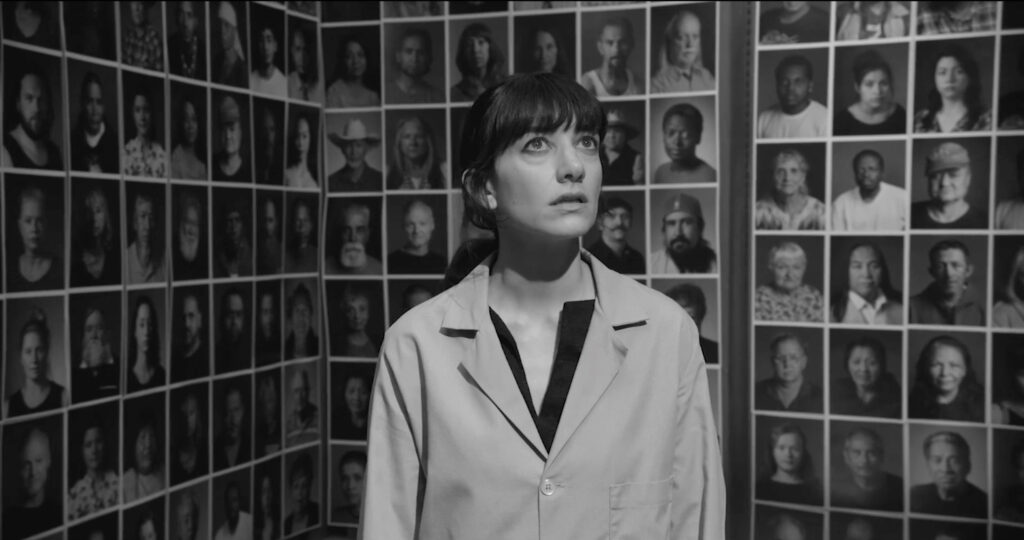
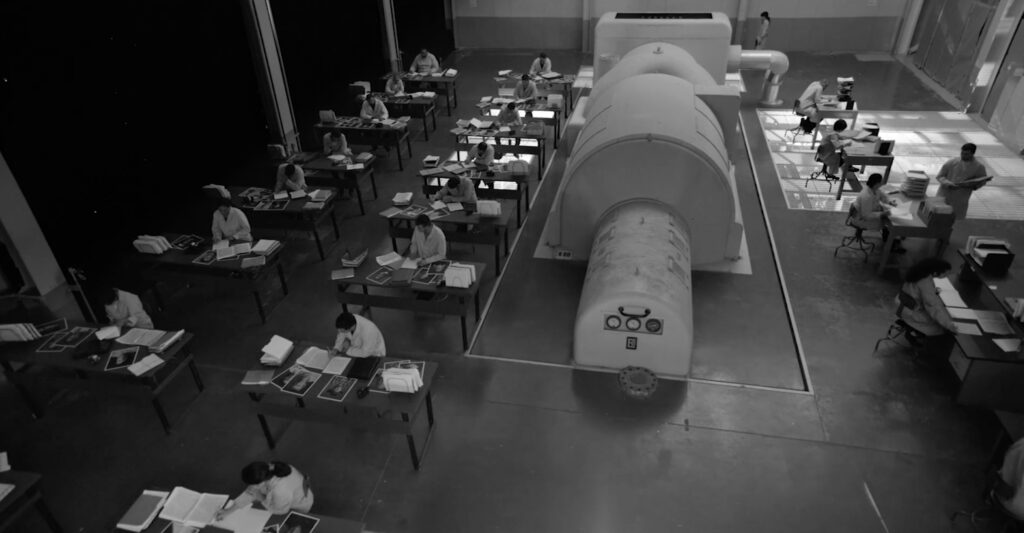
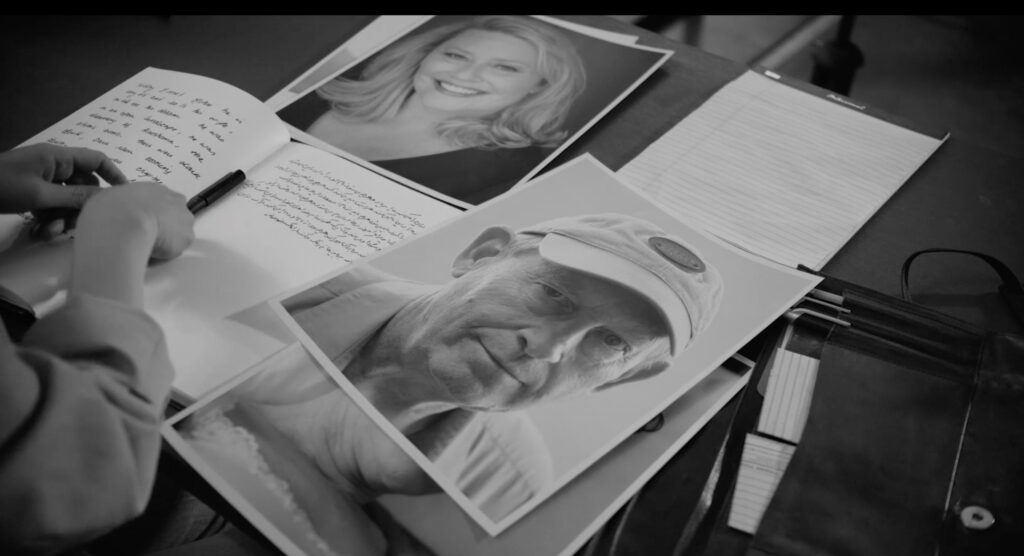
“Shiprock,” mountain in New Mexico was selected as the mythic site for “The Colony,” while the actual filming of the inhabitants took place in a power plant. The crew had been scouting for a dark, claustrophobic setting for the paper-pushing bureaucrats, but were delighted with the atomic bomb-facility ambiance of the power plant. Here, rows of lab-coated dream catchers could quietly go about their business of cataloguing and analyzing the dreams of the residents of a nearby town. It took a week to cast and photograph the actual 200 New Mexico residents from which the photo-based component of “Land of Dreams” were drawn.
Shirin Neshat, Portrait detail from Land of Dreams series, 2019, Digital c-print with ink and acrylic paint. Copyright Shirin Neshat. Courtesy the artist, Gladstone Gallery, New York and Brussels, and Courtesy Goodman Gallery, Johannesburg, Cape Town and London
Sheila Vand plays the part of a photographer who plumbs the dream world of the town’s people at the behest of the Iranian authority figure that leads The Colony. In a scene set in a darkroom we see her reflection meld with the face of her subject as it materializes in the bath of the developing tray. Vand’s character has entered the dream of another – a violation that carries with it the punishment of an inevitable loss of identity and the pronouncement: “The dream catcher will go mad.”
Shirin Neshat, Land of Dreams, 2019, video still. Copyright Shirin Neshat. Courtesy the artist, Gladstone Gallery, New York and Brussels, and Courtesy Goodman Gallery, Johannesburg, Cape Town and London
The “Land of Dreams” project was conceived as Neshat’s response to the collapse of the Iran nuclear deal that came with the transition of US administrations. Trump’s tenure had immediately ramped up hostilities and tension with Iran. The artist felt that “something had to be done.” The shadow of something falling over the world stage with which Neshat is only too familiar has crept in like a fog. Now her dichotomy of alienation is being played out in the country of her adoption, with the scale of the stakes much higher.
If the channelling of the quranic chant of a Muslim woman multiplied a thousandfold lent Neshat an expressive super-power some 30 years ago, how will this energy bottled as myth and allegory play out in America’s vast “Land of Dreams?” As the political pillars of power are being shaken globally, should the chord of polarization snap, it might be good to know where some of that kryptonite is likely to land.
TheMuseum of Contemporary Art Toronto (MOCA)Shirin Neshat exhibition runsthrough to July 31, 2022