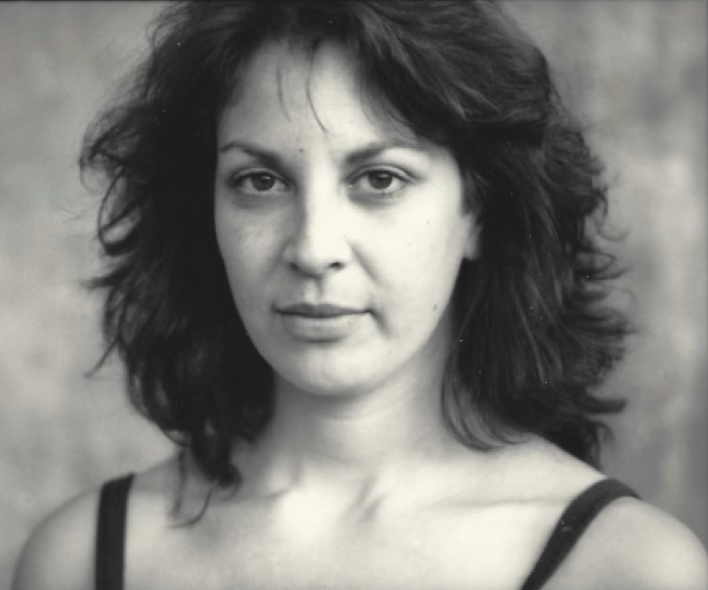
A lifetime devoted to artistry. The illustrious Sybil Goldstein (1954-2012) currently having a retrospective of a lifetime of painting and artistic endeavours. A dedicated artist that couldn’t stop working and creating. She created art everyday leaving a massive collection of paintings, drawings, and works on board, canvas, and paper. The exhibition showcases Goldstein’s previously unseen pieces to the public, celebrating her vital role in Toronto’s cultural narrative.
Sybil Goldstein
Sybil Goldstein / URBAN MYTHS, an extensive exhibition showcasing her life’s work. Curated by David Liss, it is currently on display at Koffler Arts from January 20th to March 1st, 2026. “By bringing her long-hidden pieces into public view, the exhibition not only honours Goldstein’s remarkable legacy but also reaffirms her place within the cultural history of Toronto and the wider artistic movements that shaped her generation ,” says Liss.
A number of her works were sold at an auction that took place shortly after her passing. Any pieces that did not sell — which comprised the majority of her artistic creations, amounting to over a thousand works — were kept by her family. Now, thirteen years following her death, Sybil’s family is seeking assistance within the Toronto art community in finding homes for the many pieces of art within the estate.
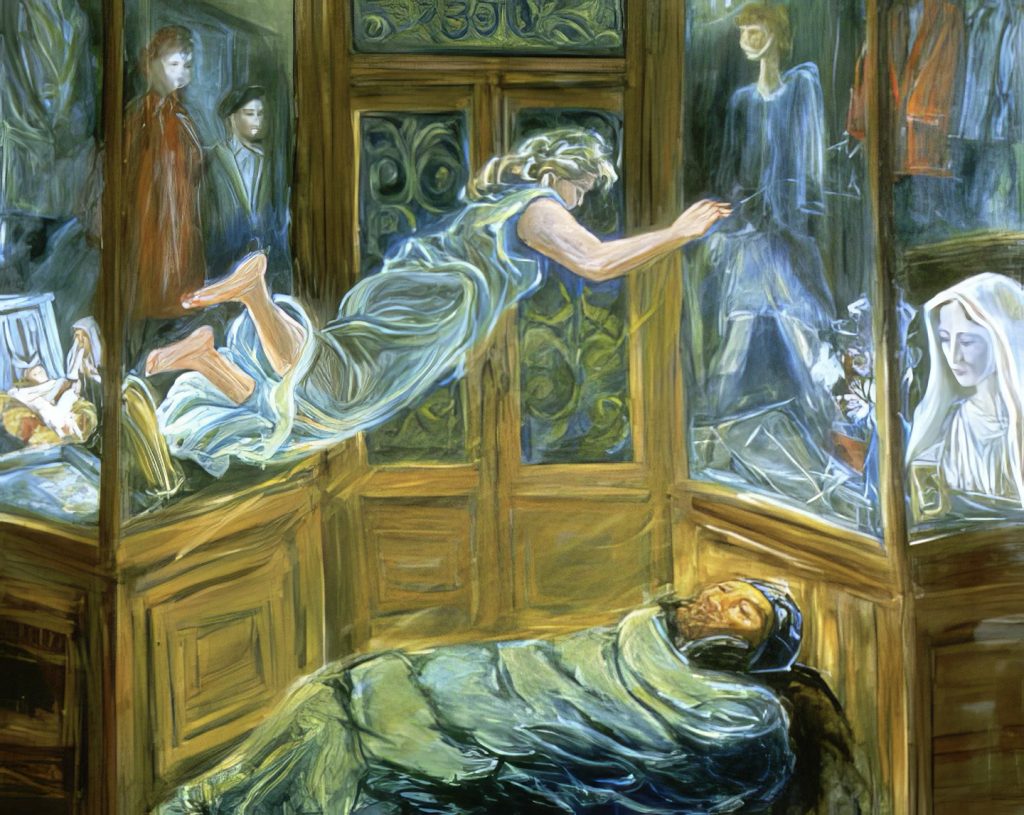
Sybil Goldstein,College Street at 2:00am, 2000, oil on canvas, 172.7 x 198.12 cm
Koffler Arts, an organization that champions community initiatives, has made the decision to present this posthumous retrospective. It is especially noteworthy that an unprecedented exhibition is currently being held, providing visitors with the opportunity to take home one of her original artworks following the exhibition’s conclusion. The family due to the difficulty in marketing art regards the monetary significance in the Canadian art market as nonexistent; however curators and scholars are visually able to identify the significant importance of the art works placement and contributions to the Canadian identity. On a personal level, the artwork carries a charm that resonates with personal feelings and interpretations, permitting individuals to choose an image that will resonate within their homes, enrich their spirits, and ideally bring joy to their lives.
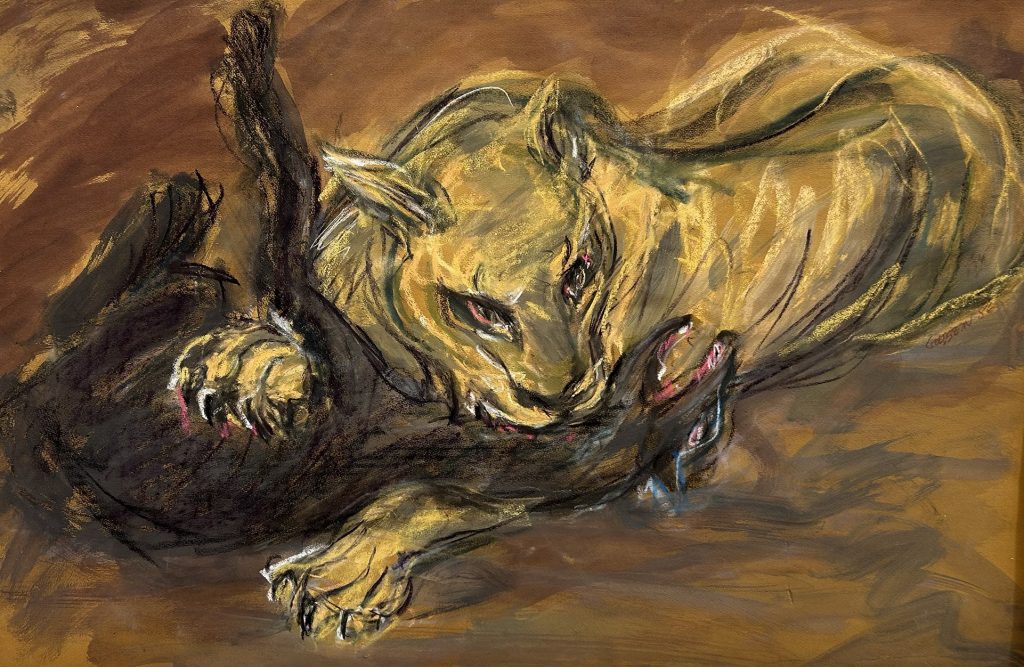
Sybil Goldstein, Untitled, Lion Killing Its Prey, pastel on paper, 83.8 x 115.6 cm
While pausing silently to appreciate the artworks showcased in a salon-style arrangement within the exhibition, one experiences an uncanny feeling that Goldstein is somehow present. In the midst of the admiration permeating the room, one can detect a pleasurable enjoyment alongside an intellectual appreciation for the contrasting elements within the pieces that embellish the walls. Furthermore, there is an element of empty calmness, as if the traces of her journey are indicative of having traversed a difficult path. It is this essence that generates a lingering admiration for a talent that clearly was well accomplished.
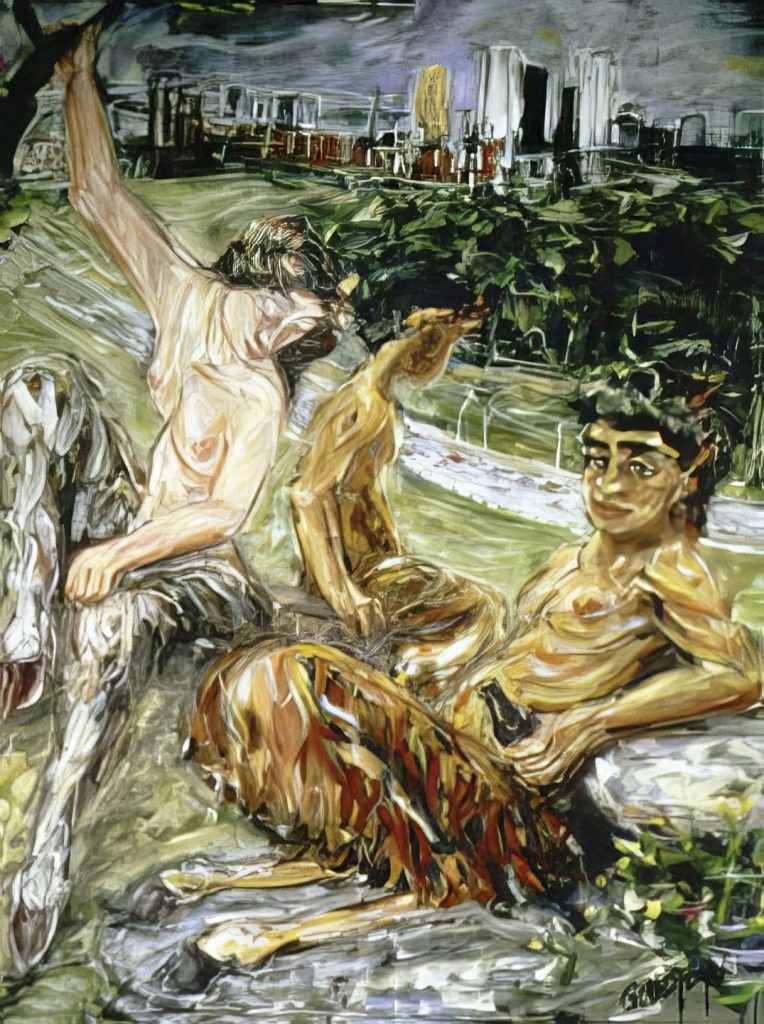
Sybil Goldstein:, Satyr Family Overlooking the Don Valley, 1984, oil on canvas, 152.4 x 121.92 cm
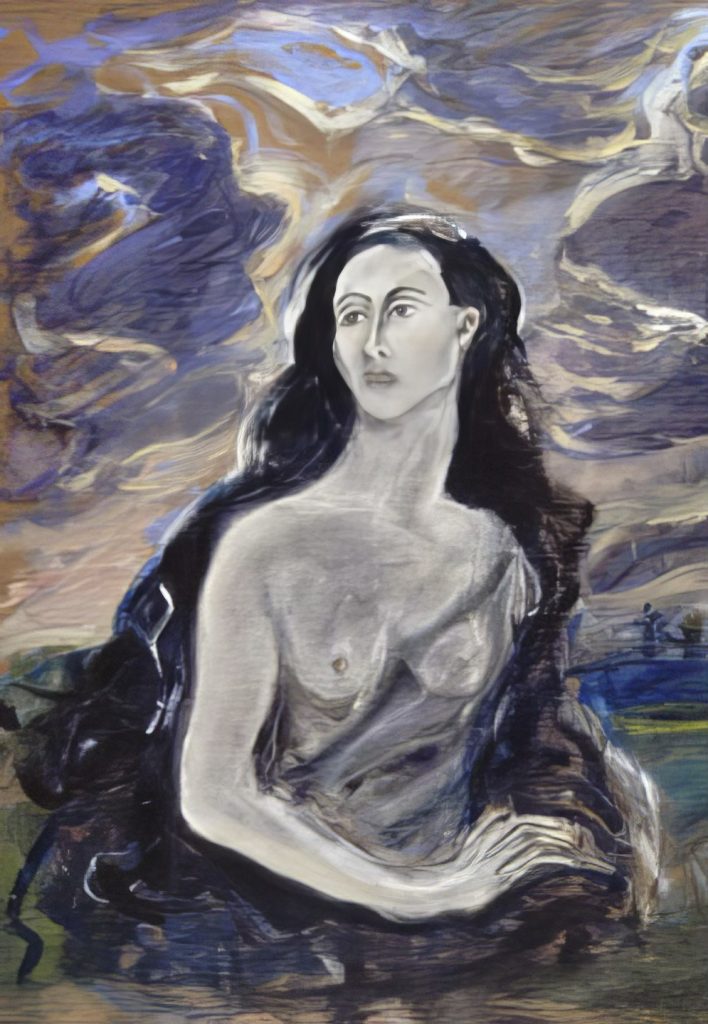
Sybil concentrated her artistic efforts on urban culture, depicting individuals at street corners engaged in their everyday activities, alongside the interiors of offices, bars, subway stations, and shopping malls, wooded areas, and neglected spaces. Numerous scenes featured mythological beings such as angels, satyrs, and spirits. Additionally, she drew inspiration from classical old masters like El Greco, Velasquez, and Rubens.
Sybil Goldstein, After El Greco, 1991, oil on canvas, 50.8 x 40.64 cm
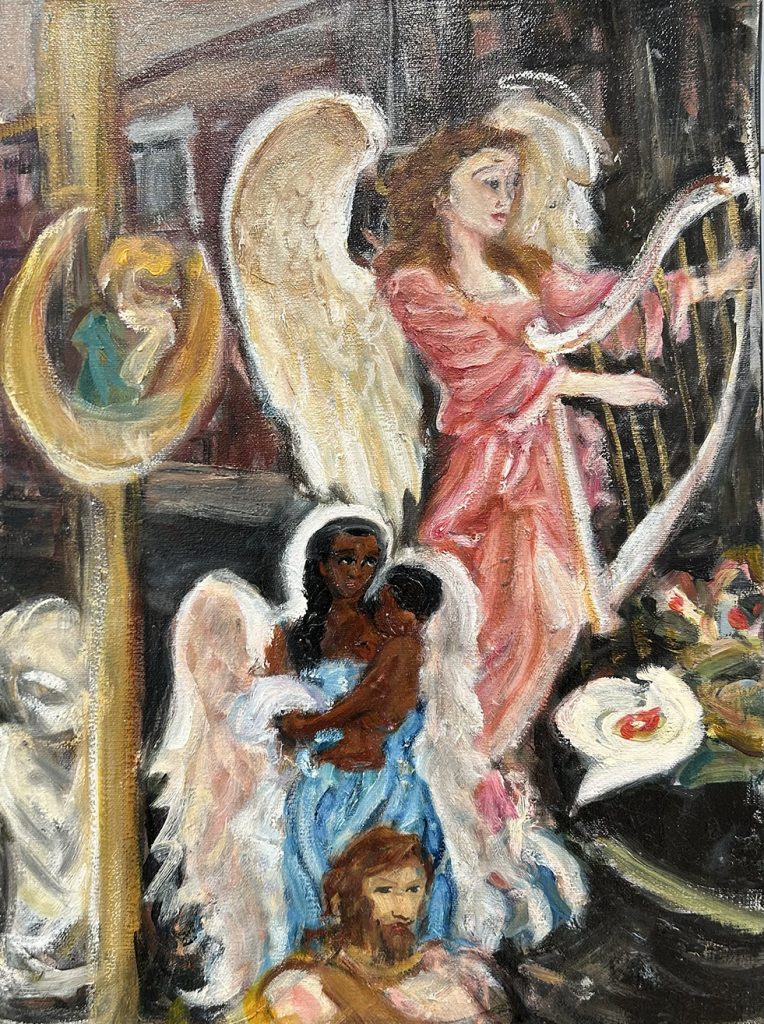
Covering surfaces of canvas, paper, or on board, her lively lines and occasionally hurried, rugged brushwork reflect an artist’s pursuit to encapsulate the fleeting movements and moments of her life, illustrated through images like Satyr Family Overlooking the Don Valley, After El Greco, Dundas Windows A&B-Birth of an Angel, Untitled-Lion Killing It’s Prey, College Street at 2:00am, Queen & Roncesvalles, Adelaide & Spadina, Spadina & Dundas, Dufferin Mall, Queen & Yonge, Joe Shuster Way, Union Station, among others, depicting various locations in downtown Toronto.
Sybil Goldstein, Dundas Windows A&B, Birth of an Angel, 1982, oil on canvas, 50.8 x 40.64 cm
In 1981 Goldstein was one of the founding members of the ChromaZone Collective, along with Andy Fabo, Oliver Girling, Rae Johnson, Brian Burnett, Tony Wilson, and others, who organized exhibitions and events that were characterized by their support of a figurative Neo-expressionist movement gaining international recognition during their early years.
It is important to note that Goldstein was the artist responsible for the stunning Sistine Chapel-inspired artwork on the ceiling of the Cameron House located on Queen Street West. Goldstein passed away unexpectedly on July 2, 2012.
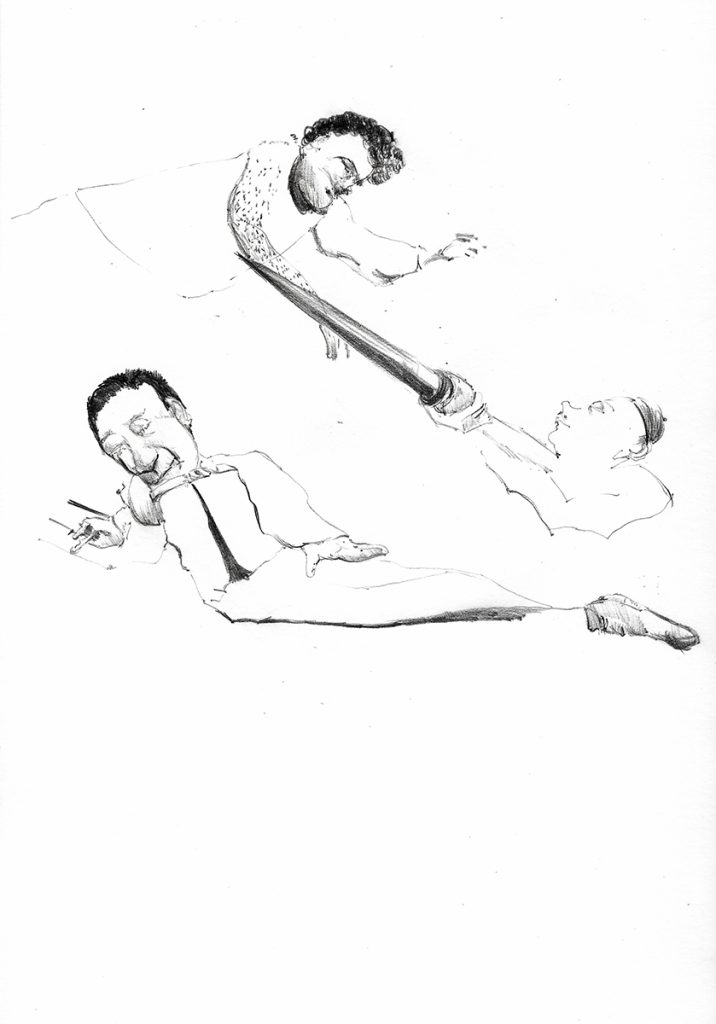
Luís Almeida’s paintings have an uneasy joyfulness to them. His narratives occupy the space between pure, unfiltered emotion and wild interpretations run amok.
Luís Almeida, Untitled (chinatown) (2025), pencil on paper, 29,7 x 21 cm, 11 ⅔ x 8 ¼ inches, all photos courtesy of the artist
Almeida creates an alternate space where the act of painting churns, spews and whips around the canvas until reality is overtaken, leaving the outside world in its wake. His subjects push through the edge of representation, forming a new bio-logic based on instinct. Yet, with all his gnarly techniques and bizarre color theory, the resulting vignettes remain almost completely without judgement – a purity of thought on canvas without the fuss of overthinking one rarely sees in Contemporary Art.
Almeida is the quintessential observer/translator, reacting solely in the studio where the loaded brush meets the waiting canvas – that physical application of paint in an electrified moment beyond his initial observations to an alternative world. There is a lot of discussion by physicists today, of as many as 11 unifying forces that make up our universe. The way Almeida breaks down and reconstructs his constantly shifting and morphing subject matter surely passes through some of this extended space physics advance.
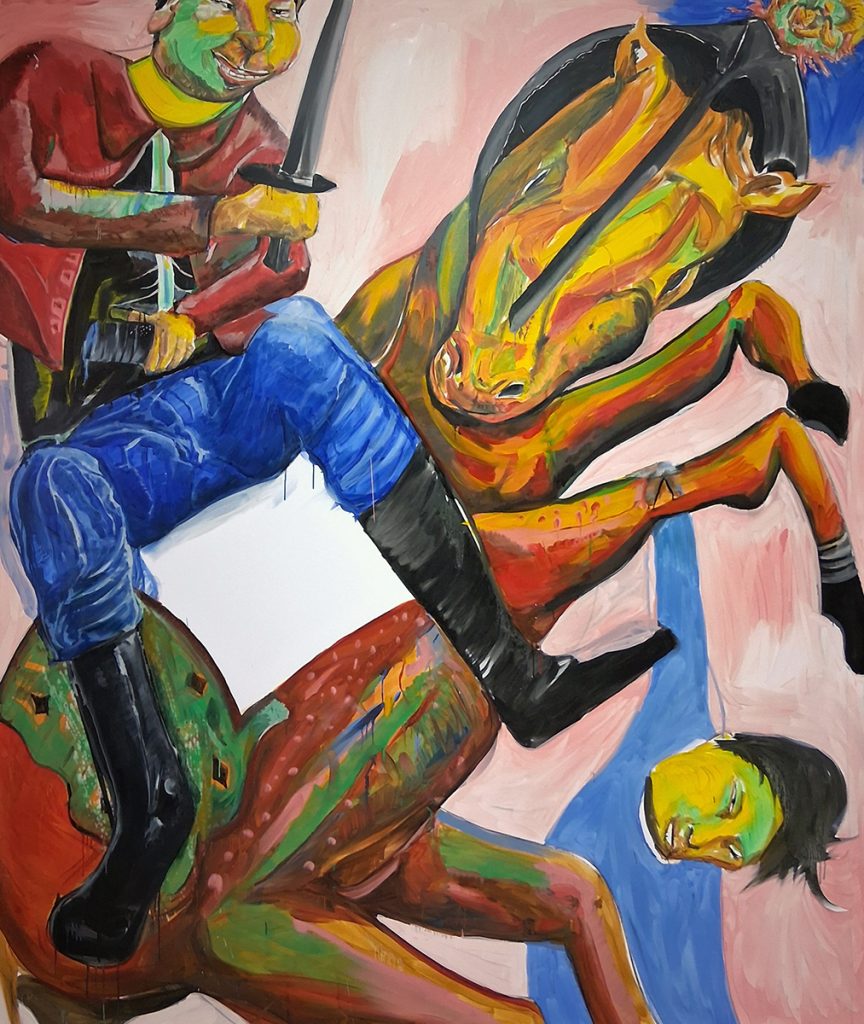
Luís Almeida, Horseman (2025), oil on canvas, 190 x 160 cm, 74 ¾ x 63 inches
Take for instance the painting Horseman (2025). Here we see a bucking horse protesting the sword of its rider as it threatens to behead someone hanging onto the horse’s leg below. What initially draws the eye into this whirlwind of motion is the purity of the diamond-shaped white form that the rider and the horse share. This relatively ‘clean’ space promises to offer safety in an otherworldly place, but the protagonist in this drama has other ideas in mind. In the end, it’s the three areas of blue that create a classic pyramid of stability that keeps this topsy turvy composition from exploding outwardly.
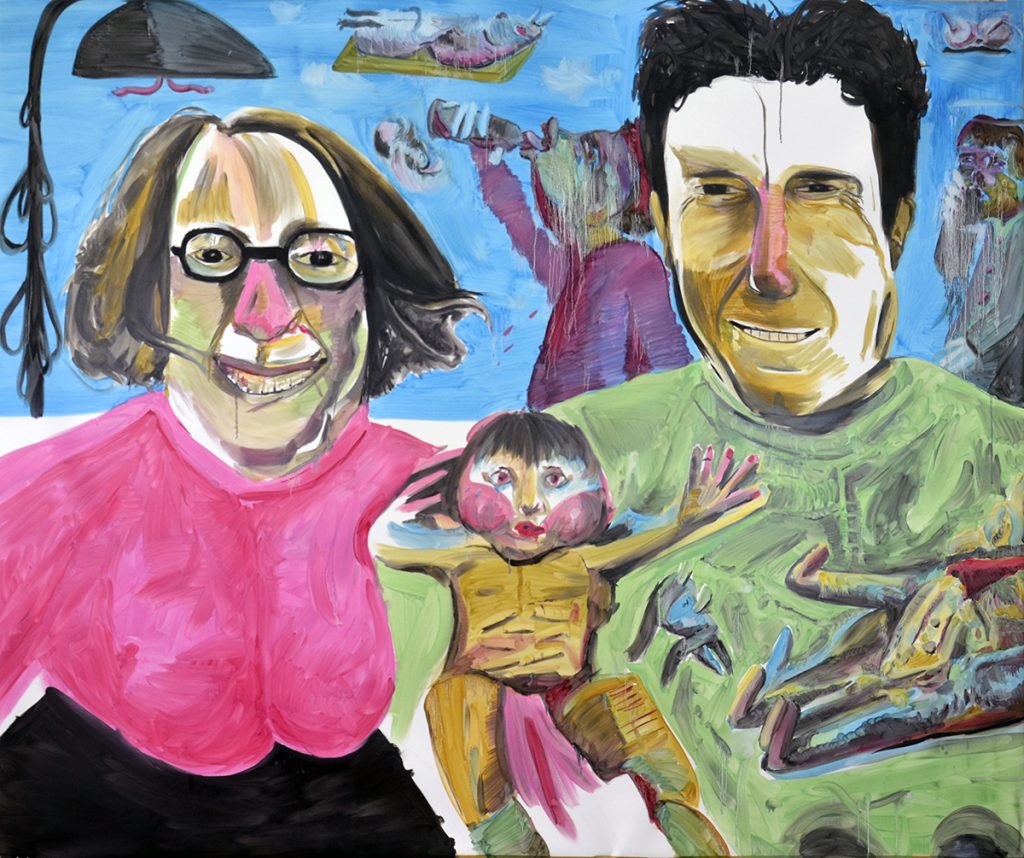
Luís Almeida, Happy Family (2025), oil on canvas, 160 x 190 cm, 63 x 74 ¾ inches
Happy Family (2025) has its share of tension as well, only in this instance it is overpowered by love. Challenging this state of bliss in the background, where we have a few indications of the seedier side of life rendered in drippy washes of color. Additionally, a sinister hand creeps in through the bottom right of the composition to create more tension. Despite all the unwanted intrusions to this otherwise buoyant scene, it is the love of family signified by a new born babe that keeps the positivity afloat.
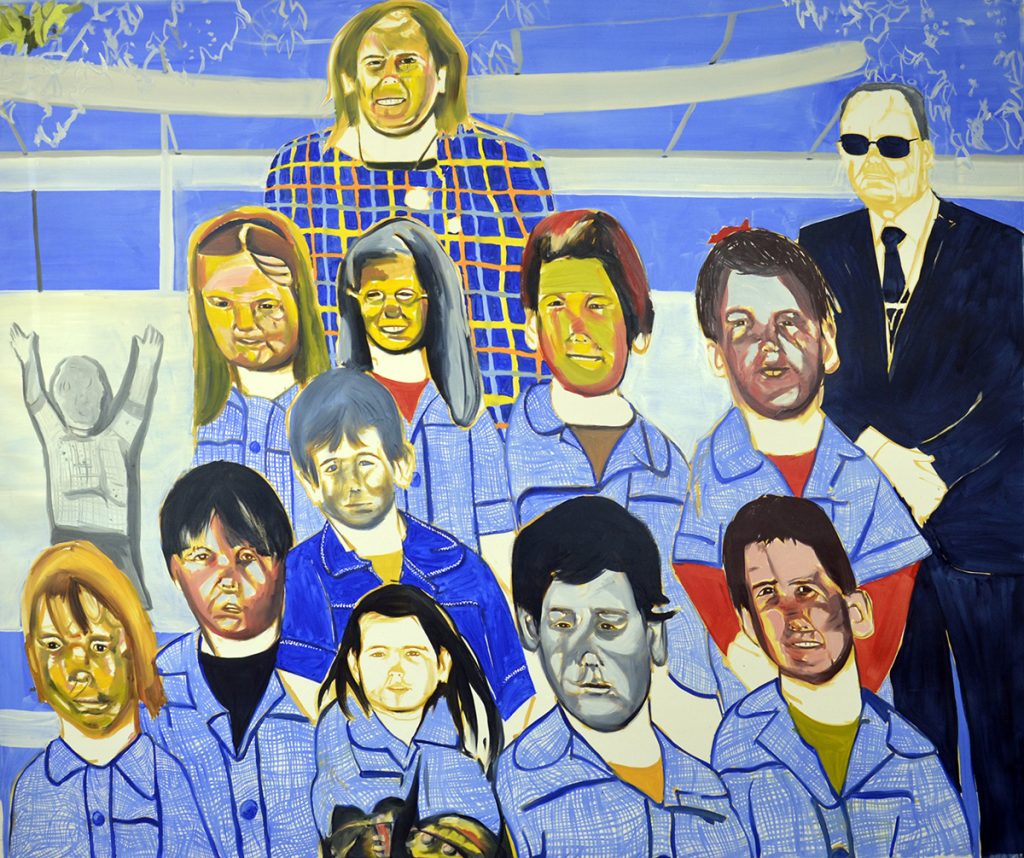
Luís Almeida, The Good, The Bad and The Ugly (2025), 160 x 190 cm, 63 x 74 ¾ inches
The Good, The Bad and The Ugly (2025) has its own, more subtle brand of bizarreness. Almeida reigns in his energy level just enough to focus the narrative to the more mundane aspects of life. We have all seen group photos of children related by some function or form. I am guessing this one is related to a sporting event where the teacher/coach and the school principal are overseeing the proceedings. Oddly, the principal, if that is who he is, with his dark sunglasses and a black suit, looks more like a security guard than an educator. What is most fascinating in School Children are the individual faces and how they all express such completely different personalities. Shy, confused, happy, lost in thought and miserable, each child commands their allotted space while their uniform dress and the similarly colored background creates a profound push/pull effect.
Luís Almeida, a painter ‘s painter who challenges himself as much as he does the viewer.
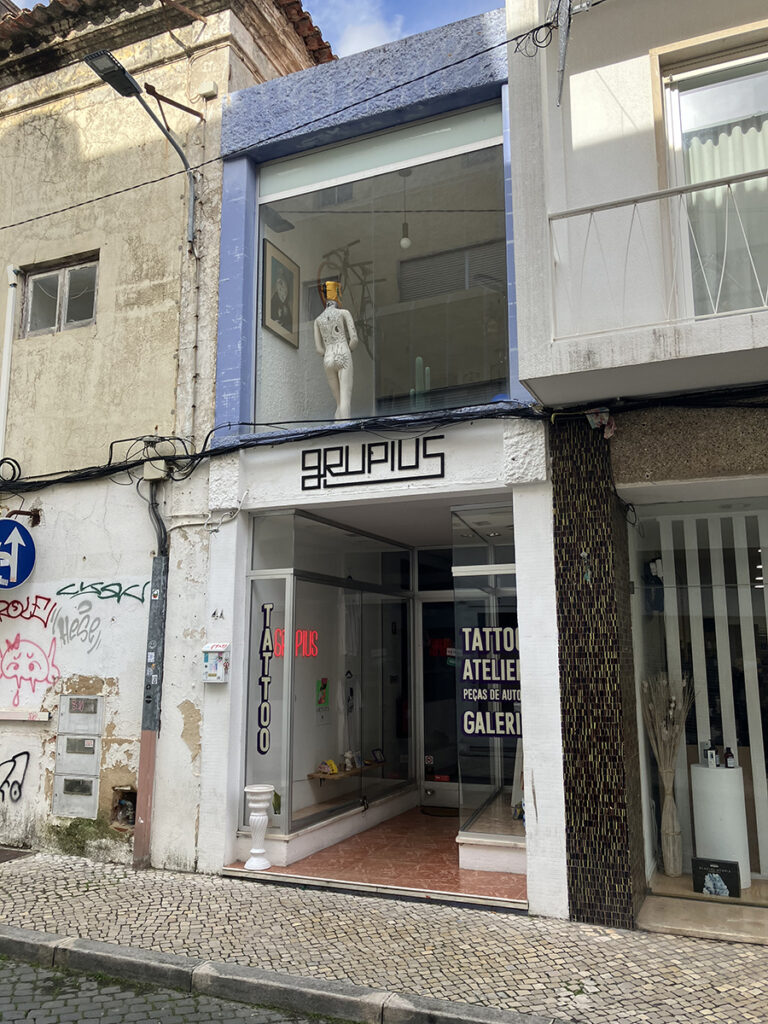
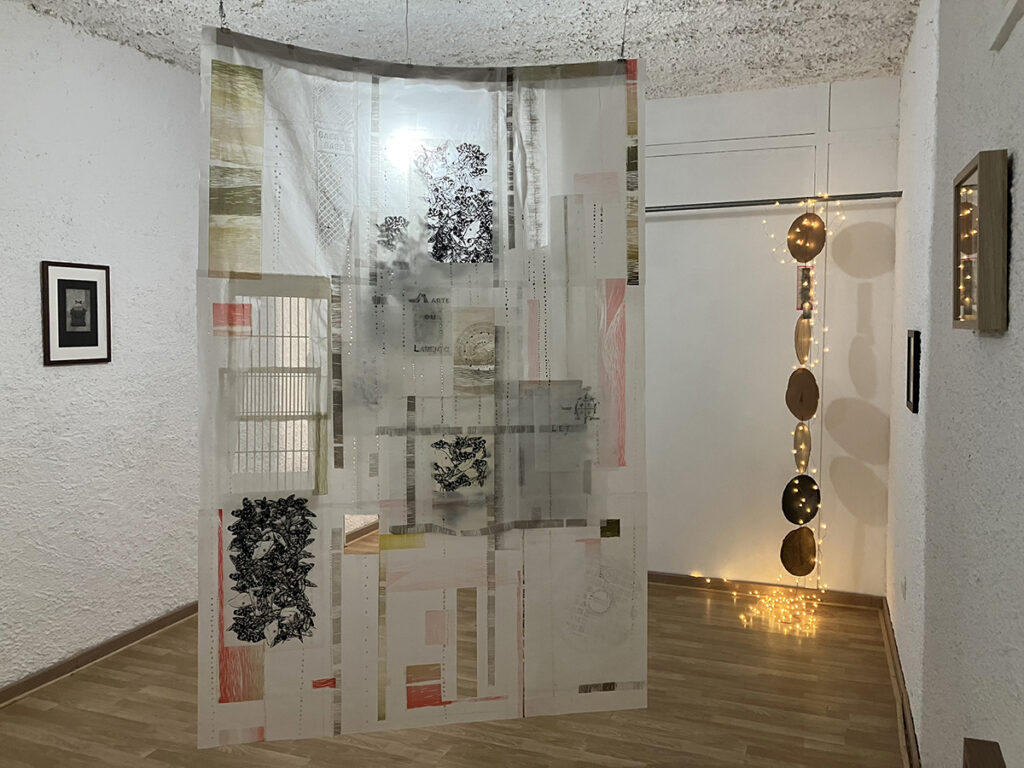
Situated above a Tattoo Atelier in Caldas da Rainha, Portugal, is the gallery Grupius Atelier. The current exhibition Veins of the Invisible: Mika Aono, is an enchanting exhibition of prints, collages, assemblages and fabric work that all come together to transform relatively tight quarters into a uniquely spiritual experience.
Veins of the Invisible: Mika Aono, installation view, photo: the author
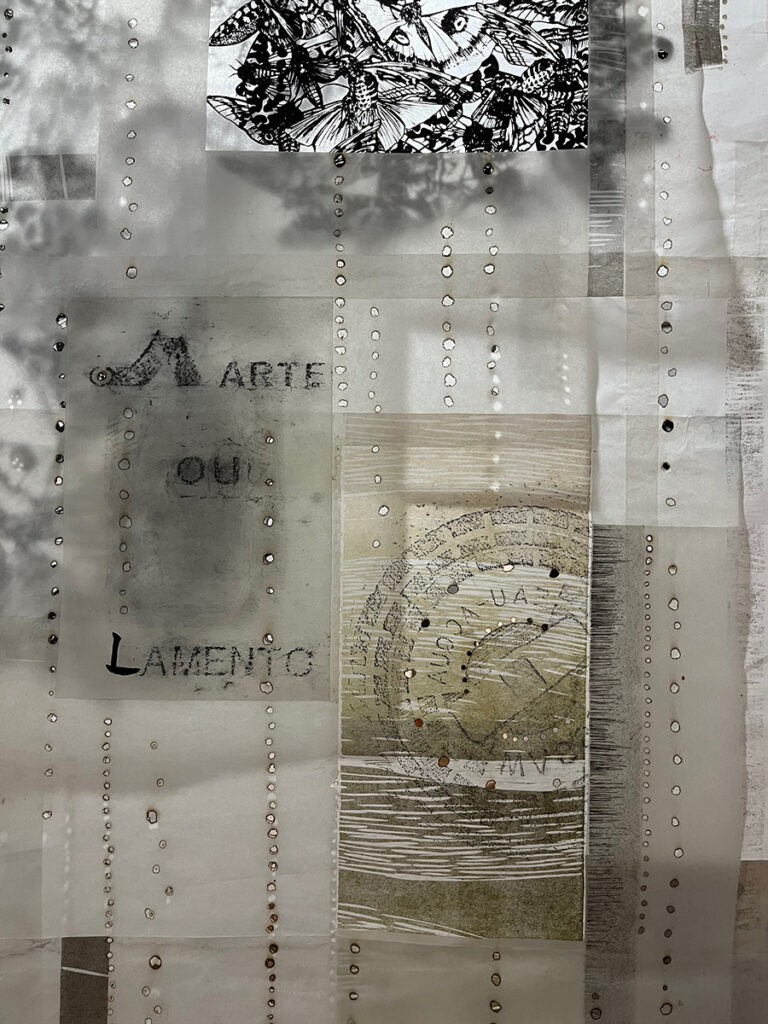
Dominating the space is a multimedia collage On the Way (A Caminho) (2025) that hangs from the ceiling, dividing the space on a subtle diagonal axis. By placing it on such an angle Aono opens up the space, increasing the visual flow for visitors to pass through the space. On the way (A Caminho) features numerous printing approaches from highly refined woodblock prints to impressions garnered from municipal manhole covers and other utilitarian street plates that are unique to Portugal. Other areas are more abstract and experimental where Aono burns through the paper with incense, while in one particular area paper is cutaway creating a partially shuttered window effect. Set up in something of a grid, the entire piece echoes back and forth within its own space creating a dialog with both the confines of the roomscape and the viewer’s thoughts.
Mika Aono, On the Way (A Caminho) (detail) (2025), relief, screenprint, mixed media, 6 x 10 feet, all remaining images courtesy of the artist
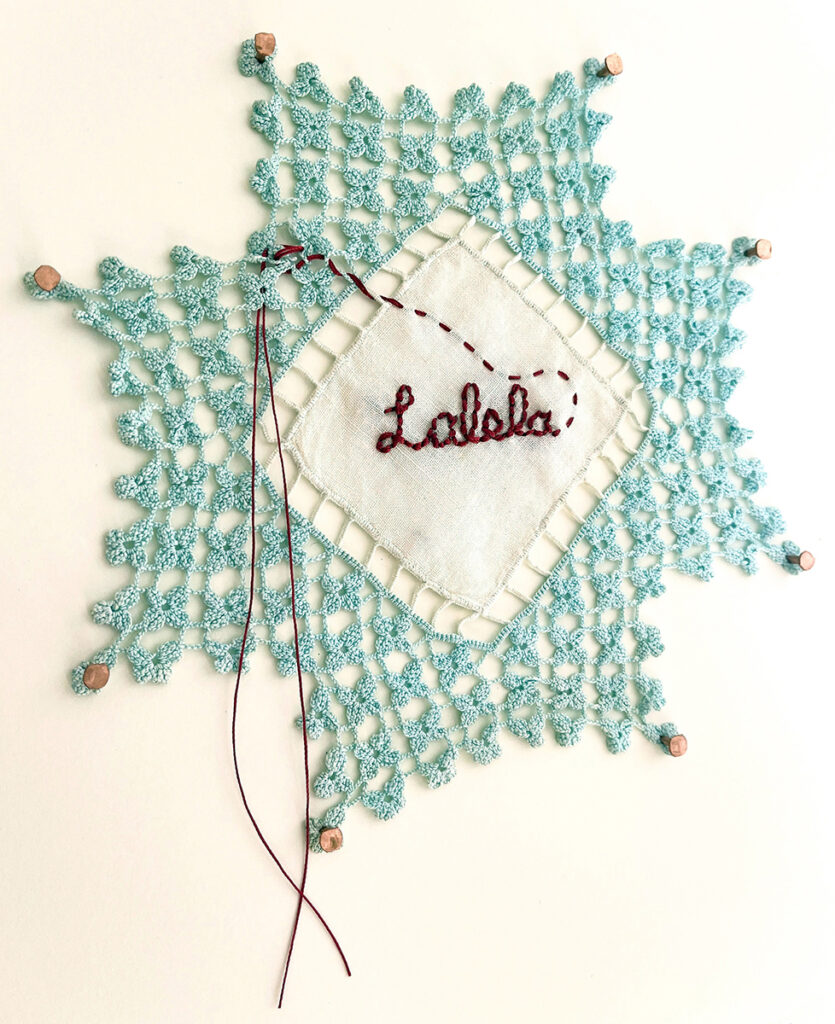
Aside from Aono’s obvious skill as a printmaker, there are other intriguing approaches here. For instance, in Dear (Minha Querida) (2025), Aono stitches on a found flea market doily made by a local artisan the melodic South African name Lalela she heard a friend mention. The baby blue of the handiwork, the copper nails that hold the doily in place, and the wine and white color of the thread used by the artist for the name all come together to signify human connection through love and admiration. In a statement, Aono writes: “(Lalela is) a word from the Zulu language, and it really touched me. Lalela means to listen—but not “just listen.” It is an invitation to listen intently, with open presence, to allow yourself to be permeated by what is around and within you. In Zulu culture, “lalela” calls for a deep, respectful attention: to listen not only with your ears but with your whole self—with heart, mind, body, and spirit.”
Mika Aono, On the Way (A Caminho) (detail) (2025), relief, screenprint, mixed media, 6 x 10 feet, all remaining images courtesy of the artist
Another example is Trans-it (2025), which appears at the right in the second image above. Here the artist hangs from a preexisting pipe near the ceiling of the gallery a string of tiny lights draped over thick paper discs pierced again with glowing hot incense sticks to make lines and clusters of holes. At play here are the different intensities of light and shadow, and the way this work is both grounded and ascending as it elicits an uplifting mood.
Mika Aono, On the Way (A Caminho) (detail) (2025), relief, screenprint, mixed media, 6 x 10 feet, all remaining images courtesy of the artist
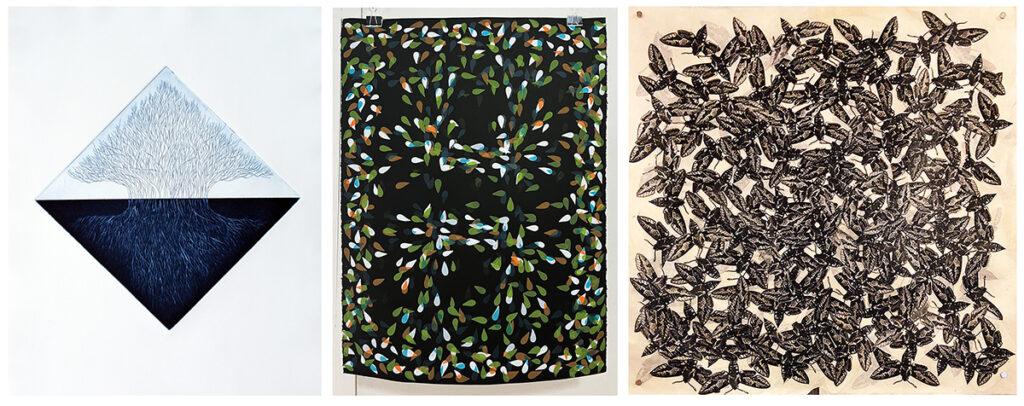
Aesthetically, the art of Aono has many aspects. Take for instance three prints; Mirror Mirror (Espelho, Espelho) (2025), Full of Tears (Cheia de Lágrimas) (2025) and Where To (2025). Through these three examples Aono moves from a very profound connection to mother earth; then to a sixties where a colorfully mesmerizing series of teardrops that loosely encircle six voids in a soft grid suggest motion; to a powerfully rendered, albeit disorderly jumble of moths clustered and casting shadows in a complex mass that reflects controlled chaos through interaction.
Veins of the Invisible: Mika Aono at Grupius Atelier in Caldas da Rainha, Portugal, runs through December 4th 2025.
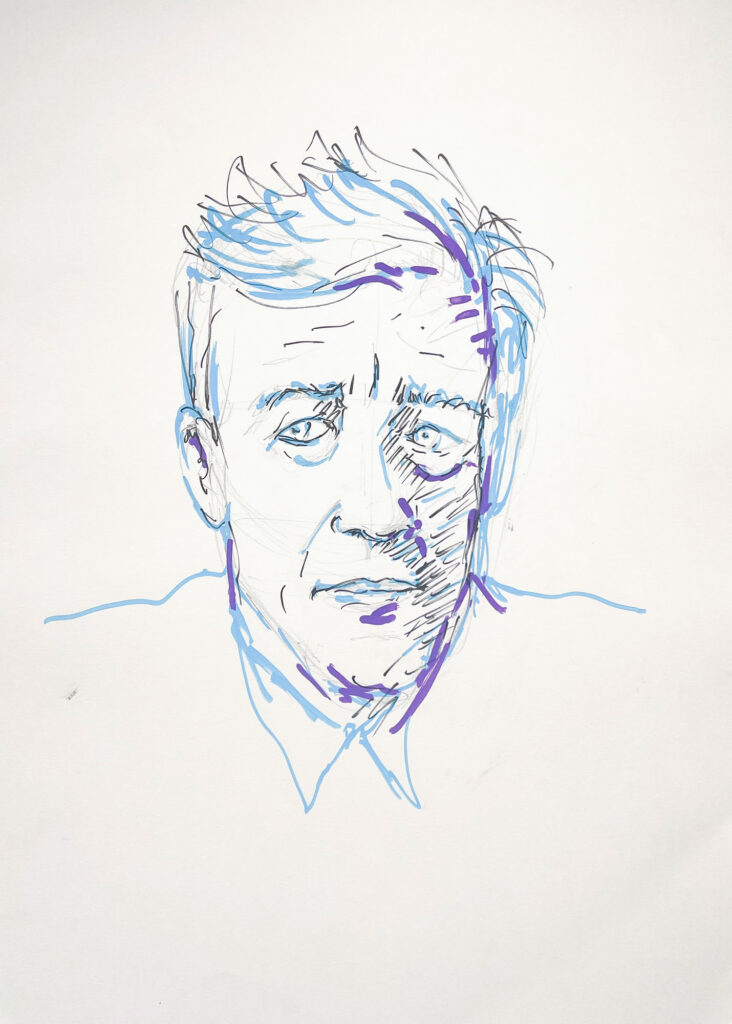
Joan Bofill, David Lynch, 2019, Posca markers, fine liner, and pencil on paper, 42 × 59.4 cm (16.5 × 23.4 in). Image Courtesy of Joan Bofill
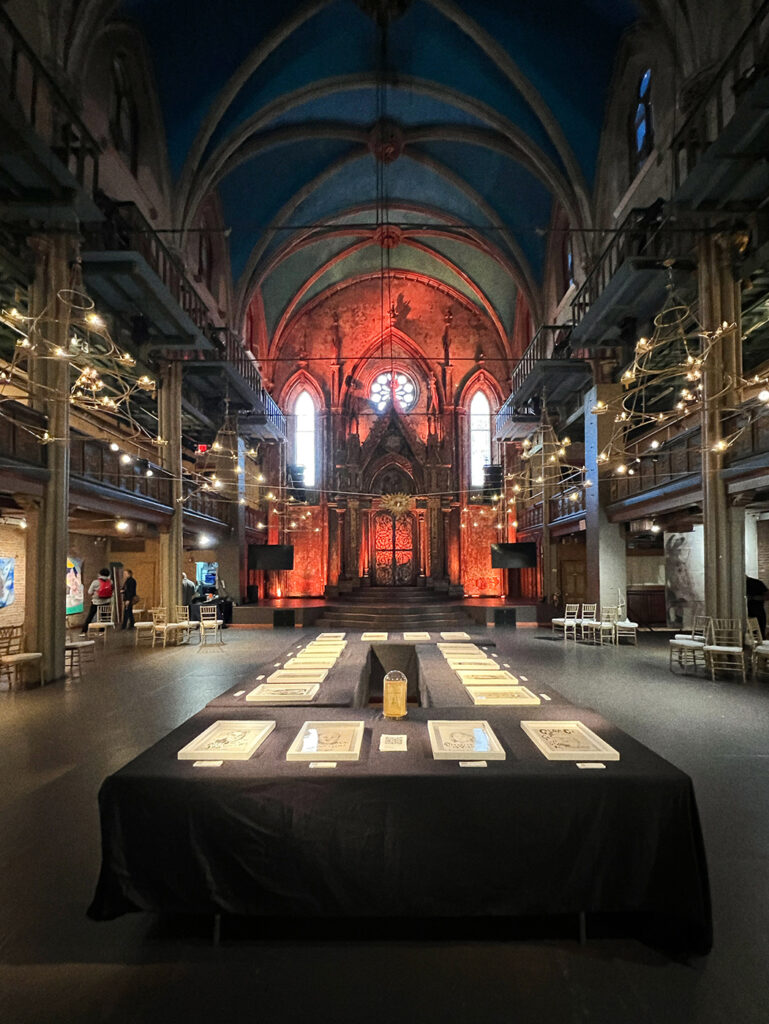
Joan Bofill, a Spanish visual artist and filmmaker, engages with a mode of portraiture which he calls “Double Portrait,” to capture a meaningful trace and record of his encounters with distinguished figures. At the Angel Orensanz Foundation’s gothic synagogue, Bofill’s exhibition, “Double Portrait: Paintings In Conversation” (October 16-17), takes place in collaboration with (Director) Sozita Goudouna’s The Opening Gallery. The Angel Orensanz Foundation for the Arts, established 1992 in New York City, is an artistic and cultural space/institution open to artists, writers, thinkers and leaders, including Philip Glass and Spike Lee; Arthur Miller, Alexander McQueen, Salman Rushdie, Maya Angelou and Alexander Borovsky; Elie Wiesel and Chuck Close. The current show brings together both large-scale paintings and the smaller “Double Portraits.” The “Double Portrait” project specifically involves both the filming of the encounter or interview and the artist’s drawing/painting of the figure with India ink and graphite. The series emerged from his documentary work, particularly his film about Hollywood producer Stuart Cornfeld (premiering at AFI Festival October 23). While conducting interviews for that film, Bofill began drawing his subjects simultaneously—a practice that evolved into something more deliberate.
Joan Bofill installation view at Angel Orensanz Foundation for the Arts
“Double Portrait” is a synthetic process with dialogue based on mutual trust and the dynamic interplay of personalities – the artist’s and the interviewee’s. The artist envisions the “Double Portrait” as a principled endeavor – one that refuses to exploit or use people for their fame and which happens naturally and organically through a web or network of human connections. Throughout the continuation of this practice, Stuart Cornfield might introduce another filmmaker like David Lynch to the artist purely out of delight for the conversation that the artist engaged in with the person.
The manner in which Bofill tunes into the conversation with the figures with an observant, creative, and informed mind gains the trust of the interviewees, which allows them to open up to the artist to create together a playful and friendly synthesis of ideas, not necessarily as thesis and antithesis, but as intuition embracing intuitions, and experience empathizing with experience.
All the information garnered by the artist feeds into the artist’s psyche in interpreting and digesting the subject’s persona and history, which contributes to the final image through the subconscious.
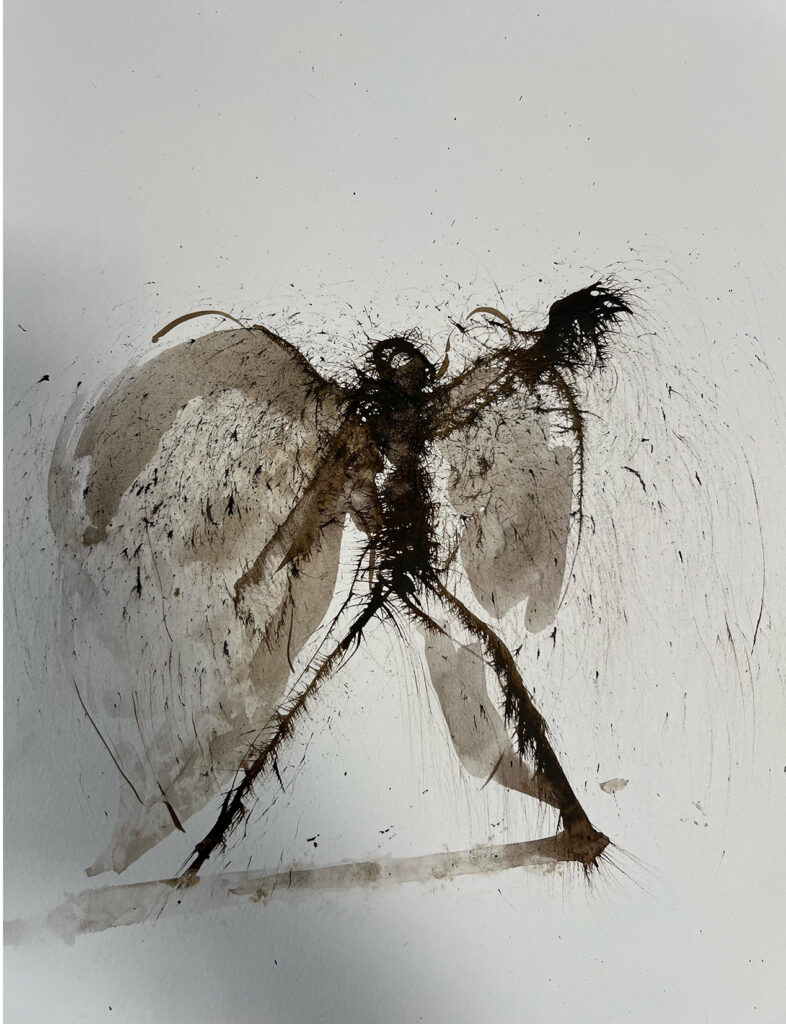
Being heavily influenced by Surrealism, of which Spanish painters Salvador Dali and Joan Miro were key figures, the artist’s visual renderings of the subjects traverse the territories of the transient, ephemeral, spectral, and angelic. A uniquely different kind of visual qualia or style can be detected in this kind of work from the artist’s usual repertoire of figurative and abstract painting. It should be humbly assessed that Bofill’s most successful and consistent body of work to date is the “Double Portrait” not because of its ambitious and large scale but because of its narrowed down scope, clarity of purpose and originality of vision, and its historical and cultural significance in dealing with iconic figures.
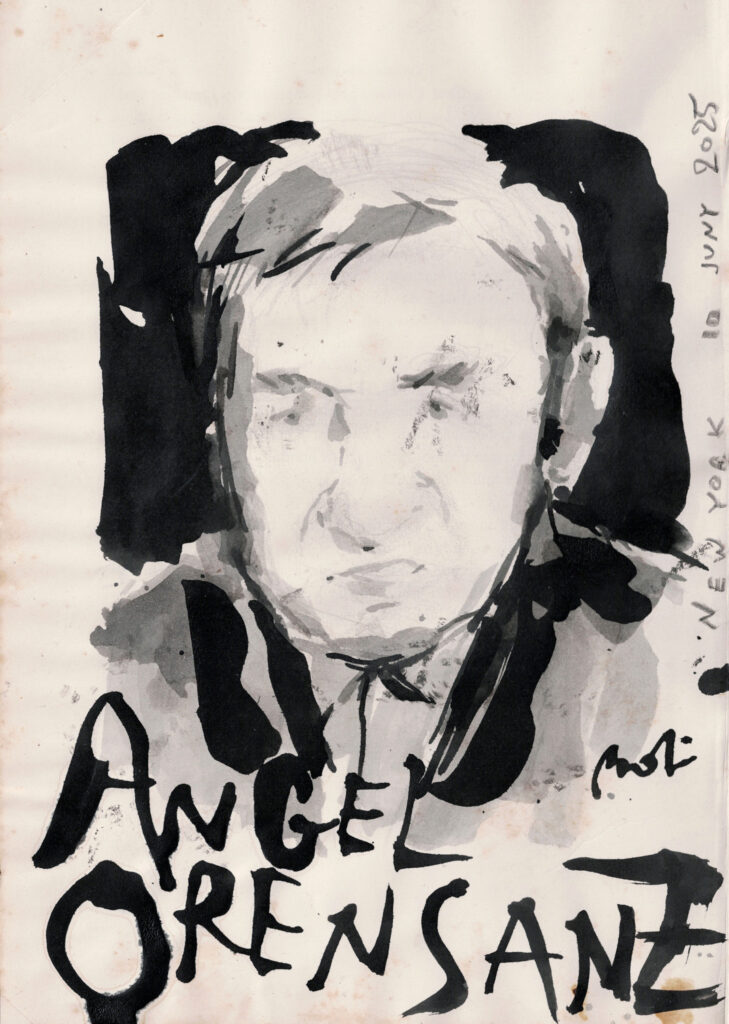
Joan Bofill, Angel Orensanz, 2025, work on paper and video – min, color, sound, work on paper, 20.7 × 30.2 cm (8.15 × 11.89). Image Courtesy of Joan Bofill
The paper on which the “Double Portrait” is executed takes on a special meaning or significance because the artist often rips out a page from an old art history book or monograph without the image or the slide of the artwork, which the artist purposefully removes, leaving a blank white space for the drawing and painting. This act is akin to the making of a palimpsest, in which the artist recognizes the historical significance of the continuity of tradition, lineage, and canon over long centuries and millennia. The artist appears to suggest, in engaging with figures from the Spanish-speaking domains, the American mainstream, and African and Caribbean origins, that the “Western” history and culture has evolved into a global union of people and ideas and not strictly limited to the history and the cultures of people with a European ancestry. What remains is no longer purely Western people and society but a globalized cultural network of institutions, ideas, trade, and encounters.
A clear distinction can be observed between Bofill and the other “artists” in the streets chasing after famous people: Bofill approaches the “Double Portrait” project with sincerity and lucidity, with the goal of earning the trust of the other by maintaining his own artistic integrity and sensitivity. There is no wax or fluff in Bofill’s work; it is neither over nor underworked; it is made just about right, which is very difficult to achieve for many artists who may overshoot or undershoot from the most ideal outcome. The accidents are no longer accidents but serve as the patterns of an organic and creative process based on discovery and an earnest investigation (for the truth of what they may discuss). While Bofill may not be Picasso just yet, he is a young master in his own rights.
Through repetition of the “Double Portrait,” Bofill slowly accumulates the structure and the voice of his unique style, which is ghostly or angelic at times, traversing into the spiritual and the metaphysical territories, perhaps because the artist is acutely aware of the passage of time and our own mortality.
Why “Double Portrait”? What is the effect of assigning a QR code to each drawing or painting, which leads to a video interview of the person depicted in the artwork?
The answers may be obvious, but the truth requires a great deal of thought and effort to be properly excavated. The video interview may capture in real time the various facial expressions, the speech patterns, the voice, and gestures and the manners of the person. The video may be the shadow of the object, which is the drawn portrait, or it may be the object itself, with the shadow being the drawn portrait. Sometimes, the video may contain more information than the drawing or painting itself.
But art is the process or the act of curation of information. In photography, it is the cropping of the subject, filtering out the unnecessary details or noise. Similarly, the video component of the “Double Portrait” serves to provide context for the framed information and to create an ecosystem of ideas and meaning, of which only a small amount makes it into the visual rendering like the tip of the iceberg.
But, really, art should transcend this kind of curation and accumulation of information, going beyond to capture something invisible and essential, which can never be found in the recorded video of the interview.
And this is where the true test for the artist lies. Even when the artist could not communicate properly with the subject, due to the limitations or differences of language, the artist connected with the subject. And this shows in the paintings. The artist allows the subject to subconsciously alter the internal state of the artist’s own being, which makes Double Portrait in essence an interactive and collaborative project.
Joan Bofill, Sagrada Familia – Familia Sagrada, 2023-2024. Image Courtesy of Joan Bofill
“Double Portrait” is not just the words or the act of sitting down and conversing with one another, but it is the intermingling of personalities, the interaction of personal energies, and the interconnection and trust between the two – the observer and the subject. The subject opens up to the observer (who is the artist) because the observer opens up to the subject with great sincerity; the observer/artist also allows the subject to enter into the observer/artist’s psyche, just as the observer/artist is doing the same to read into the subject’s own feelings, lived experiences, and ideological stance. And what results is that the artist’s hand serves as the subject’s hand, on a psychological or subconscious level, which is consistent with the Surrealist and even Dadaist (which evolved from the Surrealist) practice and philosophy. In effect, the observer is observed, and the observed, observing.
Bofill’s portrait of David Lynch is filled with sparks of light (which metaphorically becomes the spark of ideas) that penetrate into the shadows of his face. His strong and determined depiction of Angel Orensanz keeps his identity and ideological persona as a revolutionary and advocate for the advancement of art and culture.
In conclusion, the artist achieves something greater than the sum of its parts for the “Double Portrait” project, by the very nature of its limited focus and artistic philosophy and sensitivity that reflects highly of the artist’s own fine-tuned and intellectual nature. Bofill approaches the subject not as an object of portraiture but as a subjecthood for empathy and human connection, and this is what makes the people respond to and engage so brilliantly and meaningfully with the project.
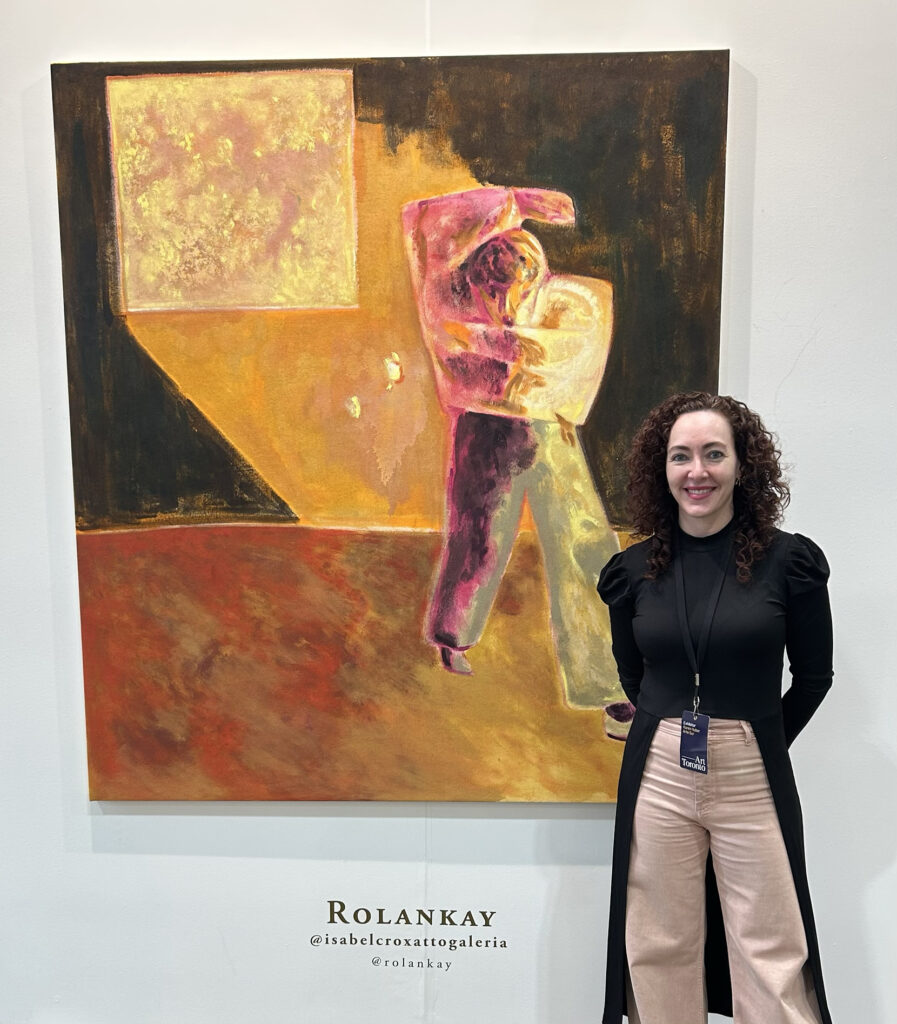
Mexican curator Karen Huber in front of art work by Chilean artist Rolankay (1989-) titled Illumination, 2025, oil on canvas 67-3/4 x 59-7/8 inches courtesy of Isabel Croxatto Galeria from Santiago, Chile
Art Toronto is Canada’s leading art fair, held annually at the Metro Convention Centre located on Front Street in the vibrant downtown area of Toronto. It is the largest art fair in the country, showcasing works from both emerging young artists and established masters. Under the leadership of Mia Nielsen, the Director of Art Toronto, the fair has consistently thrived, with a new central theme introduced each year. This year, the focus is on Latin American art (Arte Sur), curated by Karen Huber, a Mexican curator and gallerist based in Mexico City. Huber is recognized for her innovative approach to presenting contemporary Latin American art from Central and South America. She has assembled 11 esteemed galleries for Art Toronto, which are featured in a dedicated section of the fair’s exhibition space. The participating galleries include Alejandra Topete Gallery from Mexico City, Mexico; Aninat Galería from Vitacura, Chile; BLOC Art from Lima, Peru; Crisis Gallery from Lima, Peru; deCERCA from San José, Costa Rica; Judas Galería from Valparaíso, Chile; Isabel Croxatto Galería from Santiago, Chile; PROXYCO Gallery from New York, USA (featuring Latin artists); Subsuelo from Rosario, Argentina; Swivel Gallery from New York, USA (featuring Latin artists); and The White Lodge from Buenos Aires, Argentina.
The Latin American focus is a must see. According to Huber, every art fair in the world needs a section for Latin American art. This huge continent brims with creativity encompassing all mediums resulting in fresh works touching upon all aspects of humanity stemming from young voices, indigenous peoples, well seasoned artists and those artists no longer alive. In talks with fellow colleagues, curators and friends, Huber feels Latin America is no longer seen as a minority. In her opinion, it has become very active in every country and in every city in the world and it is an important part of the economy. Huber feels it is essential to give visibility to Latin American artists in spaces like art fairs, galleries, museums and institutions. Many feel there has been a void in the art market for contemporary Latin American art. More galleries are now expanding to exhibit Latin American art opening the world to more conversations about art, to more story telling from different backgrounds and linking various cultures together. There is a growing curiosity among individuals regarding Latin American art. Individuals are increasingly seeking to travel to fairs in Latin America to witness and discover the wealth of offerings that this continent presents.
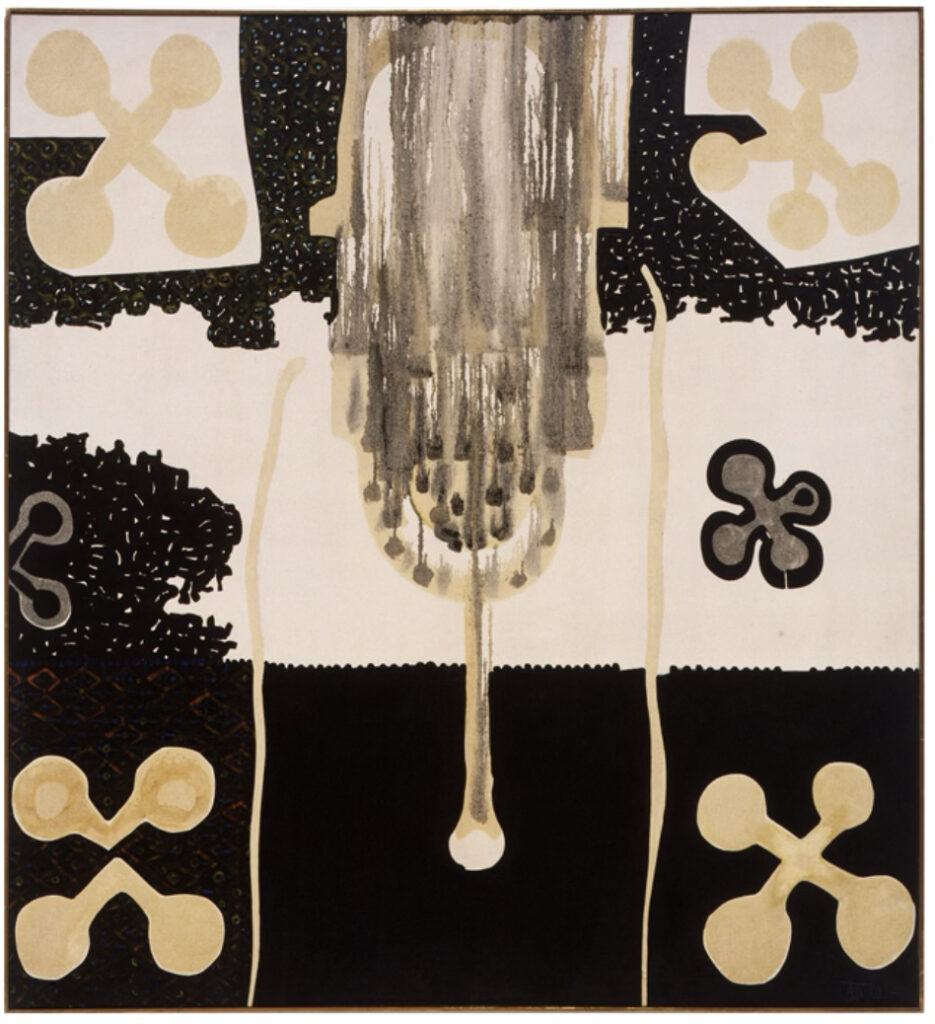
Canadian artist Harold Town (1924-1990), Tyranny of the Corner Puzzle Set,1962, oil and lucite on canvas, 82 x 75 inches, courtesy of Christopher Cutts Gallery
Although most galleries within the Art Fair showcase emerging contemporary artists, there are exceptions like Christopher Cutts Gallery booth A71, who highlights emerging talents such as Alexander Rasmussen alongside the renowned Canadian master Harold Town. Director Christopher Cutts made a noteworthy observation: “They positioned me in a corner this year, so I thought there was no more fitting artwork to display in that corner than Harold Town’s piece titled Tyranny of the Corner Puzzle Set from 1962”.
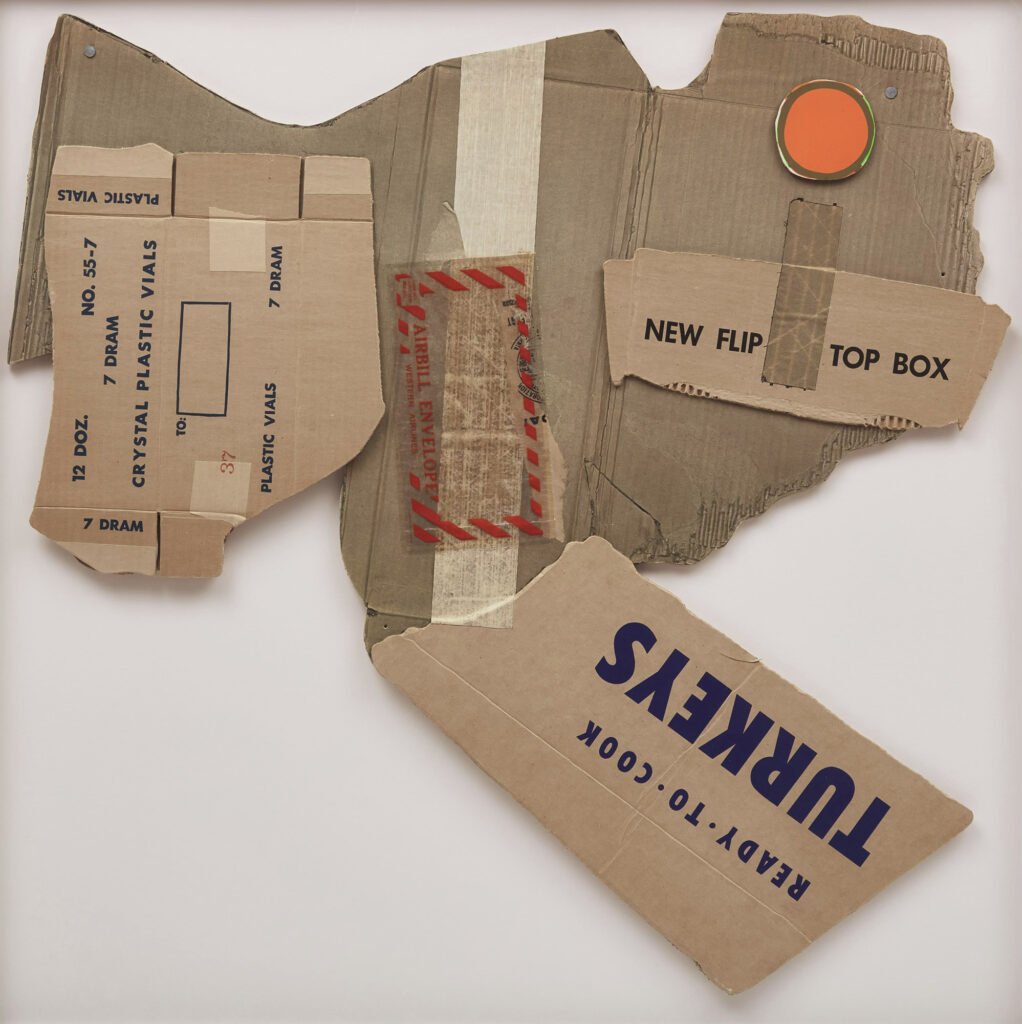
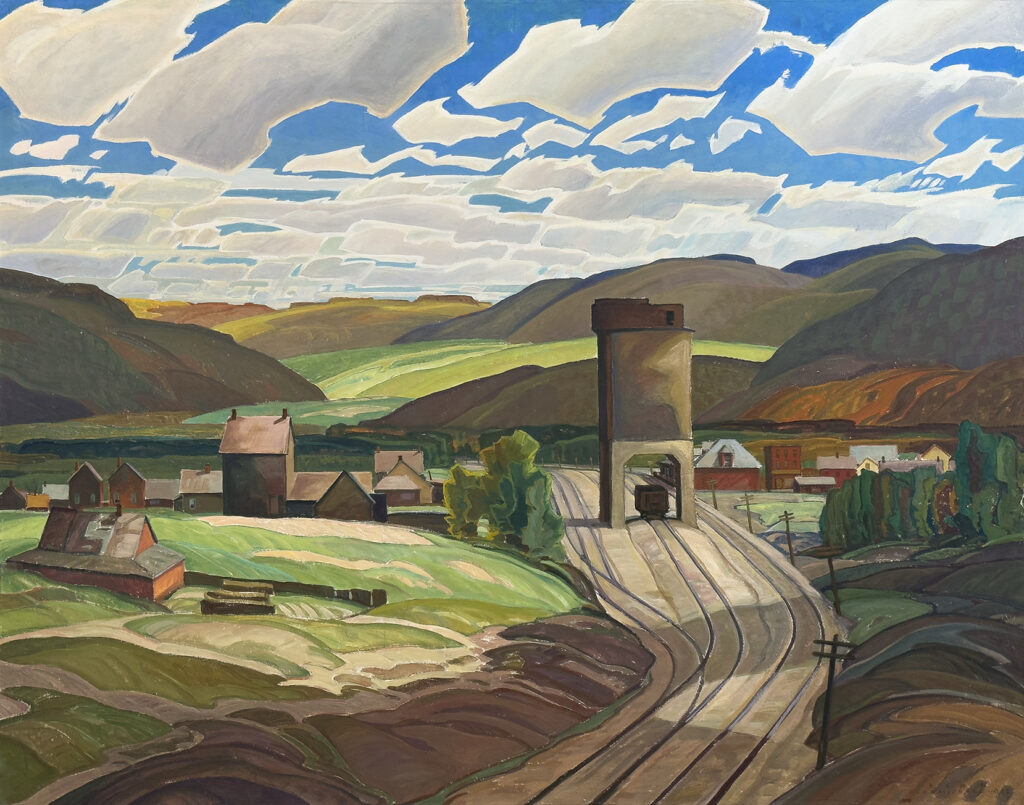
American artist Robert Rauschenberg (1925-2008) Cardbird lll, from Cardbird Series (Gemini 305), 1971, offset lithograph and collage with tape on corrugated cardboard, 35 x 35-1/2 inches courtesy Cowley Abbott Art AuctioneersCanadian artist Group of Seven Member Franklin Carmichael (1890-1945) Coal Chute, 1942, oil on board, 38 x 48 inches courtesy Cowley Abbott Art Auctioneers
This year signifies a milestone for innovators Rob Cowley and Lydia Abbott, who are continually expanding the limits of art sales. Together, they operate Cowley Abbott, Canada’s Art Auctioneers, which specializes in showcasing and selling secondary market artworks both regionally and internationally. Their Private Sales section, featured within the auction house and exhibited at the Art Toronto art fair booth A51, highlights Canadian masters such as David Blackwood, A.J. Casson, and Franklin Carmichael, alongside international icons like Andy Warhol, Robert Rauschenberg, and Larry Poons.
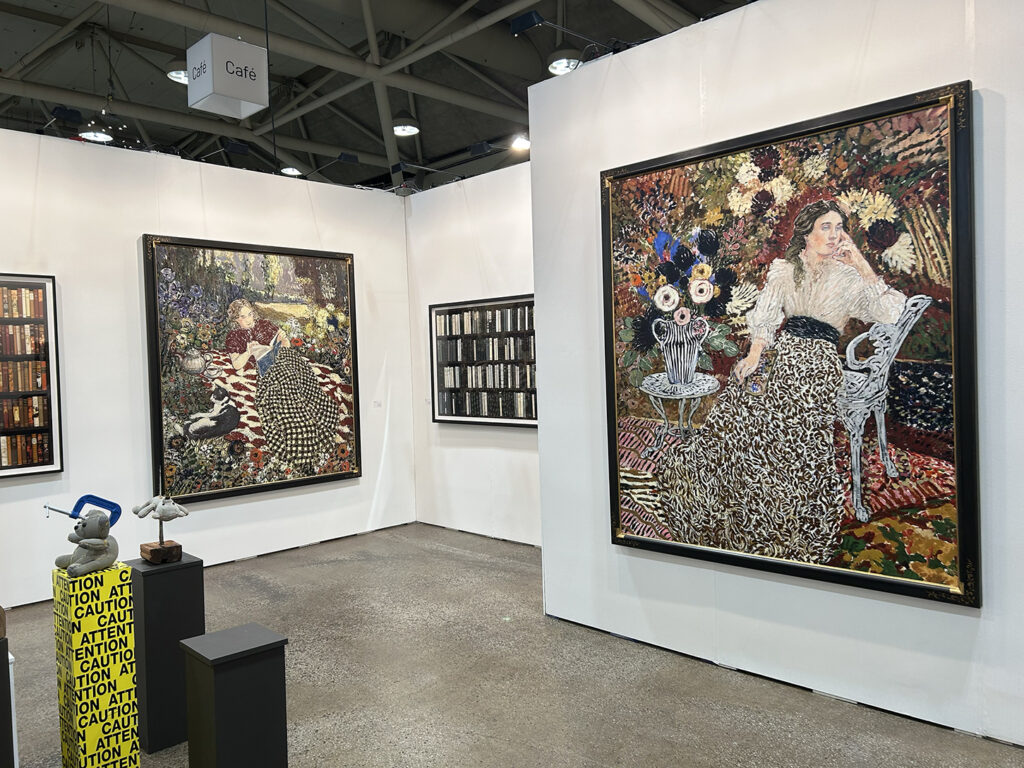
Rebecca Hossak Art Gallery at Art Toronto booth C54 featuring works by artist Nikoleta Sekulovic (1974-) (left) Alice, 2025, acrylic and oil stick on linen, 78-7/10 x 68-9/10 inches. Nikoleta Sekulovic (1974-) (right) Vanessa Bell,2025, acrylic and oil stick on linen, 84-3/5 x 72-4/5 inches
The Rebecca Hossak Art Gallery, booth C54, located in London, UK, showcases two remarkable artworks by the artist Nikoleta Sekulovic, who was born in 1974 in Rome, Italy, and has German/Serbian heritage. Sekulovic is among the most sought-after artists represented by the gallery. Last year, she presented two pieces at Art Toronto, successfully selling both, and subsequently featured her work at Miami Basel, where several pieces sold out. Sekulovic is a contemporary figurative painter renowned for her vividly conceived portraits that pay tribute to iconic women throughout history. She employs a unique style that she has cultivated, characterized by a contemporary craftsmanship reminiscent of Pre-Raphaelite design.
The art fair offers a wonderful experience for those seeking inspiration and knowledge from the numerous art dealers and artworks displayed.