Six Short Takes on Painting Exhibitions in New York

by John Mendelsohn

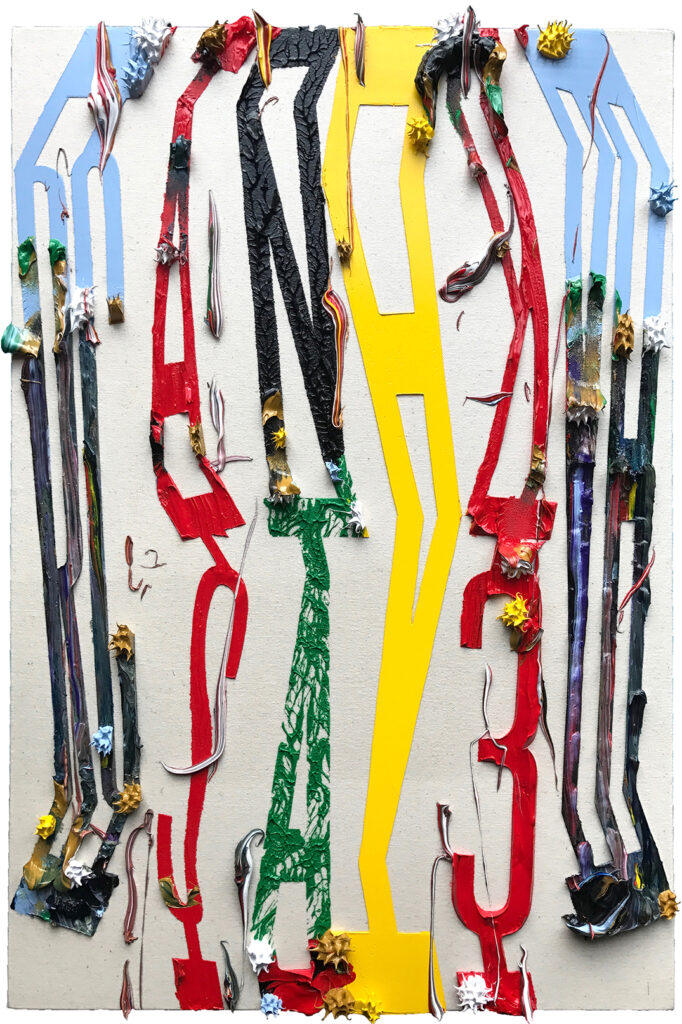
Dennis Hollingsworth, “extreme gospel”, 2017, oil on canvas, 30x20 in.
Photo courtesy of the artist
Dennis Hollingsworth, “extreme gospel”, 2017, oil on canvas, 30×20 in.. Photo courtesy of the artist

Perplexing, ingratiating, tricky – the paintings of Dennis Hollingworth are all these things and more. Most of the paintings in this exhibition date from 2016-2017, and will introduce some viewers to this intriguing artist’s work, last seen in in New York in 2019.

Hollingsworth primarily uses text in these works as a painterly motif and a cryptic language. A series of large words are stacked, elongated, turned inside out and backwards, and hung out to dry. The words take on a physical presence in thick relief, having been masked and painted on bare canvas, accompanied by fragments of patterns, and multicolored skeins of pigment.

The words exist on the edge of comprehensibility, as if we are hearing pressured speech or a transmission compromised by impinging forces. There is an aspect to this work that suggests concrete poetry or asemic writing. The former asserts the primacy of graphic form as means to convey poetic meaning. The latter uses the gestural qualities of writing as an abstract language in itself.

Both of these forms point to the central doubt in Hollingsworth’s work, a questioning of how or if language can communicate. With the words themselves windblown and torqued, they are like messages that cannot quite be grasped, but emphatic in their insistence in being heard.

Dennis Hollingsworth: Letters to the Future. Helm Contemporary, 132 Bowery, New York. December 15, 2023 – January 19, 2024
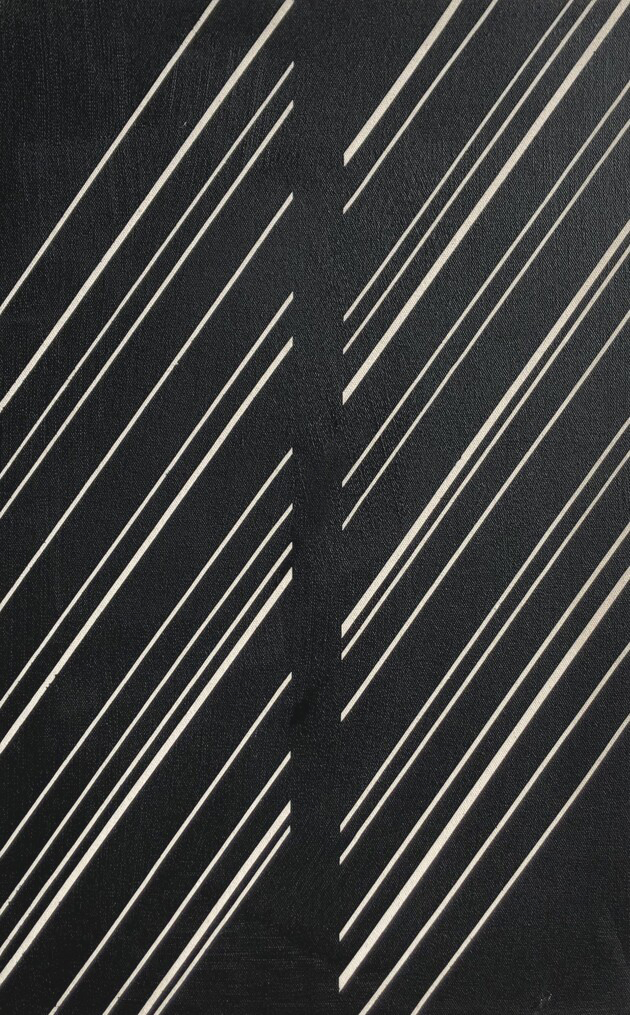
David Rhodes, 11 April 2023, 2023, acrylic on raw canvas 23x15 in.
Photo courtesy of the artist and High Noon Gallery
David Rhodes, 11 April 2023, 2023, acrylic on raw canvas 23×15 in. Photo courtesy of the artist and High Noon Gallery

David Rhodes paints stripes in black and white. This bare description is both true and not true, in that it is what we see, and that it is not all that is there. This artist’s work is both physically embodied in black pigment on raw canvas and philosophically an enquiry into what constitutes the experience of a painting.

Within the strictures of diagonal lines of varying thicknesses, Rhodes allows patterns, rhythmic movement, and optical afterimages to emerge. The lines themselves are taped to a hard edge, but glitches occur, with minor bleeds and skips allowed to stand. At Helm Contemporary the paintings have dense, zigzagging, miss-matched sections, leaving us with the frisson of what should, but does not fit. And at High Noon the paintings, dominated by black, have a central, vertical black stripe – an empty zone, the void that cannot be filled, except by our own sense of rupture or relief.

The implacable quality of these paintings, with their uncompromising commitment to a singular vision, bring to mind the work of Clifford Still. The connection goes beyond the jagged forms, at times mountain-like and imposing, and rather suggests a similar existential journey, following a path inscribed in oneself that leads further and further into a spaciousness.

David Rhodes: Aletheia. High Noon Gallery, 124 Forsyth St., New York. January 18 – March 3, 2024

David Rhodes: Partita. Helm Contemporary, 132 Bowery, New York. January 26 – March 1, 2024
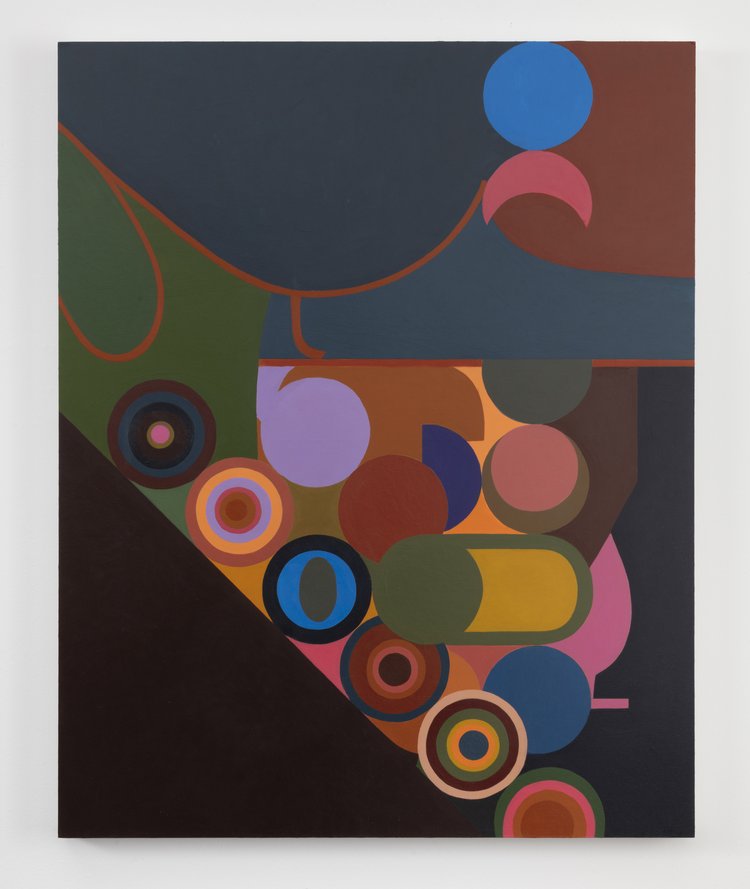
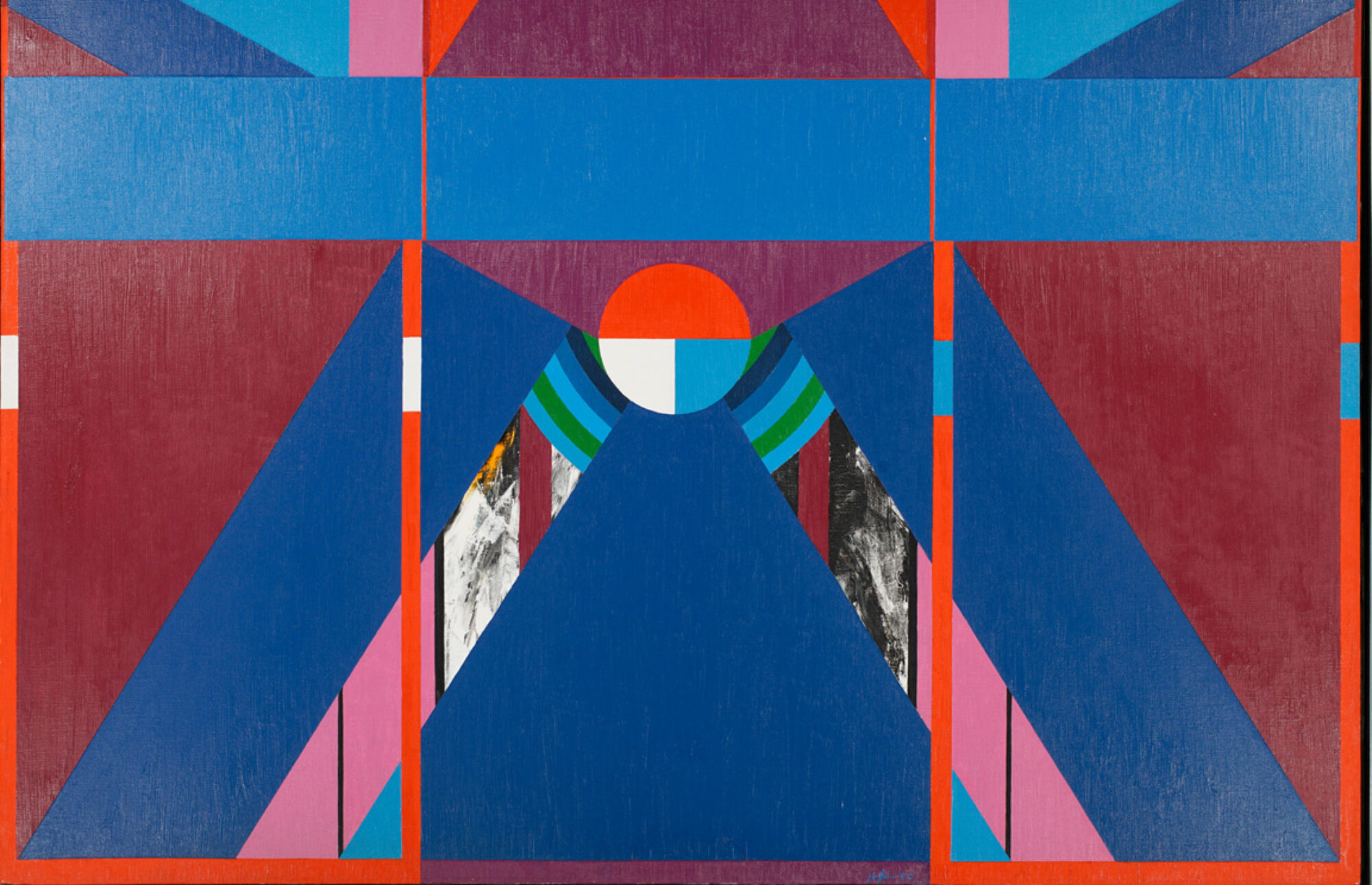
Mario Naves, The Hallelujah Crowd, 2023, acrylic on panel, 30x24 in.
Photo: Adam Reich / courtesy of Elizabeth Harris Gallery
Mario Naves, The Hallelujah Crowd, 2023, acrylic on panel, 30×24 in. Photo: Adam Reich / courtesy of Elizabeth Harris Gallery

Mario Naves paints paintings. That is to say he aspires to make works that embody a kind of aesthetic resolution and solidity. In this intention he stand apart from the heady, supercharged possibilities that abstract painting currently offers. And in this there is a harking back to modernist models – think here about the work of Stuart Davis and Charles Demuth, and other painters of modern life, with the mechanistic and the graphic becoming worthy subjects of the artist.

But for Naves, the life he reflects seems infused with the technological, with its sheer surfaces that facilitate the seamless locking together of form and function. The facture is smooth and screen-like, with the shapes conforming to a kind of free-form geometry, a painterly choice that keeps any potential psychological mess at bay.

Yet at the heart of this work is a mystery. The curving shapes suggest silhouetted identities and personal scenarios that are encoded within the formal matrix. Disjunctive motifs – disks, stripes, flat vistas of color – are layered together, as if experience cannot be just one thing, but must always be various and contingent. The palette is bold, ranging from sonorous, saturated color to low down, unsaturated hues, and often with an insistent darkness as a recurring presence.

Mario Naves: Gratitude and Expectations. Elizabeth Harris Gallery, 529 W. 20th St, New York. January 6-February 17, 2024
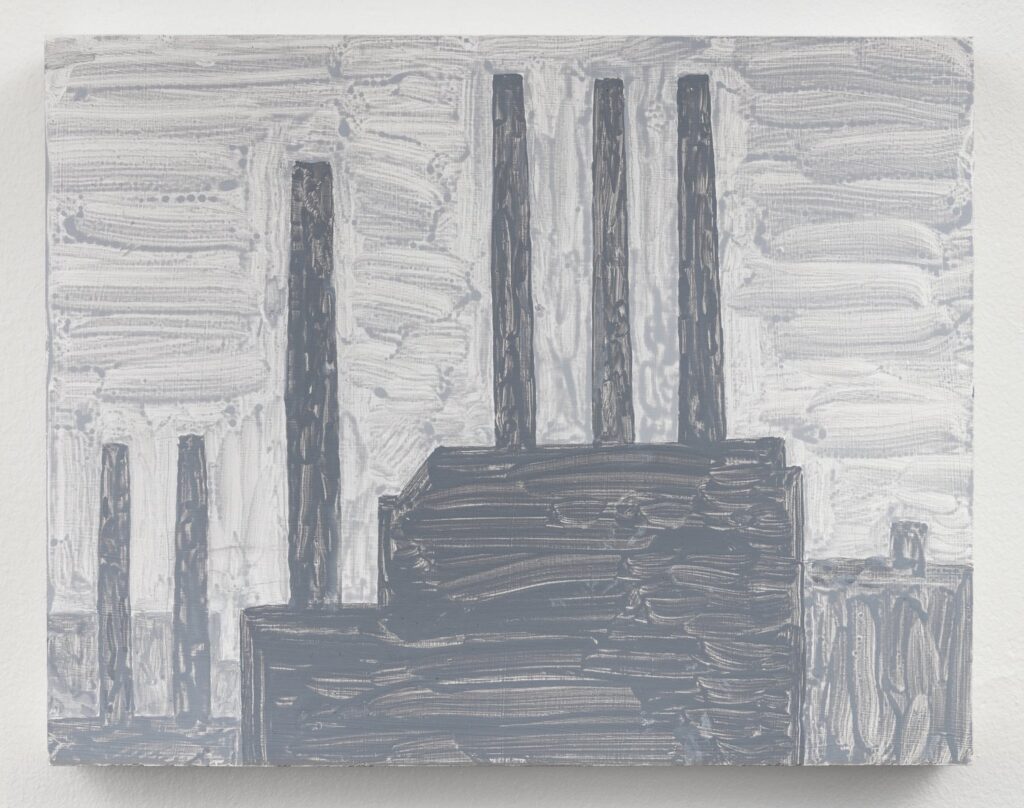
William Carroll, City 54, 2023, acrylic on canvas, 11x14 in.
Photo: Adam Reich / courtesy of Elizabeth Harris Gallery
William Carroll, City 54, 2023, acrylic on canvas, 11×14 in.
Photo: Adam Reich / courtesy of Elizabeth Harris Gallery

William Carroll is a walker in the city, specifically New York, and what he notices is what we see in his small-scale paintings. Working in transparent brushstrokes, primarily in tones of gray, or in two colors, he depicts vignettes of urban life. This is the perennial city, not the leviathan of glass-clad towers, but the unchanged town of rusted bridges, old churches, and empty bill boards with their bare scaffolding.

There is a persistent melancholy here, in the restrained tonalities and the unpeopled scenes of rooftops, power plants, and apartment buildings. In this focus, Carroll shares a poetic kinship with Edward Hopper, with their shared interest in the infrastructure of the city as a kind of surreal stage set which might hold the stories of the isolated and the dispossessed.

Carroll’s images are washy, with a direct, home-grown quality that sits at an angle with his minimalist sense of structure and reductive form. There is as well a gritty lightness at work here, a claiming of the modest and personal as having a place in the life of the metropolis. The paintings of the upper reaches of the city’s towers, each in two sherbet-like colors, are buoyant images that hint at the fulfillment that life there can also promise.

William Carroll: Living in the City. Elizabeth Harris Gallery, 529 W. 20th St, New York.
January 6-February 17, 2024
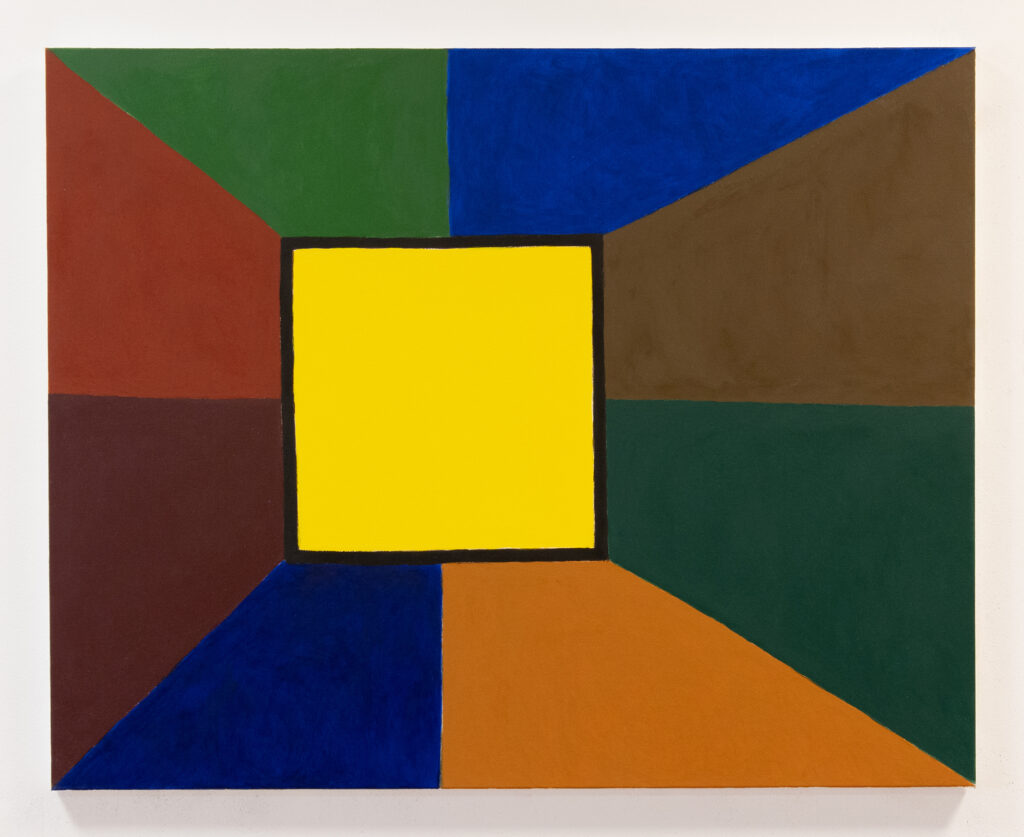
Harriet Korman, Untitled,  2022, oil on canvas, 24x30 in.
Courtesy of the artist and Thomas Erben Gallery, New York
Harriet Korman, Untitled,  2022, oil on canvas, 24×30 in. Courtesy of the artist and Thomas Erben Gallery, New York

In her exhibition, Portraits of Squares, Harriet Korman (full disclosure: my spouse), extends her pursuit of painting that is abstract and structured, but activated by color and by the feeling that we are encountering a consciousness at work. Here are ten recent works, all 24×36 in., made of intuitive, hand-painted geometric forms, with the emphasis on a single square. One canvas from 1979 is also being shown. In the work from the last two years, the square is set within a matrix which varies from concentric bands, to a grid of squares and rectangles, to a perspectival vortex. The square that is the subject of each “portrait” is thus both an independent entity with its own character, and emergant from the life which engendered it.

The mood in these works is by turn introspective and declarative, with a willingness to let the works’ basic elements take the artist on a trip to the inner life of geometric painting. There we sense distant echoes of ancestors: Mondrian and Albers, traditional quilts, and other, older forms of abstraction. But what is most compelling is that with the plain means at hand – resonant color and formal composition – this artist has created a visual fugue that unfolds like music.

Harriet Korman: Portraits of Squares. Thomas Erben Gallery, 526 W. 26th St., New York. January 18 – March 2, 2024
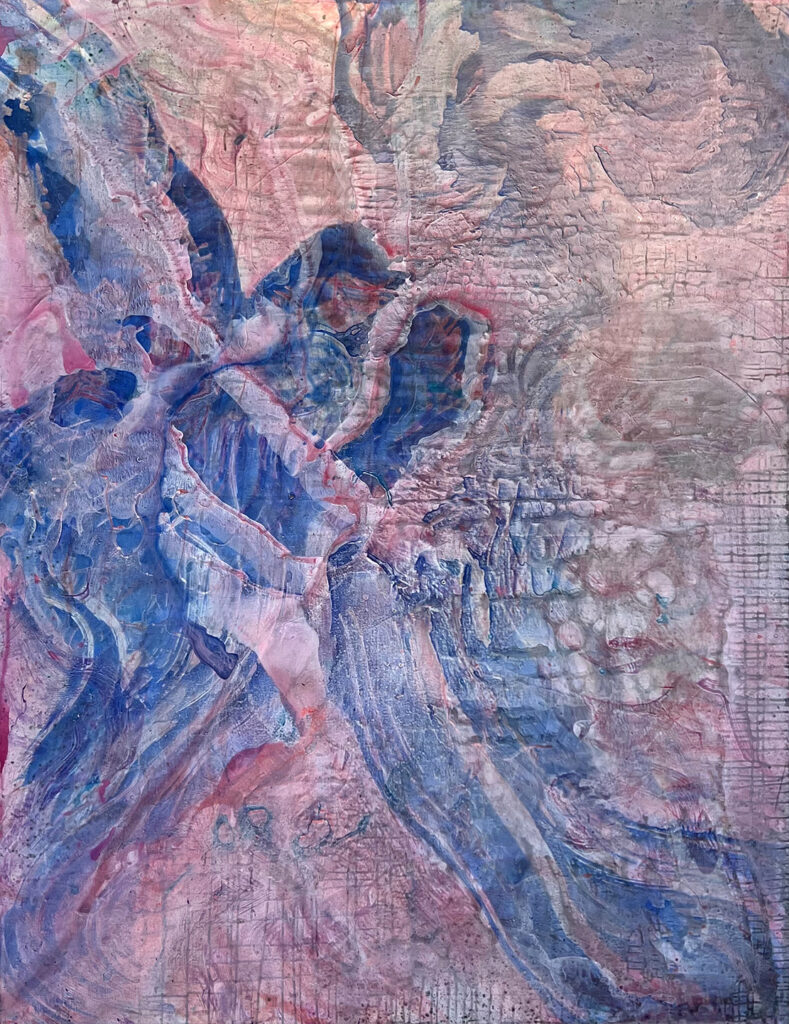
Daniel Rosenbaum, Spirit Guide, 2018, acrylic on canvas, 86x72 in.
Photos courtesy of Woodward Gallery, NYC; © 2024 Daniel Rosenbaum
Daniel Rosenbaum, Spirit Guide, 2018, acrylic on canvas, 86×72 in. Photos courtesy of Woodward Gallery, NYC; © 2024 Daniel Rosenbaum

“Psychedelic” is a word that lately is much in the air, particularly in regard to the therapeutic use of psychoactive substances. It carries forward the traditional practice of mind-expansion via hallucinogenics that re-emerged in the 1960s. Daniel Rosenbaum’s paintings feel like they are part of this perennial, conscious-raising project. His vehicle is just paint on canvas, and the faith that abstraction is like a drug that goes right to brain, bypassing rational thought.

Rosenbaum’s paintings in this two-part exhibition range from works that evoke figural imagery to purely abstract engagements. Throughout are flowing currents of visual energy – rippling linear patterns that create nests of involuted loops and liquid unfurlings. We sense that the mutable nature of paint and Rosenbaum’s physical immersion in it constitute the works’ central drama. A painting’s image arises both spontaneously, and with the visible direction of the artist’s hand. Paint streams and pools, and moves with gestural writhings, becoming in itself a kind of animated body.

The body appears literally in a number of the paintings, including a comet/human hybrid, an archangel with reaching wings, and figures from a Renaissance painting. In two abstract canvases, each about 7-feet tall, Rosenbaum is able to expand his vision of cascading floods of color, which through sensitive layering take on an almost topographical presence, to evoke a watery realm and an airborne spirit.

Daniel Rosenbaum: Inner Guardians, Outer Explorers. Woodward Gallery, 132A Eldridge St. and Down Town Association, 60 Pine St., New York. January 12 – March 31, 2024
Jongsook Kang: Dreaming Desire

by Dr. Thalia Vrachopoulos

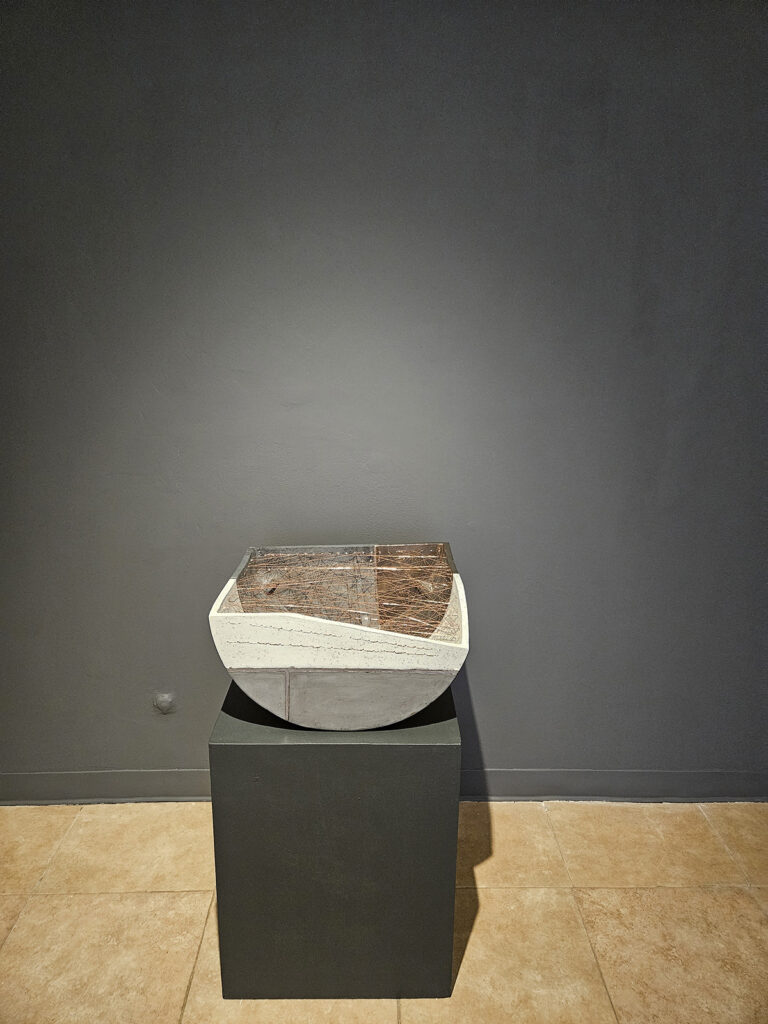
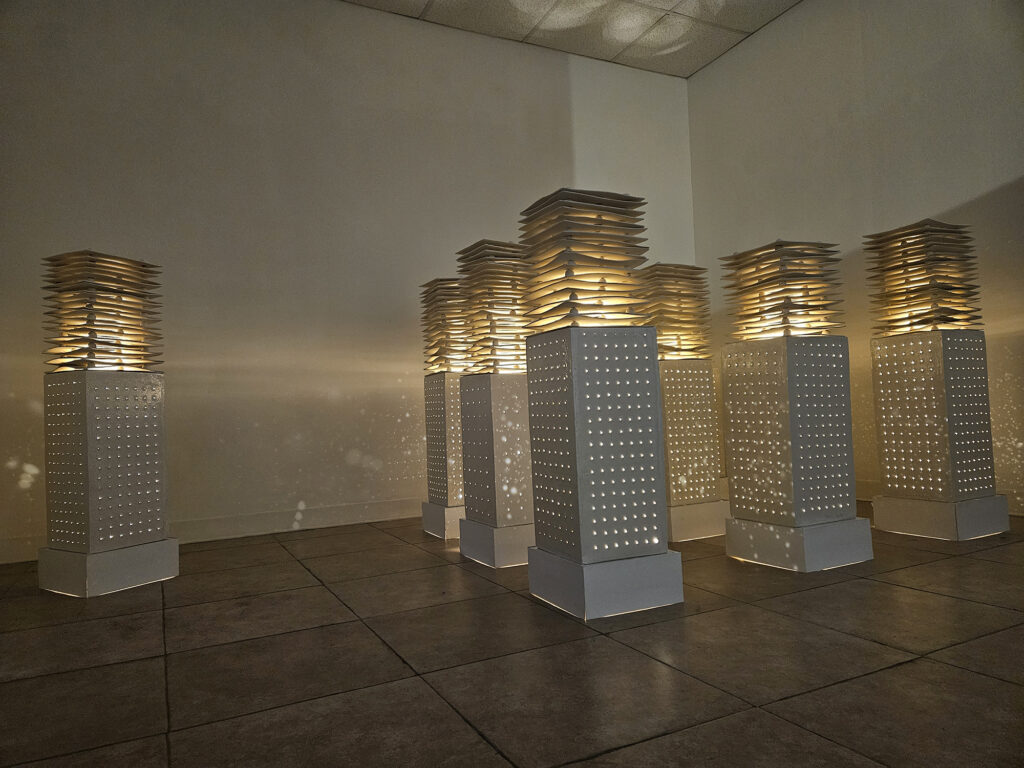
Jongsook Kang, Emptiness and Dreaming, 2023, installation view

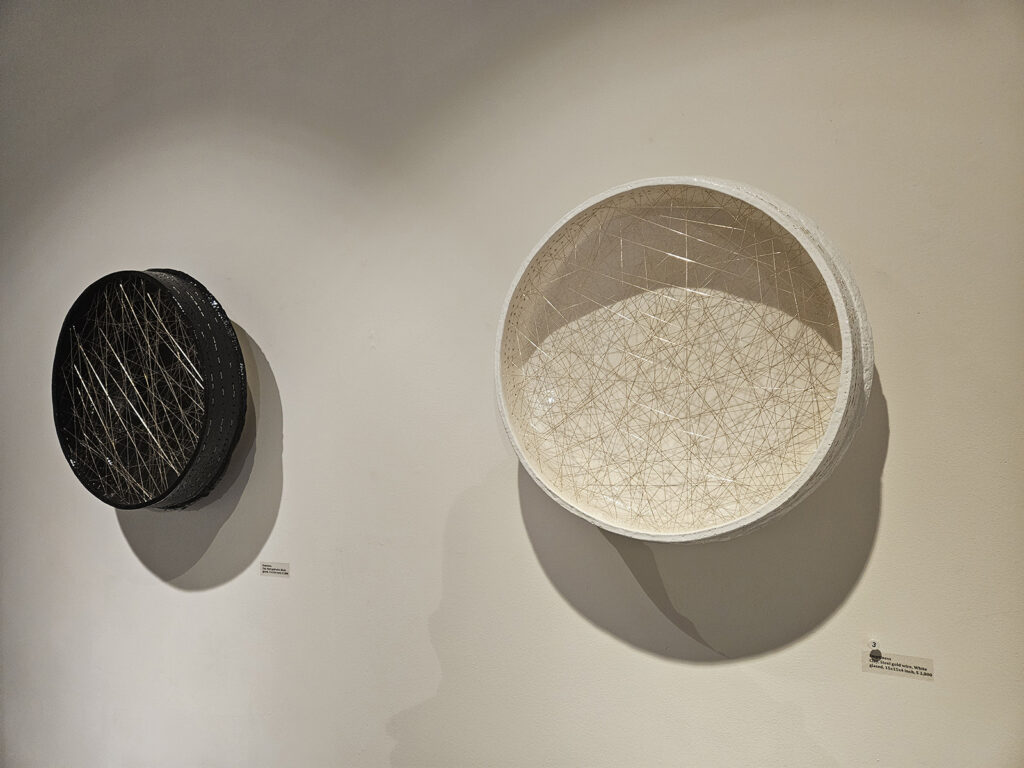
Jongsook Kang’s two-part series Emptiness and Dreaming Desire, presented together at this solo exhibition, manifest the artist’s innermost spiritual and mundane experience undoubtedly manifesting the secret nucleus of her ceramic sculpture in the last twenty years; namely New York/Seoul cities and Eastern Philosophy. Deeply inspired by the mystical teachings of Śūnyatā of Japanese Zen Buddhism, Kang imports a reflective quality that conveys silent introspection by interweaving a nexus of gold, silver, black and copper wires throughout her pieces that faintly recall the Japanese aesthetic of wabi-sabi but also the Korean philosophy of emptiness as fulness called bium. By so doing, she ritually metamorphosizes her objects into memory vestiges of human social networks or relationships in her beloved cities New York or Seoul. These ceramic edifices can be read in terms of the isolation felt during the Covid-19 pandemic, or in general as the loneliness of city life. Simultaneously, they can be seen as reconstructions associated with objects and mnemonic taboos – a transcended net of intertwined potentialities withdrawn from our a-priori forms of time and space – for the deceased victims of the Corona virus crisis.

Jongsook Kang, Emptiness and Dreaming, 2023, installation view

Furthermore, Kang’s delicate layers of clay, which vaguely recall Seoul’s or New York’s towering skylines casually observed from across the banks of Hudson or Han Rivers, deliberately function as metaphors and concrete incorporations of Confucian ontological principles. This philosophy is combined with Daoist aesthetics in Korea to formulate ideas of the yin and yang which represents the opposing yet similar principles of dark/light, feminine/masculine, action/inaction, dark and light in cosmic harmony.

Jongsook Kang, Emptiness and Dreaming, 2023, installation view

Kang skillfully handles physical and architectural space through the precise use of artificial lighting as a metaphysical duality of substantial positivity or negativity (as in in yin-yang Taegeuk philosophy). Moreover, the artist consciously transfigures her skyscraper-like constructions of square plates into imaginative comments about the ever-growing solitude of everyday life, principally experienced in global metropoles like New York or Seoul. Through her sculptures Kang also comments upon the eternal continuation of incessant change in a hectic world of constant becoming. As she laconically wrote in her artist’s statement: “in other words, my sculptures embrace the possibility of countless changes, and infinite possibilities that lead to eternity. The realization of the true colors of yin and yang, in which the eternity of light is condensed, can be said to be my own Dream-Desire”.

Many German philosophers or psychologists of 19th and 20th century Sigmund Freud for example, firmly believed that desire is the inner drive that substantially formulates every human being, while always being dynamic and tenuously alternating between objects and needs. While concurrently eternal and torturously unceasing like a strong current, desire undeniably (re)defines the unique individuality of each and every life form on the planet. Kang’s Dreaming Desire powerfully constitutes the polymorph matrix of opposing desires, in which frenetic life and spiritual emptiness or receptive yin and active yang harmoniously co-exist together despite their existential dissimilarities and internal struggles.

Loy Luo: Secrets

by Jen Dragon

In the current solo exhibition at Mazlish Gallery in New York City, the soulful paintings of Loy Luo evoke timeless songs with unknown origins and infinite possibilities. The abstract artworks have the depth and strength of stone combined with the lightness of air and space. Luo not only encourages her audience to look but also to listen and move in place as they view her art. The musicality comes from Luo’s background as a musician and her notations that are painted on the canvas recount ancient songs of friendship and love. To fully experience the evershifting color, depth and space, the viewer is compelled to move from left to right and from up to down in order to grasp the dimensions described by the powerful presence of each artwork.

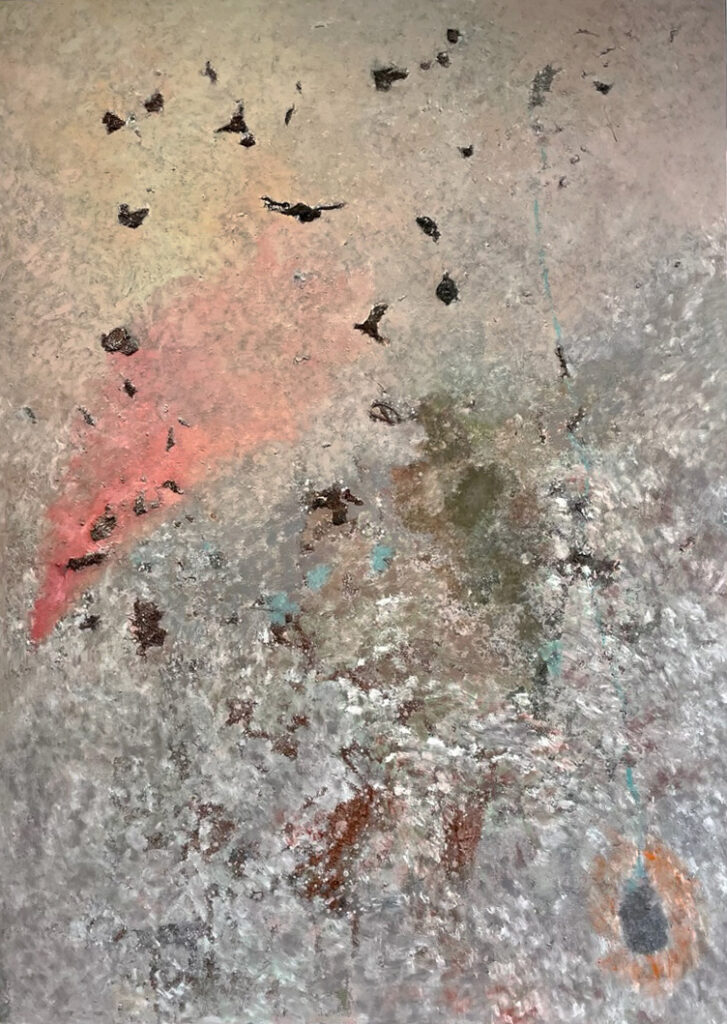
Loy Luo, Abstract Theater A8, 2021, acrylic, oil & mixed media on canvas. Photo: John Mazlish

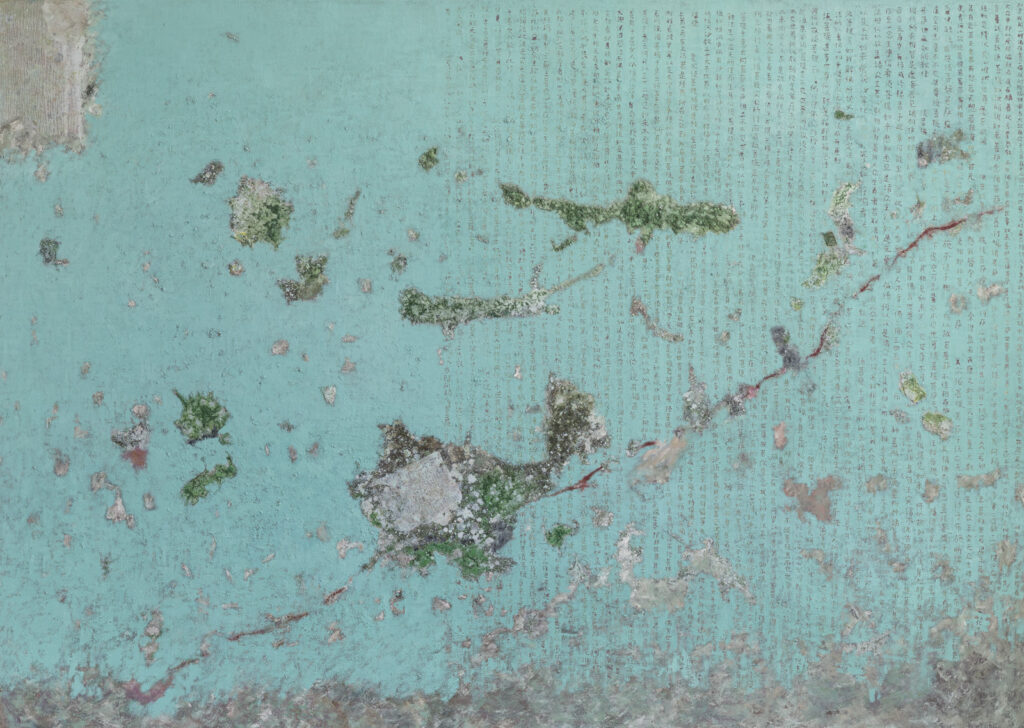
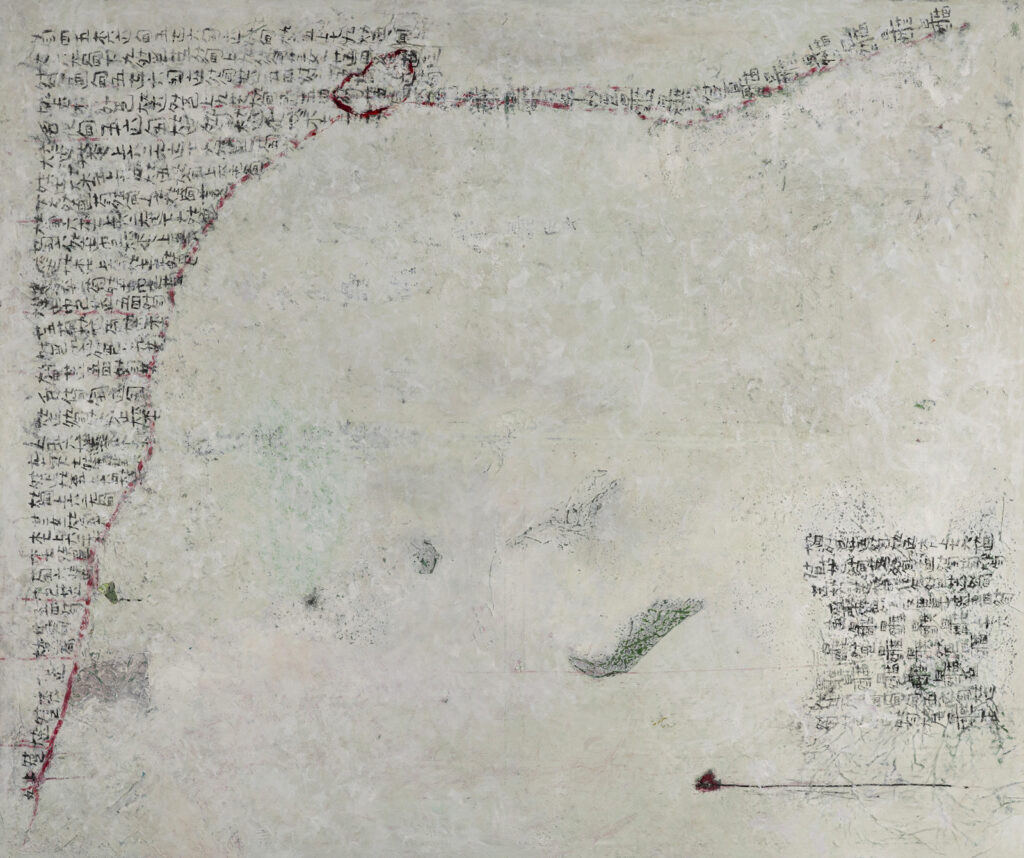
All of Luo’s artworks present a vast, borderless space. In this floating, gravity-free world, Luo paints intangibles with such conviction that these abstractions are made manifest. With precise, deliberate brush marks, Luo creates an alchemic surface that changes according to the ambient light.  In Half Diamond Sutra, the mineral green of the ground unites the suspended marks and objects as well as the calligraphic notations scratched into the patina. In Abstract Theater A8, the sense of the self suspended in the experience of gazing towards a rosy light peppered with floating forms that are at once bird-like yet solid. The vertigo created by this tilting space is caused by a depth of field that seems to accelerate with the passage of time. In the Rune series, the sensation of different spaces is more direct: in Rune 2, the painting evokes the sunlight through trees as one gazes upwards and in the painting Rune 3, the atmospheric blue places the viewer adrift in a celestial orb.

Loy Luo, Half-Diamond-Sutra, 2023, mixed media. Photo: John Mazlish

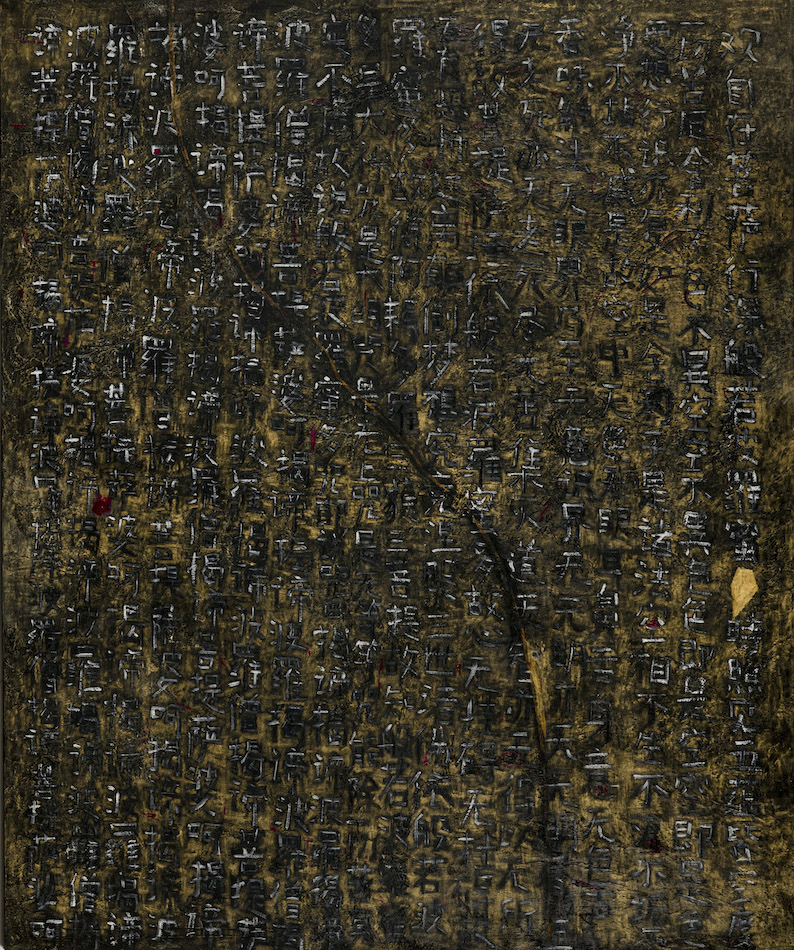
This cartographic quality continues through to the Heart Sutra series. In these paintings, there are luminous pigments lurking beneath a calming overlay of earth colors. It is in the incising of the paint through this glowing patina that Loy Luo reveals the depth of the painting’s journey. Calligraphic symbols rain down the canvases in a constant torrent of memories evoking stories, songs and poems. Some artworks, such as Heart Sutra I, go so far as to play with the light. As the viewer moves in front of the painting, the colors shift magically from black to gold and back to black. This optical illusion reveals and obscures its own meaning, cajoling the viewer to come close and then to step away in a continual “back and forth” sensation. It is only by remaining engaged with the artworks over time does the understanding of the inscribed words, the space and the shifting colors become clear.

Loy Luo, Heart Sutra 1, 2023, mixed media on canvas, 72" x 60". Photo: John Mazlish
Loy Luo, Heart Sutra 1, 2023, mixed media on canvas, 72″ x 60″. Photo: John Mazlish
Loy Luo, Guqin 2, 2023, mixed media, 60" x 72". Photo: John Mazlish
Loy Luo, Guqin 2, 2023, mixed media, 60″ x 72″. Photo: John Mazlish

The most recent series of artworks, Guqin, refer to the horizontal slide guitar native to China with which Loy Luo performs her music. In Guqin I and II, Luo writes the notes of a traditional folk song on a white field. Sometimes the notes are cut off abruptly by a jagged sanguine border like an ancient wound that refuses to heal. In both paintings, the texts seem to have been incised into white marble that is at once solid yet poised to vaporize like a cloud- just as the memory of music disappears just after it is performed.

The uniting force behind all of Loy Luo’s artworks is the immense strength and space she describes with her large abstract paintings and smaller works on canvas. The alternating erasure and endurance of her mark making, the piercing luminosity of her colors and the power of implied telluric currents are all infused by Luo with a lightness of being. The inscriptions are manifested thoughts that rain down in the mind of the viewer like a half-forgotten melody as the artist presents an ancient tale, patinated with age and its accompanying palimpsests, conveying timeless instructions on how to love and live.

Loy Luo at Mazlish Gallery, 98 Mott Street, #600A, NYC N.Y. 10013 • 917-373-4550 • www.mazlishgallery.com

Sophia Vari: A Retrospective

by John Mendelsohn

This fall in New York, the work of sculptor Sophia Vari (1940-2023) is the focus of a retrospective exhibition in Chelsea, and an installation of twelve large-scale sculptures on Park Avenue. Together they give us a picture of this artist’s development, and its culmination in work created from 1997-2011.

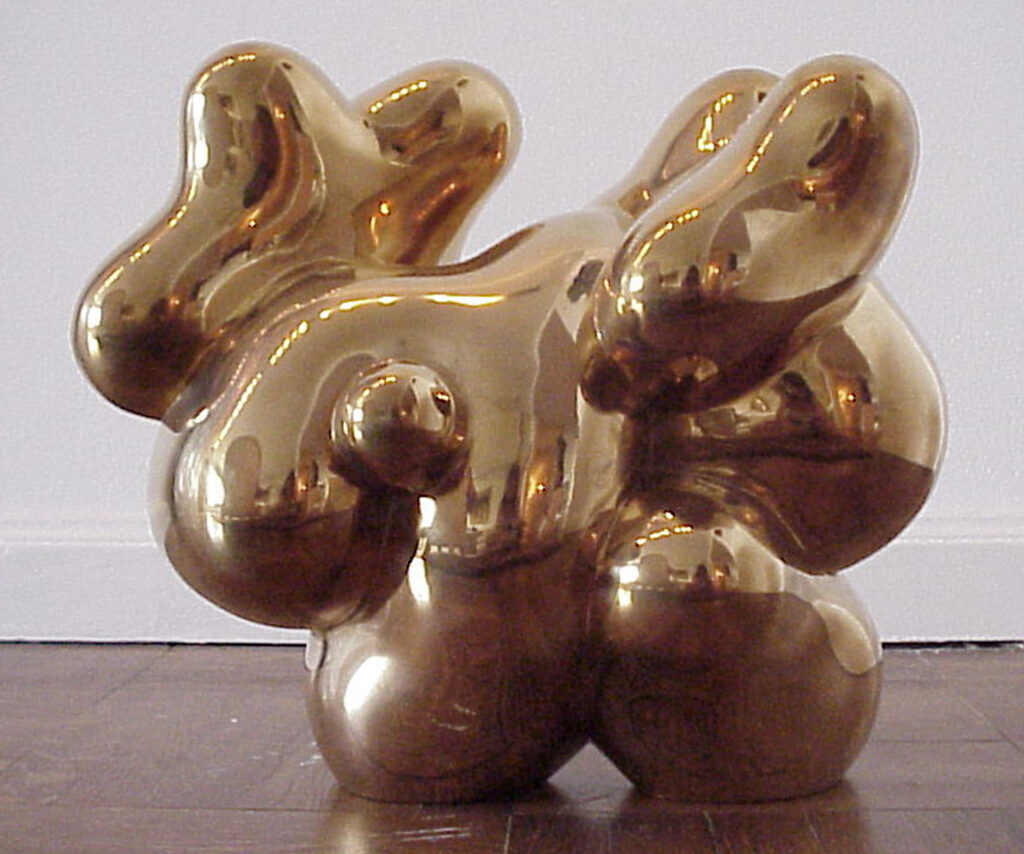
In the exhibition at the Nohra Haime Gallery, the earliest pieces, from the 1980’s, are flowing, rounded depictions of small figures. These works anticipate the abstract works that followed through the 1980s – intriguing, beautiful sculptures whose curved forms intertwine, suggesting organic growth. The mythological titles of works evoke the birthplace of the artist in Attica, Greece. A prime example is CENTAURE ELEVANT DEIDAMIE [Centaur Kidnapping Deidame], with its golden, sensuous bulges suggesting the struggle of Deidame, (also known as Hippodamia, “tamer of horses”) with one of the centaurs who attacked her bridal party, attempting her abduction and rape.

Sophia Vari, CENTAURE ENLEVANT DEIDAMIE, 1988, bronze, gold, 13 x 12 x 10in. 33 x 32 x 21 cm. Copyright © NOHRA HAIME GALLERY. All rights reserved

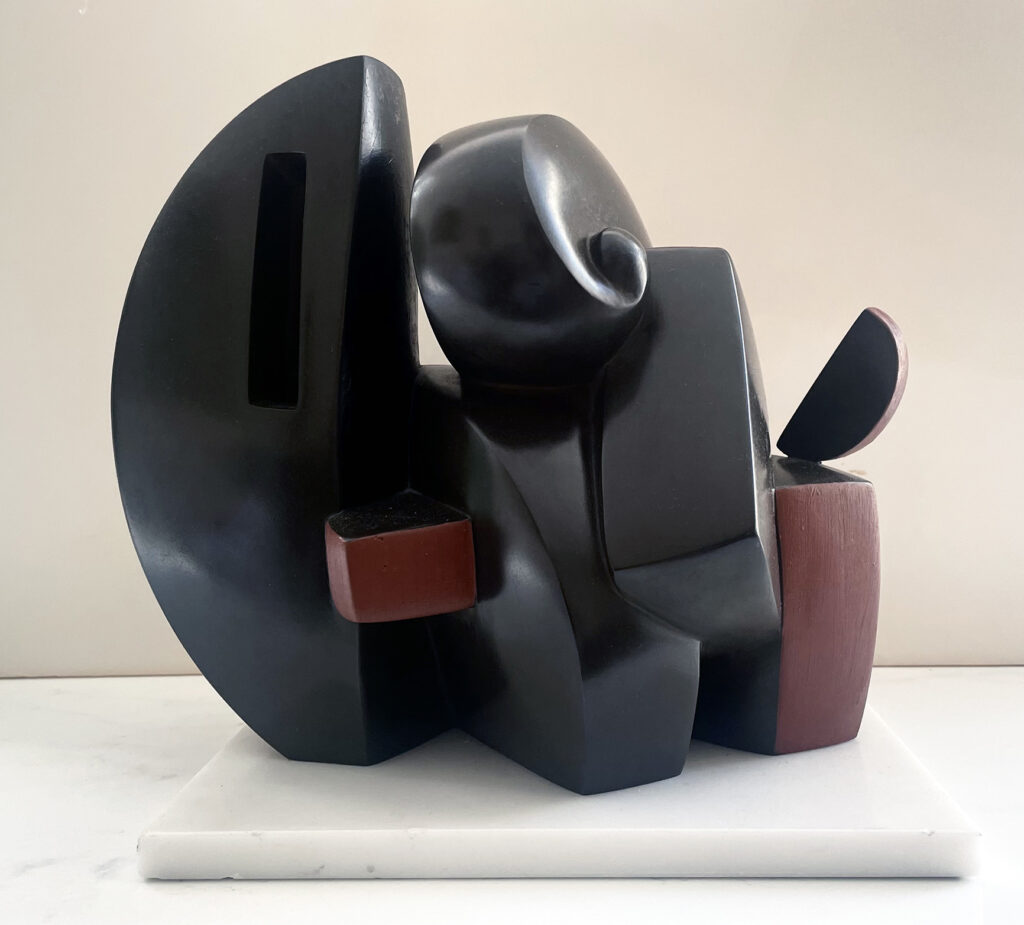
In the 1990’s Vari’s work incorporated a new set of influences. There was an emphasis on intersecting planar structures that seem like a hybrid of the organic and the mechanical. They suggest the artist’s absorbing the examples of both Cubism and the Olmec culture of ancient Mexico, whose art included massive heads sculpted in stone. FORMES DU SILENCE [Forms of Silence] combines soft-edged geometry with curving shapes that suggest plant or animal life.

SOPHIA VARI, FORMES DU SILENCE, 1996 – 1998, bronze, brown patina & terracotta oil, 11 1/4 x 13 3/4 x 8 5/8 in. 28.5 x 35 x 22 cm. Edition 2/6. Copyright © NOHRA HAIME GALLERY. All rights reserved
Sophia Vari, FORMES DU SILENCE, 1996 – 1998, bronze, brown patina & terracotta oil, 11 1/4 x 13 3/4 x 8 5/8 in. 28.5 x 35 x 22 cm. Edition 2/6. Copyright © NOHRA HAIME GALLERY. All rights reserved

From the earlier compact works, Vari progressed to sculptures that stood vertically, suggesting abstract figural movement, and a winding, knotted energy. Polychromed planes, evident in the previous pieces, become defining characteristics here, lending a kind of painterly verve to these resolutely sculptural works. The presence of color and strong form are reflected in the collages from the 1990s through the 2000s, with their canted, rectilinear elements in paper and cardboard, enhanced by trompe l’oeil shadows in charcoal.

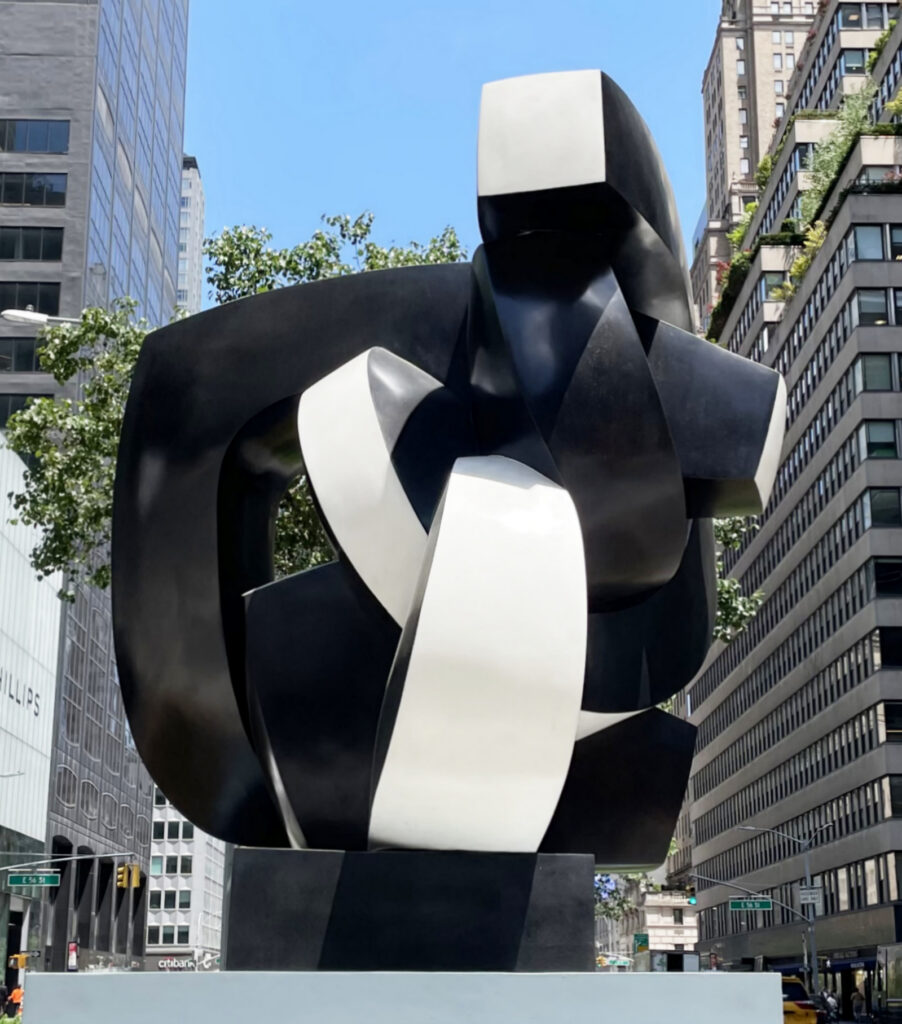
The twelve sculptures installed on the mall on Park Avenue from 53rd to 62nd Streets represent a quantum leap in Vari’s work, both in scale and artistic ambition. Tragically, the artist died just three days before the installation was completed. The work is presented by the Nohra Haime Gallery in collaboration with The Sculpture Committee of The Fund for Park Avenue and the NYC Parks’ Art in the Parks program. This suite of sculptures arrives in New York after having been shown in cities across the world including Paris, Rome, London, Beijing, Athens, Cartagena, and Geneva.

Sophia Vari, Point immobile, 1993. Bronze, black patina and yellow paint. 66 1/2 x 58 x 56 in. (169 x 147 x 142 cm). Edition of 3. Copyright © NOHRA HAIME GALLERY. All rights reserved

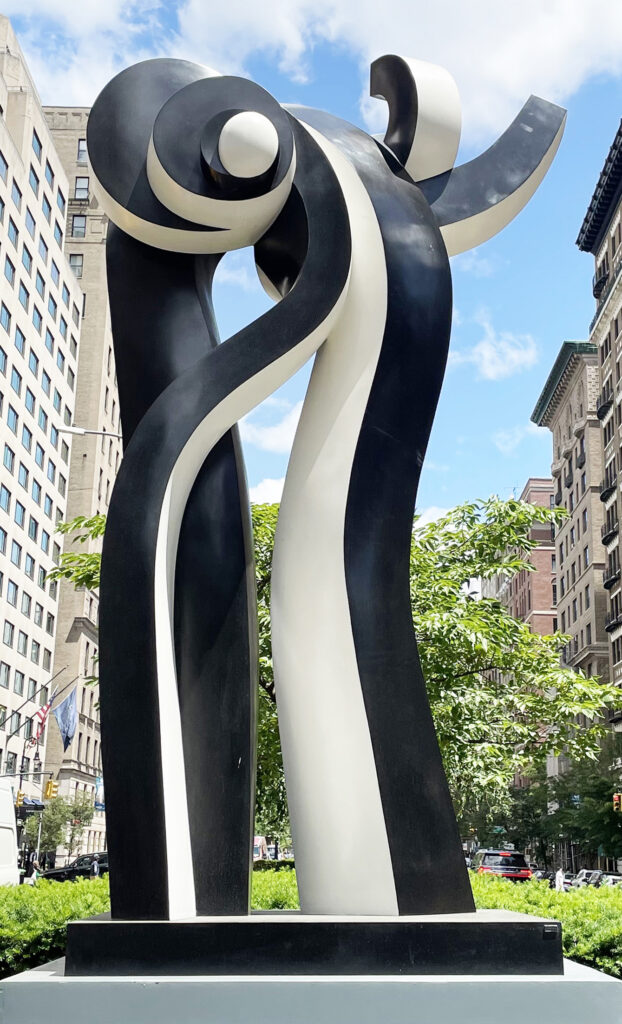
These are muscular, fully embodied works, reductive and staunchly modernist in their visual language of twisting, arced cubic elements. There are echoes of the rigors of Cubism and Constructivism, but a playfulness is at work here too. The sculptures are full of movement and compacted energy, and often suggest human conundrums or even individual personages. The bronze has a black patina, and selected planes are painted, usually in white, but at times red or yellow. The effect is strongly graphic, accenting the choreography of striding, reaching, and locking together.

The sculptures range in emotion from jaunty, to ominous, to satirical, all expressed abstractly. In the piece Point immobile [Still Point], the moment of equilibrium is reached, but paradoxically not by the reconciling of opposites. Rather, like for warring lovers, the quietude begins when the forms are so tightly bound that no further struggle is possible.

Sophia Vari, Les serpentes de la guerre, 1993. Bronze, black patina and red paint. 91 x 52 3/4 x 50 1/2 in. (231 x 134 x 128 cm). Edition of 3. Copyright © NOHRA HAIME GALLERY. All rights reserved

The sculpture Les serpentes de la guerre [The Serpents of War] features sinuous, vertical tentacles whose melding and separating are emphasized by long, white planes that contrast with the black, snaking curves. The planes end in two circular “heads” which hold a single white sphere, a form which Vari repeats, seemingly connoting a node of consciousness embedded in the physicality of form.

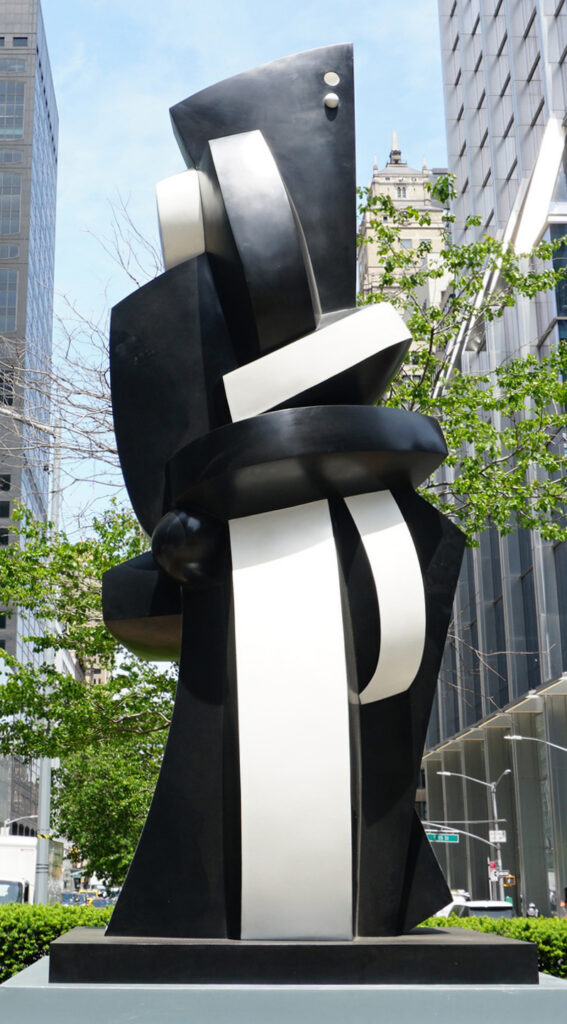
Sophia Vari, L'Homme (The Man), 2004. Bronze, black patina and yellow paint. 118 x 49 1/4 x 41 1/2 in. (300 x 125 x 105 cm). Edition of 3. Copyright © NOHRA HAIME GALLERY. All rights reserved
Sophia Vari, L’Homme (The Man), 2004. Bronze, black patina and yellow paint. 118 x 49 1/4 x 41 1/2 in. (300 x 125 x 105 cm). Edition of 3. Copyright © NOHRA HAIME GALLERY. All rights reserved

L’Homme (The Man), which like many of the sculptures is over ten feet tall, conveys the presence of a figure all wrapped up in himself, a monument to his self-possessed identity. His blindness to his pretention to power is signaled by the two tiny eyes in his massive cockscomb head, one a protruding orb, the other an unseeing concave space.

Sophia Vari: A Retrospective at the Nohra Haime Gallery, August 7 to September 30, 2023 and Sophia Vari On Park Avenue: A Tribute, Twelve Monumental Sculptures on Park Avenue, 62nd to 53rd St., New York, May 20 to November 5, 2023

Carol Bruns at White Columns

by Robert Egert

Carol Bruns, Fringe Elements, 2023. Photos by Marc Tatti, with permission from White Columns and Carol Bruns

Carol Bruns’s work first caught my attention in 2018 at SRO gallery in Crown Heights. Her exhibition showcased a mix of sculpture and works on paper. Her figurative sculptures conveyed the presence of human bodies in space, twisting, straining to emerge from their own materiality. Despite the rough construction and exaggerated physicality of those figures, one could still discern vestiges of humanist dynamics or perhaps a loose tether to drawing or sculpting directly from a nude model.

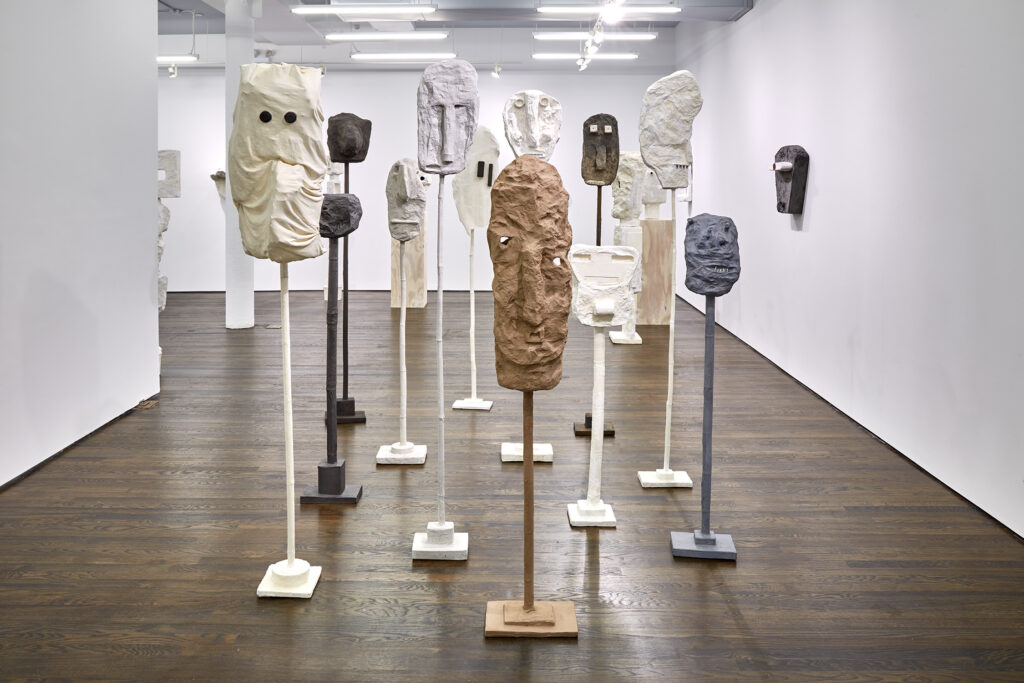
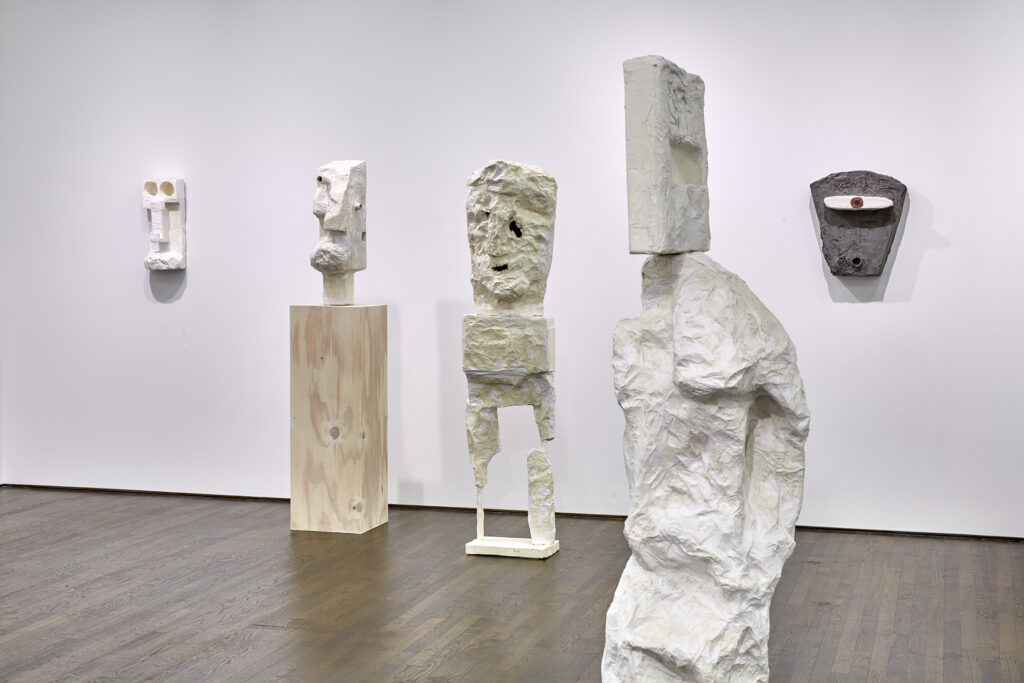
In her new, expansive show at White Columns, Bruns has departed entirely from the figurative tradition and embraced a kind of archaic, mythic approach. The gallery is filled with oversized masks, slender stacked totems, and distorted effigies. While these figures and heads still seem to struggle to emerge from the process of their making, once emerged they say less about the figure and more about the psyche.

As is true for many sculptors, materiality and process cannot be taken for granted, and Bruns has developed a unique process over several years. Her approach produces a papier mâché-like material that is thinner, lighter, and more malleable. It’s flexible enough for her to incorporate other materials such as hair, fibers, plant matter, and Styrofoam. The pieces are predominately painted in monochrome black or white, adding to their stark, confrontational presence while unifying the disparate elements. The final effect is disarmingly fresh, unpretentious, and incredibly present.

A cursory viewing evokes the art of West Africa, Polynesia and other pre-industrial cultures, including archaic Greece. While those connections to the art of past are clear, these pieces go beyond homage or derivation, for the clear influence of psychology and contemporary ideas about the self that are immanent in the work. Bruns cites early twentieth century modernists as an inspiration, in addition to the original, unnamed artists that inspired them, but her work is firmly rooted in the twenty-first century.

Every artist begins with intentions, and for Bruns I suspect the intention is to evoke mythos, to mine the archetypal psyche, to connect with the root forces and human experience that unites us simultaneously to pre-industrial, tribal artists as well as the early twentieth century modernists who referenced them. But, despite all intentions, none of us can help but be mediums for the zeitgeist, and the same is true for Bruns, whose work channels our contemporary state of being, clinging to individuality, polluted by industrialization, and disenfranchised by the post-industrial economy.

Carol Bruns, Archaic Man, 2023. Photos by Marc Tatti, with permission from White Columns and Carol Bruns

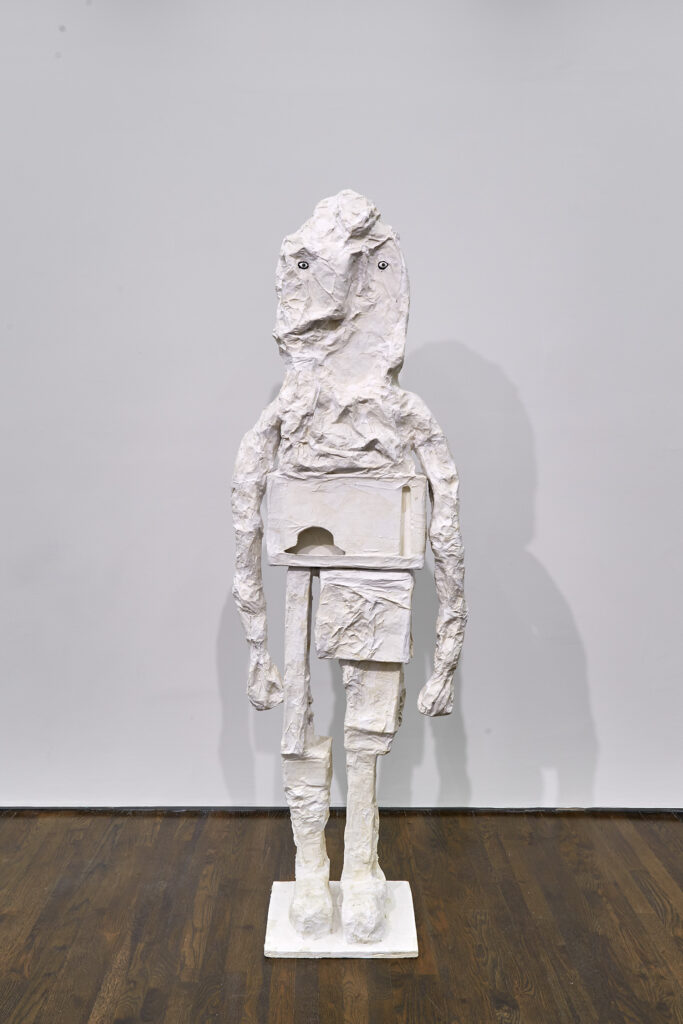
Consider Archaic Man, whose title and direct advancing aspect forces us to consider it relative to the Greek Kouros. We can take this to be a representation of a God in human form but unlike the ancient ones, this is one infiltrated by industrial elements. The classic forward stride of the Kouros is replaced by found objects stacked to an absurd approximation of an articulate leg, rendering a figure that one would more likely associate with having survived a terrible accident than a God descending from Mount Olympus.

Or Seeing in the Dark, which speaks to subjective, interior truth dissociated from shared sensory perception. Here’s a figure that is so totally inwardly focused that their sensory organs have essentially been swallowed back into the head, a totally modern idea that assigns priority to individual, subjective experience over shared truth.

Carol Bruns, istallation view.
Photos by Marc Tatti, with permission from White Columns and Carol Bruns
Carol Bruns, istallation view. Photos by Marc Tatti, with permission from White Columns and Carol Bruns

The White Columns’ exhibition alternates free-standing totems, wall-hung objects, and pedestal-mounted head-like figures. This installation approach emphasizes variety and contrast among Bruns’s work and highlights subtleties among the pieces. This enables us to read the emotional and mental states depicted: Faces that appear crushed, silenced, or occluded, reduced to a mere gash for a mouth or two small holes for eyes. In these pieces the subject is always the interior self while the form is the distorted, tortured body.

Bruns selectively employs a non-transformative approach to materials, often incorporating recognizable found objects like Styrofoam packing into her work. This suggests a fluid connection between cultural vocabularies and expectations. Unlike her earlier work that maintained ties to traditional representation of the human body, Bruns’s new creations invest in the ability of myth and cultic power to transform materials as opposed to representation. Bruns is tapping into the realm of expression that flirts with primordial and introspective emotional states that don’t easily translate into language, evoking at once a sense of ancient mysticism, ritualistic power and contemporary psychology. Her pieces resonate with traditional objects from the distant past, yet they remain palpably contemporary and enigmatic.

Carol Bruns’s exhibition at White Columns serves as an invitation to explore the intersection of ancient symbolism with contemporary concepts of self. Her pieces remind us of the enduring potency of myth and ritual, while mining the contradictions of the contemporary psyche.

Carol Bruns at White Columns from July 13 – August 26, 2023. White Columns, 91 Horatio Street, New York, NY 10014. Tuesday–Saturday, 11AM–6 PM.