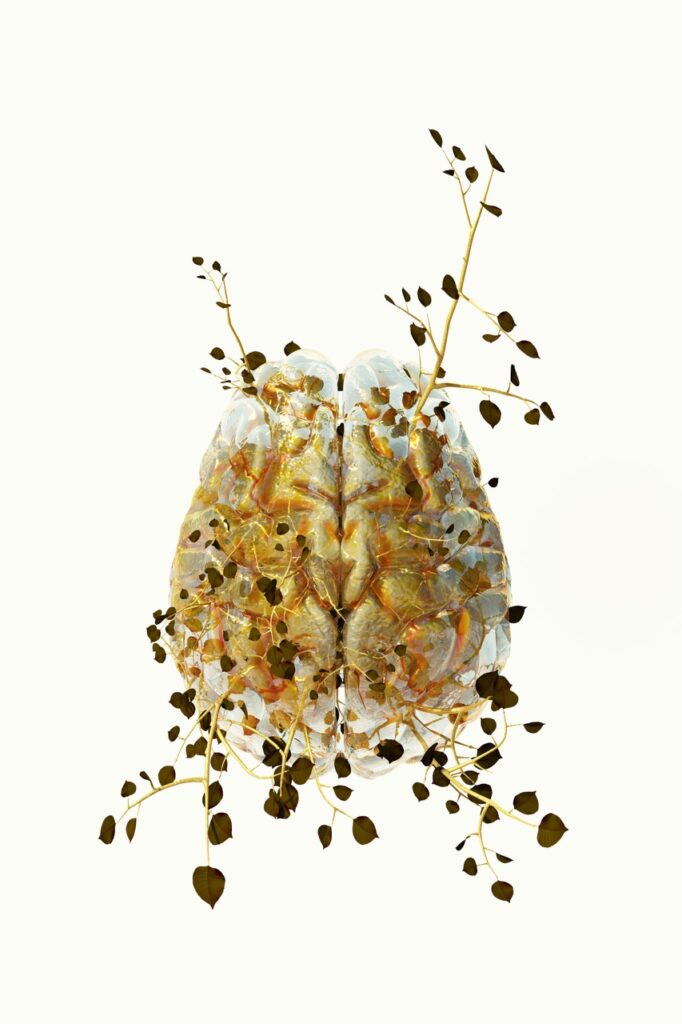
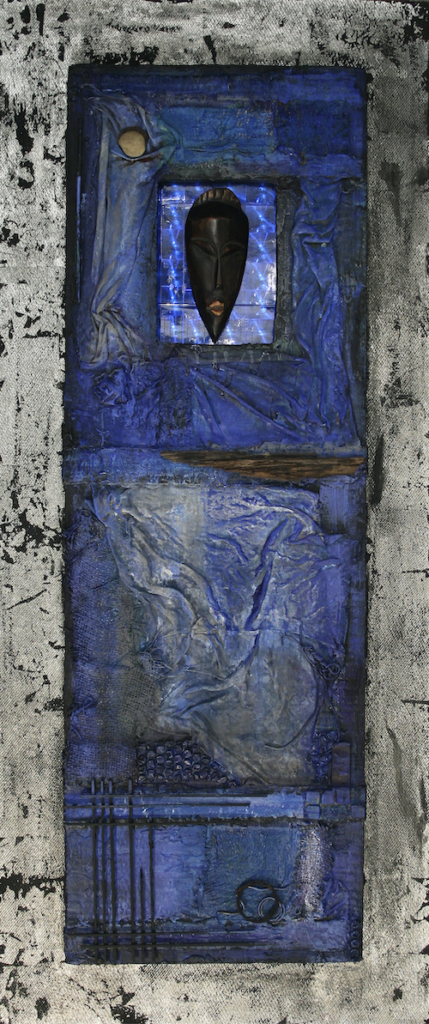
Costos Picadas, Biomes and Homologies, BRAIN, 2023, print 8″ × 20″ on archival paper. Limited edition. Image courtesy of the artist
Costas Picadas comes from Greece, having been brought up in a family of doctors. But, eschewing that way of life, he decided to become an artist and studied in Paris before moving to New York City, where he now lives and works. A few years ago, his paintings were messy affairs, being taken up with dense overlays of rounded globular forms, much like the cells you might see in a microscope. Often, too, scribbles would make their way across the picture plane to the white sides framing the composition. The results were energetic and entertaining, as if the painting had forgotten its own boundaries.
But quite recently, Picadas has become a bit more restrained. His current works make use of similar drop-like forms, but the overlay of skeins of line is mostly gone. In consequence, the artist has moved more closely to classically defined abstract expressionism, an idiom so powerful it still effectively supports current efforts in the genre.
The ab-ex movement was enabled to a good extent by the efforts of foreign-born artists, and so Picadas is working within a decades-long tradition, It no longer makes sense to characterize this work as evidencing the original cultural influences on the artist practicing the style, Instead, the vernacular has become thoroughly international. The efflorescences of Picadas’s paintings are understood at once as joining the efforts of previous artists in New York.
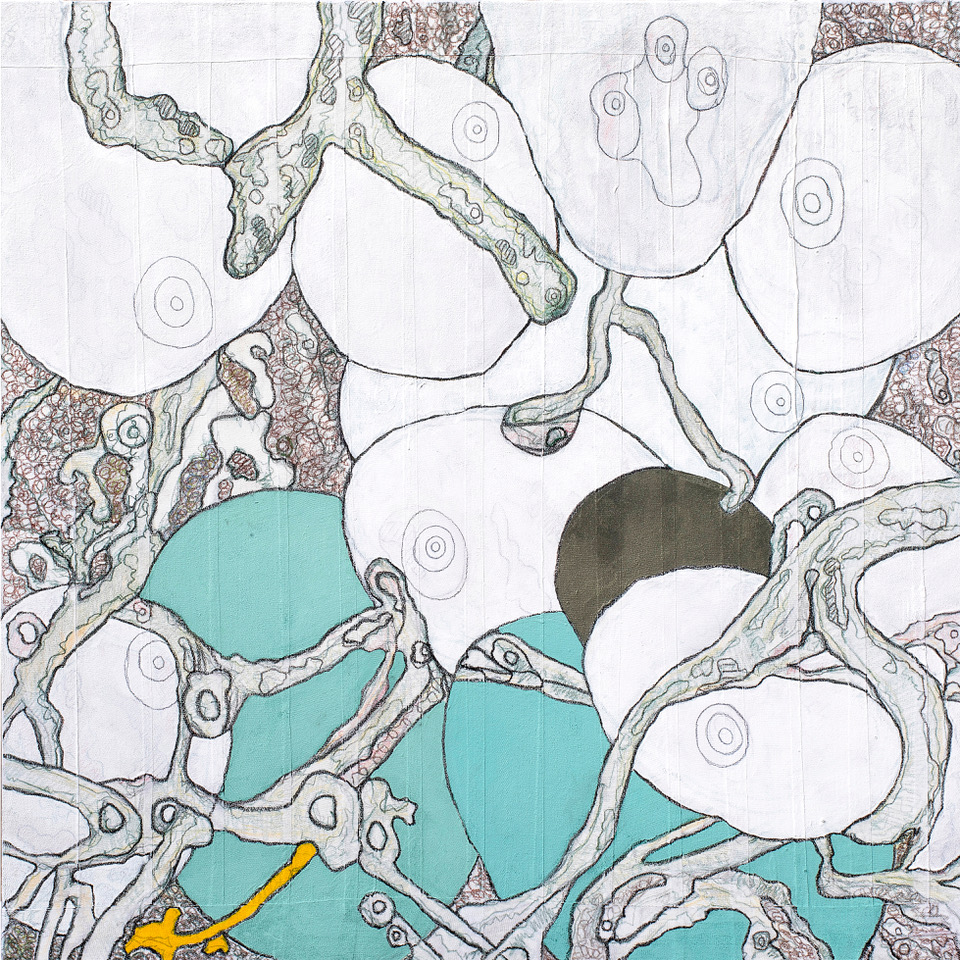
Costas Picadas, Biomes and Homologies, Biome 3, 2022, mixed media on canvas. Size 48×48 Image courtesy of the artist
Yet there are differences, too. Remembering the medical background of Costas’s family, we can imagine his imagery as coming from pictures taken with a microscope’s magnification. The works are hardly compositions for doctors to study, but perhaps there is a trace of medical rigor to be found in the pictures. In the painting Biome 2 (2022), globules in white, with designs within them drawn in a very light gray, drift across the entire composition. They are painted on a grayish wall of bricks. In the lower part of the work, small splotches of black dot the areas between the globules accompanied by pale green, inchoate forms and even a single golden form. This piece surely looks like a slide of some foreign bacterium. The surface, which is busy, carries the interest, although we are unsure about a precise meaning beyond the dense arrangement of diverging shapes.. In Biomae 11 (2022), a black vertical column acts as the major support of the image, but light blue-gray lines, forming circles and rough, undefinable forms, cover the dark mass rising upward. Thinner lines adorn the sides of the column, whose brute force is softened by the embellishments.
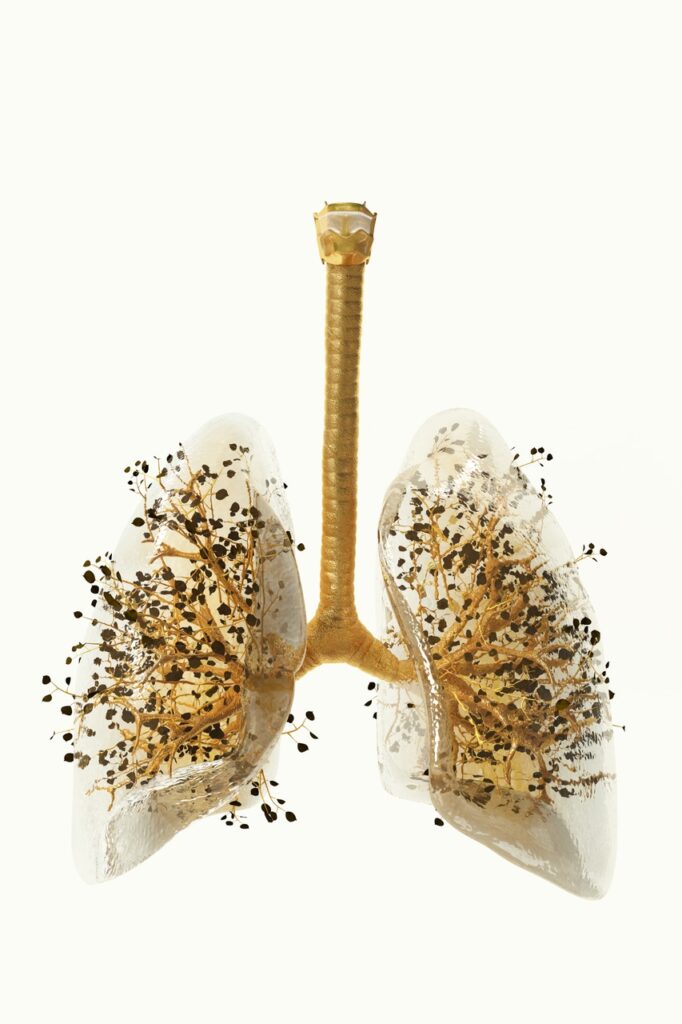
Costas Picadas, Biomes and Homologies, Lung, 2023, print 8″ × 10″ on archival paper. Limited edition. Image courtesy of the artist
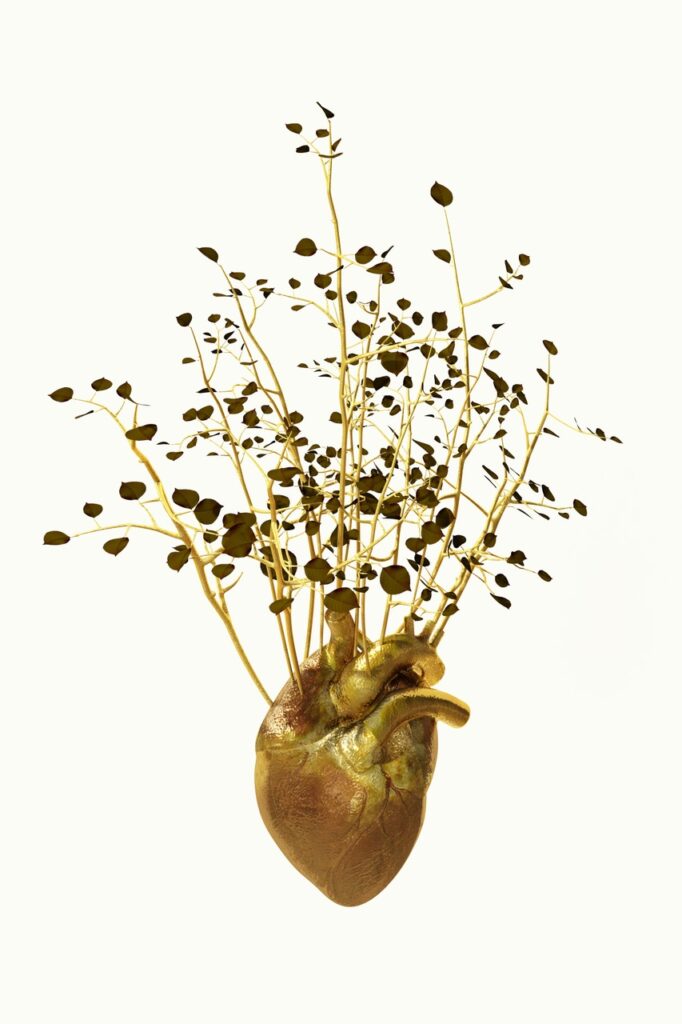
In a separate but strikingly effective group of works, Picadas uses a computer process to generate imagery closely aligned with the body and with nature. The work is small and figurative, but exquisitely detailed in ways that emphasize not only the overall gestalt, but also the sharp details. Lungs (YEAR?), Costas posts a highly detailed, highly realistic vision of the organs of breath: a trachea moves down the composition to split into two pipes, one each going to the semi-oval shape of each lung. Covering the lungs are small black blotches that combine with a tree-like maze of slender stems, ostensibly to carry the oxygen to the rest of the body. The graphic immediacy of the image astonishes; the sharpness of detail feels microscopic. In another image, called Heart (YEAR?), the reddish-brown semi-oval shape of a human heart anchors the thin stalks bearing black blossoms that rise from the upper surface of the organ. Here anatomy meets the lyrical bent of nature, and both appear enhanced by the affiliation.
Costas Picadas, Biomes and Homologies, Heart, 2023, print 8″ × 10″ on archival paper. Limited edition. Image courtesy of the artist
Picadas’s art reverses our expectations by merging the intuitions of the process, its justifications as an interpretation of what we see, with the much more stringent detailing of natural (or scientific) imaging. In his case, the merger makes sense in that he comes from a family whose vocation was scientific in nature. By softening his effects a bit, Picadas mkes it clear that the scientific methods contribute well to a view most effectively disposed toward painting, rather than to the rigors of the lab. Picadas uses his background well, but medicine never overtakes his pictorial intelligence. We can conclude that the painter’s merger, between cellular depiction and free-wheeling abstraction, consistently results in compelling art.
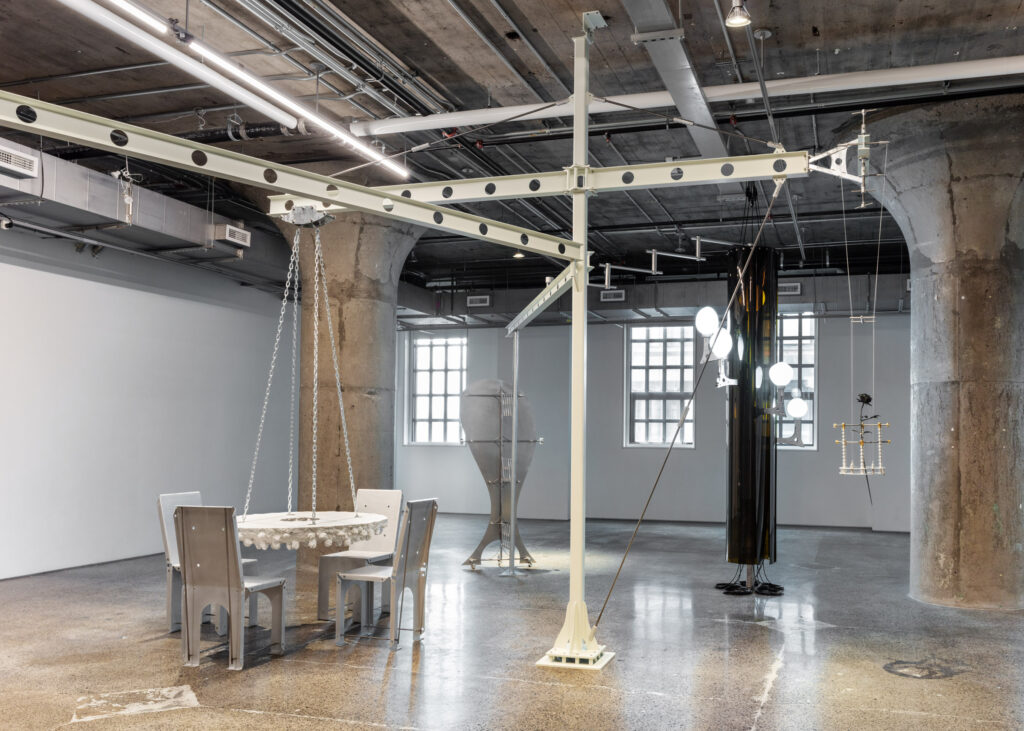
Susan For Susan, Trade Show, 2023. Installation view at MOCA Toronto. Courtesy the artist. Photo: Laura Findlay
The cluster of Spring 2023 exhibitions at the Museum of Contemporary Art in Toronto (MOCA), might best be viewed as a bouquet of sorts, its vase the Auto Building, a 10-storey architectural industrial heritage building on Sterling Road. Built in 1919 by the Northern Aluminum Company, the building is characterized by its exposed concrete framing and used as an aluminum foundry and manufacturing plant that was operational as recently as 2006. Its adaptive reuse for the creative and digital sector, as well as its museum venue, seems still to be in the process of completion, and the “landmark structure” as a whole might fully be appreciated when its grounds and architectural nesting are complete.
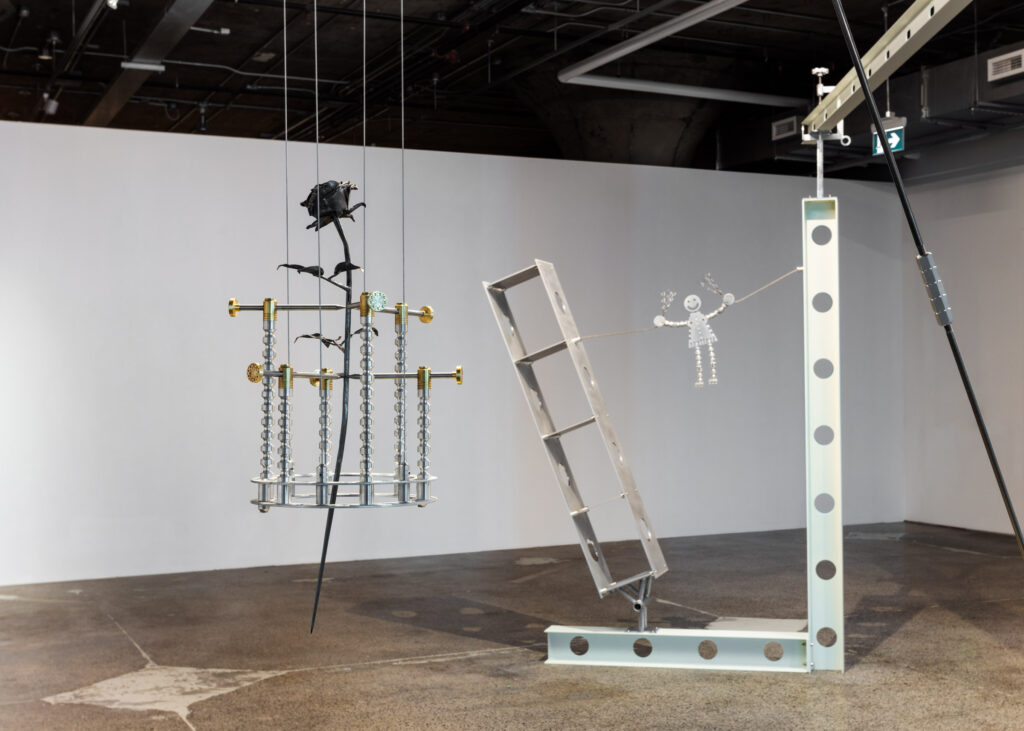
Susan For Susan, Trade Show, 2023. Installation view at MOCA Toronto. Courtesy the artist. Photo: Laura Findlay
Exhibitor Susan For Susan, the collaborative design team of brothers John and Kevin Watts, in their Trade Show exhibit, delivers the bridge between the cultural practices of art, architecture, and design. Central to the exhibit is an elaborate gantry – a system for moving heavy loads across warehouse floors.
Trade Show is essentially one big sculpture broken into separate parts: a concrete table suspended by chains with a set of box pan chairs, an accordion movable metal mirror, a lamp column structure, and a tilting metal bookcase held in place by the out-stretched arms of an aluminum puppet. An ironically creepy component of Trade Show is a lizarov frame holding a handcrafted black rose made of steel. The lizarov method is used in surgery for limb reconstruction and reshaping bones, but its use here inevitably brings to mind the iron maiden, a medieval torture device with spikes that enclose a human being.
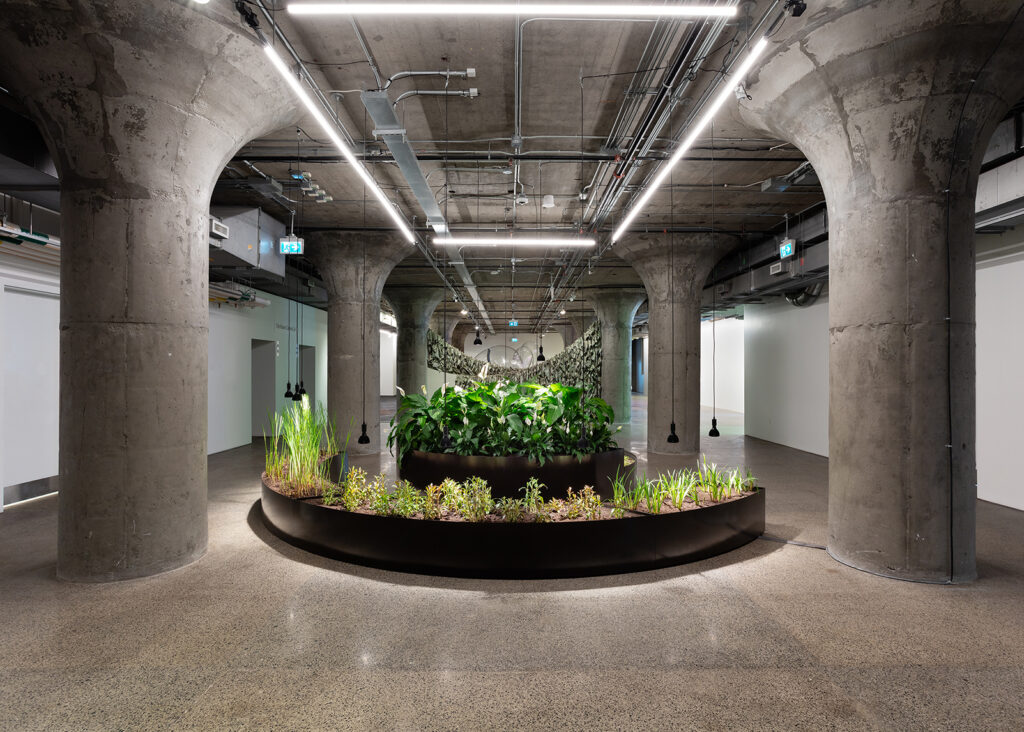
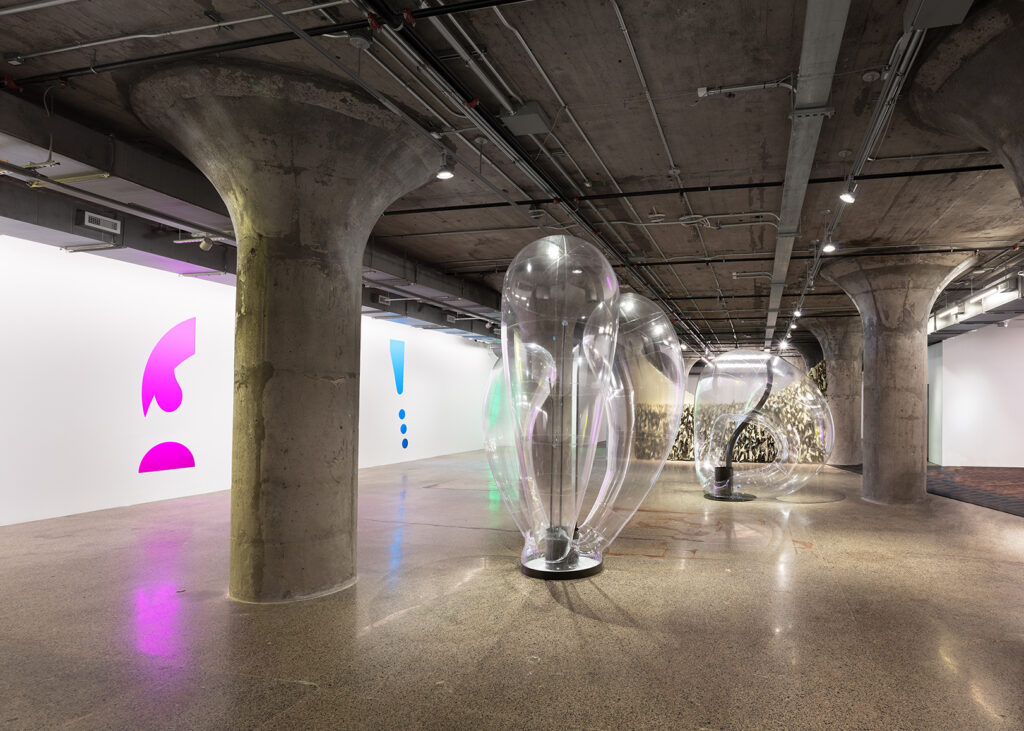
Canadian-French artist Kapwani Kiwanga is presented at MOCA with her first major survey exhibition in Canada. Her Remediation exhibit is the product of researches into the tensions between toxicity and regeneration of our environment. She studied anthropology and comparative religion at McGill University, but her focus had been medical anthropology. In view of the violent convulsions that the earth has undergone over time, Kiwanga has been interested is in how nature and humankind have variously responded to these phenomena. MOCA’s industrial past inspired the artist to produce many new site-specific works such as flooring and window interventions and inflatable vivariums. In natural settings, plant life has found a way to fight back from contaminated environments. On the other hand, Kiwanga has succeeded here in seeding MOCA’s brutalist interior.
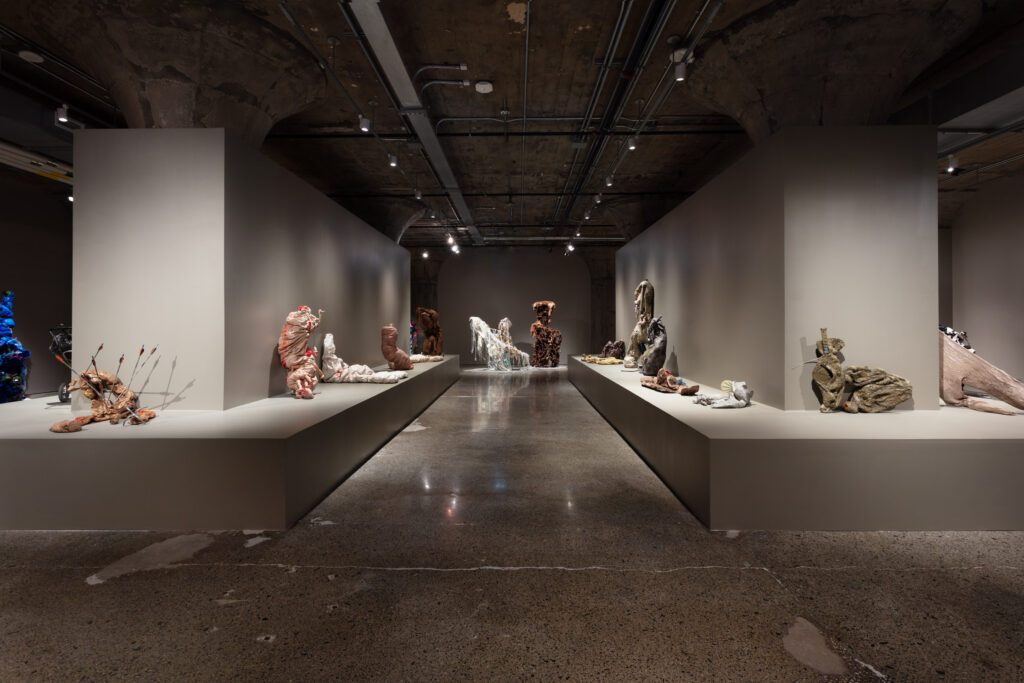
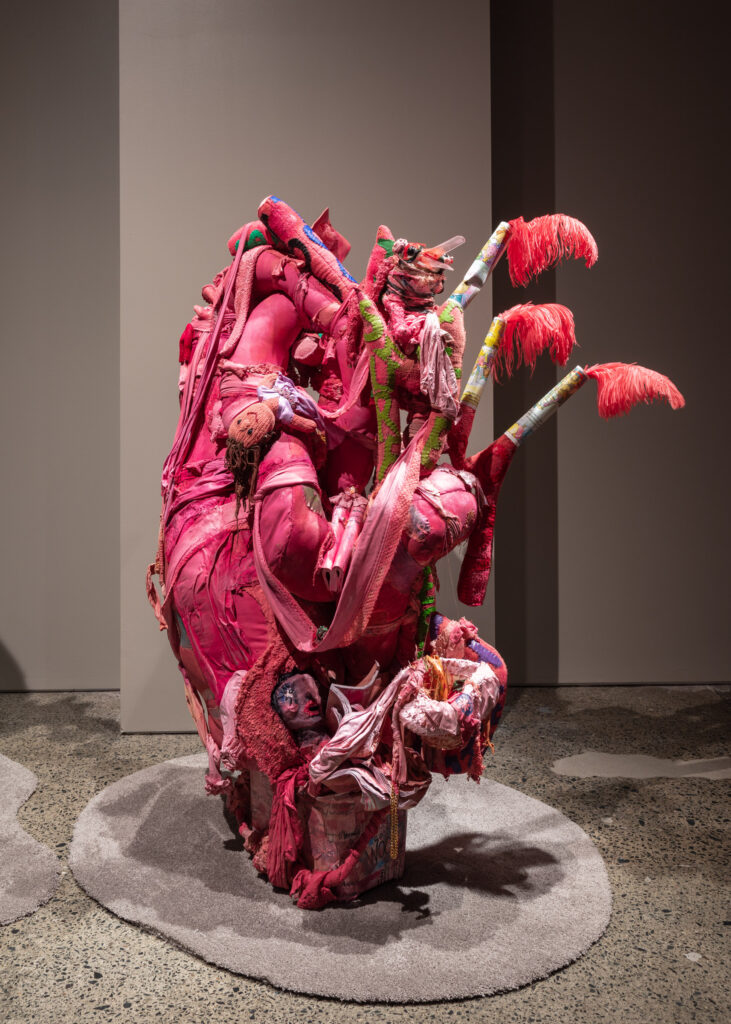
Commissioned by MOCA Toronto, Greek/Canadian artist Athena Papadopoulos produced her large-scale sculptural works The New Alphabet in response to the isolation of the past two years of the pandemic. The first of two bodies of work, Bones for Time makes use of hospital and wool blankets that mime the artist’s body shape into letters. With Trees with No Sound, Papadopoulos finds new use for unwanted furniture, clothing and stuffed objects. It seems that almost anything may grace a Papadopolous tableau, from hair dye, lipstick, red wine, bleach, shoe polish, and iodine tincture to nuts and bolts. The artist’s working process is an exultation in the breadth of cultural effuse and its subsequent regurgitation creatively. She has stated that “The works are not meant to be moving upwards towards a point of precision, they are of a world that is downward and sprawling.”
Athena Papadopoulos, 2023. Installation View, The New Alphabet, at MOCA Toronto. Courtesy the artist. Photo: Laura FindlayAthena Papadopoulos, Trees with no sound: Manzanilla de la Muerte, (Little Apple of Death), 2023. Installation View, The New Alphabet, at MOCA Toronto. Courtesy the artist. Photo: Laura Findlay
The ground floor of MOCA’s North End Gallery features Turkish conceptual artist Serkan Özkaya‘s installation ni4ni, or as it would be read when sounded out, “An Eye for an Eye.” The artist combines digital technology with a massive, mirrored sphere for a truly immersive experience, a sense of having been shrunk to the size of a blood vessel, an experience not unlike the 1966 sci-fi adventure Fantastic Voyage. Here it’s a journey toward an all-seeing eye that casts a 360 degree image. The technology has roots that date to 100 A.D., with scientist and astronomer Ptolemy, who had developed an equi-rectangular projection method able to translate a spherical surface onto a plane.
Serkan Özkaya, ni4ni v.3, 2023. Installation view at MOCA Toronto. Courtesy the artist. Photo: Laura Findlay
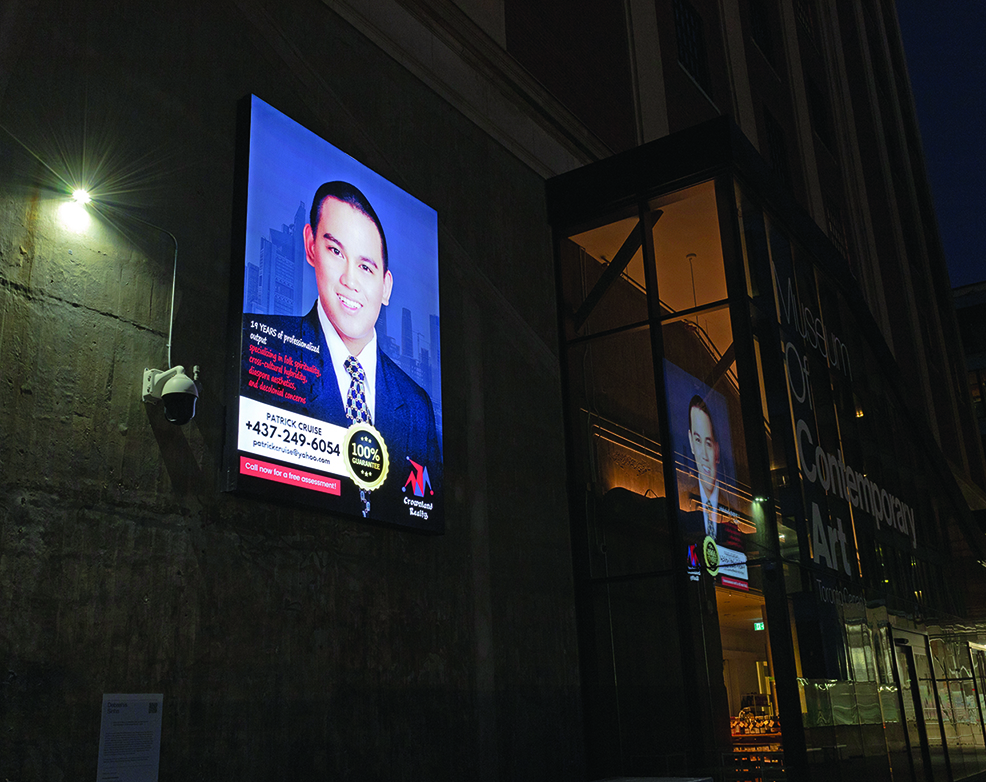
Approaching the MOCA Auto Building from the rear and seeing a billboard for an apparent real estate advertisement seemed peculiar for an art museum, but less so having exited the museum. Crown land is, in fact, a portrait of Philippine-born artist Patrick Cruz at age fifteen, appearing in the sign as a realtor. If the Cruz lightbox signals an implied entanglement of art world with real estate, and there might be some truth to it, in terms of the present cluster of exhibitions, the connective threads between building, museum, installation, and individual artist, coalesce nicely here into a cohesive whole.
Patrick Cruz, Crownland, 2023. Installation view at MOCA Toronto. Courtesy the artist. Photo: MOCA Toronto
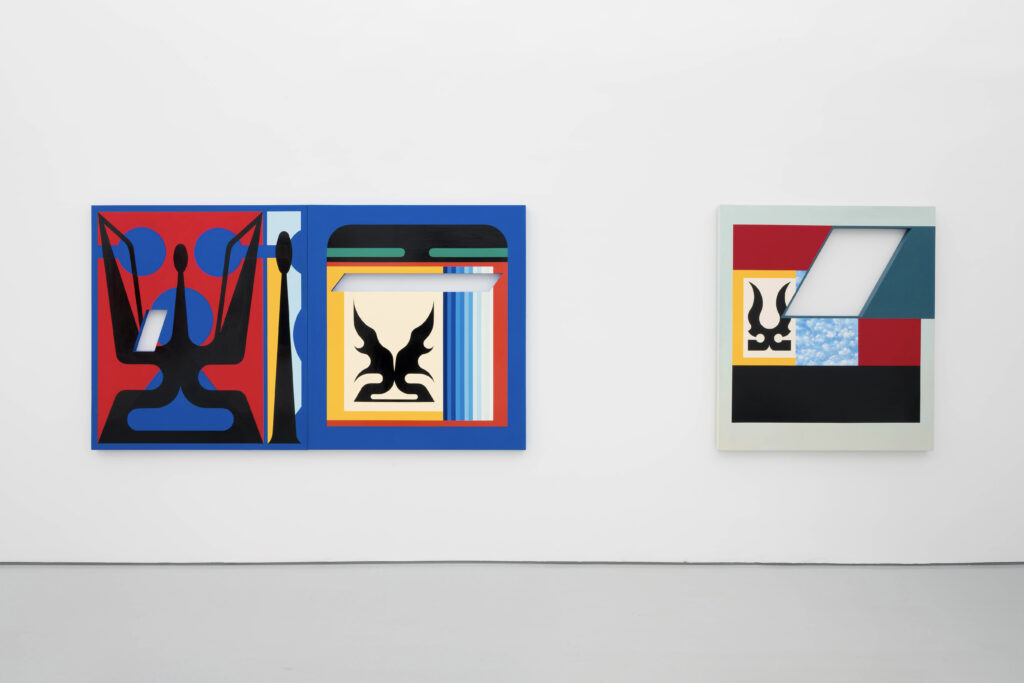
Francesco Igory Deiana installation viewInstallation view from left: Francesco Igory Deiana, Untitled, 2023, acrylic, one shot enamel, latex paint on wood, 137 x 244cm, 54″ x 96″, unique. Right: Untitled, 2023, acrylic, one shot enamel, latex paint on wood, 137 x 122cm, 54″ x 48″, unique
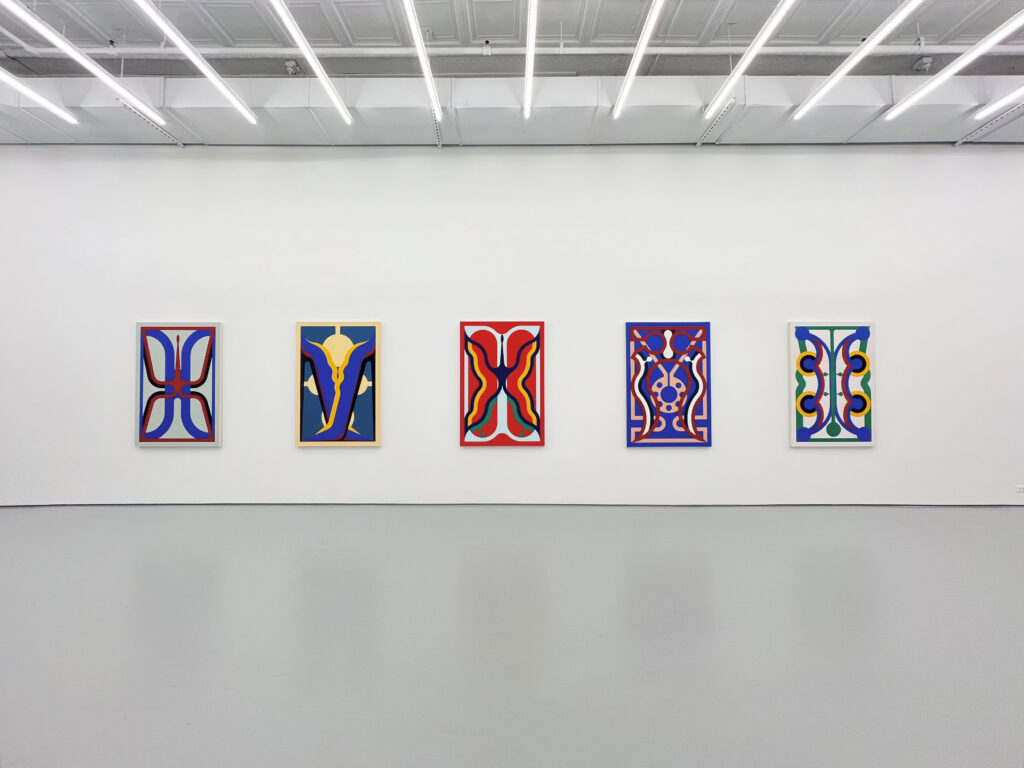
Francesco Igory Deiana’s exhibition comprises three different mediums and several entirely disparate approaches to art making: drawings, paintings, and sculptures. The salient unifying feature is that all of the work is exquisitely well crafted. The paintings, which make up the bulk of the show, are rendered in latex and acrylic in solid bright colors, for hard edged abstractions with strong, simple graphics. Ribbons of color, some shiny, some matte, wriggle down and across the surfaces. There are emblematic wings that might be borrowed from a Bavarian crest and stylistic serifs flare off in the otherwise essentially symmetrical compositions. In the back area of the gallery one larger and one smaller painting face each other. These two portray folding screens adorned with various abstracted motifs.
Francesco Igory Deiana installation view
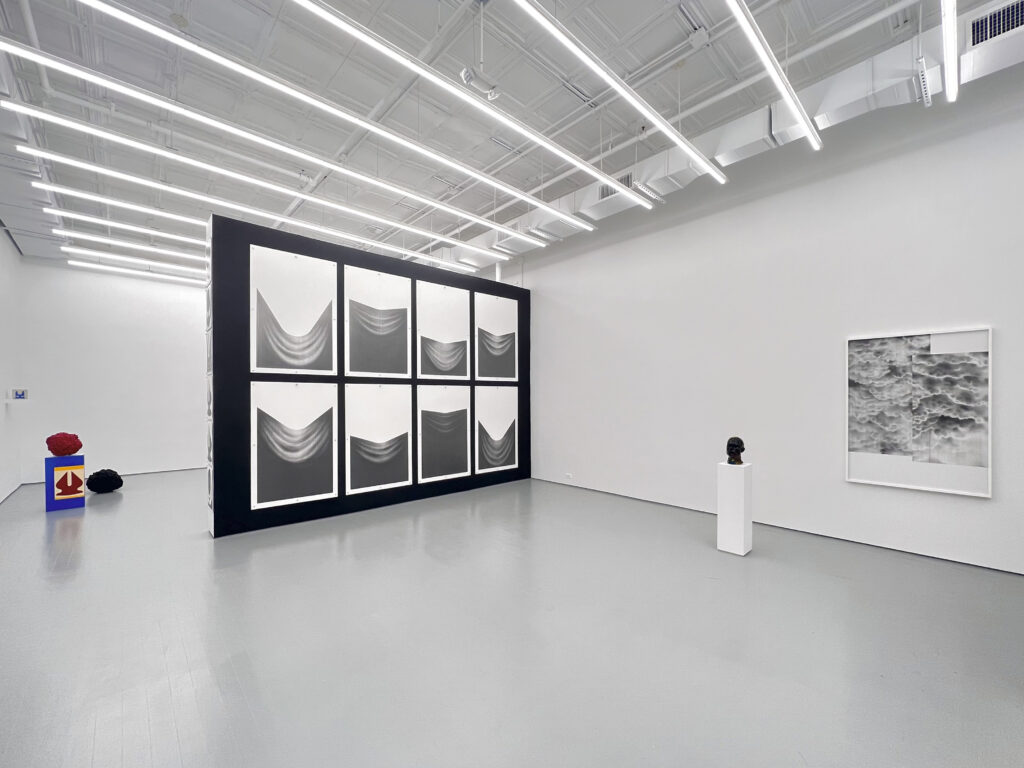
The monochromatic graphite drawings are backed with smudgy cloud formations like shimmering or dappled light. Atop this parallel vertical straight lines run about an eighth of an inch apart, like piano strings, twinkling in and out of the gloaming hypnotically. They are poster sized vertical rectangles; hung in a grid four across and two high. The imagery is cut off midway in a crescent so that the way they are displayed one has to either bend down or be very tall to look at either row straight on which forces the viewer to experience them peripherally and swoon a bit with the illusionistic Op Art effect.
There are fewer sculptures: a couple of globes resembling balls of wool and a cast, pigmented resin human head. It is not clear what ties these pieces in thematically with the rest, but in its gestalt the display is entirely appealing and sensually gratifying.
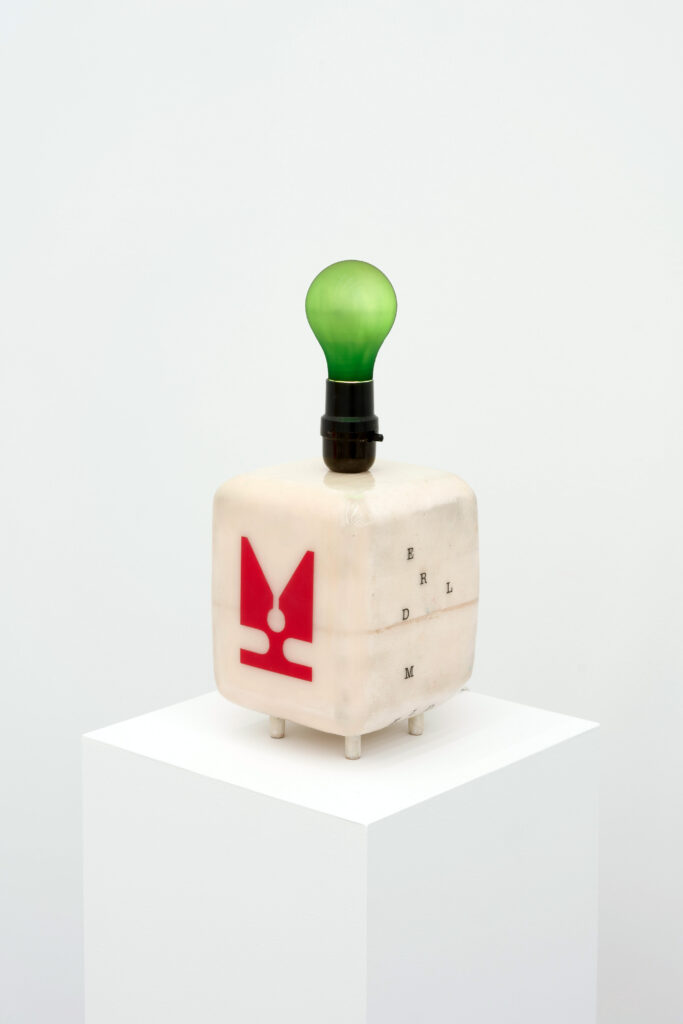
Francesco Igory Deiana, Dream Light, 2022, foam, resin, acrylic, lamp, 33 x 14 x 14 cm, 13 x 5 1/2 x 5 1/2 in unique FD/S 9
Francesco Igory Deiana: CRAZY ANGEL at Ruttkowski;68, New York City from April 7, 2023 to May 13, 2023
The Counter/Self, the title of this exhibition, immediately captured my attention. I have always been interested in the hidden characters of people, including myself. We all have many faces and various personalities in addition to the one we consider our true self. It brings to mind Janus with his two faces in mythology and all the people through historical and contemporary times who often changed their personalities. As I have experienced myself, it can happen when we’re under social pressure, relocating, or trying to succeed in a society that has a different culture than the one we’re used to. Every self is performative and we also summon different characters to avoid conflict with others or to please them, as needed. Each of us express or hide our various sides of ourselves. Both social and personal identities are created by inner drives and external expectations that mirror our dreams and fears. There are also the masks we choose to put on intentionally to transfer us into another world or character. So, I thought this exhibition would offer endless possibilities in addressing this complex and exiting theme.
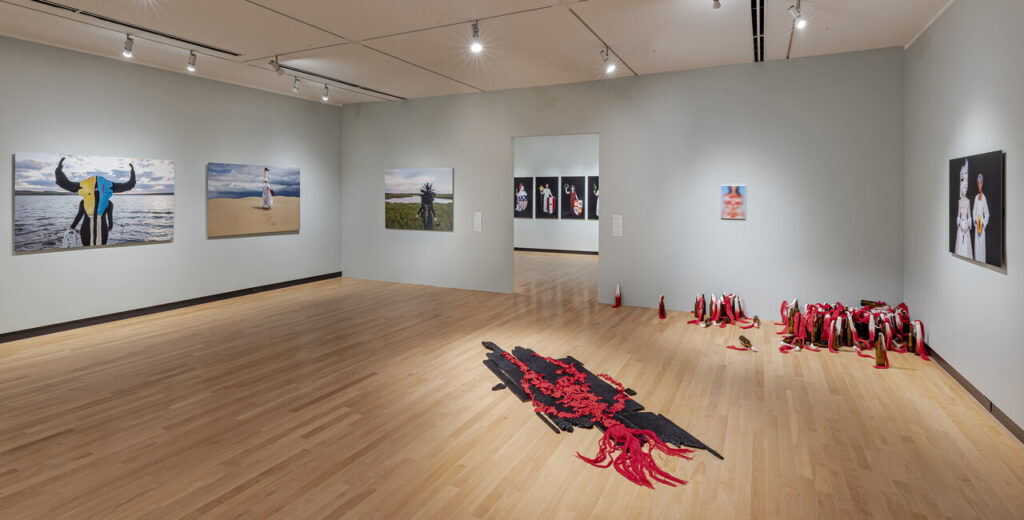
Installation view of THE COUNTER/SELF, Art Museum at the University of Toronto. Photo: Toni Hafkenscheid. Courtesy of the Art Museum at the University of Toronto
In this exhibition at the Art Museum at the University of Toronto in its Justina M. Barnicke Gallery, Indigenous and diasporic Canadian artists analyze both national and personal identities by creating imaginative alter-egos with challenging narratives.
The first image we encounter is Meryl McMaster’s My Destiny is Entwined With Yours from the series As Immense as the Sky (2019), depicting a woman wearing shaman-like clothes in a grandiose landscape. Coming from a nêhiyaw (Plains Cree) and British/Dutch background, ancestral history is very important to McMaster and is the central theme of her photography. Each image is a contemplation on how one’s identity is formed. She traveled across Canada to site specific locations and research in order to re-experience ancestral stories learned from Elders, Knowledge Keepers within her Plains Cree community, family members, and friends. All of the images have a story to them, documenting the artist’s relationship with the natural world and the history written in the landscape. She admires the beauty of the land, listens to its wisdom but also fears for its future. In her explorations of the self, McMaster’s photographs reimagine many of the stories and traces left behind by different cultures.
Meryl McMaster, My Destiny is Entwined With Yours, from the series As Immense as the Sky, 2019, chromogenic print. Courtesy of the artist, Stephen Bulger Gallery and Pierre-François Ouellette art contemporain
She often talks about the collapse of time into the present, while we often feel being outside of time when looking at her artwork. Her concept of time comes from two overlapping ideas. One is that time is a linear path that extends from the present in all directions, while the other one is recurrent and cyclical.
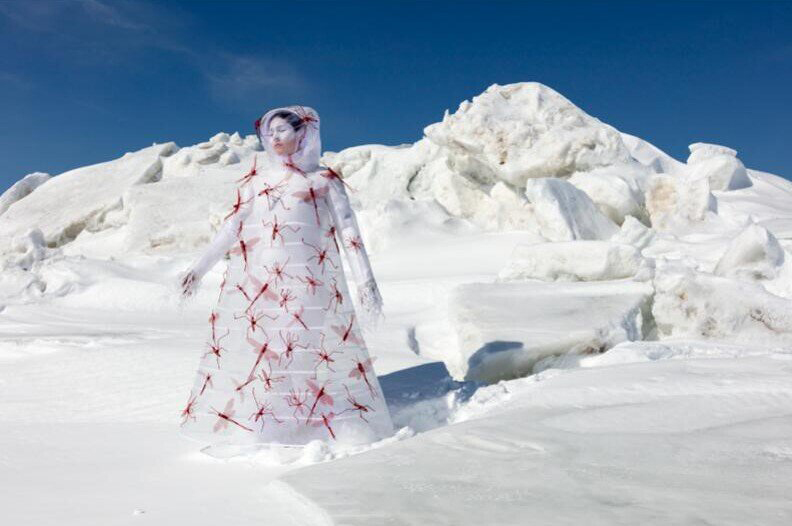
In the series As Immerse as the Sky, McMaster focuses on how the experience of time shapes the self’s connection to the immediate world. She creates dream-like images aiming to break down the barriers of time and space, picturing realities of collective history and the present, in new ways. Her image-making procedure starts with assuming a persona with a character and then playing out the story. All images are private performances, the artist’s responses to memory and to emotion. Landscape plays an important role as a dominant element in the composition as well as in creating the mood. The artist believes that the land holds more knowledge and power than we are able to see. Her pieces feel real as well as magical. Otherworldly figures populate the landscapes wearing mysterious sculptural attires. The created image is mythical and mystical at the same time. What Will I Say to the Sky and the Earth II (2019) is staged in a winter landscape where everything is covered by blindingly white snow, that is heavy, almost like stone. The sky is blue — one of McMasters favorite colors — and beautiful. The artist stands in a meditative pose, wearing a white garment and veils. Over her dress there are numerous red creatures that look like dragonflies and ants. Red is a powerful color and for McMaster it represents her ancestry and her responsibility to pass down the knowledge of the elders to the next generation. From where and how did these creatures get here? What do they represent? Are they bringing life into this frozen world or invading it? Putting it in some kind of danger? There are no answers for these questions from the artist as she seems to play a passive role. It seems like, as she said earlier, we have entered another dimension of time, where any kind of balance is possible.
Meryl McMaster, What Will I Say to the Sky and the Earth II, 2019, digital C-prints. Courtesy of the artist, Stephen Bulger Gallery, and Pierre-François Ouellette Contemporary Art
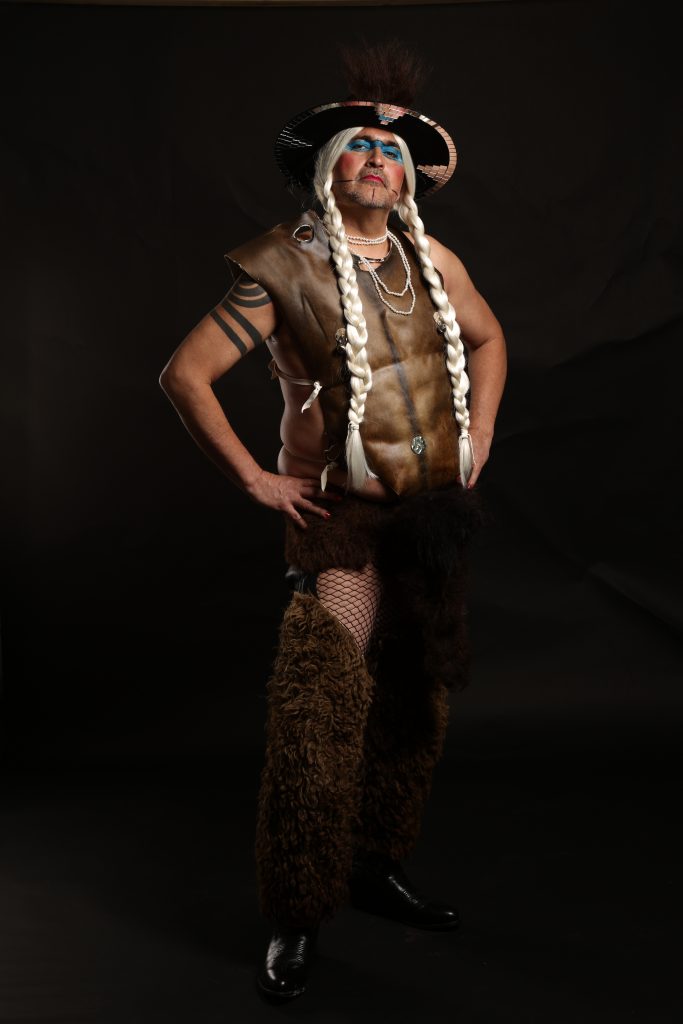
Like McMaster, Adrian Stimson is also searching for his identity in his work. He is a member of the Siksika (Blackfoot) Nation in southern Alberta, Canada, and an interdisciplinary artist who exhibits internationally. His performance art examines identity, pinpointing how a strange mixture of the characteristics of the Indian, the cowboy and the shaman has been created and idealized. Buffalo Boy and The Shaman Exterminator are recurring personas in his mythology. In the Buffalo Boy performances, the artist fashioned his alter-ego Buffalo Boy (a play on the name Buffalo Bill) into someone totally different, in opposition to the colonial image of a ‘real’ Indian with feathers and buckskin, hunting buffaloes with spears. Stimson wants to change this stereotype and reprogram the Indian image. New Born Buffalo Boy (2022) is a product of his reprogramming of the idea of the Indian, making it more open, and more contemporary with homoeroticism depicted with a great sense of humor. Stimson stands in poses of pride, wearing a strange mixture of traditional and modern outfits. In his images his face is painted with black paint around the chin mimicking Indian tattoos, his lips are red and he wears heavy blue make up around his eyes – giving him a woman’s provocative appearance. He wears a braided wig under a cowboy hat, a leather shirt and buffalo hide leg coverings as well as sexy stockings. In Buffalo Boy, Stimson creates a new person with mixed sexuality that contradicts both the traditional Indigenous and the colonial ideals, opening doors to a new reality where he is free to construct his own identity.
Adrian Stimson, New Born Buffalo Boy, 2022, performance still. Courtesy of the artist
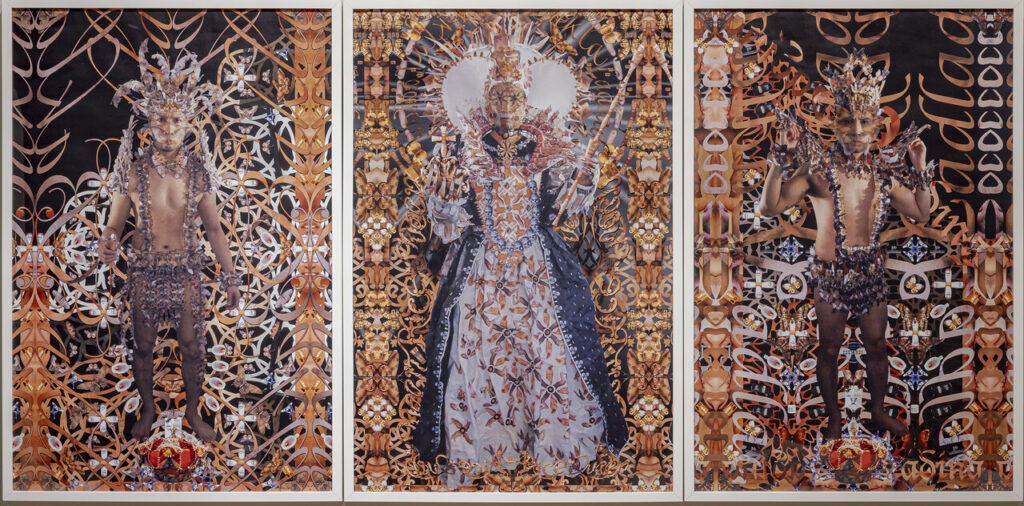
Julius Poncelet Manapul also addresses sexual identity issues in his triptych, Whitewashed Bakla in the Presence of the Rice Queen (2017). The artwork, especially the two male figures on the sides, brings to mind Carnival in Rio de Janeiro, with its crowded composition, the use of masks and decorative ornamentation. The male figures’ outfits combine Indigenous Ifugao, Igorot and Ilocano attire designed from paper templates of butterflies, often used in the Philippines. Their faces are half covered by Asian masks. The Rice Queen in the middle reminds me of renaissance portraits of queens as well as sculptures of the Virgin Mary dressed for a religious procession, carried by singing believers. All the figures are paper cut-outs, framed by butterfly motifs combined with skin whitening products and gay porn elements. The references to Spanish culture are strong as the artist comes from a Filipino background, where the Spanish influence and domination is still present. Manapul’s works show the artist’s opposition to colonialism, European hegemony and sexual normativity.
Julius Poncelet Manapul, Whitewashed Bakla in the Presence of the Rice Queen, triptych, 2017, digital collage print. Courtesy of the artist
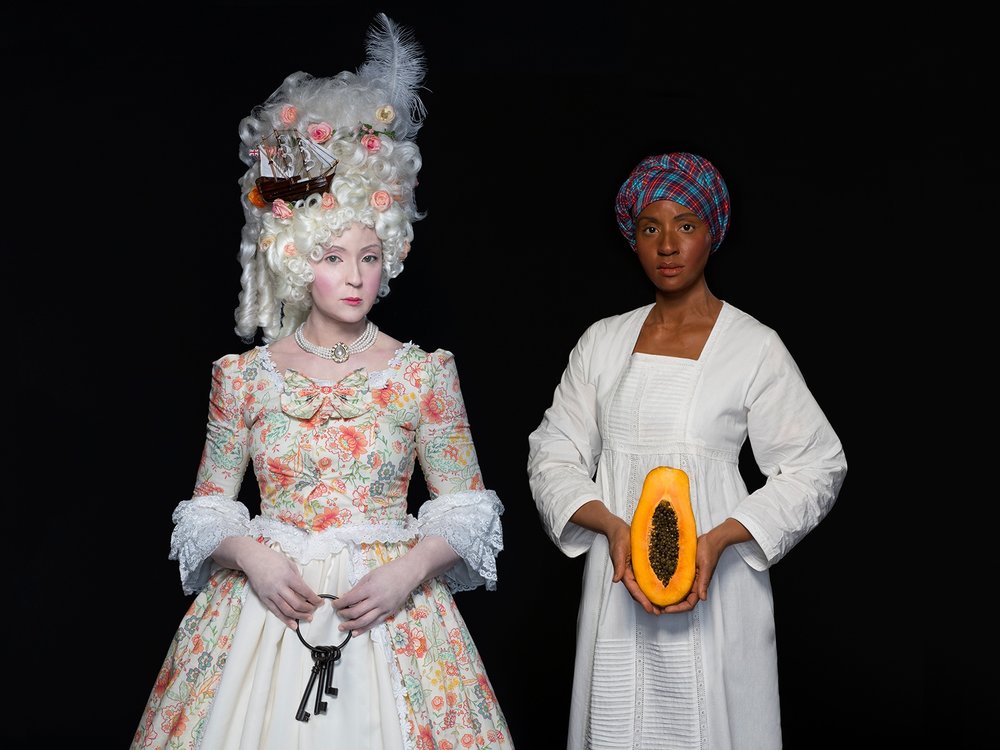
Stacey Tyrell examines power, heritage and racial issues in post-colonial societies and the Caribbean diaspora. Mistress and Slave is a complex composition with personal and historical references. In this provocative image, Tyrell impersonates two historical women, Dido Elizabeth Belle Lindsay and her second cousin Lady Elizabeth Murray, who lived in 18th century England. Dido Belle was a mixed-race daughter of a British aristocrat, Sir John Lindsay, and an enslaved African woman in the West Indies, Maria Belle. Dido Belle grew up with her Murray cousins in England. Sounds like a happy ending. The pictured Lady Elizabeth and Dido Belle tells a somewhat different story, not that nice. The two young women stand side by side without looking at each other. There is no connection between them as they represent two different worlds. Lady Elizabeth is white and her appearance is an accurate depiction of British society norms at that time. She wears an intricate, rice-powdered wig with a boat, pearls and, more importantly, holds the keys of the household, symbolizing her power over everything and everyone in it. In strong contrast Dido Belle is a black person and appears in a simple white dress with a colored turban on her head. She seems more pure and much more natural than Lady Elizabeth. She holds half a papaya in her hands, a reference to her origins, that also reminds us of female genitalia. It is hard to guess her position in the household. Tyrell beautifully addresses racial issues and her dual (Canadian and Caribbean) ancestry in this artwork.
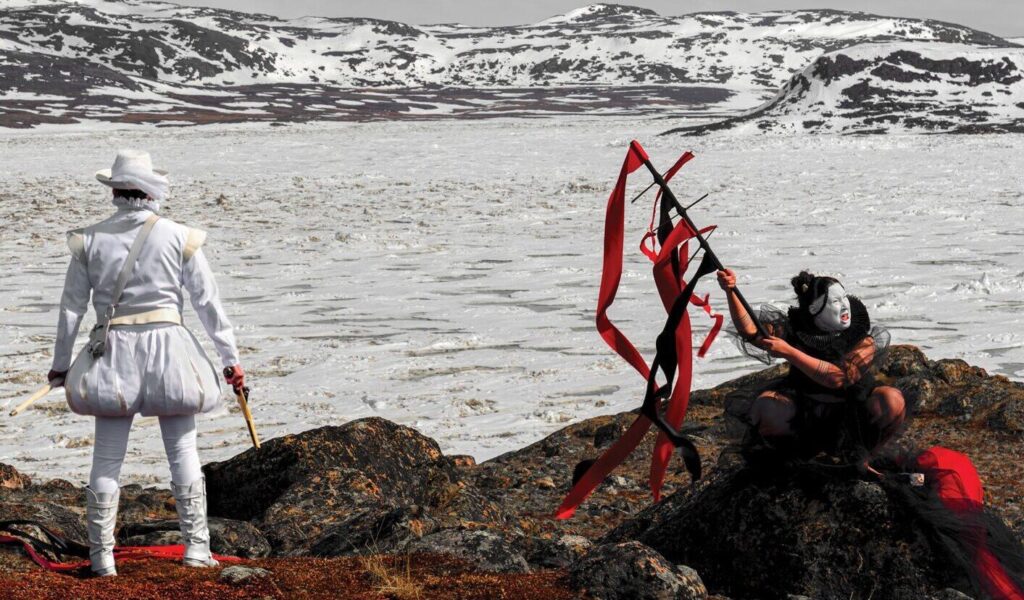
Like in Tyrell’s work, power is a central element in White Liar and the Known Shore: Frobisher and the Queen (2021). This monumental and theatrical composition, is a collaborative artwork created by Laakkuluk Williamson Bathory (Inuk) and Jamie Griffith (Canada, UK), two multidisciplinary artists based in Iqaluit, Nunavut. In an almost unrealistic landscape, depicted in the winter in Nunavut, when the water is frozen and the mountains are covered by snow, two figures appear. Griffith adopts the persona of the English explorer Sir Martin Frobisher. He is the White Liar, wearing the white clothes of the Elizabethan era, holding a gun in his hand to symbolize his power and cruelty. He is standing with his back to us. Williamson Bathory impersonates Queen Elizabeth I with her famous white make-up that also refers to whitened bones, an Inuit symbol for respects to ancestors. Her dress somewhat mimics Elizabeth’s style, especially the collar but the red color could be associated with blood. She holds a red and black flag that originated in the Greenlandic mask dance. She is turned in the opposite direction from Frobisher. Her facial expression shows anger and fear, screaming into the distance. The entire composition gives me an uneasy feeling. The two figures are not related in any way. The color code is also worrisome, with the whiteness of the land and Frobisher’s clothes juxtaposed against the dominant red of the Queen. We can’t see Frobisher’s face as he looks at the empty, rigid land. There is no welcome from the land or the people. It is an isolated place with people who wanted to left alone. What does he want from this land? In reality, what he got was fool’s gold, a useless rock that the British mistook for real. Fortune seeking went wrong here but colonialization remained, causing the Indigenous people suffering in their own land historically and into the present.
Laakkuluk Williamson Bathory & Jamie Griffiths, White Liar and the Known Shore: Frobisher and the Queen, 2021, photography on stretched canvas. Courtesy of the artists
The Counter/Self delivers a strong political message through very rich visuals. Communal histories depicted through the artists’ personal experiences create a dialogue about cultural legacies and social expectations, bringing up questions about our national narratives and power structures. The artists’ stories, being tragic or enigmatic — even flamboyant or whimsical — turn our attention to important, harmful and mostly unsolved issues about racism, colonialism and sexual orientation. It is an exhibition you need to visit more than once to fully understand its message.
The Counter/Self: Group Exhibition, curated by Mona Filip, January 11 – March 25, 2023, Art Museum at the University of Toronto, Justina M. Barnicke Gallery, 7 Hart House Circle, Toronto. Museum hours: Tue, Thurs, Fri, Sat 12 – 5 pm, Wed 12 – 8 pm.
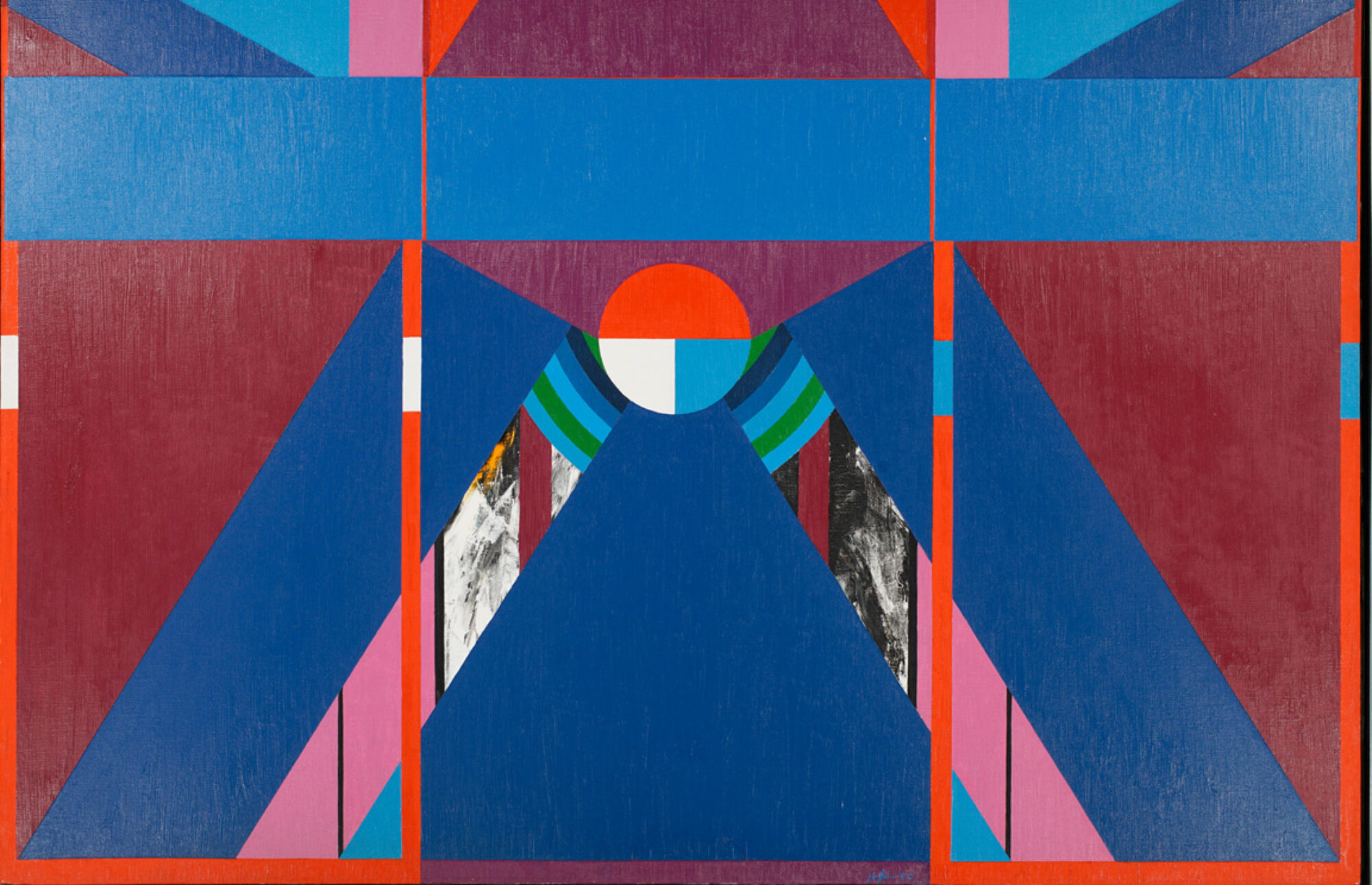
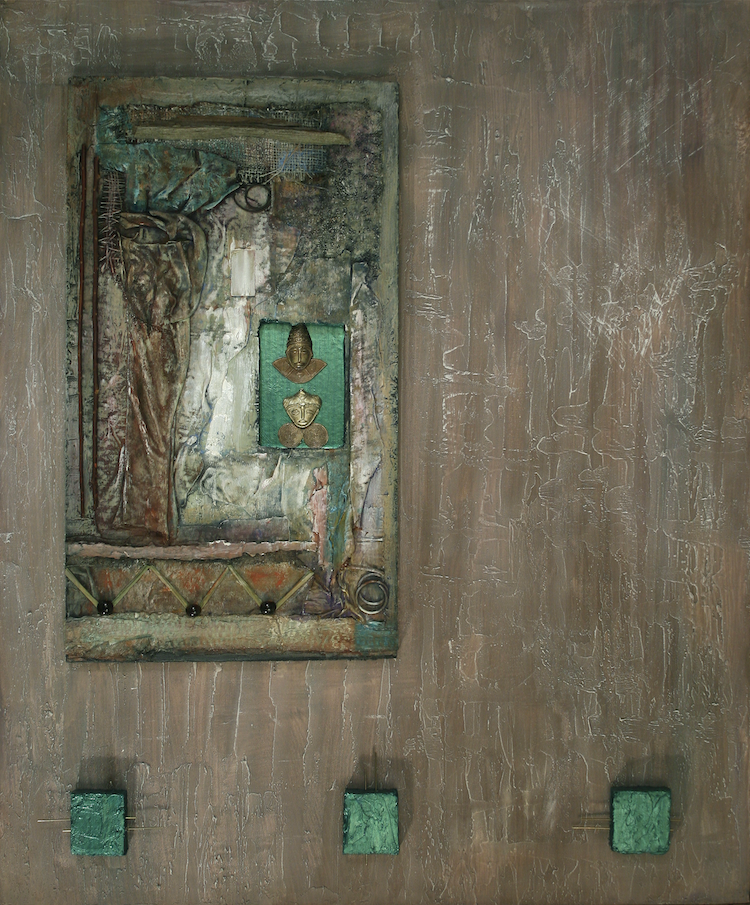
Alvin Roy, a painter of considerable gifts, was born and raised in Houston during the Civil Rights era. He studied first at the Houston Technical Institute, then moved to New York City to further his studies at Pratt Institute. Toward the end of the Vietnam War, he enlisted in the Marines. This decision provided him with the chance to travel and experience other cultures. In Okinawa, Roy studied watercolor techniques with a local master, also internalizing the recognition that the spiritual life of an object is as important as the formal attributes it consists of. Roy has remained in Houston for more than forty years now, using mixed-media assemblage to create bas-relief wall pieces. Jazz, an important influence, occurs in his work in the form of saxophones, keyboards, and colorful patterns that reflect the texture of the music. Roy also turns to Egyptian culture, imaging pharaohs and, also, figures of ancient spiritual archetypes. Most recently, Roy has resorted to mixed-media techniques and collage on paper to explore the quilting tradition in the southern United States and to address the history of the Underground Railroad.
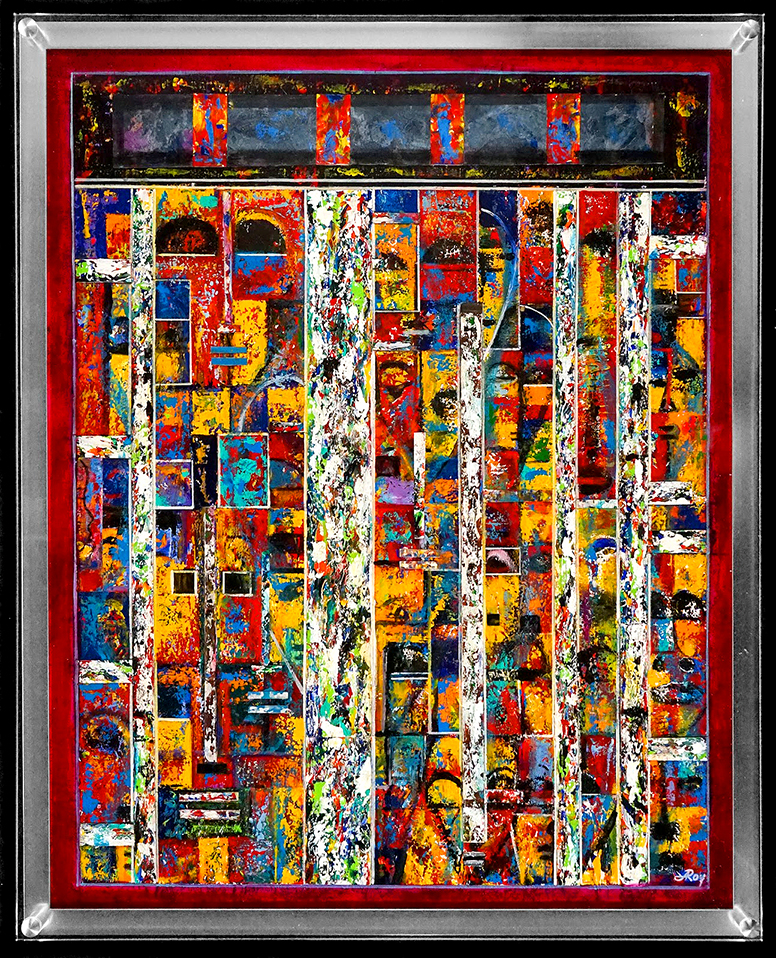
Roy’s formidable energy is evident from the start. His work, at first glance, looks entirely abstract, but the reliefs are more truly described as a mixture of abstract and figurative influences. His recent series, “Talking Heads,” regularly includes white vertical bars, decorated randomly, that divide the large painterly field occurring behind them. Color is important in its own right, but oneiric forms are also found. Eyes, noses, mouths, and, every so often, a full figure can be found in these complex assemblages of abstract shapes, often pieced together as one would find in a quilt. Roy’s colors also are unusually strong; they are dense, often dark, and luminous, as if rising from the night in a dream. His talents are such that he has found a way of connecting with history and culture more by implication rather than by direct illustration. His multi-cultural approach, evident in the combination of forms, materials, and allusions, make him a national artist of note—even when his inspiration is deeply personal.
Perhaps the most accomplished element in Roy’s work is his ability to create intricate genres: partly non objective, partly figurative; both sculptural and representational; and measured and free. In many ways, this is the manner in which an innovative exploratory artist works—by merging genres, images, and materials. In Roy’s case, such combinations are made stronger by the framework of history, as well as references to the ancient art of Egypt. We are living in a time of unusual eclecticism, and Roy’s composite efforts make wonderful use of the old and the new. Certainly, the work’s overall impression tends to be one of colorful abstraction, but recognizable figurative elements, sometimes partially hidden by the overall pattern of the paint, also make their way into Roy’s art. One instinctively feels that his historical references structure and deepen the paintings’ ability to communicate. It is not easy to find such a successful mix of histories, and patterns informed by those stories, in works that convey a visionary point of view. Alvin Roy’s work can be viewed in a virtual gallery at: