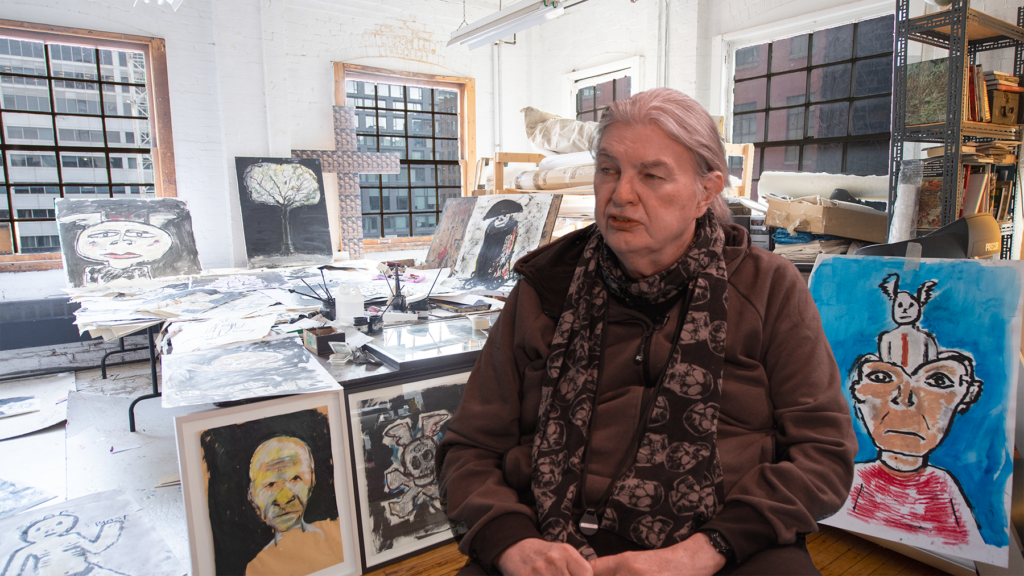
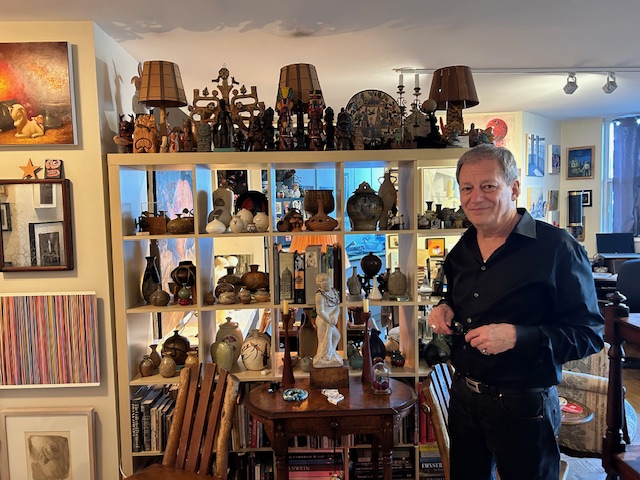
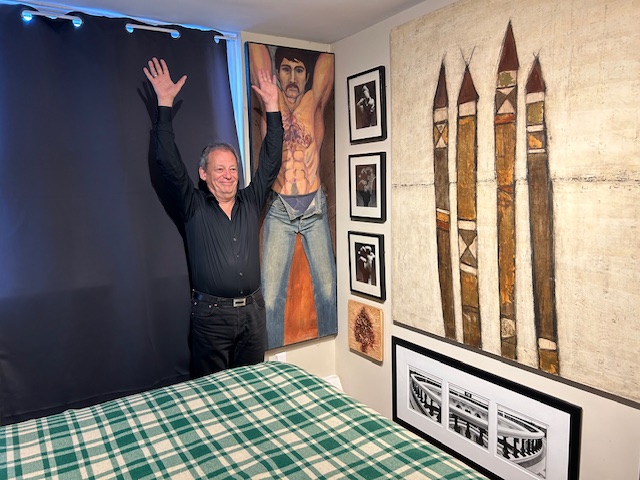
John Scott, 2021, being interviewed at the Weekly on the Arts program
John Scott was born in Windsor, Ontario, Canada, in 1950 and died at the age of 72 in 2022. He was raised in the Cold War era that concerned itself with the imminent threat of nuclear conflict.
A Canadian multimedia artist, Scott, was known for his drawings, paintings and sculpture/installations. His artistic creations have drawn comparisons to those of American artist Jean-Michel Basquiat (1960-1988), who similarly explored themes of mortality, destruction, and the disparity between wealth and poverty. In the wake of Basquiat’s passing and his rise to fame, Scott has been dubbed the “Basquiat of Canada.” It is important to note that Scott, being ten years Basquiat’s senior, had already established his artistic identity well before Basquiat’s initial creations.
Renowned for his compulsive mark-making and ironic wit, Scott was a visionary in the art world. He was a long-standing professor in the Faculty of Art at OCAD University, challenging and inspiring his students to develop their individual creative styles and express their innermost thoughts and emotions through their art. Scott was an influential artist within the Toronto art community from the early 1980 until his death through his iconic, political and accessible work.
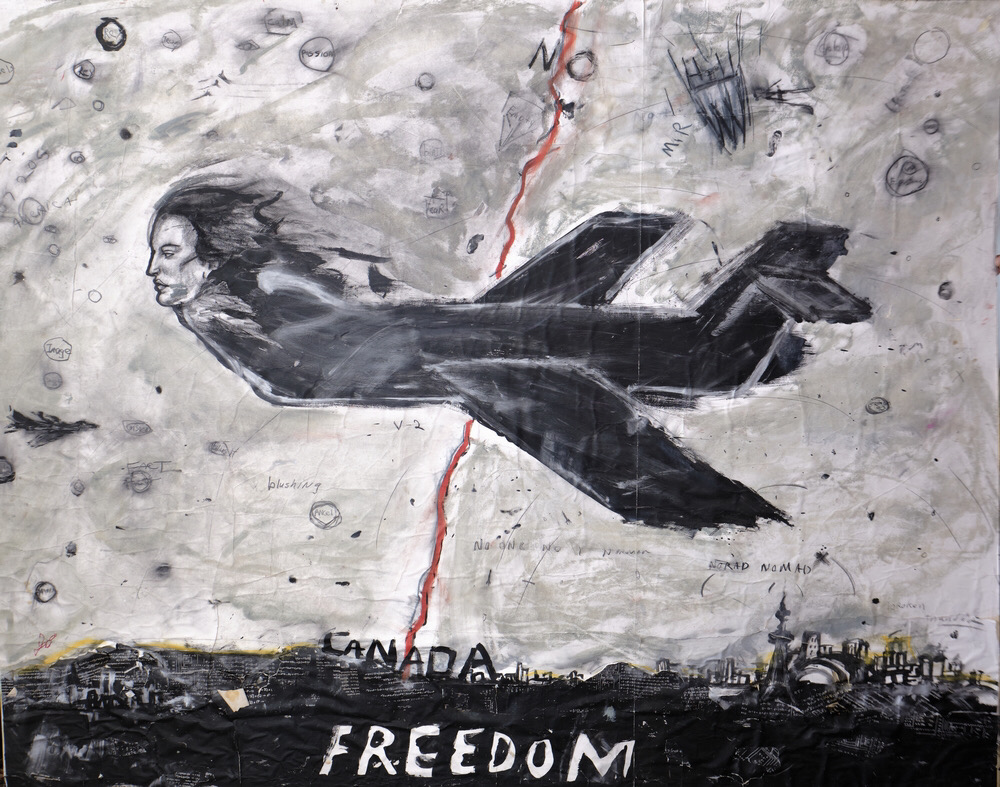
John Scott, No Freedom, 1995, mixed media on paper mounted to foam-core, 58 x 73 1/2 inches
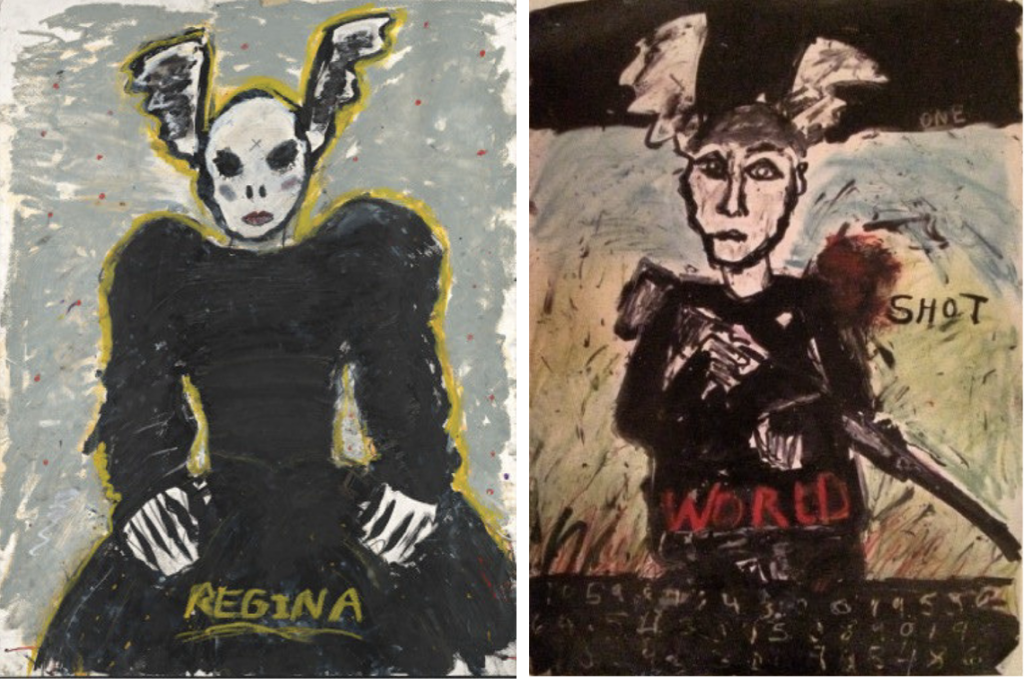
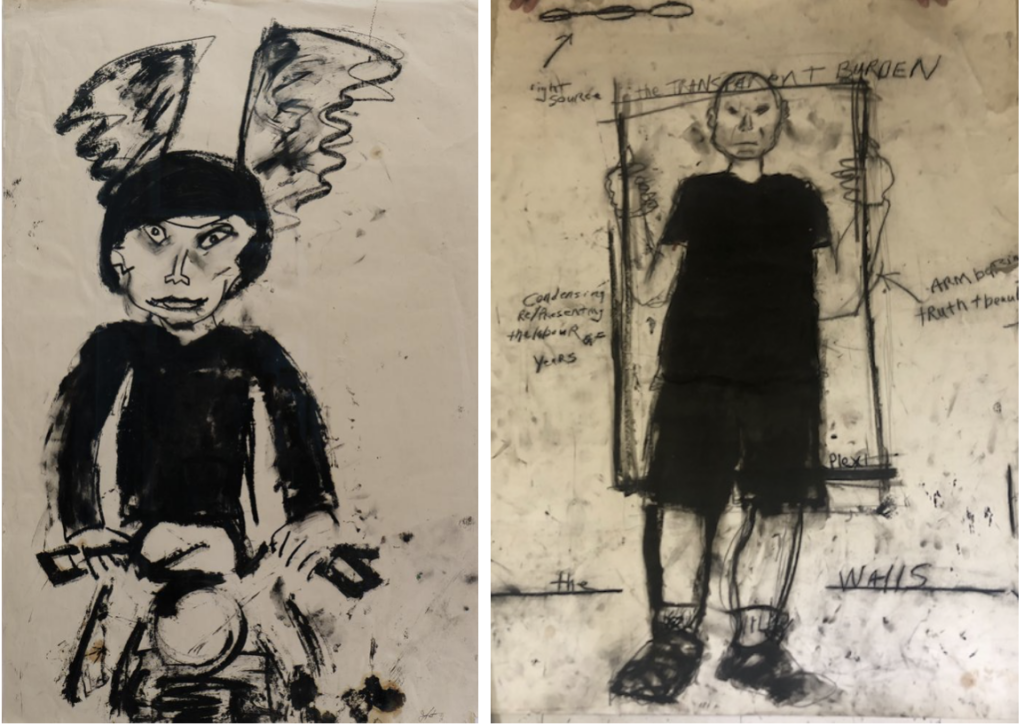
Scott’s paintings and sculptures addressed themes of war, industrialization, authority, social class, and fear. For example, he portrayed fighter planes hovering over a blackened earth, cities detached and cast adrift in space, and strange genetic modifications of life. He depicted scenes of political devastation through representations of “twisters” with evil faces, drones, endless tanks whose purpose is surveillance. His many humanlike figures have large bunny-like ears which portray their vulnerability and sensitivity to larger forces.
John Scott, Left; Regina (Queen), 2007/2021, Mixed media on paper mounted on canvas 50 x 38 inches.Right; One Shot World, 2007/2021,Mixed media on paper mounted on canvas 50 x 38 inches
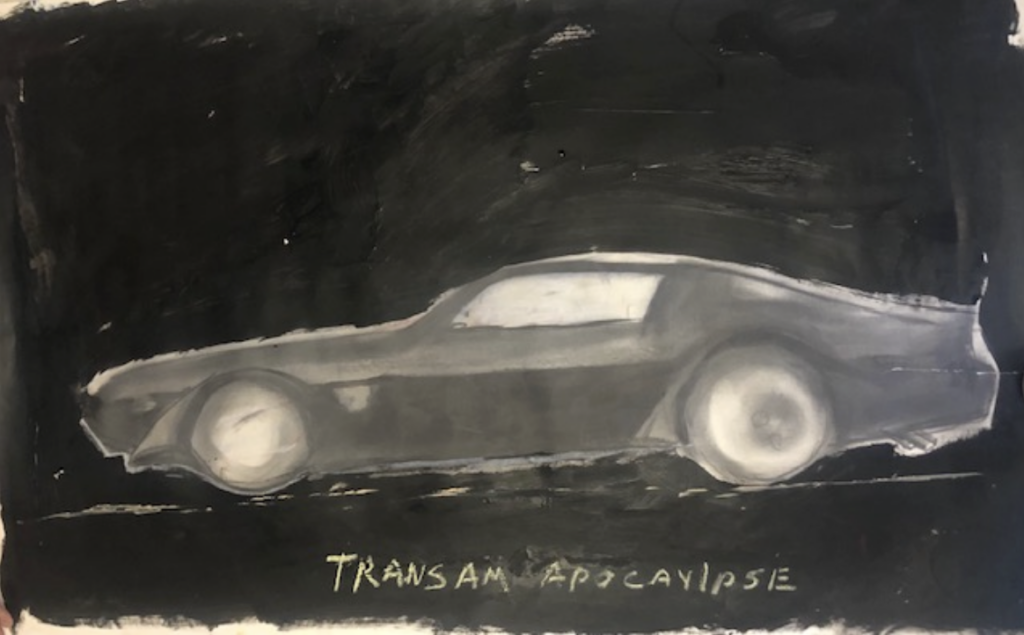
Scott lived in a large messy studio in the urban core. He regarded people that he encountered with kindness and generosity, whether they were homeless or affluent, students or scholars. He lived out his belief that art should be accessible by gifting everyone who came into his space with a personalized drawing, and his artwork is ubiquitous in the homes of the many people who knew him. His work was also accessible in another way: while the subject matter may be complex, and the readings layered, regardless of their knowledge of art, the audience easily “got” his work. Nowhere is this accessibility better evidenced than in his work, owned by the National Gallery of Canada, titled “Apocalypse Trans-Am.” This installation of a 1981 Trans-Am car covered in black paint with the Book of Revelations scratched into the surface was lauded as one of the most popular works in the gallery’s collection.
John Scott, Trans Am Apocaylpse, 2016, mixed media on paper 32 x 50 inches
Historically, Scott successfully positioned himself as a prominent artist within the art community, as evidenced by his inclusion in art history texts, museum retrospectives, and various collections and exhibitions. He became the first recipient of the Governor General’s Award in Visual and Media Arts in 2000.
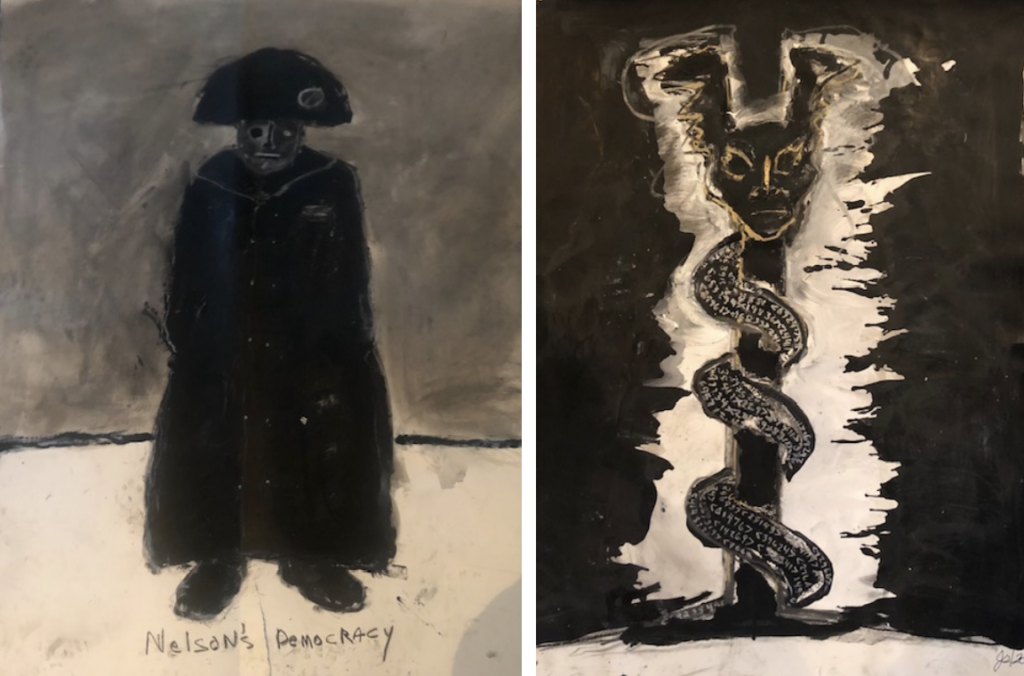
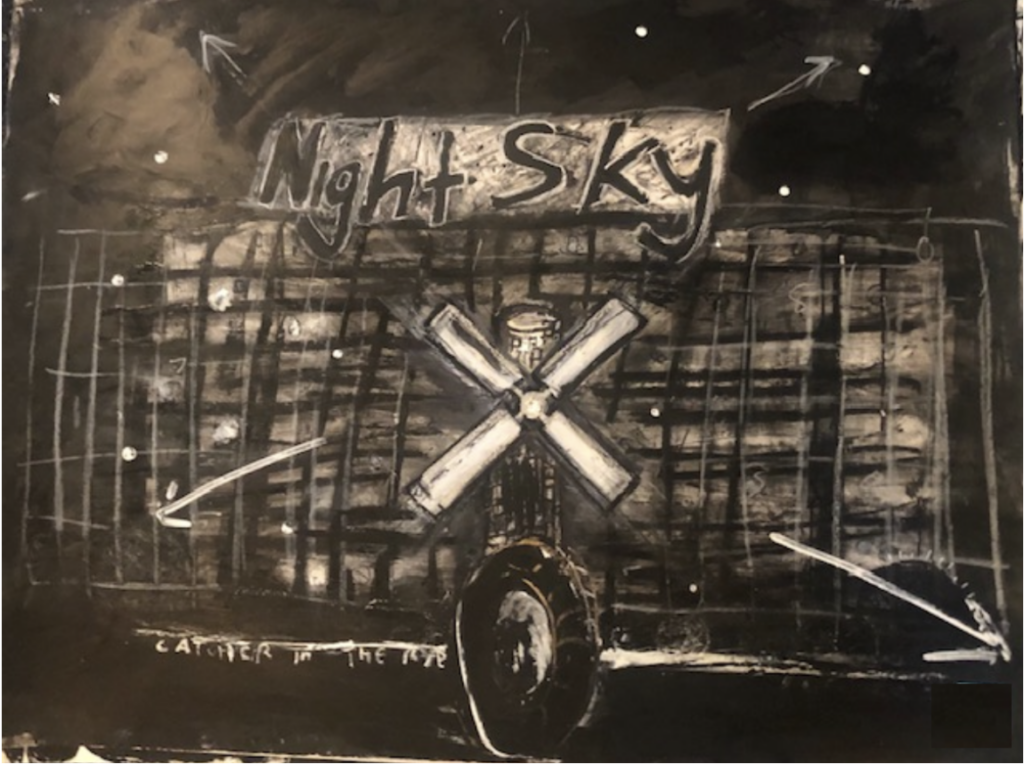
Scott’s oeuvre is characterized by a range of pivotal themes, such as “100 Workers, Carnivore, Teddy-Bear,The Bunny-man, The Dark Commander, Trans-am Apocalypse, Jet Fighters, Watch Towers, Tanks, and culminating in the “Night Sky” imagery, which he produced subconsciously, aware that his time was drawing to a close.
John Scott, Left; Dark Commander – Nelson’s Democracy, 2012, Mixed media on paper mounted on canvas 50 x 38 inches. Right; Snake Watch Tower, 2020, Mixed media on paper mounted on canvas 50 x 38 inches
“Fallen Angel, “words written on paper by Scott featured in the McMichael Canadian Art Collection’s exhibition Fire Storm, serves as a profound reflection of John Scott’s personal interpretation of his existence within the world. This exhibition presents a diverse array of his works, spanning from his early career to 2015. Among the highlights are a small plastic maquette for “Trans-Am Apocalypse,” created in 1987, which includes incised text, and “The Conqueror Worm,” a sculpture from 1997 constructed from sheet metal, rubber tires, electronic components, paint, and a metal frame. Currently Scott’s work can be viewed at the McMichael Canadian Art Collection; John Scott: Fire Storm exhibition from December 7, 2024 to May 11, 2025.
John Scott, left; Rebel Without a Cause (James Dean), 2000, Charcoal and oil stick on paper 38 x 25 inches. Right; The Transparent Burden, mixed media on paper 50 x 38 inches
John Scott works are in the collection of the Museum of Modern Art in New York City as well as every major museum throughout Canada from the National Gallery of Canada in Ottawa, The Art Gallery of Ontario in Toronto, The Kitchener-Waterloo Art Gallery, to the Vancouver Art Gallery in British Columbia.
John Scott, Night Sky, 2022, mixed media on paper mounted to canvas, 38 x 50 inches (one of the last works to be created by John Scott)
Bronx based artist Nicky Enright, born in Ecuador, disrupts and collapses events and observations at Albright College’s Freedman Gallery in two monumental drawing series, FLAGments and FRACKments. In these works, images extracted from Enright’s own photographs and past projects are distilled into immense black and white compositions. In tandem with the drawings, Enright’s video, I’M MIGRATION, presents manipulated closed-circuit and aerial footage of individuals traversing parched landscapes behind boldfaced captions. Together, the work imparts an urgent need to address our international climate crisis as global citizens in a world where diminishing resources and violent weather events are driving people from their homes in search of safety and a living wage.
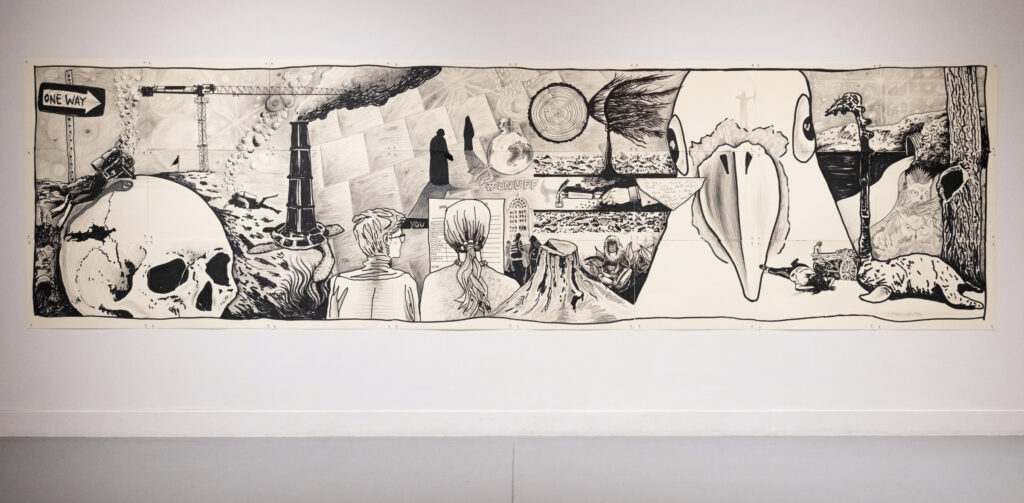
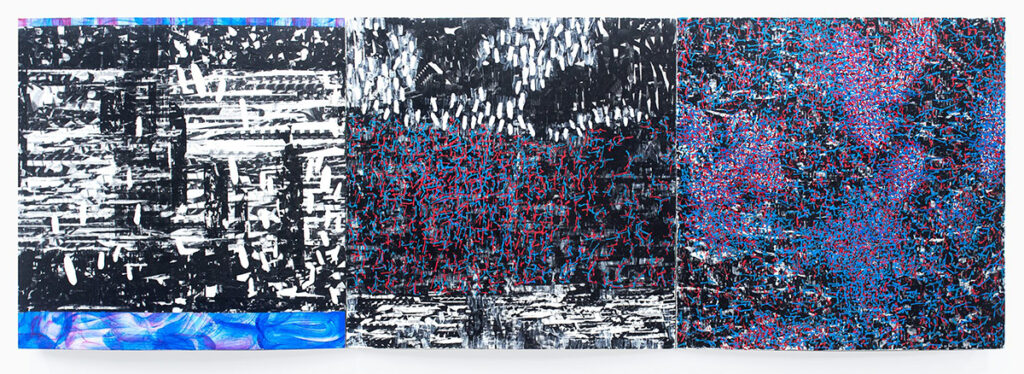
Nicky Enright, FRACKments 01: Scape, 5 ½ x 20 feet. Photo: John Pankratz
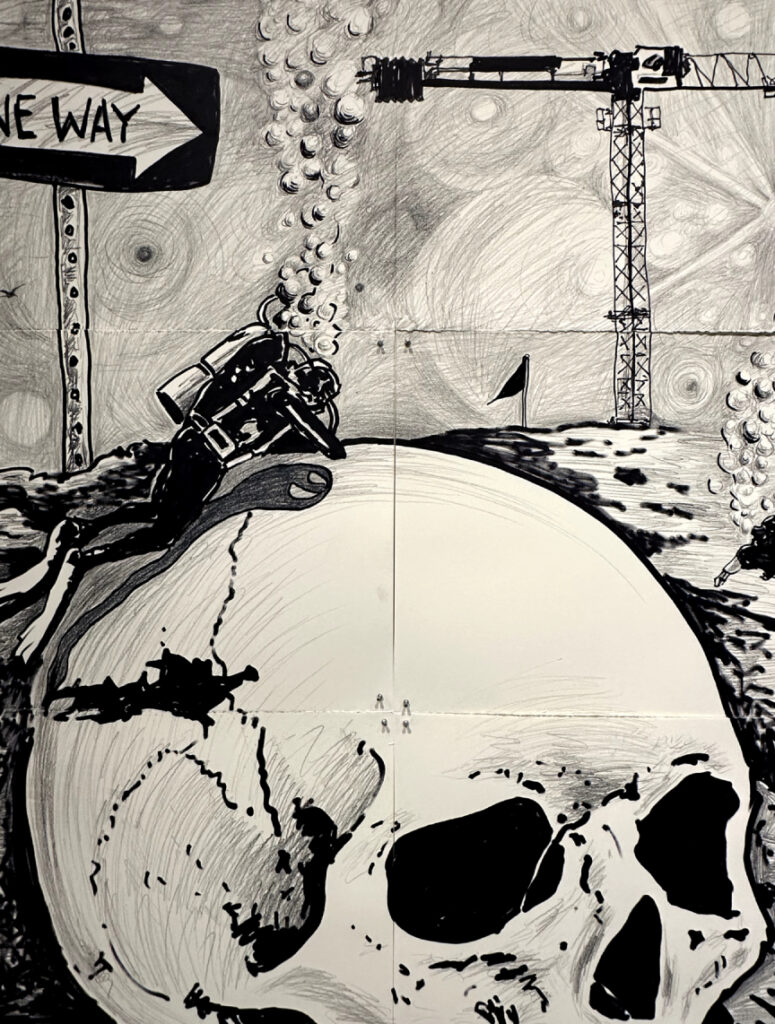
The largest of Enright’s drawings from the FRACKments series, FRACKments 01: Scape(5 ½ x 20 feet) consists of a cumulation of multiple sheets of paper arranged side-by-side on the wall. Urgency is evident in the rapid application of ink and wax pencil. The materials preclude erasure. Consequently, improvised images and bold passages of light and dark emerge from its execution. Enright’s early days as a graffiti artist seem to inform the energy and necessity of Scape’s realization. The drawing is a dense description of catastrophe, mutation and layered associations. Its constellation of colliding themes forecasts a perilous future. An enormous cracked skull on the left side of the drawing is counterbalanced on the right by an even larger portrait of an unwitting pigeon or parrot. The pigeon/parrot’s massive size might be the result of an extreme close-up or, perhaps, giant birds inhabit Enright’s unruly world. As the pigeon/parrot gazes outward from the drawing, two young figures are intent on a receipt, as if analyzing a list of challenges encountered in the chaotic world they’ve inherited. Elsewhere in the composition, scuba divers float above a bleak topography containing a small flag and large industrial crane. The arm of the crane intersects a billowing smokestack attached to the back of a turtle. Scape shows the planet on a precipice, where extreme evolution is necessary if habitats and species are to survive.
Nicky Enright, FRACKments 01: Scape, 2023. Detail photo: Matthew Garrison
Enright’s drawings belong to a lineage of large-scale work that layers imagery and highlights significant world events. The most recognized is Picasso’s black and white response to the 1937 Nazi bombing of the small Basque town, Guernica. Picasso’s grayscale palette is often compared to newsprint, the prevalent mass media of his time, but the painting’s exclusion of color also distills the shear horror of the attack. Hovering over Guernica’s destruction is a jagged lightbulb, emblematic of the detached technology that separates violent actions from tragic consequences. Similarly located in Enright’s drawing, Scape, is a tree on its side, cleanly sliced through with a saw, its interior rings floating above a tempestuous world, indexing the passage of time and loss.
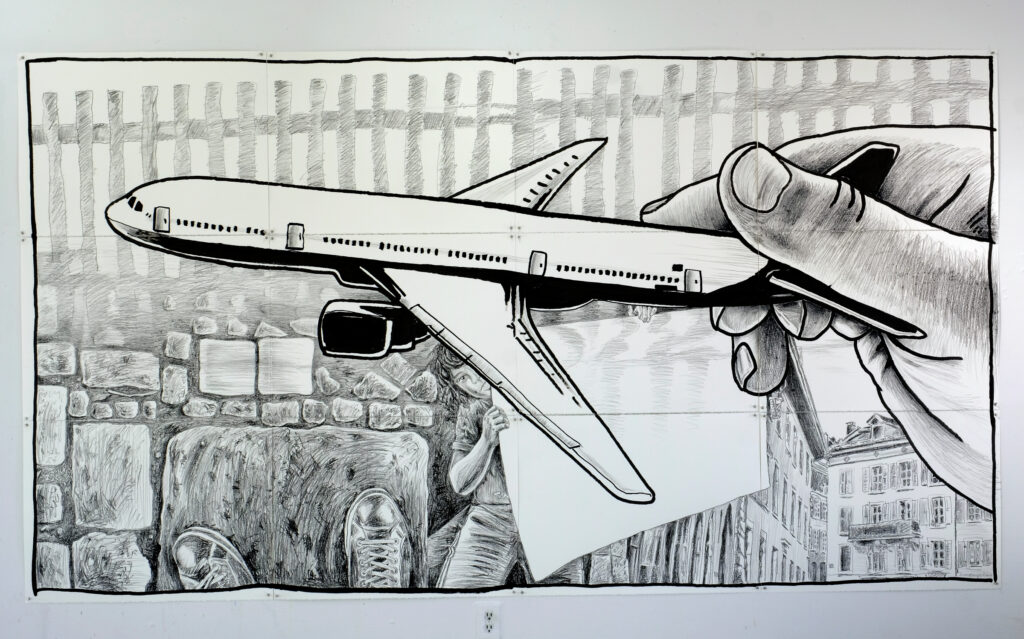
Life and resources are precious in FLAGmentsandFRACKments. For instance, in Enright’s piece, FRACKments 07: Trash, the remnants of life are commemorated with white lines against a dark void, while the drawing, FRACKments 02: Cementerio Mundial, simultaneously evokes a “world cemetery” and the funeral of his uncle, Tío Miguel, who died in Ecuador in March 2024. Time itself is expansive in the work, reaching far beyond the present, encompassing past and future generations. Children are interspersed throughout the two series. Enright’s young son, currently living in Switzerland, peers out of the drawing, FLAGments 05: Gazebo, and plays a game of life-size chess in FLAGments 06: Stars. In Enright’s drawing, FLAGments 03: Customs (5 ½ x 10 feet), his son holds a blank sign. Text appears throughout many of the drawings as handwritten correspondence, brand names and graffiti, although it is occasionally absent in areas where words are expected. In addition to the empty sign, Stumbling Stones are incorporated into Customs. Enright encountered these small brass stones during a residency in Berlin. Stumbling Stones (Stolpersteine in German) is a vast memorial conceived by artist Gunter Demnig in 1992. Each stone, inscribed with the name of a Holocaust victim, is laid in front of the victim’s last known private residence throughout Europe and Russia. The absence of names on the stones in Enright’s work allows for personal reflection.
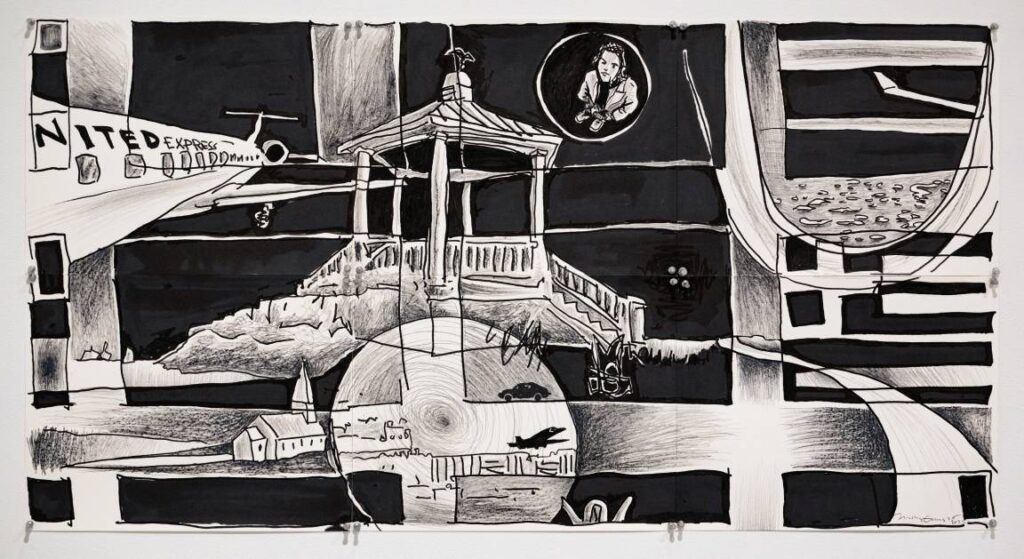
Enright’s art also aligns with artists whose work investigates the movement of people. For example, Jacob Lawrence and Romare Bearden addressed The Great Migration in paintings and collage. And, Mexican muralist, José Clemente Orozco, recounted the migration of indigenous American civilization thousands of years ago in the 1934 fresco, Migration, a part of his immersive mural, The Epic of American Civilization. However, Enright acknowledges modern modes of transportation and surveillance in his exploration of borders and migration. His video, I’M MIGRATION, consists largely of drone footage, while airplanes and vehicles are incorporated into his drawings. Consequently, border crossings come to encompass, not only checkpoints, but also the broader implications of flying, airport customs and transportation security. Enright’s drawing, FLAGments 05: Gazebo, deconstructs air travel and flags through vertical and horizontal bands that read as an amalgamation of national symbols. The drawing includes both interior and exterior views of an airplane. A capsule shaped porthole in the upper right corner looks out onto the aircraft’s wing through what might be seen as household blinds. A plane soars off the left edge of the drawing. This could be a rendering of the same plane observed simultaneously from interior and exterior perspectives or, perhaps, it is a representation of the arrival and departure of respective aircraft. A gazebo dominates the center of the drawing, described by Enright as a meeting place. Yet, the gazebo is empty, allowing for personal projections of community within its structure, or inferring an evacuation. Hovering above the gazebo is a bird’s-eye view of a young figure encircled within a void, silently observing the ebb and flow of events.
Nicky Enright, FLAGments 05: Gazebo, 42 x 22 inches. Photo: John Pankratz
Enright’s installation of FLAGmentsandFRACKments in conjunction with I’M MIGRATION directly connects migration to nationalism and global warming. Also contributing to border tensions are populations seeking a living wage. In Enright’s piece, FLAGments 08: Zero, a hand holds a bill adjusted to show its value in U.S. dollars (.000024). He explains that the design for Zero was based on the least valuable currency in the world at the time of its realization, the Iranian Rial. In response to this severe economic discrepancy, Enright advocates for a global minimum wage and has designed The Globo, a universal currency that incorporates legal tender from more than twenty-five countries. He also questions the very concept of borders established through dominance and warfare, which often contradict nature’s own configuration of rivers, coasts, and mountain ranges. Once again, Enright’s stance recalls Orozco’s mural, The Epic of American Civilization. In Orozco’s panel, Modern Migration of the Spirit, a heap of religious artifacts lay at the base of a mountain comprised of heavy artillery. Here, spirituality is distorted to align with the values that justify brutality and barbarism in the shaping of civilizations. Christ himself, the Prince of Peace, is presented as an ax wielding warrior with his fist raised. A natural landscape has been recreated in the image of its conquerors.
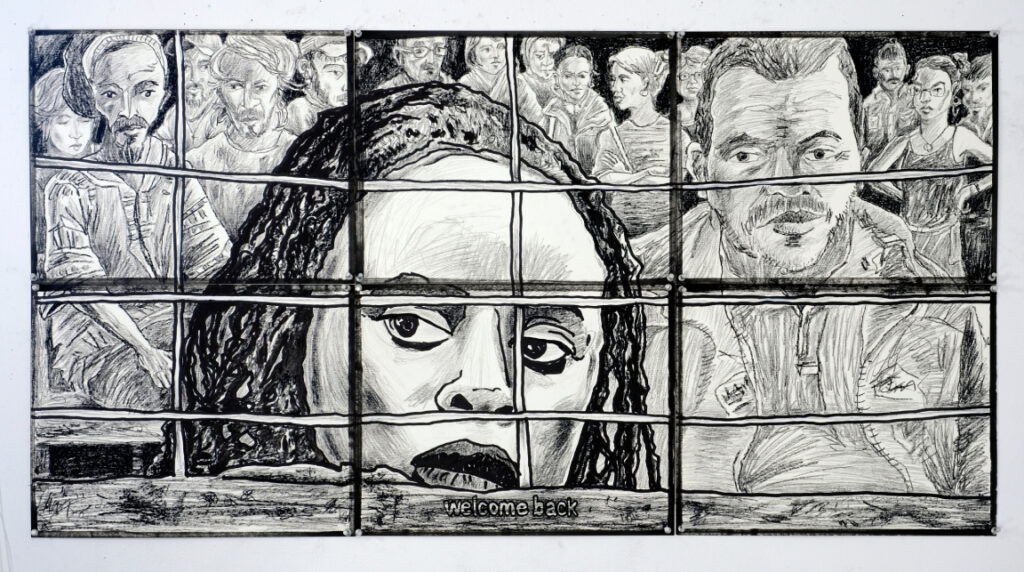
Enright’s expansive conception of time across generations necessitates a drastic and immediate response to the realities of climate change. Economies reliant on extracting value from precious resources and populations must recalibrate to emphasize restoration and repair and, in the process, acknowledge that migration is inevitable and beneficial to a healthy society. In Enright’s drawing, FLAGments 01: Welcome Back, people are held captive behind a fence. They are looking in different directions, and some appear to be lost in reflection. Their detachment from one another implies sustained conditions that are unchanging, as though condemned to a perpetual state of waiting. The irony of the drawing’s title inscribed on the fence calls into question their location. Have they returned home, or are they confined elsewhere? Will they be released or forcibly transferred? The humanity of the detainees is in stark contrast to their captivity. These conditions, so frequently viewed in the media, are often met with indifference, apathy and jingoist threats. An uncertain future permeates Enright’s work. FLAGments and FRACKments encompasses a planet on the brink of ruin with inhabitants who must uproot to survive a fragmented world of borders, ideologies and governments that would prioritize nationalism over humanity.
Artist, László Moholy-Nagy, observed in his seminal text, Vision in Motion, “From the time of the first flags and emblems, creating the romance of heraldry, the customs of religion, peoples and nations have been given meaning by hues of the spectrum.” The chromatic identifiers described by Moholy-Nagy are referenced in FLAGments and FRACKments through its absence of color. Similar to Enright’s selective employment of text, his drawings in black and white provide space for personal associations, allegiances and tenets. Although individual connections might also arise from self-imposed limitations, change begins with the realization that societal conditions and values shape and constrain our grasp of history and the moment we inhabit. Enright’s recognition and dismantling of these internal barriers pave the way for a vibrant, interconnected world.
Nicky Enright’s FLAGments and FRACKments runs through December 13th, 2024 at the Freedman Gallery, Albright College, Reading, Pennsylvania.
The art world is a realm where new discoveries occur on a daily basis. While some may argue that finding a life-changing bargain is improbable, the reality is that such opportunities do exist, often emerging unexpectedly. Artworks are unearthed regularly in the most surprising locations. One must simply open their eyes and comprehend what they are observing. A valuable find may be located in an attic, within a museum’s vault, in an antique store, or at an auction where it is misrepresented or mistakenly labeled as “Attributed to ….” a designation that it is believed to be a work by the artist. “Studio of ….” indicates that it is thought to be a piece created in the artist’s studio or workshop. “Circle of ….” implies that the work is from the artist’s era. “Style of ….” or “Follower of ….” denotes a piece executed in the artist’s style. “Manner of ….” suggests that the work is in the style of the artist but was created at a later time.“After ….” indicates that it is considered a copy of a work by the artist.
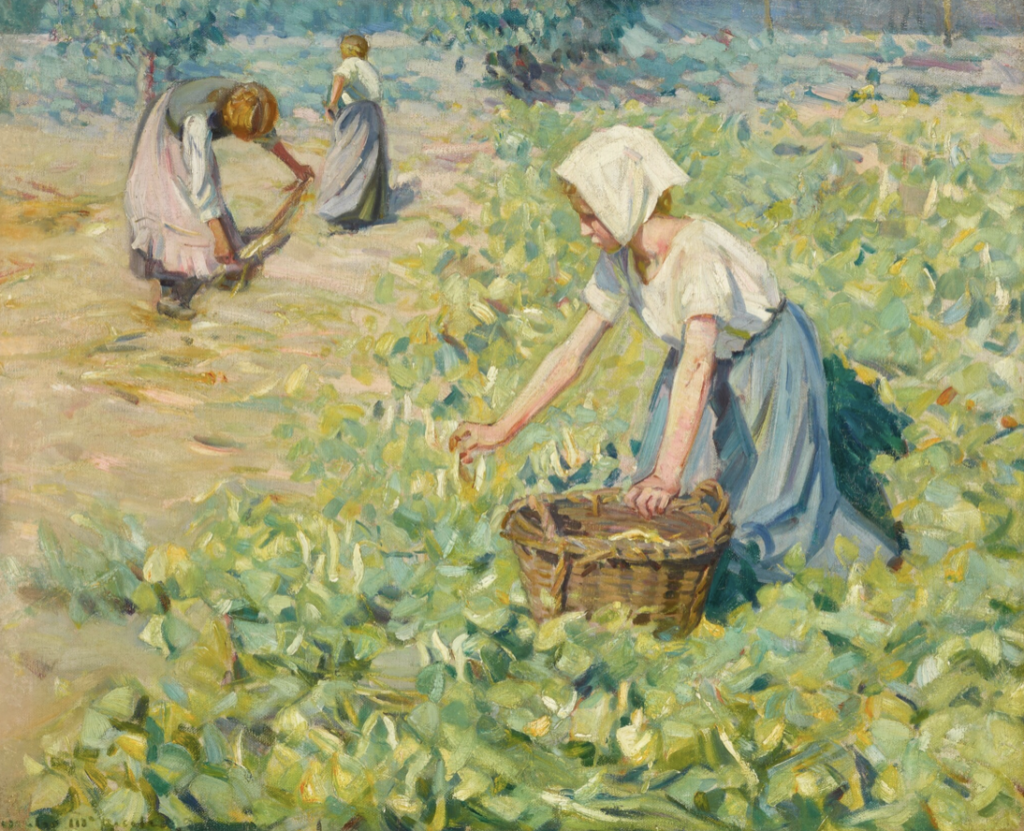
In October 2024, a notable painting by a Canadian artist, lost for over a century, was rediscovered by a gentleman in England. He acquired the artwork at an auction, which was described as being “in the style of” Helen McNicoll, for just over £2,000.
This long-missing piece by Canadian impressionist Helen McNicoll has been located and authenticated in the United Kingdom by the expert team from the BBC television program “Fake or Fortune?” They have estimated it at approximately £300,000 more or less.
Helen McNicoll (1879-1915), The Bean Harvest
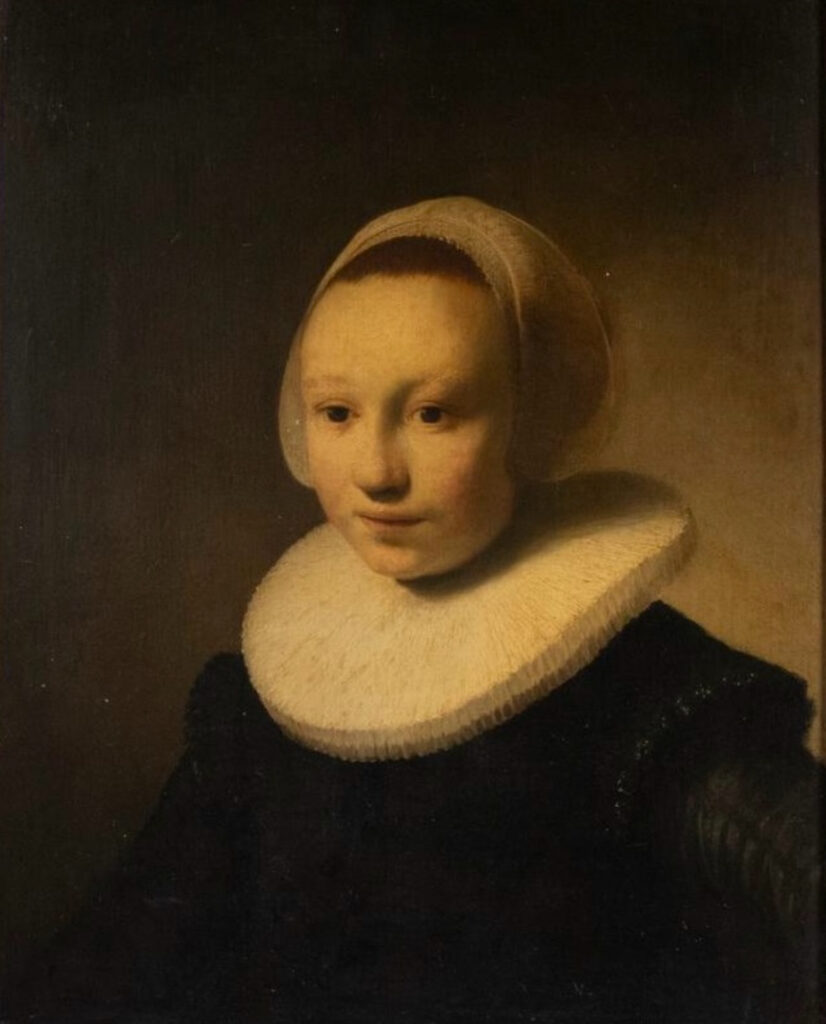
In September 2024, a 17th-century painting by Rembrandt was discovered in an attic in Maine, USA, and sold for $1.4 million in a record-setting auction.
The piece, titled Portrait of a Girl, was offered during the annual Summer Grandeur sale at Thomaston Place Auction Galleries, listed as “After Rembrandt Harmenszoon Van Rijn Portrait of a Girl, an oil painting on cradled oak panel, unsigned, with a label from the Philadelphia Museum of Art, which had lent it for a 1970 exhibition. Measuring 20 1/2″ x 16 1/2”, it was estimated to fetch between $10,000 and $15,000.
The bidding was fierce, ultimately resulting in the artwork being acquired by an unnamed European collector.
Rembrandt Harmenszoon Van Rijn (1606-1669), Portrait of a Girl
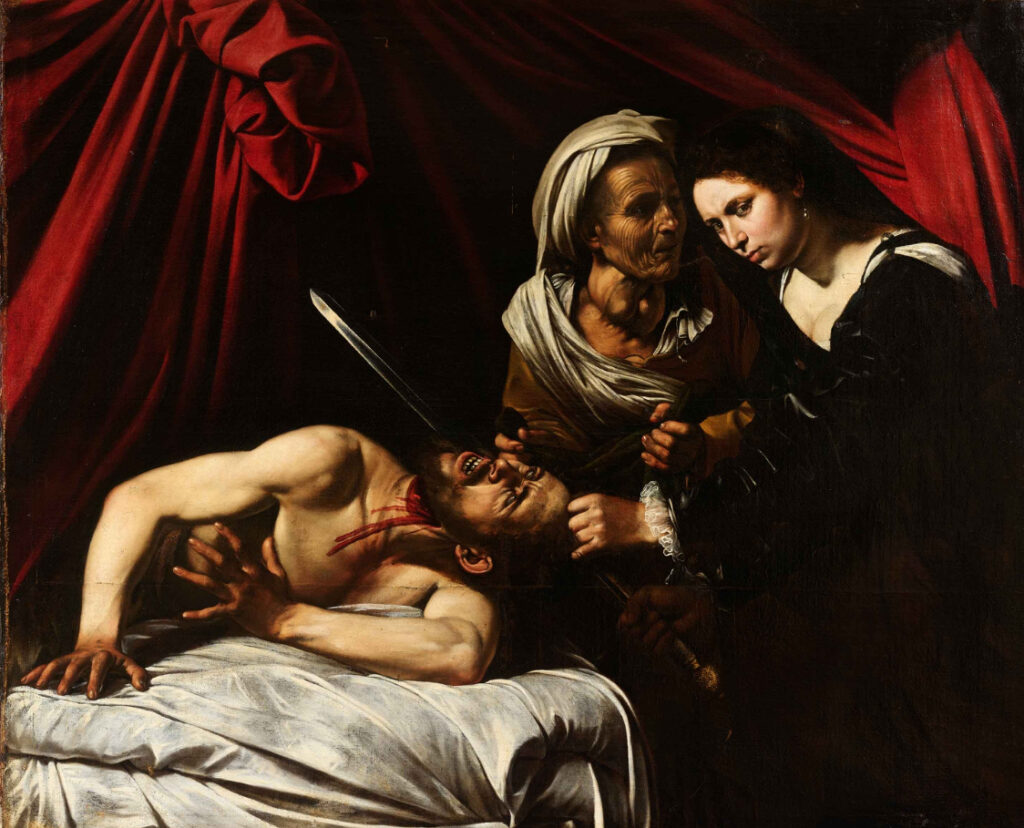
In February 2014, experts announced the discovery of a long-lost painting attributed to Caravaggio. This artwork, found in a French attic in 2014, has been appraised with a pre sale estimate ranging from €100 million to €150 million. With only 65 known paintings by Caravaggio in existence, this piece represents the 66th, having remained in an attic for over a century.
The painting, which bore signs of age and water damage, was presented to a dealer and appraiser of Old Master artworks in Paris, who confirmed its significance as a lost creation of the renowned Italian Renaissance artist.
Shortly before its scheduled auction, the painting was sold privately to a foreign buyer, with the details of the sale, including the price and the buyer’s identity, protected by a confidentiality agreement..
Michelangelo Merisi da Caravaggio (1571-1610), Judith Beheading Holofernes
August 2014. After a span of 25 years, an oil painting acquired in 1988 for approximately $200 from a Spanish antique shop has been verified as an early Surrealist creation by Salvador Dalí.
The painter and art historian who bought the artwork, entitled The Intrauterine Birth of Salvador Dalí, had long suspected its attribution to Dalí. His suspicion has now been validated by experts.
Initially, the painting was regarded as the work of an unknown artist due to a signature that dated the piece to 1896, eight years prior to Dalí’s birth. However, a decade of scientific analysis has established the painting’s creation date as 1921, when Dalí was 17 years old, and has revealed underlying black and blue pencil marks, a technique frequently employed by the artist.
Furthermore, handwriting analysis indicated that the inscription on the canvas, a dedication to a teacher corresponds with known samples of Dalí’s handwriting from the 1920s. Tests also revealed that a common spelling error he made had been rectified.
The owner has subsequently sold the artwork to an anonymous collector for an undisclosed sum.
Salvador Dalí (1904-1989), The Intrauterine Birth of Salvador Dalí
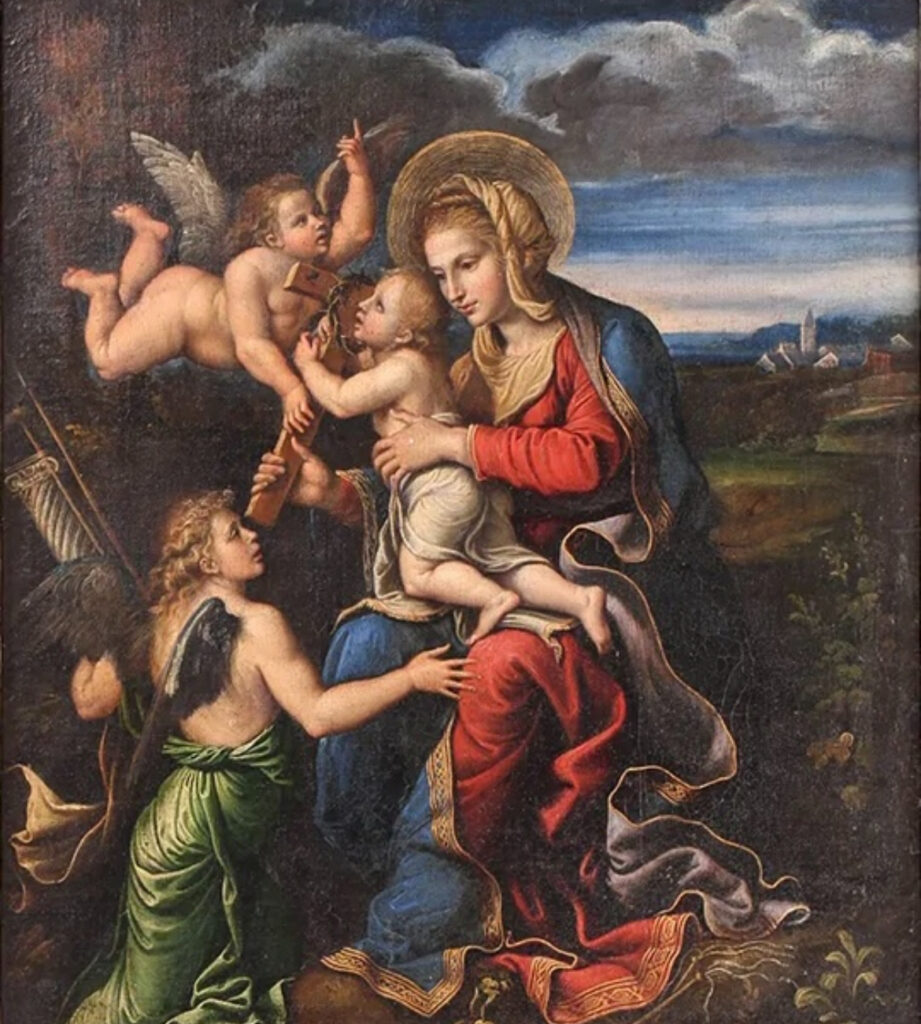
In June 2022, a significant lost painting attributed to a follower of the Italian Renaissance artist Filippino Lippi who completed his apprenticeship in the workshop of Sandro Botticelli, was discovered in a London bungalow and subsequently sold for £255,000 ($321,000) at Dawsons Auctioneers in London, England. The artwork was owned by a woman in her 90s who transitioned to a nursing home the previous year.
Her family sought the assistance of Dawsons to appraise the residence and its belongings as they initiated the sale of the property to assist with her medical expenses. The woman, who is reported to be suffering from dementia, was originally from Italy and relocated to the United Kingdom in her youth.
She inherited the painting from her father upon his passing 30 years ago, yet she remained unaware of its significant value and historical relevance. While the auction house has credited the piece to one of Lippi’s followers, the notable final bid indicates that some bidders may believe it to be an original work by Filippino Lippi himself.
According to the Artnet Price Database, only five paintings by Lippi have fetched higher prices at auction, with a record of $2.3 million established at Christie’s New York in 2005.
Filippino Lippi (1457–1504), The Depiction of the Madonna and Child
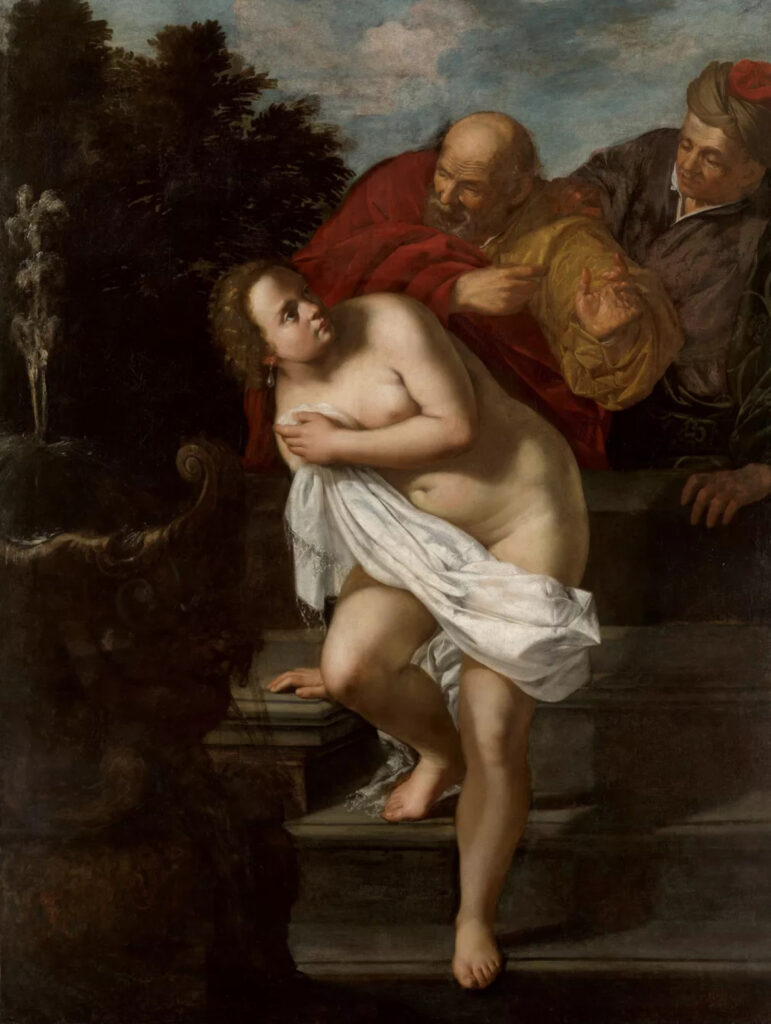
In September 2023, a previously lost painting by Artemisia Gentileschi was found in the storeroom of Hampton Court Palace in England. The artwork, titled Susanna and the Elders, had been misattributed for approximately 200 years, initially assigned to a male artist and later to the “French School.” Its rediscovery occurred when experts identified it in relation to a description found in an inventory of Charles I’s art collection.
The English monarch possessed seven paintings by Gentileschi; however, it was believed that only one, Self-Portrait as the Allegory of Painting (La Pittura), had survived his execution in 1649. After five years of meticulous conservation efforts, which involved the removal of dirt, overpainting, and previously affixed canvas strips, Gentileschi’s extraordinary portrayal of Susanna and the Elders has now been restored to view. The conservation process also uncovered the “CR,” or “Carolus Rex,” mark on the reverse side of the canvas, thereby further validating the painting’s provenance.
Commissioned by Henrietta Maria, the wife of Charles l, circa 1638 or 1639, the recently uncovered painting illustrates the biblical narrative of Susanna. In this story, Susanna is caught off guard by two men while she is bathing. She rebuffs their propositions, leading them to wrongfully accuse her of infidelity, a charge that carries the death penalty. In the end, Susanna is vindicated.
Artemisia Gentileschi (1593-1653), Susanna and the Elders
I have a deep appreciation for the vitality of paintings and artworks, as well as the narratives they embody. They thrive in environments where they are cherished, and their journey continues through time in various contexts and subsequently, living on eternally.
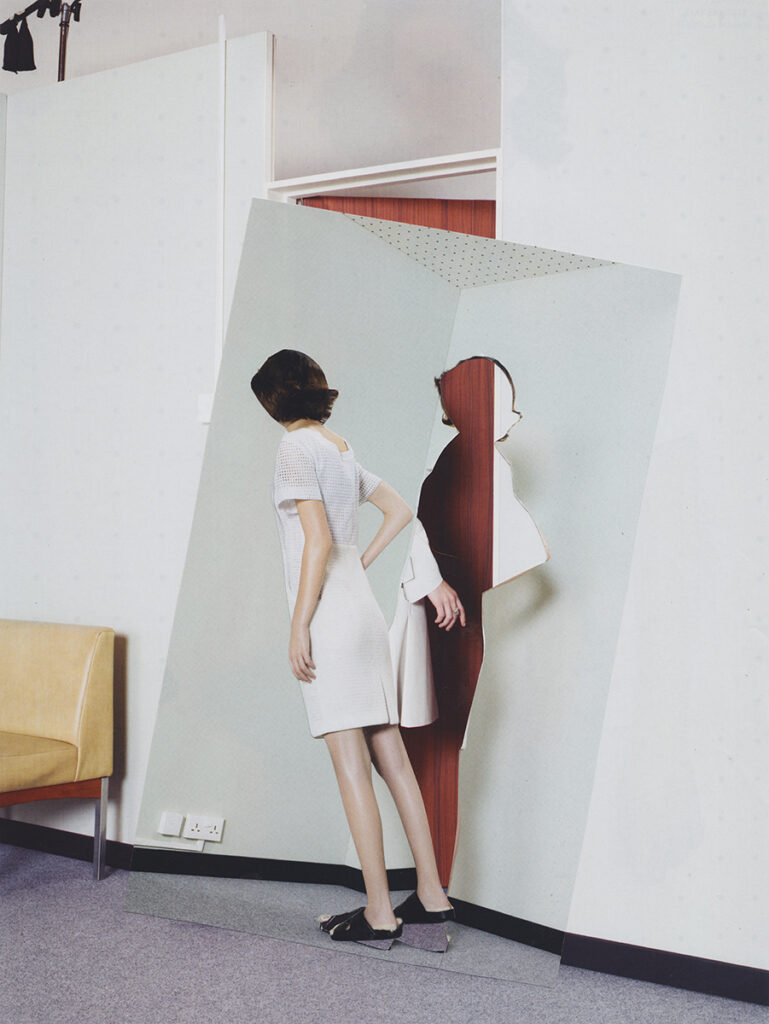
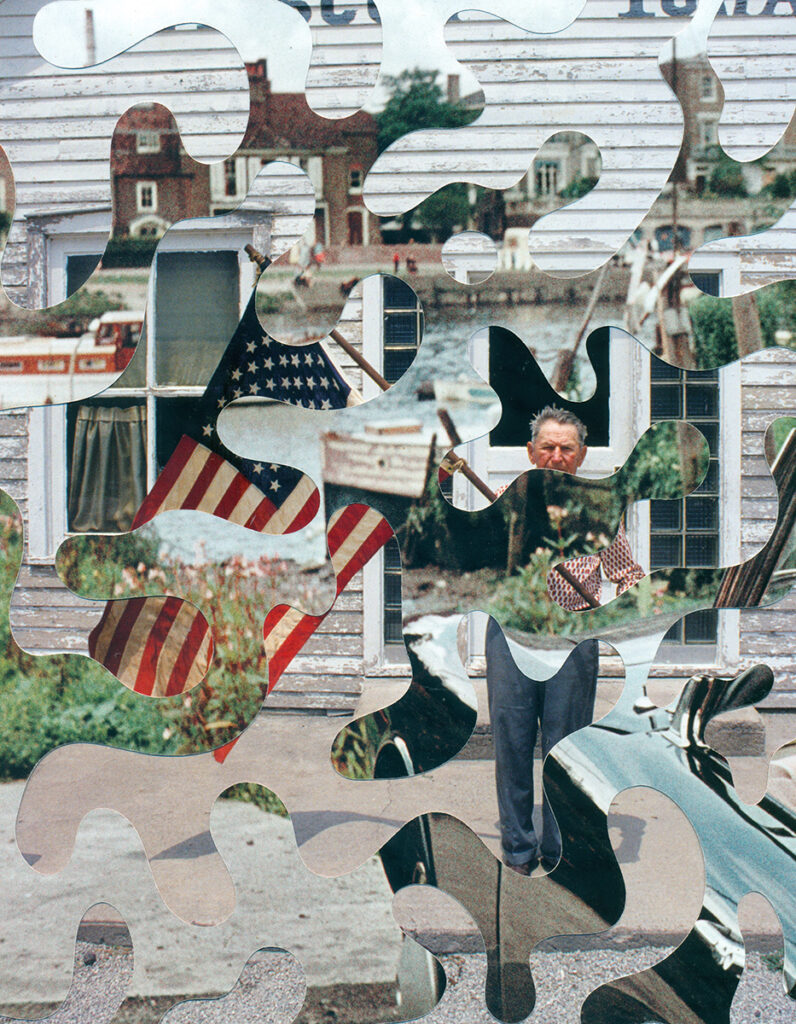
The first exhibition of “Altered Logistics” was subtitled “Contemporary Collage and Appropriation Art.” It was co-curated by Max Tuja (aka: Max-O-Matic) and held in 2023 at SUNY Cortland/Dowd Gallery in Cortland, NY. The selection of art back then stemmed from our passion for collage in all of its forms and philosophies, which in turn became the main focus of the original exhibition.
For this latest version of the exhibition “Altered Logistics: Redux,” I continue the emphasis on collage as it best describes the method of combining previously unrelated elements that form a new message, emotion or narrative. This can be easily seen in eleven of the sixteen artist’s works in “Altered Logistics: Redux.” In addition to these eleven artists, I have selected five artists that focus more on that moment of change, when the cognitive reprocessing of intake and altering strikes. In addition to these two sides of the general concept, “Redux” has both analog and digital examples of art, allowing me to continue the international take on the subject. As a result, this exhibition ends up being a complex visual experience, and one that I hope brings new insights and inspiration to all that see it.
Erick Baltodano, Unremastered #9, 2020, paper collage digitized, 30.8 x 23.2 inches
Beginning with the more collage leaning creators who expand the concept of logistics is Lima, Perú based Erick Baltodano. Baltodano boils down his method and message to its most basic elements while challenging our understanding of just what consciousness entails. Whether it stems from a knockout punch in the boxing ring, or our relationship with the more mundane physical day-to-day world, Baltodano shifts his focus to that transitional space between dimensions, thus shifting our understanding of time-based reality.
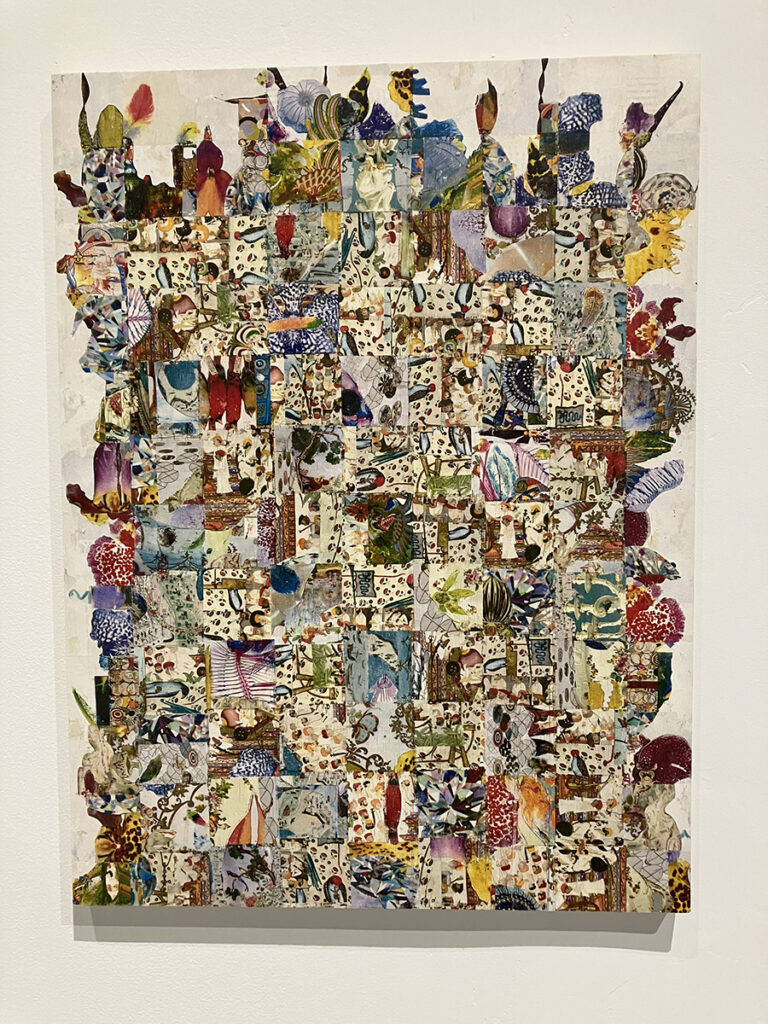
Joel Carreiro, B2fz8, 2021, milk paint and heat transfer on panel, 18 x 24 inches
New Yorker Joel Carreiro’s multicultural menageries of heat transferred images from fine art and design books are a mesmerizing reshuffling of our global visual history. From a distance, Carreiro’s art looks like a colorful and compelling mass of minutiae with no specific reference. Up close, snipits of vaunted visuals known and new emerge quickly, blending together to form odd connections and jazzy juxtapositioning that constantly alters our own understanding of reshaped perceptions.
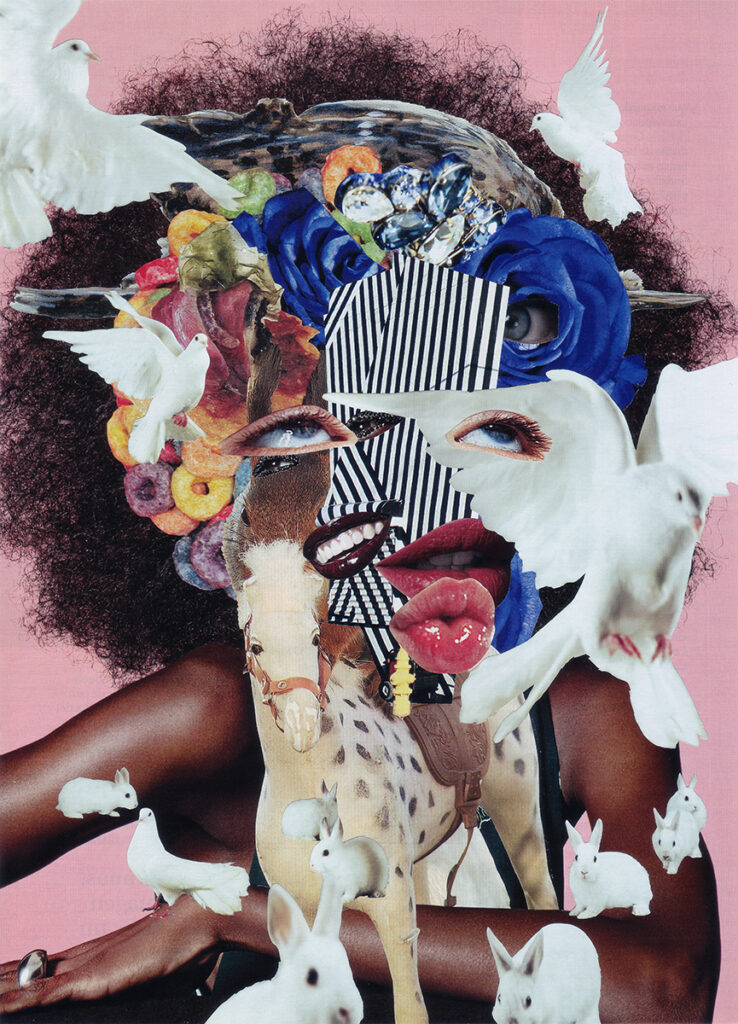
Cless, Palomas y Conejos, 2018-2020, hand-cut paper on a found magazine sheet digitized, 21.5 x 16 inches
Cless, an artist based in Valladolid, Spain, focuses on representing the five senses to create individual portraits that appear to be more alive than any representational image would suggest. Cless attains this by breaking the facial planes in key areas to extend or emphasize their reach. As a result, the Surrealistic aspects of his art enables the artist to introduce multicultural elements, as the once individual portraits now become open ended and more broadly interpreted, depending on the individual viewer’s own experiences.
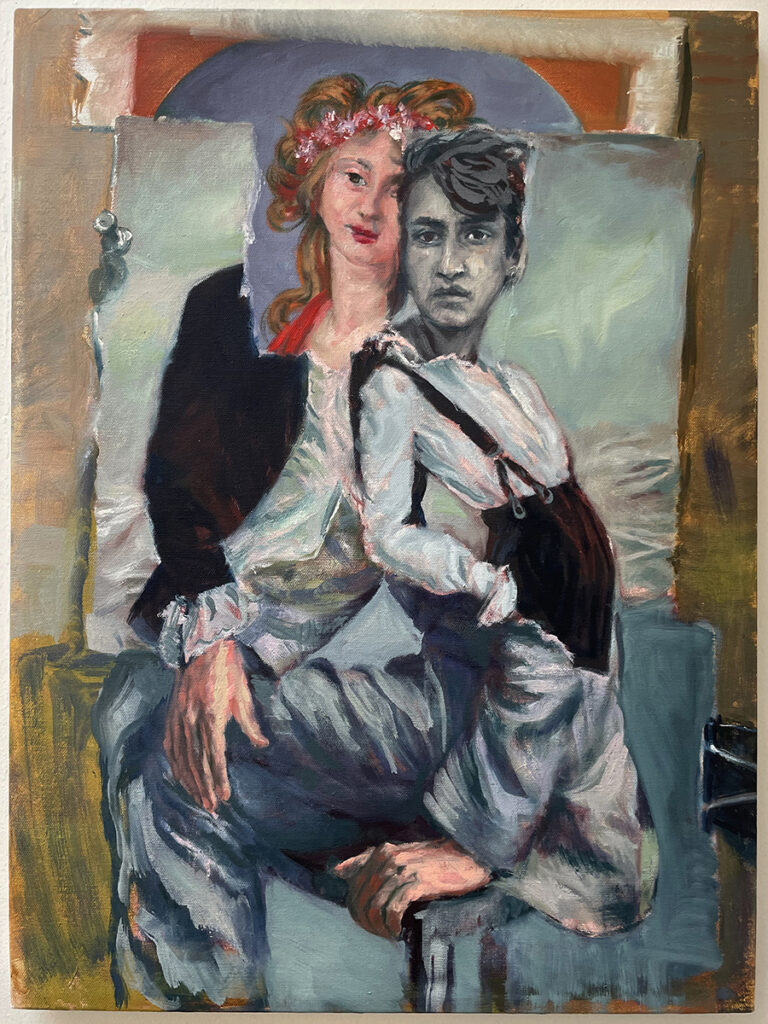
Don Doe, The Yin of Suspenders, 2024, oil on canvas, 23 x 17 inches
Brooklyn based Don Doe alters his logistics with fractured elements as well, only in this instance the artist is more focused on the pressures and absurdities of body image and gender roles across time. Doe accomplishes these vastly important subjects by collaging together loosely related visual references from a litany of magazines, and finding just the right combination of segmented images. When combined, his art produces a challenging take on society’s built-in tendency to distort and derange.
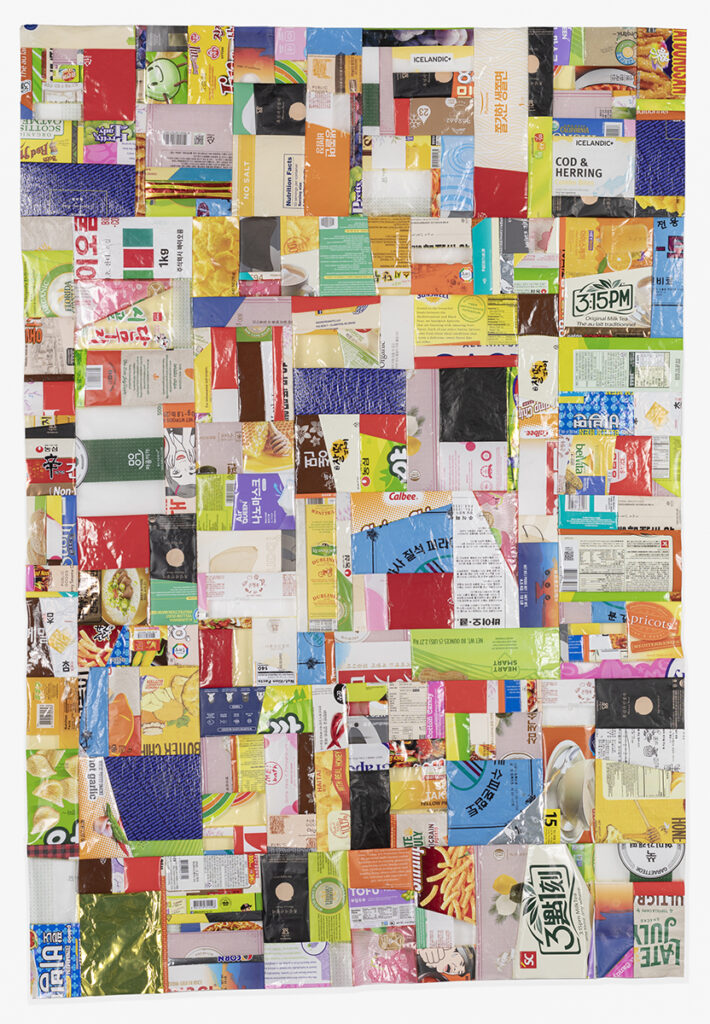
Yeon Jin Kim, Plastic Jogakbo #14, 2023, Plastic and thread, 42 x 61 inches
New Yorker Yeon Jin Kim puts a contemporary spin on the art of traditional Korean Jogakbo with her stitched together found plastic sheets. Using mostly from shopping bags and decorative packaging, Kim’s art is both visually compelling and socio-environmental, leaving viewers with much to think about regarding the time we live in. Does endless labeling, branding and advertising alter our decision making? Is it sinful/wasteful to fall into the trap of the ubiquitous plastic shopping bag? Or is the artist making a statement about understanding an altered individuality in a time when more and more of us are becoming logistically tribal?
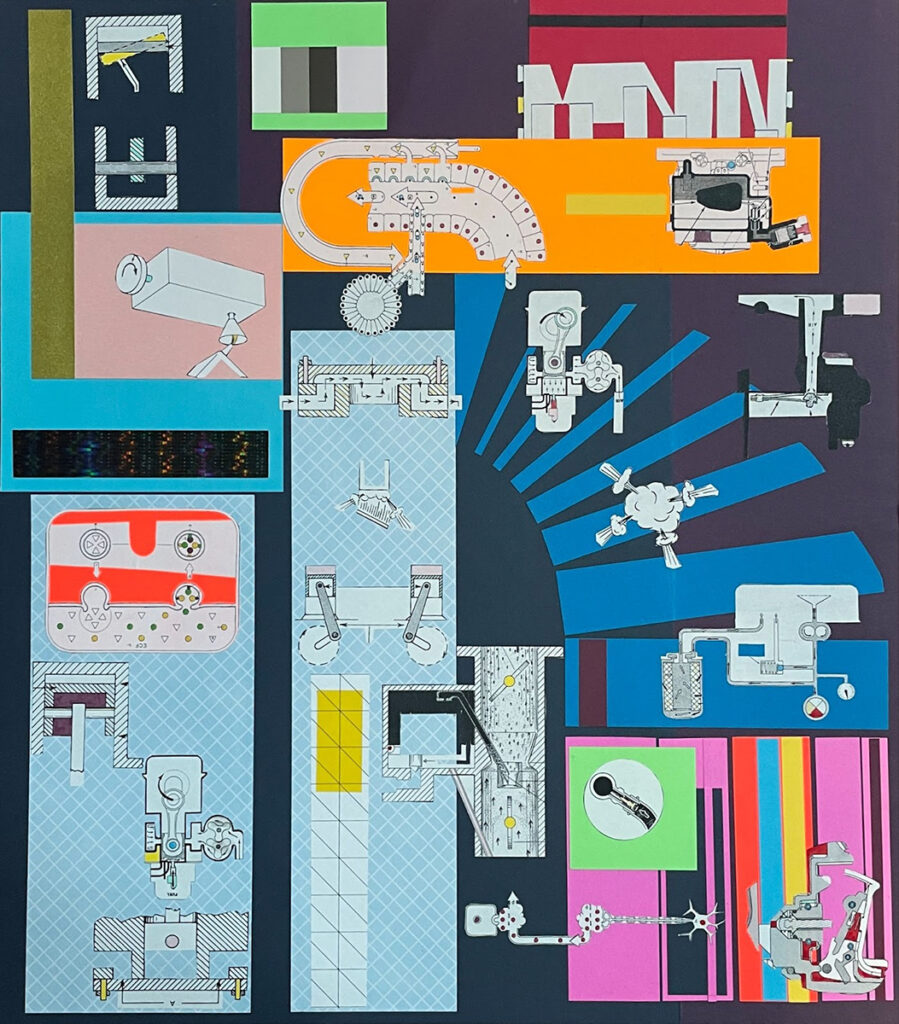
T. Michael Martin, Rat-a-tat-tat, 2024, mixed media collage on paper, 18 x 16 inches
Kentuckian T. Michael Martin draws our attention to the prevalence of the machine, especially the ones that get us from place to place, compute, keep us focused or watch our every move. The time of finding our own way has long been obliterated from all sides as we bounce from point to point like a pinball in a world where we have lost too much control over our own devices. On the other hand, Martin’s art puts things into perspective in more ways than one, as he carefully coordinates color and movement in his compelling and contemplative compositions.
Max-O-Matic, Memory (14), 2023, paper collage digitized, 35.5 x 27.5 inches
Based in Barcelona, Spain, Max-O-Matic shows an altered state that includes two distinctly divergent worlds crossing paths without canceling the other out. The key alteration is aesthetics, followed closely by the socio-political aspects of today’s unleashed mixed-beliefs. As a result, Max-O-Matic shows how a relatively direct method can change the flow of logistics visually as two points of view collide and somehow coalesce, while enhancing the strength and meaning of both.
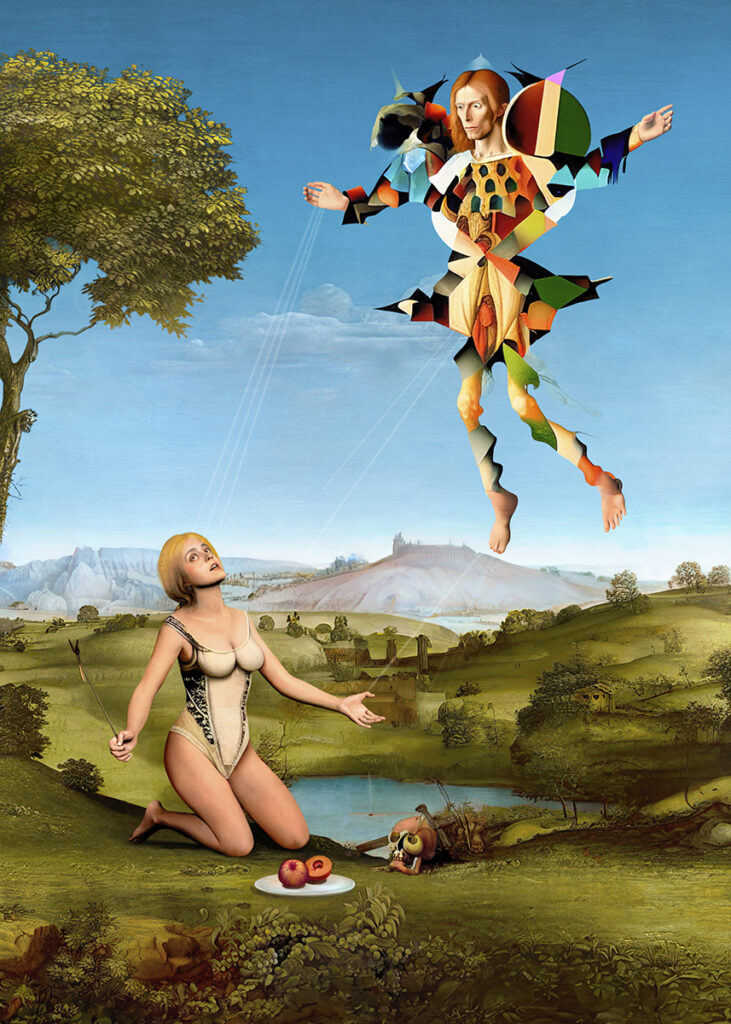
Kevin Mutch, Legend of St Francis, 2024, digital painting, 36 x 25.7 inches
Hamilton, Ontario, Canada resident Kevin Mutch alters our thinking in a whirlwind of subjects from creationism to creativity. He gets to the heart of each issue with a flair for the dramatic and an understanding of the narrative that may remind some of the art of the Renaissance, while the depth of his imagery, and the presentation of his thought process is more than modern. There is also humor in these works, a feeling that life is a playing field for one’s imagination, a way of entertaining oneself. In the end, it is Mutch’s unique ability to communicate complex thoughts that move us past logic and belief.
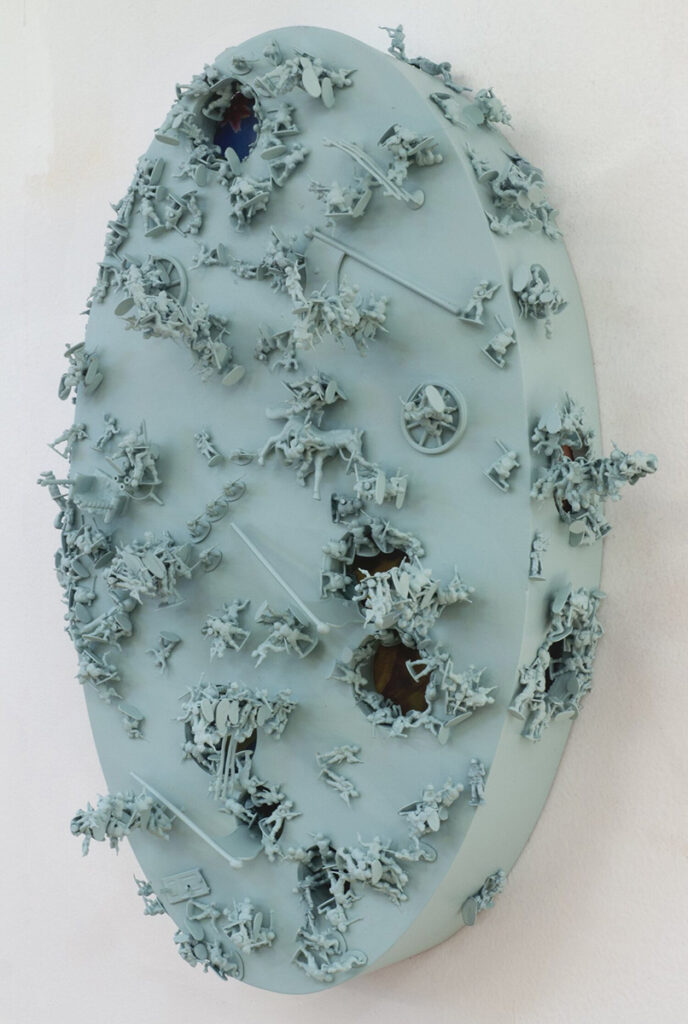
Margarete Roleke, War and Religion, 2016, light box with lenticular and painted toys, 21 x 16 x 7 inches
Margaret Roleke of Connecticut addresses the general understanding of such broad subjects as war and religion, and moves these topics into an arranged state so we can see how they relate. Controlling people’s rights and beliefs, and conquering new lands are, of course, a big part of it. With Roleke’s art, we are reminded that in order to motivate the masses, one must control minds and bodies to alter the logistics. Wars don’t happen and religions can not be established without the masses, and without the ability to control thoughts and ethics in some way or form.
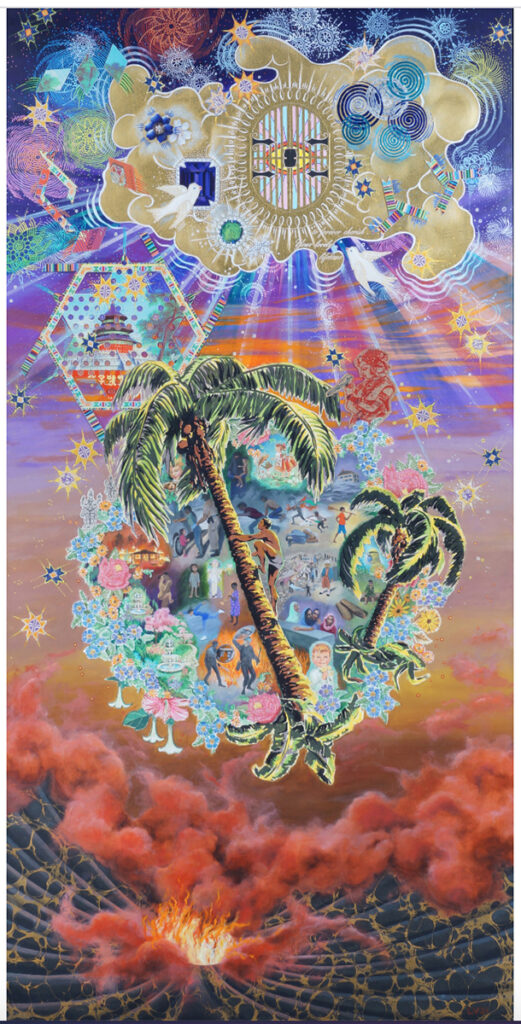
Lydia Viscardi, Social Climate, 2021, acrylic and collage on wood panel, 84 x 42 x 1 ¾ inches
Lydia Viscardi of Connecticut brilliantly mixes metaphors that both dig deep and expand exponentially. Using both the familiar and the otherworldly, Viscardi presents a new take on how we develop as human beings, how we cope with life’s ups and downs, and where we are and what we may believe in. In the end, it’s about that sweet spot between heaven and Home Depot, being grounded or lost, or pining for some place just out of reach, where fantasy and reality coalesce.
Cecilia Whittaker-Doe, Looking Everywhere, 2023, oil on panel, 12 x 16 inches
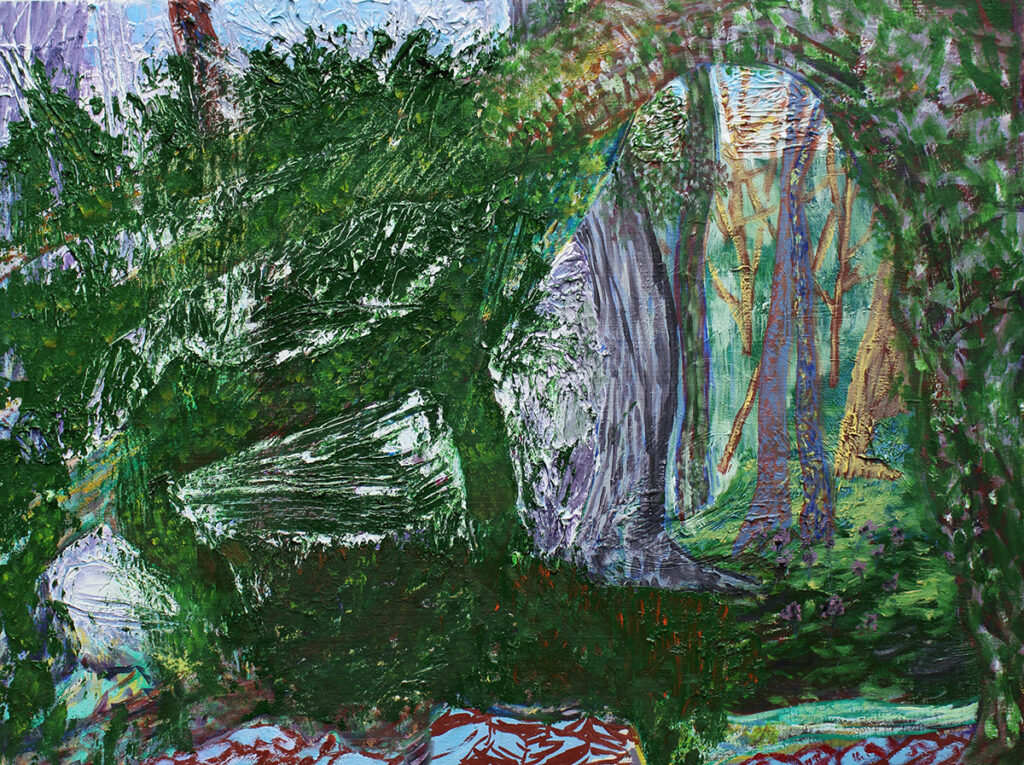
Brooklynite Cecilia Whittaker-Doe reinvents the concept of the landscape, altering color, proportion, placement and logistics. In so doing, she reveals a multi-dimensional field where fractured vistas are repositioned in a semi-kaleidoscopic way that alters any sense of gravity or physics. Like a dream, we are presented with a disjointed narrative that is somehow pulled together by a thread, edging in continuity and clarity.
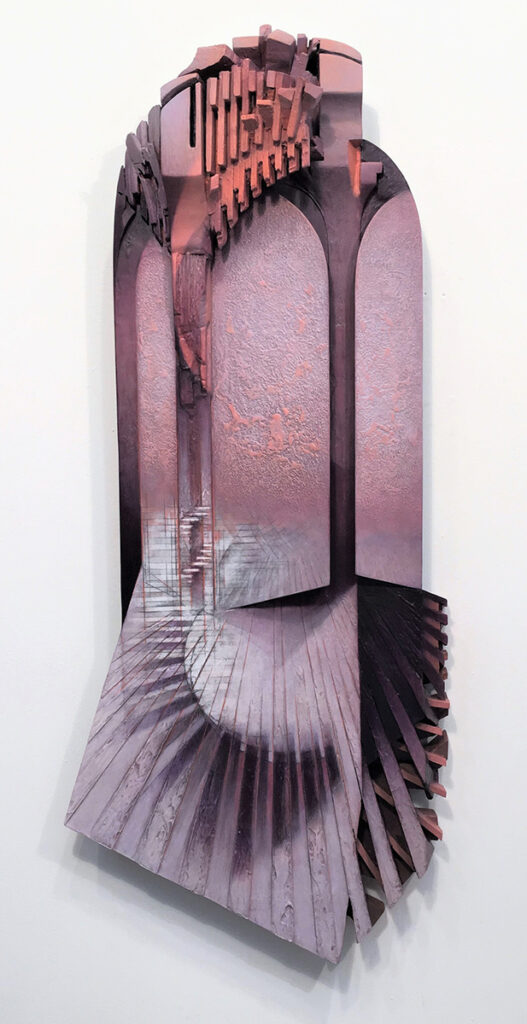
Serdar Arat, For Piranesi, 2019, acrylic on wood, 35 x 15 x 5 inches
From the experience of change, or when the moments of cognitive processing of space and time strikes there is Serdar Arat of New York. His art alters our conception of flow that architects depend on, and how we perceive our own movements in both familiar and foreign lands. In Arat’s wall reliefs there is also that distinctive spiritual side that comes from the element of antiquity, especially in the displaced details. It’s that familiar feeling of the passage of time, that experience of seeing, breathing in and touching an ancient or past world for that matter, that sticks with us forever, altering our understanding of just who we are in the grand scheme of things.
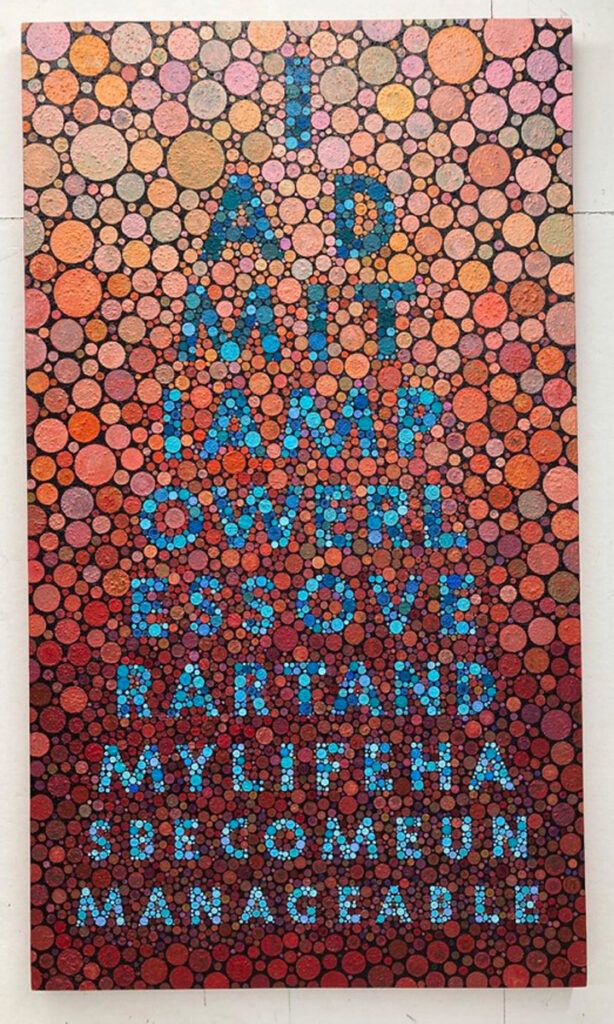
Vincent Dion, Step One, 2023, acrylic and aggregate on wood panel, 84 x 48 x 2 inches
Connecticut artist Vincent Dion uses a very familiar symbol, the Color Vision Test, to get his message across. From the intense written reality of “I ADMIT I AM POWERLESS OVER ART AND MY LIFE HAS BECOME UNMANAGEABLE” to the benignly humorous “COLORFIELD,” Dion informs us that being an artist is both a blessing and a curse. And like artists who have used text in the past to make their thoughts known, Dion relies on the viewer’s own personal experiences and the thoughts that ensued to be tapped and adjusted, altering minds away from the preconceived to the angst of the artist.
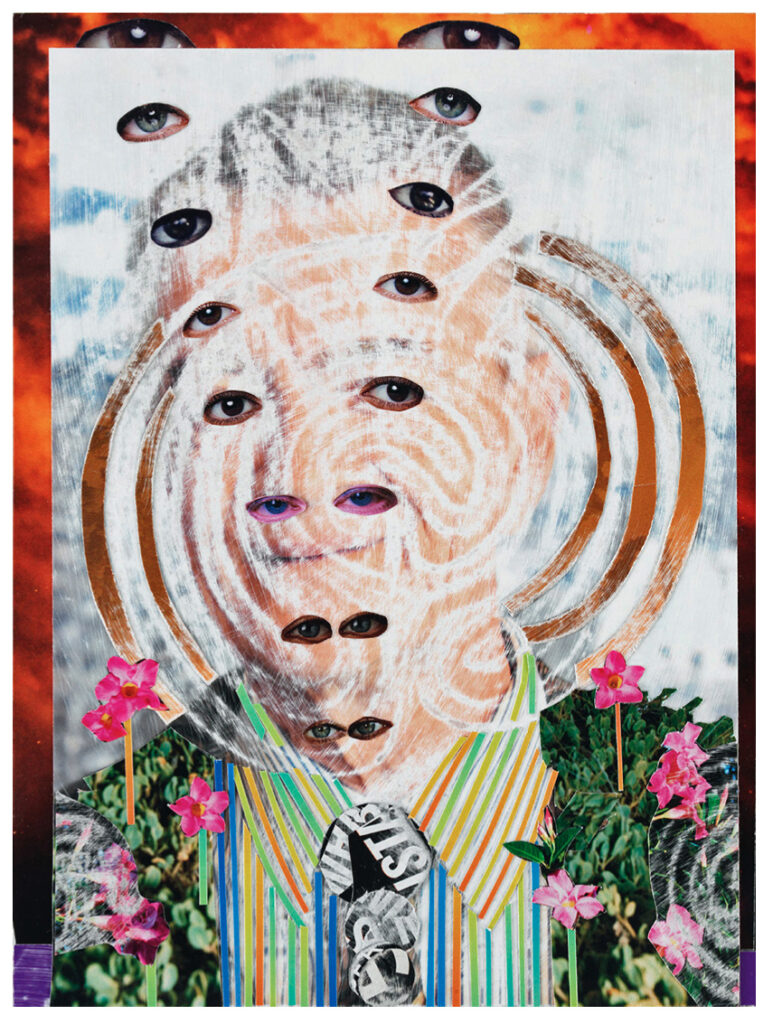
Paul Loughney, Pandering Spirit, 2022, collage on panel, 11 x 8 x1 inches
Brooklynite Paul Loughney’s logistical bent is more about seeing and processing, and how we may alter our conclusions given change in circumstance. Loughney’s art reveals the different ways we ‘see’, and how those sights seep in solid then, dispel into the far reaches of space. There is also the presence of the collective unconscious here, or maybe it’s just how we process seeing as we filter and form visual information moment to moment, day to day and year to year.
Creighton Michael, Frequency, 2011, oil, acrylic, digital transfer on convex panels, 24 x 72 x 2 ½ inches
Creighton Michael of New York brings us directly to the point of perception, that nano second when light and dark first enter the retina and are translated by the brain. Light comes in waves, the processing of that information has to be deciphered and compartmentalized otherwise we can not function successfully. So we must alter and logically implement what we perceive around us and Michael’s art reveals those subtle changes that are normally imperceptible, showing us the beauty of what we are missing.
D. Dominick Lombardi, CCWSI 118, 2022, oil and alkyd on canvas, 15 ½ x 18 inches
In my own work, there is a fascination with the theme of the exhibition, and how that may change the appearance of the person who is experiencing Altered Logistics on the brain. Done in a Pop Surreal, dark comedic way, I tend to lean aesthetically, more toward the strangeness of Lowbrow art to get my point across. I also rely heavily on mental image flashes that I believe come from the collective unconscious. I am based in New York State.
Altered Logistics: Redux will be featured at the Clara M. Eagle Gallery, Murray State University, Murray, KY, from August 26 to September 20, 2024.
When you enter the home of Flavio Belli, you are instantly surrounded by his lifetime collection of art. Everywhere you look there are paintings, textiles, drawings, prints, collages, works on paper and photography. Ceramics, sculptures and tiles adorn table tops and shelves. It is an unexpected surprise to see such a vast and varied collection, truly a lifelong passion of collecting.
Flavio Belli is a multi-faceted individual. He is an artist, curator, art consultant, and a partner in a new gallery called Tarantino Belli, in Toronto, Ontario, Canada.
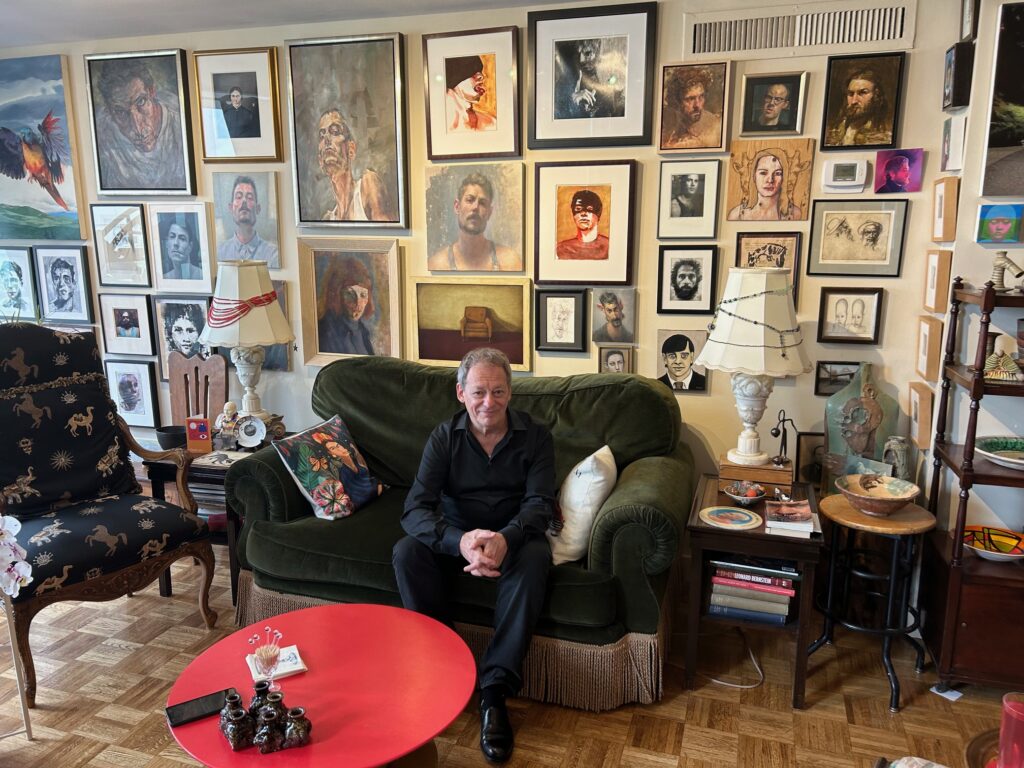
Flavio Belli sitting in his living room in front of his wall of strategically placed portraits
There is so much to see and process we wonder where to begin our conversation. We are impacted by the dizzying array of portraits on the wall directly behind the sofa in the living room. Numerous eyes gaze upon you reminiscent of old stories and recollections of allegories of each procurement, the arrangement constantly changing to Flavio’s inclination.
So, when and how did this passion for collecting art begin?
Flavio’s grandparents owned Angelo’s Restaurant in downtown Toronto from 1920 to 1958. The restaurant was frequented by many artists from Frederick Varley who was a member of the Group of Seven to the likes of Harold Town and celebrities like Boris Karloff, Lucille Ball, Edward G. Robinson and even Ernest Hemingway. Beginning in 1960, Flavio’s father opened Old Angelo’s on Elm Street. Mr. Belli senior was a lover of art and became an avid collector of art books. From time to time, Mr. Belli held art exhibitions in the restaurant consisting of paintings hung on the walls. It was in the collection of his father’s art books that Flavio became acquainted with a book on the work of Chaim Soutine and fell in love with the work and art. Such was the environment in which Flavio grew up.
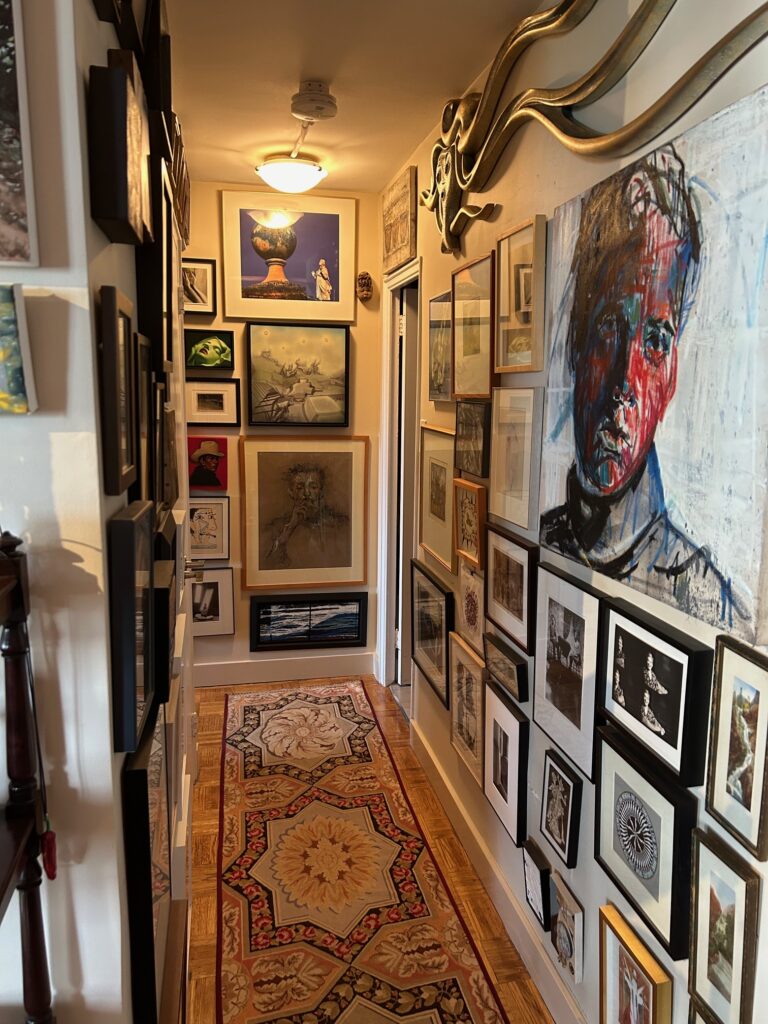
The walls of Flavio’s bedroom and hallway
In 1960, Rick McCarthy was a student at the Ontario College of Art in Toronto. One of his first exhibitions consisted of six landscape paintings, rich with impasto and bold brush strokes and was held at Angelo’s restaurant. It is here that Flavio became acquainted with the artist. Flavio started to compare the work of Soutine to the work of McCarthy. Flavio was ten years old at the time and was enamoured by the thickness and paint application on the surface of each work. An illustration within a book could not do justice to such a technique.
As it turns out, Flavio’s first piece of art was a Rick McCarthy landscape painting from that grouping held at his father’s restaurant many years before. With all of these influences around him, and the acquisition of a McCarthy painting, Flavio decided he wanted to be an artist. And so the journey began.
What is your favourite art work in your collection?
It’s like eating candy… and asking which one you like best? A Greek tile purchased in 1972 is one of Flavio’s favourite pieces. The work of Brian Kipping is another favourite of Flavio’s collection. He knew Kipping and exhibited his work and subsequently purchased four from the artist. Today he owns 10 paintings by Kipping, who passed away in 2007.
What is the highlight for you when collecting? Is it the search or the acquisition?
I would say neither. The highlight of collecting art is for the love of art, the integrity in a work, the way it’s handled, the story behind it and the artist’s focus.
There’s always a story behind a work of art. How it was acquired? How was the work created or what were the circumstances around it? What history lies behind the work? Were there encounters with the artist’s and in part, the artist’s story of his or her life. The struggles, and triumphs?
Flavio standing next to his collection of artifacts acquired over the years
Flavio has been collecting for many decades but there is one story that is his favourite. It begins on a day when he was walking along Queen Street West taking in the many galleries on his walk. Flavio loves to look at art and also the prices of art. He remembers walking into Propeller Gallery and having a look around. On his way out, the woman at the desk told him there was a student show at the back of the gallery and that he should check it out. It was a third year OCAD illustration show. His heart skipped a beat when he saw a work by a young artist by the name of Kieran Brent. It had such a physical effect on him that he knew he had to have the piece. When asked the price, he was told it was $400 but, the work couldn’t be purchased as the piece was going to be exhibited at an OCAD exhibition. Nothing was for sale. However, the artist was going to be at the gallery the next day. Flavio told the woman to tell Kieran that he was purchasing the piece and was going to leave a deposit of $200.
Flavio went back the next day to meet Kieran and pay for the remainder of the sale. As it turns out Kieran’s self-portrait won first prize at the OCAD exhibition and the image was used on a poster promoting the show. Since that time, Flavio and Kieran have become good friends, and Flavio now owns seven self-portraits and a major still-life painting by the artist.
Flavio Belli and life imitating his art collection
Flavio has made many good friends with artists that he has in his collection. As a true collector, Flavio likes to support artists. If there’s talent, he tries to help promote them. He doesn’t believe in buying out of pity or charity but, if an artist is struggling and the work has integrity, he’ll purchase several works.
If you had unlimited funds which artist or artists would you like to own?
Well if I had unlimited funds to buy any art work I wanted, I would purchase Jack Chambers “Sunday Morning #2”. Chambers has the ability to represent reality as accurately and authentically as possible. I’m a huge fan of Chambers, as well as Graham Coughtry. I can really relate to Coughtry’s semi abstraction works of bodies floating on the canvas and of course Andy Warhol whom I can empathize with.
A short video of Flavio Belli speaking about artist Zac Atticus works in his collection may eventually be accessed here.