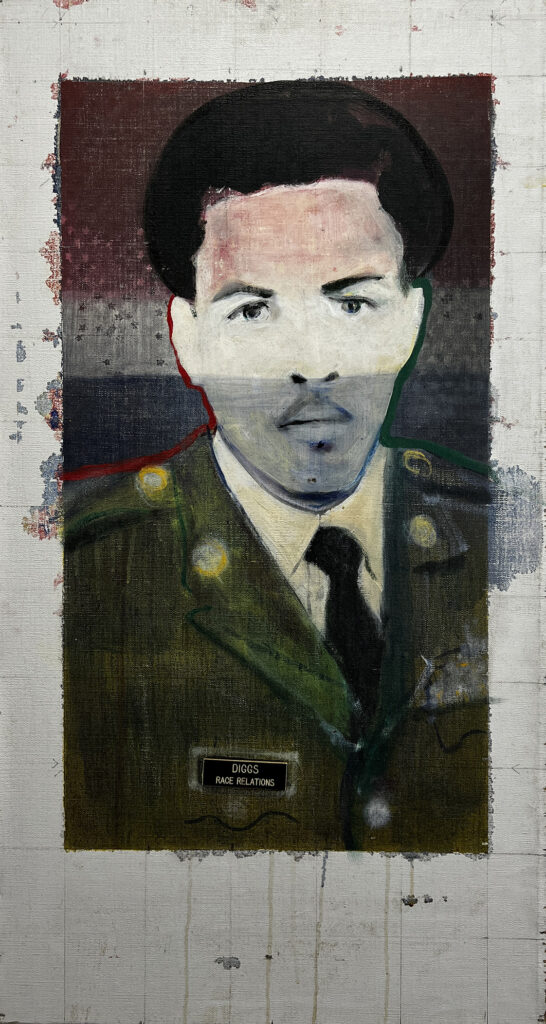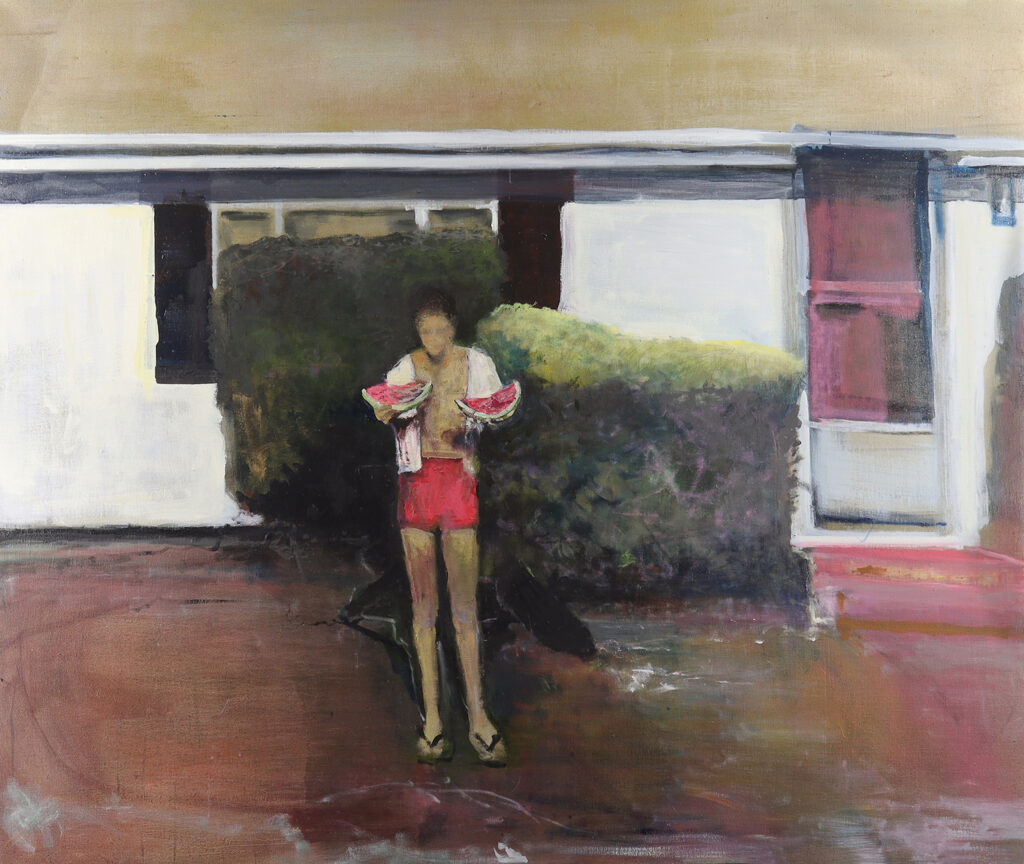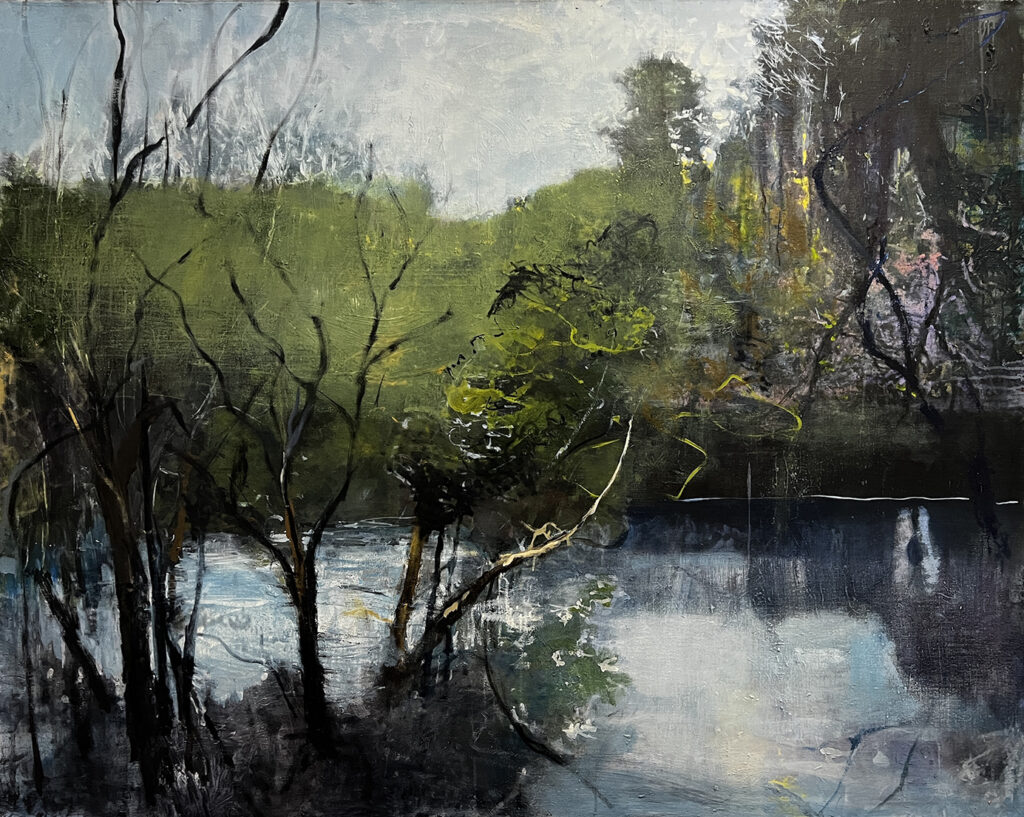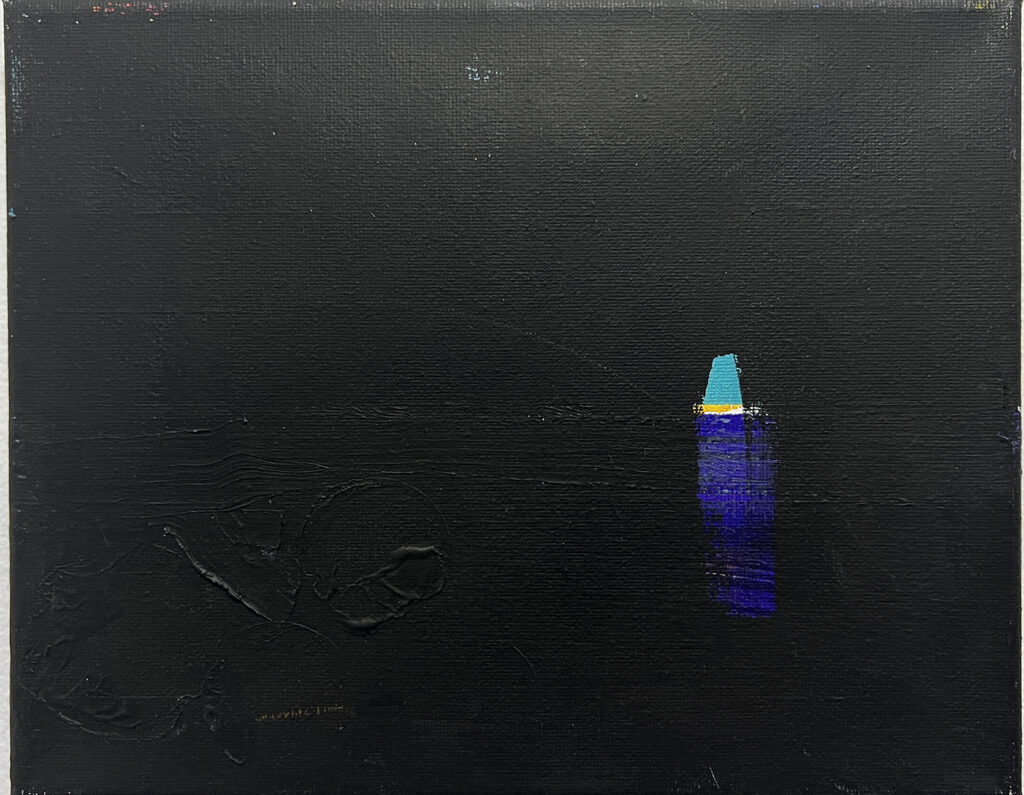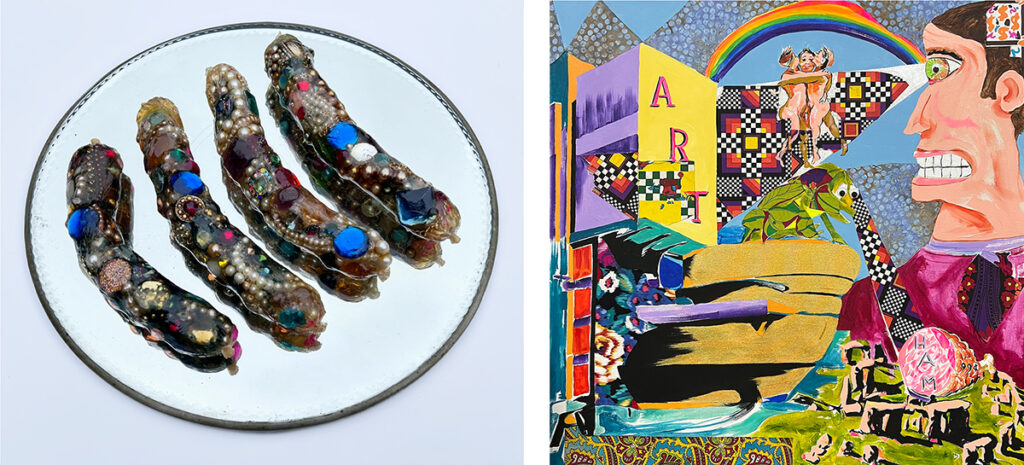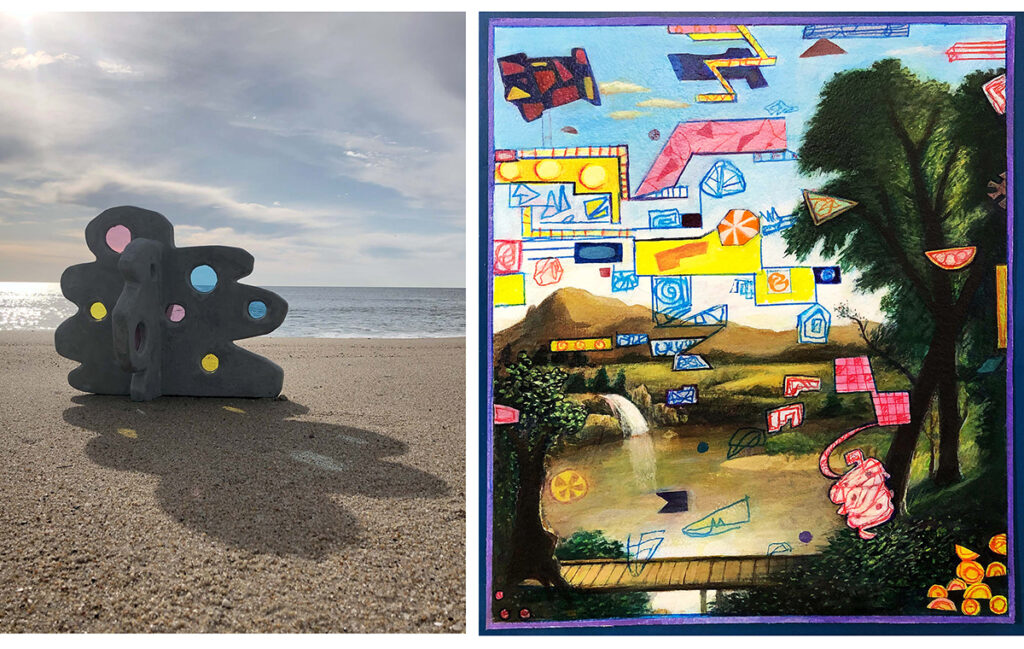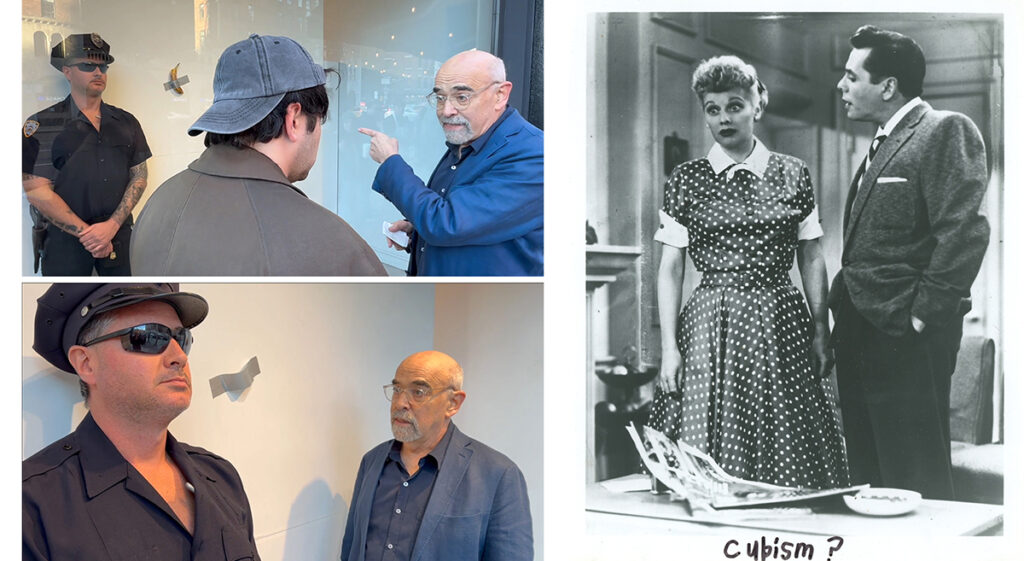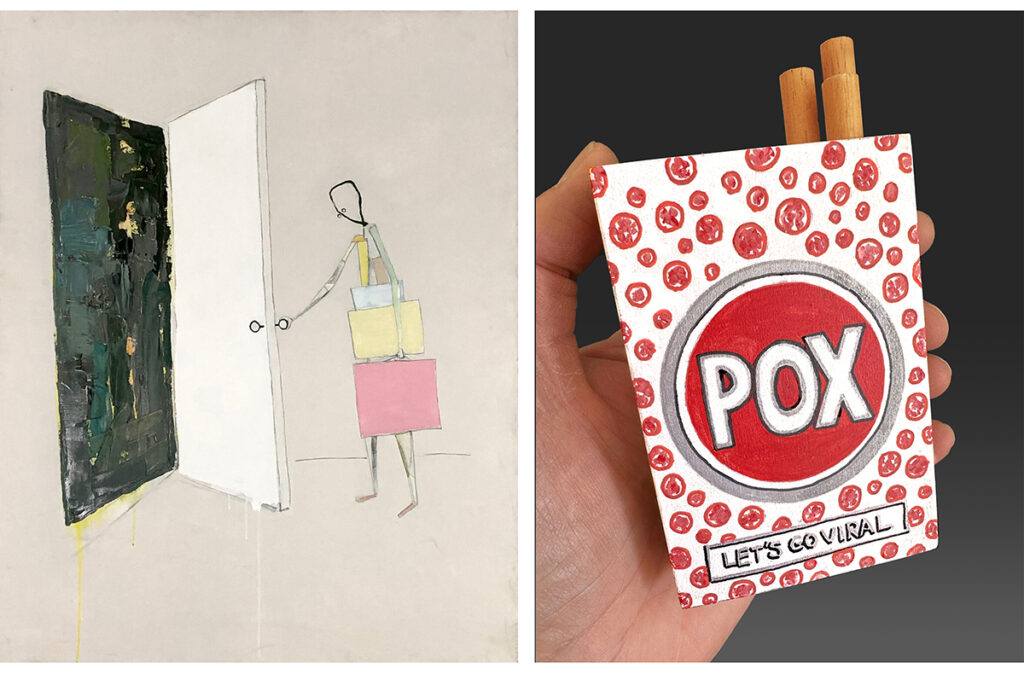
Gary Michael Dault: A Self Interview

“…but it is extremely difficult to watch oneself working….”

                       –Xavier deMaistre, Voyage Around My Room, 1794.

Q: When did you first paint?

A: In 1952, when I was twelve. My friend, Robert Nunn and I walked to the edge of the St. Lawrence river (we lived in Kingston) and despoiled a canvas board each. His despoiling was better than mine; his painting was bolder, louder and more decisive than mine.  He was a barely pubescent Vlaminck or Derain. My painting was timid, abashed.  It was a timidity, a diffidence, I then set about to outgrow.

Q: When did you first exhibit?

A: In lots of momentary, glancing-blow places, but my first SERIOUS exhibition was in 1983, at the Jane Corkin Gallery in Toronto.  It was a big show of works on Paper. I was forty-three and in the throes of teaching and writing about art—other peoples’ art. 

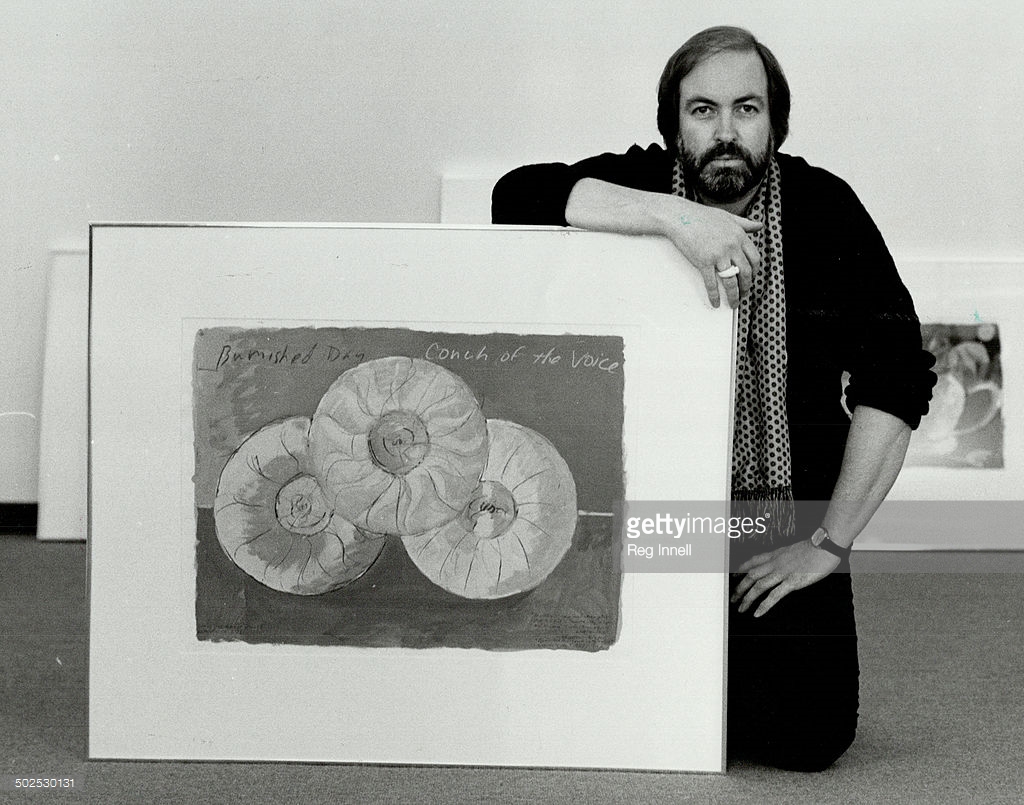
Writer turned painter: Gary Michael Dault; the former art critic for The Star; shown here with his painting Burnished Day or Conch Of The Voice (mixed media; 1983) opened his one-man show at the Jane Corkin Gallery yesterday. The show runs until April 23.

Q: Let’s jump ahead about 40 years. How did your summer-long exhibition at the Periphery come about?

A: Entirely through the kindness and courtliness—the agency—of architect, artist and musician Dimitri Papatheodorou, for whom the Periphery is both a country home and a six-acre estate-wide workshop near the pastoral, pixilated village of Warkworth, Ontario.  Papatheodorou describes the Periphery as a landscape containing visual art, music, performance and architecture, seeing it as a “time-based project” where he pursues his painting (in the exquisite new studio he has recently designed and had built) and, in a spacious gallery next to it, mounts summer-long exhibitions of some artist whose work he likes (last summer’s exhibition was of paintings by Toronto-based artist Greg Angus).

Q: What makes up your Periphery exhibition?

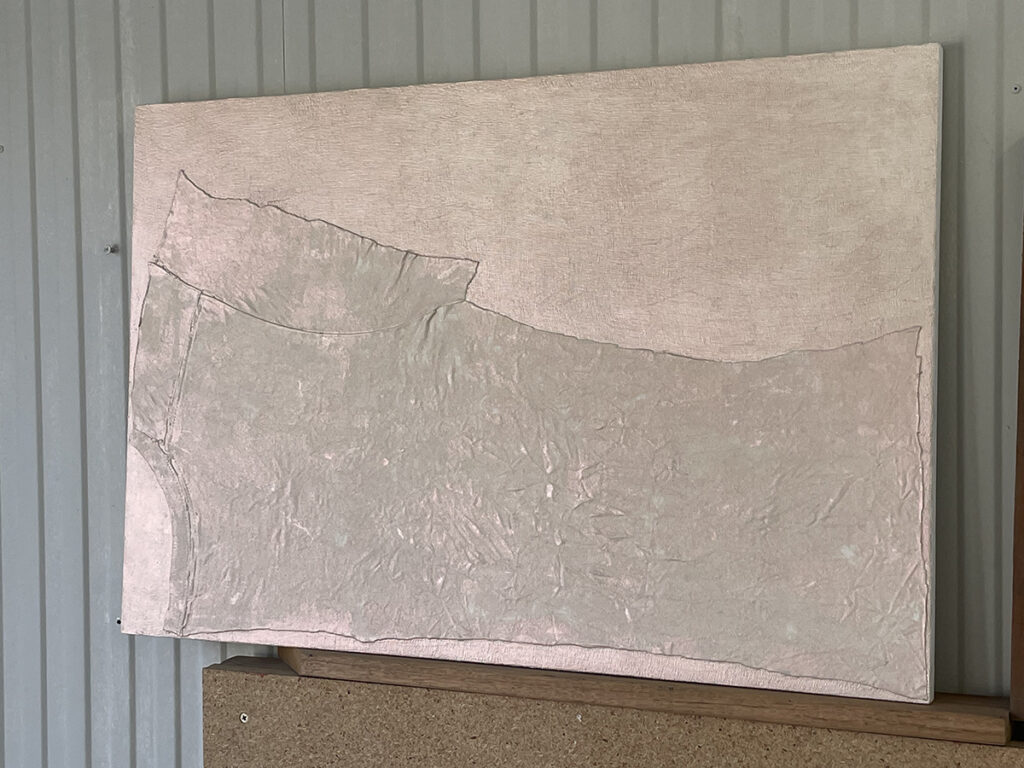
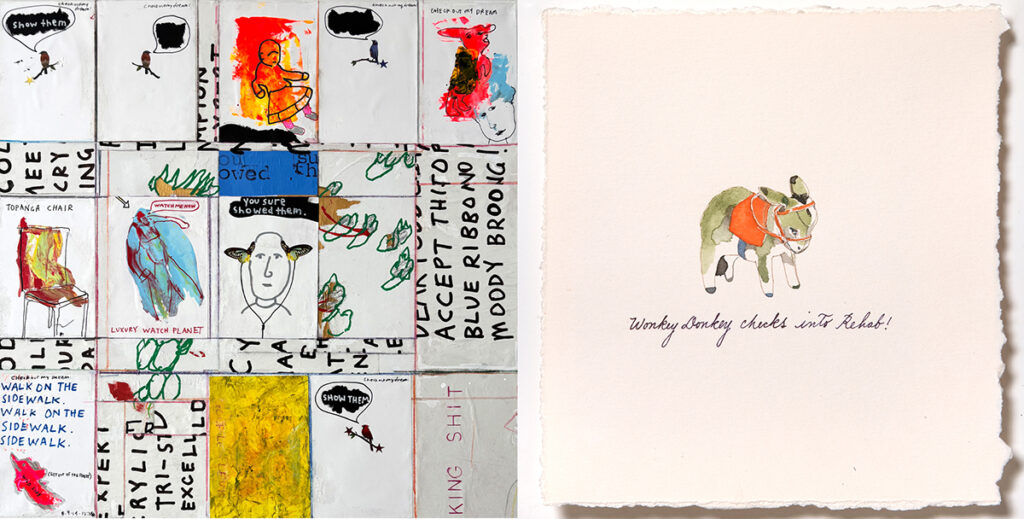
A: It’s in two parts. The first is a small retrospective, a mounting of a dozen works on paper from 2005 to 2015. The second part, titled Passatempi, Painting in the Meantime, is a wall-sized array of about 75 recent small paintings (acrylic with collage) on rough hunks of raw cardboard, some of them (my favourites) only a few inches wide.

Q: What are they like?

A: They’re muscular and messy, wildly gestural, impatient, ecstatic, frenetic and as far as I’m concerned, almost unbearably beautiful. They make my chest tight.

Q: They are, as you say, awfully small.  Why?

A: Because they are painted on very small pieces of throwaway cardboard—distaff, disreputable, ignoble shardsof cardboard, a lot of which come to me as the wrappings around books I’ve ordered or the boxes some foodstuffs like pasta come in.  I save them all for painting.  I love cardboard.  I like its used look. It has a history.

Q: When do you paint?

A: Between writing poems.  Which is to say, all the time.

Q: How long do you spend on a painting?

A: About 2-3 minutes.  5 minutes tops.

Q: What’s the rush?

A: I’m getting old.  I’m eighty-five now.

Q: That’s the reason?

A: Nah.  In fact, I’ve always worked that way.  Back in 2010, when I was exhibiting my 1 Minute Cereal Box Landscapes everywhere, each one of them took me only a minute apiece.  I’d make a whole exhibition in an hour.  Labouring over a painting is okay, I guess, if you’re Magritte or somebody.

Q: What do you like about these rapid-fire cardboards?

A: Their hecticity, the rush of them, the meaning (sometimes august, symbolic and even mythic) that always—always—emerges from them.  Not one of them is ever non-representational.  And yet not one of them knows where it’s going when it starts out.

Q: What if you make a mistake?

A: I can’t.  If a painting begins not to work—to bore me, for example—I subject it to some cleansing, cataclysmic event, like a sluicing of white paint—and then I start in to fix it.  I haven’t lost one yet.   

Q:  How did you decide on their installation?

A: Dimitri did that. He’s an architect. He has a perfect sense of form.

Gary Michael Dault

July 16, 2025

Peter Templeman: Into the Void

by Steve Rockwell

Peter Templeman, Petroglyphs, 2024, acrylic on panel, 16 x 20 inches (40.5 x 51 cm)

In his exhibition at the Christopher Cutts Gallery, Peter Templeman, having gone “Into the Void” returns here with the painted evidence of his journey. “Big Phase No. 5” (1997), an oil on canvas measures 72 x 84 inches, and the appropriately named acrylic on canvas “Wheel” (2022), at a mere eight inches square, serve as bookends to Templeman’s odyssey. The 2024 acrylic on panel, “Petroglyphs” have the qualities of an Egyptian cartouche, its “hieroglyphs” enclosed within their customary oval. Cryptic, yet conversely transparent, the panel amounts to an artist signature or seal, somehow punctuating his work as official – as if carved in stone.

Peter Templeman, Phase No. 2, 1997, oil on canvas, 72 x 60 inches (183 x 152.5 cm)

Centrepieces of the “Into the Void” works are four major paintings that Christoper Cutts acquired subsequent to a late 1990s visit to the artist studio. After decades in storage, these were combined and displayed here with contemporary works from Templeman’s studio. A visit by the artist by the artist to the Cutts Gallery this past winter tweaked a reminder of the stored works, thereby kicking its exhibition wheel into full gear. The “Phase Series (No. 2, No. 3, No. 4, and Big Phase No. 5)” are significant paintings in Templeman’s oeuvre. Besides their relative scale to the rest of the exhibition, they exemplify a successful synthesis of control and abandonment. Templeman’s painterly forays into his “void” divide variously into the more or less ordered. His “Paintings 1 – 9” as a group, paints the abyss as roiled chaos. His 2014 “Rocking on the High Seas” has the artist steering directly into the eye of the storm.

Peter Templeman, Rocking on the High Seas, 2014, oil on canvas, 24 x 18 inches (61 x 45.5 cm)

An unflinching resolve to go to the wall with each painterly outing is typical fare with Templeman. Relatively early in the artist’s career, the French Symbolist literature of Gide, Rimbaud and Beaudelaire, had primed the young artist to a receptivity of the unconscious realm. The “wall,” seemingly without exception here, is the dark unknown, against which every scumbled brush stroke gleams. In geologic terms, “Big Phase No. 5” may be seen as a motherlode, the artist’s repository of countless layers of paint. Their formation amounts to the congeal of phantasms into ever-shifting tectonic plates of pigment. Through a kind of alchemy, the deposit of everyday sight and sound minutiae is made precious in the act of having been made visible.

Peter Templeman, Big Phase No. 5, 1997, oil on canvas, 72 x 84 inches (183 x 213.5 cm)
Peter Templeman, Big Phase No. 5, 1997, oil on canvas, 72 x 84 inches (183 x 213.5 cm)

Templeman’s 2014 oil on panel ,”The Void,” features a window or portal. The viewer, once entered, is drawn into a vortex where tumult is the price of admission. The effect is one of tunnelling, amplifying a sense of dimension within dimensions. Here the artist is possibly throwing us the key to his creative “tripping,” with some of the GPS signposts along the way. Its loosely brushed “O” shape around the window hub might suggest the Greek last letter omega. Regardless, a sense of the cosmic is inferred with the artist stretching his craft to an existential limit. The 2015 canvasses such as “Top Knot” and “Physual” read as an interlacing of enigmatic glyphs. As syllabic utterances that coalesce, they exemplify the body of works where Templeman has tamed his tempests.

Peter Templeman, The Void, 2014, oil on panel, 42 x 36 inches (106.5 x 91.5 cm)
Peter Templeman, The Void, 2014, oil on panel, 42 x 36 inches (106.5 x 91.5 cm) 

With a 50-year-long career and many artists of note that Templeman has rubbed shoulders with, a consistency of development and vision predominates. While Graham Coughtry had impacted the artist as a student, Toronto’s Three Schools of Art introduced him to the art of John MacGregor, who’s improvisational surrealist method provided a significant building block. Templeman’s now distinct brushed iconography is part of a connective abstract tradition that threads generations.

An Afternoon with Collectors Ed Nemeth and Nancy Parke-Taylor

by Roy Bernardi and Jennifer Leskiw

We had the good fortune of meeting Ed Nemeth and Nancy Parke-Taylor at a recent art opening for Steve Rockwell, the publisher of d’Art International magazine. Ed is a semi-retired pharmacologist and Nancy has currently retired from her career as a lawyer. After much chatting with Ed and Nancy, we discovered that these two lovely people had a fabulous collection of contemporary Canadian and American art. Lucky for us, we were invited to their home to see this wonderful and eclectic collection.

I must say, the house itself is a work of art, located on a beautiful street lined with large mature trees. Although the façade of the house is somewhat modern, its large open spaces are filled with paintings, photographs, sculpture, works on paper, and art books covering almost every subject one can imagine. 

Ed Nemeth and Nancy Parke-Taylor with Tony Calzetta work

Upon entering the living room, your eye takes you to a beautiful painting by Toronto artist Tony Calzetta. It’s big and bold. Over the fireplace hangs an abstract by Toronto based artist Seo Eun Kim, who often goes by the name Sunny Kim. When viewed from afar, the surface of the painting resembles a needle point embroidery, when in fact, most of the surface is created by use of a baker’s piping bag.

Alcove with Barker Fairly paintings

The opposite side of the room has three lovely landscapes by Barker Fairley. The trio is serene and peaceful. To the left hangs a wonderful Harold Town single autographic print and below a landscape by Charles Comfort. And below to the left of that, a lovely Ray Mead ink abstract. Directly below the Fairleys sits a very large and quirky ceramic sculpture by David James Gilhooly. It’s fantastic and the juxtaposition of these works is so much fun. Also scattered among the table tops are intriguing metal sculptures by Santa Fe sculptor Kevin Box. Some of the pieces bring to mind origami works due to their extreme thinness and fine detail.

Ed Nemeth and a wall of abstract works

Similar to numerous collectors, Ed and Nancy’s collection comprises various pieces by the same artist, reflecting different stages of the artist’s life. Their collection features multiple works by Barker Fairley, ranging from landscapes (as depicted) to several portraits. The same goes for several pieces by Tony Calzetta from various phases of his artistic journey. A significant portion of their collection showcases multiple works by the same artist, with some displayed together while others are dispersed throughout the house, each hanging alone or in clusters in different rooms.

Robert Longo work
Robert Longo work

From here we stroll into the dining room where on one wall hangs two large scale black and white lithographs by American artist Robert Longo. The male and female are captured in a dance-like motion creating an amazing dynamism between the two. 

The opposite walls are covered in a variety of black and white photographs of various individuals including two photographs by renowned photographer Sally Mann. Among this collection is one of a young girl who once adorned the cover of an issue of American Fiction magazine. There is one striking photograph by Alfred Eisenstaedt of Dr. Joseph Goebbels, Propaganda Minister of the German Third Reich. There’s a fascinating story behind this photo. After Eisenstaedt took the photograph, there was a knock on his door one evening.  Fear engulfed him as he thought he would be arrested and taken away by the Gestapo but, to his surprise and complete relief, he was simply asked for a copy of the photograph for Dr. Goebbels’ personal collection. 

As we leave the dining room, we walk through what I would consider a reading room filled with hundreds of art books and a fabulous Janet Cardiff abstract work of art. Such a unique piece as Cardiff is primarily known for her sound performance works and videos. Cardiff, along with George Bures Miller represented Canada at the 49th Venice Biennale in 2001. Truly an amazing find. 

In this room hangs a number of photographs by Mark Hogancamp who works with toy figures, placing them in certain spaces and in certain positions in order to create a fictional city. Mark Hogancamp produced a book of his photographs titled “Welcome to Marwencol” which later became part of the idea behind the movie with Steve Carell, an American actor and comedian, called “Welcome to Marwen” released in 2018.

Belgian artist Jean Pierre Schoss blue metal sculpture

This room leads into the next which looks out into a well cared for garden. You’ll see a massive blue metal sculpture against the fence by Belgian artist Jean Pierre Schoss of Dog Bite Steel. His quirkiness and comedic appeal makes him look like a big, old friendly monster: he’s simply fabulous. Schoss uses recycled materials such as steel and creates fascinating creatures and animals. He feels the discarded material has a lot of character and always tells a life story. There are many smaller pieces scattered throughout this and other rooms. They’re very sweet and quite charming. But the outdoor monster is the best! 

What is intriguing about their collection is that the arrangement of the works is perfectly curated. They appear to be positioned in a way that they all complement one another, reflecting similar themes, artistic styles, and colours harmonizing seamlessly. 

What a treat it is to walk throughout the house and see works by Rita Letendre, Harold Town, Ray Mead, Barker Fairley, Robert Longo, Robert Chandler, Ian McKay, Katherine Bemrose, Steve Rockwell, Christopher Winter, Robert Marchessault, John Massey, Tim Deverell and Sally Mann, just to name a few.

Sylvia Galbraith at Abbozzo Gallery

by Emese Krunak-Hajagos

Seeing the description for Sylvia Galbraith’s Loretta’s Place in the catalogue for CONTACT 2025 I was hooked right away. Then I received an email from Abbozzo Gallery promoting Galbraith’s exhibition and the image looked as though it was in 3D—projected on the wall of the gallery. But when I finally visited the gallery, I saw the actual artwork—a large photograph on the main wall. I stood rooted in front of it, forgetting about the place and time— I just floated into its magic world.

There are two different worlds combined into that one image of a rather abandoned looking room with a bed frame, as though someone had just departed or the room was waiting for a new occupant. There is a rug on the floor and wood we expect to see on the floor now on the ceiling. But what makes this image unique is the upside-down landscape on the walls. Galbraith used a camera obscura when photographing the landscapes in Newfoundland, so the inverted images are inverted. But it is much more than that. Neither the room nor the rural landscape is interesting in its own. However, through combining them in this way, they undergo a metamorphosis. The interior opens and the landscape becomes part of the room, but not like a picture on the wall. Grass grows, buildings emerge, and we no longer know when the inside ends and the outside begins. Inside and outside become one, a mesmerizing symbiosis.

Sylvia Galbraith, Loretta’s Place, 2019, archival pigment print, 60 x 90 inches. ©Sylvia Galbraith, courtesy of Abbozzo Gallery

The Exhibition Statement mentions that the artist was “particularly interested in relationships between buildings and people”. However, none the photographs include people. Galbraith talks about people in their absence, like poetry does. The objects and landscapes resemble history, social status and there are real landscapes in their physicality. But what is physical? Can it be modified by our perception or even by the technique of the camera obscura? When does reality end and our dreams and memories start filling the place? In these photographs you can no longer separate them, they merge, creating an illusion that overshadows any possible reality. Looking at them you find yourself in a very different world, where interior and exterior no longer exist; an ethereal place has been created.

The title of the exhibition What Time Is This Place?, is very important. The photographs depict the rural landscape of Newfoundland in reality, as an outpost with common buildings. How do those people get here? Why? Is it an escape or a conscientious choice? Do they fit in or misplaced? We can guess their history, past and present and their social status. In Loretta’s Place the bottom of the walls in the room are sky-blue, the landscape is green, the buildings are yellow and white while the floor, the bed and the ceiling are dark, creating a dramatic contrast. The bed made me think of possible interactions between objects and people. It is just the frame, hinting at the absence of a person. But what does an absence really mean? Years ago, when I moved into my apartment, there was abandoned furniture in it that an old person left behind. For some time, I felt the presence of him, like a imprint of his memory was still there. The same is true for Galbraith photographs. Loretta might be a poor person, in a small, rural place, who still needs to buy a mattress and bed clothes. Very little else can fit into that tiny place. I think she is somewhat misplaced. This room can’t be the place she dreamed about.

Gary’s Place, Living Room (2019) is a comfortable space with a couch and framed pictures on the wall, that are overlapped with the landscape. A piano at the wall suggests that he is a music lover. His story is very different from Loretta’s. I am aware that I am creating my own narrative here, and I am sure everyone else will do the same. It is a good thing to be so deeply involved in the image.

Sylvia Galbraith, Gary's Place, Living Room, 2019, archival pigment print on Hahnemuhle Gloss paper, 24 x 36 inches. ©Sylvia Galbraith, courtesy of Abbozzo Gallery
Sylvia Galbraith, Gary’s Place, Living Room, 2019, archival pigment print on Hahnemuhle Gloss paper, 24 x 36 inches. ©Sylvia Galbraith, courtesy of Abbozzo Gallery

Some of the photographs give away their locations, like Main Road with Boats and Butterflies (2022), where the landscape is dominant. It is a nicely painted room with an antique lamp and books on a dresser, suggesting that the person who lives in it can afford beautiful, expensive things. The landscape depicts a harbor and a more populated area, a village or a small town. Butterflies fly out of the landscape, further confusing the viewer about where the landscapes ends and the interior takes over. The ceiling is another photograph that looks like a rock with some grass. It is not easy to decipher what we see or where we are.

Sylvia Galbraith, Gary's Place, Living Room, 2019, archival pigment print on Hahnemuhle Gloss paper, 24 x 36 inches. ©Sylvia Galbraith, courtesy of Abbozzo Gallery
Sylvia Galbraith, Main Road With Boats and Butterflies, 2022,
archival pigment print on Hahnemuhle Gloss paper, 24 x 36 inches. ©Sylvia Galbraith, courtesy of Abbozzo Gallery

Morning in the Red Cliffe Kitchen (2024), located in a town, where the only thing you can see is the wall and windows of the neighboring building, giving me the feeling of a suffocating, little space. Everything is old—almost grandmotherly—the stove, the couch, covered with a blanket, a chair with a pillow, the lace curtain. As in all Galbraith’s photographs, the colors are important. The vibrant reddish brown on the left contrasts the white stove, the shining kettle and the white fence, creating a quiet interior.

Sylvia Galbraith, Morning in the Red Cliffe Kitchen, 2024, archival pigment print, 40 x 60 inches. ©Sylvia Galbraith, courtesy of Abbozzo Gallery

Each photograph combines the inside of a living area with the surrounding landscape, focusing on the interaction between them. Every place has a strong impact on the people occupying them. Our personality is formed by our surroundings, whether it’s a busy city with noisy traffic or the countryside with a lake or ocean. According to that we become busy, hurried or eccentric, peaceful.

Our influence on the landscape can be positive or hurtful. I also believe that we may influence the buildings we live in. Whatever we do—work, cook or play the piano—our happiness or sadness leave a print on the walls and our memories live on in them. These photographs capture these ideas beautifully. As gallery manager, Blake Zigrossi said, they are more than photographs, they are “meta-photographs”, metaphors of our life.


Sylvia Galbraith, What Time Is This Place?, May 9 – June 7, 2025, Abbozzo Gallery, 401 Richmond Street West, Suite 128, Toronto. Gallery hours: Tue – Fri 11am – 6pm, Sat 11am – 5pm.

Danielle Frankenthal: Playing with Light

by John Mendelsohn

What need do we have for words when we have paintings, particularly the kind of lyrical and abstract works that Danielle Frankenthal offers us in her current exhibition? These are often extravagant, gestural works that are abundant in high color and visual movement. What challenges the writer is to order his thoughts about paintings that seems to ask us to forsake cognition in favor of pure sensation.

Danielle Frankenthal, Mist #2, 2024, acrylic paint, oil stick on acrylic resin, 48 x 48 in.
Danielle Frankenthal, Mist #2, 2024, acrylic paint, oil stick on acrylic resin, 48 x 48 in.

But despite the pleasures of innocent, sensuous looking that these paintings afford, our enquiring mind is nonetheless activated. First, there is the question of the unusual support of these works – square sheets of clear acrylic resin that are joined into a single box. Acrylic paint and oil stick have been applied to the inner and outer surfaces of the plastic panels, resulting in a kind of painterly diorama or stage set that deploys multiple scrims. The effect is to deconstruct the traditional layering of a painting into discrete planes, that coalesce into a comprehensible, if unstable image.

Danielle Frankenthal, L'Heure Bleu, 2023, acrylic paint, oil stick on acrylic resin, 50 x 50 in.
Danielle Frankenthal, L’Heure Bleu, 2023, acrylic paint, oil stick on acrylic resin, 50 x 50 in.

This effect of suspended marks is essential to these paintings, creating a kind of holographic presence in which the painted gestures shift from planar to dimensional space. Our second question is how this curious phenomenon is part of Frankenthal’s expressive endeavor. The exhibition has work from two series, Clouds and Gardens. The former benefits from the floating quality of the multiple planes of depths in the paintings, to evoke fugitive color and atmospheric vapors.

Danielle Frankenthal, L’Apresmidi d’une Faune, (Diptych), 2024, acrylic paint, oil stick, metal gilding on acrylic resin, 50 x 50 in.
Danielle Frankenthal, L’Apresmidi d’une Faune(Diptych), 2024, acrylic paint, oil stick, metal gilding on acrylic resin, 50 x 50 in.

A prime example is Mist 2, with its upper expanse the color of agitated fog, above a lower, coppery register. In the Clouds paintings, at times light is conjured literally through the use of pearlescent and metallic pigments. The many qualities of light constitute a continual focus in Frankenthal’s work, here intimating the diffused illumination of dawn.

A painting of the Gardens series, L’Apresmidi d’une Faune, is a diptych whose title simultaneously suggests the Mallarmé poem, the Debussy symphonic work which it inspired, and the ballet of the same name by Nijinsky. The double painting repeats, with variations, a pastoral setting with a mottled sky, a gilded glow of light, and a violent red passage that suggest the satyr’s sensual exploits. Leaping arabesques in black oil stick capture the sense of intoxicated dance.

Danielle Frankenthal, Garden 3, 2024, acrylic paint, oil stick on phosphorescent acrylic resin,
50 x 50 in.
Danielle Frankenthal, Garden 3, 2024, acrylic paint, oil stick on phosphorescent acrylic resin, 50 x 50 in.

Garden 3, with its turbulent sky, rising land, and turquoise vegetation, is the most recognizable landscape of the series. It becomes a terra incognita by an overlay of wild, wind-blown lines and the use of phosphorescent acrylic resin. This glow-in-the-dark effect reminds us that this artist is both a seeker after original expression, and part of a lineage of painting that draws its inspiration from nature, stretching back to Monet, and moving forward through Joan Mitchell and Helen Frankenthaler.

Danielle Frankenthal: Playing with Light, Curated by Lilly Wei, through April 5, 2025, L’SPACE Gallery, New York, 524 W. 19 St., New York, NY