Stephanie S. Lee’s “Ouroboros” at the Flushing Town Hall

by Jonathan Goodman

Stephanie S. Lee, Beautiful Lady Smile & 아름다운 아가씨 웃어요, 2020, Color pigment and ink on linen, 25 1⁄4" H x 17" W x 1 1⁄2" D each
Stephanie S. Lee, Beautiful Lady Smile & 아름다운 아가씨 웃어요, 2020, Color pigment and ink on linen, 25 1⁄4″ H x 17″ W x 1 1⁄2″ D each

“Ouroboros,” the solo show by Korean-born, New York-based artist Stephanie S. Lee, can best be described as an amalgam of influences. The Ouroboros, an image of a snake swallowing its own tail, dates back to ancient Egyptian and Greek mythologies. It symbolizes eternity and is wholly associated with Western culture. At the same time, Lee regularly uses the minhwa, or folk art, associated with presenting traditional Korean narratives, wishing and sharing good fortune and well-being among commoners in everyday life. In such work, traditional animals – tigers, dragons, and magpies – appear in the midst of modern New York City. Lee, a highly active resident in her community, to the point of having her own gallery called The Garage Art Center (www.garageartcenter.org) (her garage transformed into a showing space!), shows artists from around the city. Besides curatorial, design, and teaching Korean folk art, she paints regularly and considers herself an active artist. This show, very nicely installed within the spacious Town Hall gallery, indicates Lee’s sense of received form and an ongoing belief in doing good things, as demonstrated in her involvement with other artists and the community.

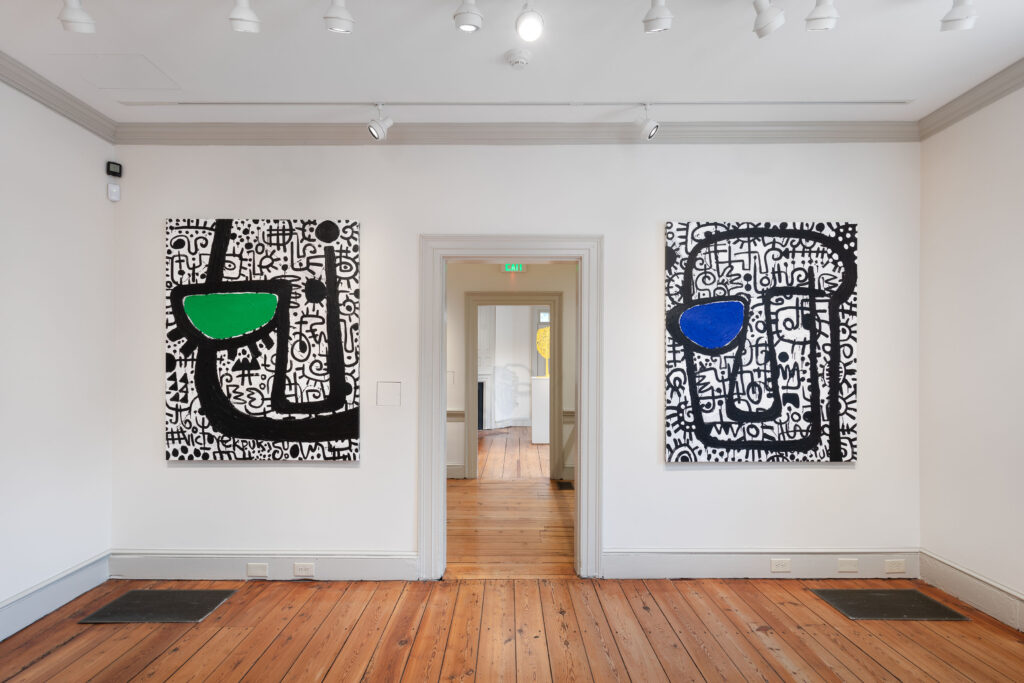
In this show, Lee combines Korean and English letter forms with images such as traditional animals, diamonds (a symbol of pure goodness that overcame hardships), or Ouroboros (the symbol of eternal destruction and reincarnation).

This series depicts her journey to finding happiness and hope while going through repetitive everyday life as a mother, wife, and middle-aged female artist. A good deal of the work in this show consists of diptychs with Korean characters, usually expressing Confucian terminology in one painting, which is then accompanied by a second, often spelling out the meaning of the Korean language in English. Other works of art include characters depicted on black diamond-shaped faux leather canvases or hanging scrolls. In her wish to merge imagery, textual references, and a nearly palpable sense of moral integrity, Lee is pursuing a language that owes its depth to Korean thought despite having lived in New York City for two decades.

Ouroboros, Solo exhibition of Stephanie S. Lee, 2022, Flushing Town Hall, Flushing, New York

Korean life in New York City, both in Manhattan and the outer boroughs (especially Queens), often determinedly remains Korean. Yet, inevitably, the city’s social structure and international culture makes its impact on all foreign cultures, no matter how insulated its immigrant inhabitants may wish to be. Certainly, this does not describe Lee’s own outlook. Instead, she embraces the diversity of New York City, even as she relies on the suggestion, sometimes overt and sometimes not, of Confucianism and Christianity for an approach to life and art. Lee studied graphic design for her BFA in Brooklyn and Museum Studies for her MS in Manhattan at Pratt Institute and learned folk art painting at Busan National University. Her work in school is reflected in her art; her paintings are exquisitely designed and are usually rendered in the naive style of the folk art she follows. In her ‘Munjado’ (Pictorial Ideograph) series, English alphabet and the Korean lettering is beautifully expressed, being indicative of the calligraphy of both culture she experienced.

Given that her art, inspired by folk tradition, reintroduces a historical Korean tradition, Lee’s work travels a long distance, both geographically and culturally. But Lee’s message is hardly antiquated; her work shows a very good sense of contemporary design and thought. On one wall, facing the viewer walking into the show, three pieces occur: in the middle, we see a large hanging scroll created in 2022. Its twisting, vertical shape establishes the symbol of infinity, with its mouth grasping its tail near the top of the hanging canvas. There are the words “useless” and “unproductive” in Korean on each snake, representing unanswered questions to herself on why she keeps creating artwork despite hardships. The symbol’s center is an open sphere created by the curves of two thin, interwoven Ouroboros, held together in the middle by a horizontal circle. On either side is a black diamond, serving as a background for single words. On the left, we see the neon-lit word “Value” in a script, and on the right, we come across the word “Art,” also in neon and written in script. When Lee presents the word “Value” on the left work, she clearly intends for the word to be understood in a non- commercial sense. (But Americans, accustomed to the economic worth of things, may take the term differently.) Her use of the word “Art” is universally understood in a moment. As for the Ouroboros, the snake symbolizes infinite possibility–from a Western point of view.

Stephanie S. Lee, Ajumma & Mother, 2022, Natural mineral color pigment and ink on linen, 46 1⁄2" H x 24 1⁄8" W x 1 1⁄2" D each
Stephanie S. Lee, Ajumma & Mother, 2022, Natural mineral color pigment and ink on linen, 46 1⁄2″ H x 24 1⁄8″ W x 1 1⁄2″ D each

Lee is giving the nod to different traditions as she works. It can be asked if the incorporation of Western mythology with the Asian folk imagination is a bit awkward; my own feeling is that, in the case of the work discussed in this show, Lee’s strong skills in design allow her to make use of the different cultures. She incorporates the imagery that is familiar to her into a vocabulary of her own making. The piece called Ajumma (2022) of the Korean characters

meaning ajumma, which in English can be understood as a married or a middle- aged woman. In Ajumma, Korean writing is intertwined with a snake made out of gems, while on the periphery of the image, several peonies, in dark or light blue, ornament the composition. In the painting Mother (2022), the word “mother” is presented in capitals and is less difficult to see. On either side of the English word, two white snakes, vines circling their bodies, mirror each other’s curves to form the shape of a uterus. On the lower half of the snakes’ bodies, luxury jewelry in reds resembling the color of blood is hanging, while at the top, a crown of brown thorns is also decorated with them. Religion is strongly followed within Korean life, and the artist agrees with both Christian and Confucian thought.

Stephanie S. Lee, Traditional Wish, 2015, Natural mineral color pigment and ink on Hanji, 48" H x 36" W x 2" D
Stephanie S. Lee, Traditional Wish, 2015, Natural mineral color pigment and ink on Hanji, 48″ H x 36″ W x 2″ D

Animals like tigers take up Lee’s imagination, as the artist remains devoted to the minhwa style and themes she admires. They represent strength and power and are perceived in a supernatural fashion as a guardian spirits. It is exceedingly hard to take a folk art theme and contemporize it in a way that does not do damage to the subject’s original implications. Sadly, we are living in a time when human overpopulation and subsequent development of natural lands are depriving wild animals of their habitat. But the large cats remain large in Lee’s imagination, often standing for human virtues that remain as guides to bravery or even a heroic stance. In the tigers I have seen portrayed by Lee, their fierce vigor is softened to some extent by the artist’s affectionate presentation. This does not mean that Lee is giving up on the tiger’s reputation for ferocity, only that within the folk tradition she is following, the animal is usually represented as less wild and friendly. So Lee’s representation is gentle and humorous rather than fierce. In her tiger paintings, she may be closest to the Korean imagination.

Stephanie S. Lee, Traditional Virtue - Filial Piety, Fraternity, Fidelity, Reliance, Propriety, Righteousness, Integrity, Conscience, 2019, Natural mineral color pigment and ink on linen, 33 1⁄2" H x 12 1⁄2" W x 1 1⁄2" D each
Stephanie S. Lee, Traditional Virtue – Filial Piety, Fraternity, Fidelity, Reliance, Propriety, Righteousness, Integrity, Conscience, 2019, Natural mineral color pigment and ink on linen33 1⁄2″ H x 12 1⁄2″ W x 1 1⁄2″ D each

There is a question implied by this show: Can Lee’s audience, either Korean or non-Korean, be able to effectively appreciate the painter’s merger of cultures? Can a crown of thorns coexist effectively with a folk rendition of a Korean tiger? Is the Ouroboros an image dispersed widely enough that it would make sense to Lee’s Asian followers? These questions might come close to taking over the real achievement of the art. Yet Lee’s visual skills, her adept use of both Korean and English words to complicate her message (in a useful way), and her unspoken insistence on principles provide her with the means to surpass the difficulties of a hybrid existence. In the poster announcing the show, the words “Mother, Wife, and Artist” are prominent, indicating the several roles someone in her position plays. Here the language is not politicized; rather, it is descriptive of a modern woman’s life. “Ouroboros” is of high interest not only because Lee merges influences but because she has dedicated herself to image-making despite the pressures of her daily activities. It is a good thing she pays so much attention to her art, which rewards its viewers with both visual elegance and honorable consideration.

Sunhee Kim Jung at Paris Koh Fine Arts

by Jonathan Goodman

Sunhee Kim Jung, American Dream, 2005, oil on canvas, 40" (h) x 50" (w)
Sunhee Kim Jung, American Dream, 2005, oil on canvas, 40″ (h) x 50″ (w)

Sunhee Kim Jung’s show of paintings explodes with color and vitality. The exhibition, presented at Paris Koh Fine Arts, located just beyond the George Washington Bridge in New Jersey, consists of a group of floral works of art, notable for their density of effect, their intensity of hue, and their open optimism, the result of an outlook devoted to beauty. Although she is from Korea, Kim Jung studied in the Washington, D.C., area; she received her BFA from the Corcoran School of Art, and then went to American University to take her MFA. Since then the artist has moved to Maryland. Although her show takes place very near to a major bridge spanning the Hudson, her work does not reflect the asphalt streets, tall apartment buildings, and steel bridges that turn New York into a site of industrial density. Instead, Kim Jing relies on an accurate but also romantic natural vocabulary: trees, flowers, dense arrangements of foliage. It looks very much like Kim Jung is painting from real life, not from her imagination. Yet the imagery possesses a vividness that results from the way she envisions, on her own terms, the particulars of her subject matter.

One of the strongest attributes of the artist’s floral projects is her attention to detail. Kim Jung’s gaze is highly focused, although not to the point of scholarly obsession, providing her with artistic freedom. Her studies present a strong interest in natural form—the work is usually strengthened by a precise understanding of the flowers’ shapes and hue. This precision results in a language of highly specific elements. There is a larger question, a critique, that can be noted: Is Kim Jung’s orientation anachronistic? This kind of work has been part of both Western and Asian art history for a long time, Painting flowers in detail has long been the basis of still life, an established way of working for hundreds of years. Its historical hold on contemporary art has been freed by the idea that today anything is possible, even if the concept or the form has not yet been developed or is already known. One remembers the flowers painted by the modernist Mondrian, which stand out as examples of the tradition. They have an excitement and energy that makes them new, despite the well-established nature of the motif. Kim Jung follows this path. She finds excitement in a realist, but also independent, reading of nature. Her interest in floral forms, modified to a degree by her own imagination, results in an enthusiastic treatment of the garden and the expanse of the woods.. 

Sunhee Kim Jung, A Bearing Life, 2005, oil on canvas, 50" (h) x 40" (w)
Sunhee Kim Jung, A Bearing Life, 2005, oil on canvas, 50″ (h) x 40″ (w)

The individual images tell their story—without a romantic reading. They become expressions of energetic beauty kept from visual overreaching or excessive sentiment by Kim Jung’s close detail. One can study the paintings the way a botanist would, with an eye for factual visuals whose elements seamlessly create the entirety of a flower. In A Bearing Life (2005), the entire composition is devoted to an upward gaze that rises to meet the top of a palm tree. There a canopy of fronds takes up a good part of the picture. The brown trunk rises to the rounded central core of the tree, from which the branches supporting the fronts extend outward, away from its center. Coconuts, green and brown, occur in the painting’s upper register. As an entirety, A Bearing Life is impressive. It is true to life, but the way the image is presented makes it necessary that we look upward, as if we were standing underneath the tree. The originality comes from the upward point of view Here Kim Jung’s work is made more interesting by her idiosyncratic manner of painting, which transforms our knowledge of plants into something original.

Sunhee Kim Jung, Silver Surfer Baby, 2007, oil on canvas, 20" (h) x 20" (w)
Sunhee Kim Jung, Silver Surfer Baby, 2007, oil on canvas, 20″ (h) x 20″ (w)

Silver Surfer Baby (2007) is a complicated painting. It presents a frontal tangle of brown leaves, which look like they are in the late stages of decline. They make it difficult to see an important part of the painting: the silver image of a baby, rotated so that its head is facing downward, as if ready for birth. This ambiguous image is surrounded by a yellow-gold oval frame. The painting’s background is a light green, which contrasts with the brown of the leaves. We can read this work as an emblematic rendering of the beginning of life, in the form of the fetal baby, and the final stages of life, indicated by the lifeless leaves. Most of the time Kim Jung is given to description, but flowers and blooms can easily take on symbolic meaning if the artist intends them to be seen in that way. In this painting, with its infant, Kim Jung has developed an approach that complicates the floral imagery she is so good at rendering. The baby is capable of representing a meaningfulness greater than itself, an embodiment of possibility, and as a symbol of the start of life, it is a highly optimistic image. The brown leaves might well be seen as the loss of nature. Together the two images extend across the duration of life.

Such a combination of objects underscores the complexity of Kim Jung’s production. As an Asian artist who has lived in America for many years, Kim Jung is an artist who cannot but help bring differing outlooks and visual styles together. Of course, floral painting has been central to Eastern art for centuries, although the high point of such work occurred a long time ago. Still, the impulse to paint a strikingly attractive flower, and to describe it within the context of deliberate beauty, is strong. But Kim Jung has foregone the use of brush and ink in favor of Western materials, which she uses in a way that emphasizes detail as much as expressive lyricism. 

But that does not mean the details are unable to express their own sense of beauty. How can one not paint a flower without paying attention to its innate elegance? The point is that Western and Asian culture have done this in different ways, while an artist like Kim Jung, having lived in two very different worlds, has been able to combine the two ways of seeing. We are living in a time of extreme eclecticism, which could explain the formal aspects of this art. But eclecticism doesn’t truly apply to the artist’s work. Instead, the combination suggests a mixed understanding of traditions that enforces our sense that the art has been merged by Kim Jung’s creativity.

Sunhee Kim Jung, Red Leaves, 2005, oil on canvas, 42" (h) x 64" (w)
Sunhee Kim Jung, Red Leaves, 2005, oil on canvas, 42″ (h) x 64″ (w)

The work Red Leaves (2005) is a densely painted presentation of red leaves and gray, veined ones; their numbers make the composition condensed enough that the ridged green stalks the artist includes are slightly hidden. Above the welter of leaves, at the very top, one can see a slight horizontal sliver noticeable for its brightness, consisting primarily of stalks. The deep red of the leaves, spread across the expanse of the canvas, develops a striking contrast with the gray leaves and the green stalks. Red Leaves is a work dedicated to artistic and natural profusion, leaving us fully taken with the imagery, which seems, because of the freedom of the plants’ placement, to occur more in the exterior world than in the controlled circumstances of a private garden. This reading may, or may not, be correct; perhaps the ultimate purpose of the painting is the display of the deep red, cupped forms that quietly take over the rest of the imagery. Their intensity of color makes them highly noticeable in comparison with the quieter hues surrounding them. Visual art often works with contrasts—noticeable differences leading to original juxtapositions of forms and colors. In Red Leaves, the red color operates as a means to intensities of feeling, which is a good way of describing Kim Jung’s work generally. She uses the forms and colors of the flowers as a stand-in for emotional involvement. This way of working is especially successful by virtue of its indirect assertion.

So Kim Jung is a highly talented artist proceeding within a highly developed tradition. Her work cannot be called Asian, yet the very act of painting flowers lies deep within the history of her original culture. The boldness of her paintings may originate with her education and long stay in America. The work is devoted to detail as much as it concerns the general energies of the flowers. Yet her efforts are far from scientific study. Instead, it projects a visionary energy. The vitality behind her work is expressed by visual decisions that emphasize particulars, vivid hues, and forms that stay close to the actual shape of the flower. But while she is an artist determined to present nature in actuality, Kim Jung is also an artist of considerable passion; her emotions find their expression in her art, which acts as a bridge between her internal life and the rest of the world—the people who look at her paintings. Her feelings are presented by forms that remain with her audience because they are so sharply rendered. It is clear that, over time, these works will retain their vehemence and attraction. Being both accurate treatments of nature and clear statements of emotion, the paintings become memorable portraits of what the artist sees and feels.

Sunhee Kim Jung Solo Exhibition (September 6 – 29, 2022), Paris Koh Fine Arts, 201 Bridge Plaza North, Suite 1, Fort Lee, NJ 07024

Framing the Stretcher: Adventures and Misadventures of an Idea

by John Mendelsohn

Daniel Dezeuze, Untitled, 1981, acrylic on gauze cut-out, 22-1/2” x 18-1/4”

In the intriguing exhibition, “Framing the Stretcher: Adventures and Misadventures of an Idea”, the curator Gwenaël Kerlidou has assembled pieces by a variety of European and American artists that use the painting stretcher as an independent, visible element. In thirteen works by eleven artists, this show traces how artists have deconstructed the received form of the stretched canvas, exposing and transfiguring its constituent parts. In the process they have reconceived painting itself, as both a physical presence in the world and a mysterious medium of shared awareness.

Kerlidou writes in an essay for the exhibition that he sees in this work, “the stretcher as a formal device on equal footing with the painted surface.” Not only does the stretcher become a self-sufficient entity, but the support for painting undergoes a promiscuous metamorphosis into netting, transparent film, translucent plastic, and other materials. The result is both a questioning of the viability of the painted image, and a transformation of painting that opens it up to new expressive possibilities.

The curator sees this tendency as a process in time that has among its origins the Supports/Surfaces movement in France in the 1960s whose artists took the elements of painting and created work that was without precedent, materially and conceptually. In the exhibition, the earliest work by two French artists represent this movement: Christian Bonnefoi’s hazy gestures in black graphite and gray acrylic floating on stretched gauze, from 1981, and Daniel Dezeuze’s irregular teardrop of gauze, whose zones of charcoal and green zones are pierced by a hexagonal opening, from 1979. 

Alexi Worth, Yellow Leaf, 2022, mixed media on mesh, 36" x 27". Courtesy of DC Moore Gallery, NY
Alexi Worth, Yellow Leaf, 2022, mixed media on mesh, 36″ x 27″. Courtesy of DC Moore Gallery, NY

In the exhibition’s opening sequence, these works find kindred spirits in works by Pierre Louaver (1954-2019), architectonic painted cut-outs suspended on polyester and plexiglass, and Alexi Worth’s painting of fingers reaching for a yellow, mottled leaf, rendered in pigment on layers of mesh.

In the gallery’s larger space, the full range of novel stretcher/support possibilities become apparent. And we see how contemporary artists combine a deconstructive energy with minimalist, optical, and imagistic impulses. 

Max Estenger, Black See-Through Painting, 1990, clear vinyl on wood, acrylic on canvas, 40" x 40"
Max Estenger, Black See-Through Painting, 1990, clear vinyl on wood, acrylic on canvas, 40″ x 40″

On the minimal end of the exhibition’s spectrum is Max Estenger’s painting with its sculptural evocation of stretcher bars in wood. Replete with clear vinyl stretched over it, and insets of small canvases painted black, it recalls the deadpan meta-objects of Richard Artschwager. Heather Hutchison’s two box-like paintings both have open faces of translucent color made with layered plexiglass, pigment, and beeswax. The works’ structure is like a theater proscenium, enveloped by a scrim that is lit to evoke the effulgent light of the natural world.

Heather Hutchison, Camp Fire, 2019, Plexiglas, birch, beeswax, pigment, tape, 8-3/8" x 27-7/8" x 3-3/4"
Heather Hutchison, Camp Fire, 2019, Plexiglas, birch, beeswax, pigment, tape, 8-3/8″ x 27-7/8″ x 3-3/4″
Mark Dagley, Untitled, 1991, oil, acrylic, polymer resin on canvas, steel, wood construction, 80" x 60” x 2-1/2”
Mark Dagley, Untitled, 1991, oil, acrylic, polymer resin on canvas, steel, wood construction, 80″ x 60” x 2-1/2”

The emotionally fraught notion of exposing the anatomy of a painting, with its skin stripped from the skeleton of the stretcher is embodied in two works. Mark Dagley’s turbulent atmosphere of painterly gestures in pink, black, and gray are on a canvas support that abruptly ends in one corner, revealing the bare reality of the stretcher bar, chicken wire, and the wall behind it. Fabian Marcaccio similarly has an exposed corner of a 3D printed stretcher that has yet to be overtaken by a multi-colored profusion of organic growth that reads as nature’s revenge on exhausted culture.

In the work of Laurence Grave, a canvas turned to the wall and then painted in low saturation colors on the reverse side suggests both refusal and renunciation, and a declaration of artistic and personal independence. Similarly charged with contained yet erupting feeling is Chris Watts’s painting with raw clouds of black and blue-purple on transparent, resin coated mesh.

Mike Cloud, Spade, 2018-19, oil on canvas with mixed media, 42” x 16”. Courtesy of Thomas Erben Gallery, NY

Mike Cloud’s triangle of stretcher bars – partially broken apart – hold within them three agitated passages of painting in impasto. The whole work has a sense of emotional extremity, with two dog leashes that hang from the bars, upon which is inscribed a link to a website that recounts the suicide in 2018 of the fashion designer Kate Spade.

The exhibition’s relatively modest scope suggests much larger possibilities for exploring the art of the past decades through its historical lens. In his essay, Kerlidou points to European artists to consider in this light, including Lucio Fontana, Carla Acardi, and Imi Knoebel, and others who were discovering, as he writes, “a sort of ‘zero-degree’ approach to painting”. American artists who relate to this radical reexamination of the physical means and psychic ends of painting might include artists as varied as Robert Rauschenberg, Alan Shields, Steven Parrino, Meg Lipke, and many others.

Framing the Stretcher: Adventures and Misadventures of an Idea: October 12-30, 2022 at Mizuma & Kips Gallery, 324 Grand Street, New York, NY

René Moncada: RENE’SENSE

by Anne Leith

© René Moncada, Black Hole, weaving painting, 44” x 58”

René Moncada’s exhibition at the Jane St. Art Center beautifully presents some of his best-known artworks. These include videos of his performance art, such as: footage and images of his series I AM THE BEST ARTIST René murals; his ecological performances since 1972 in Venezuela educating the public of the dangers of contaminating the environment; the sculptures of knotted string woven on live models which he identifies as living sculptures; and fascinating sculptures created with Styrofoam and found objects. Much of his work is controversial and still provokes outcry from a wide range of critics. One such work presents a female figure entitled “Miss Construed.” 

© René Moncada, Miss Construed, 2021-2022, 54” x 32”

René arrived in NYC in the early 1970s, where he began a lifelong relationship with his wife Joanne. With her help he focused on his art and was on his way, exploring and experimenting with challenging ideas and materials. 

One such work is I AM THE BEST ARTIST René, a huge street mural painted on a 50’ long wall at street level in Soho from the 1970s – 1990s. This was not a static piece. It was tagged over repeatedly by other artists and then repainted over and over by him, a constantly evolving artwork, a constant performance piece. Jane St. Art Center has on display videos and photos of him working on this wall, a fascinating look at an artist in action, engaging with his peers (often hostile to his unabashed declaration of self-worth). 

© René Moncada, Anti-Cristo, 2021-2022, 38” x 28” x 24”

While this remains his signature work, another major theme in his art is his philosophy which claims that women are Nature’s Paragon, which he explains by saying “There is nothing more powerful than that upon which every woman sits; this is indeed the seat of power.” The female vulva and labia are the foundational concept to express his world view and his struggle against censorship in art.  

The essence of his work is his respect for, and love of women, and female sexual images are everywhere: discovered in a Mott’s Apple Juice label (later changed by the company!); in beautifully carved wood bas-relief; in his signature drawings of the goddess/woman in flowing labia robes; and in natural shapes like caves. These elegant drawings of forms emerging in space have a delicacy and sensitivity that deny any outside criticism of vulgarity. His daily practice of making these drawings create a quintessential record of how ‘woman as muse’ is central to his art. He has self-named these vulvic forms ‘Renés’. Perhaps unexpectedly, once you have ‘explored’ his way of seeing it is hard not to think of them as a ‘René’.

The performative aspect of René’s work is central to his practice. In one performance series, he knots haute couture string dresses on women’s nude bodies, turning them into elegant living sculptures. The photo documentation of the performance then becomes its own work of art, equally challenging and stimulating.

© René Moncada, 18 Bronzed Mental Flaws Floss, 36” x 28” x 36”

Moncada’s use of found materials goes back to the 1970s. The string used in his body art and the plastics and metals in his sculpture are all recycled materials.  Rock forms made from Styrofoam, a material that has become an ecological dilemma, are hand painted naturalistically and heaped in massive piles or tied in found plastic chains, painted to resemble metal. He also creates ’high art’ sculptures using these ‘low art’ materials, painted to resemble bronze and rock with a dazzling deceptive reality. The rocks resemble the natural formations treasured by the Chinese people called Scholar or Spiritual Rocks, adding another level of interest. 

© René Moncada, Marble Mental Flaws Floss, 2021-2022, 26” x 34”

Perhaps his finest work though is his life story, as seen told in video interviews.  For example, he was brought to the United States in 1964 to play baseball for the St. Louis Cardinals. In NYC he worked as an art director and illustrator for ‘gentlemen’s’ magazines.  In his own unique and highly entertaining way he tells of the women he has met and loved throughout his life and the art that ensued. His sense of humor and his unabashed passion for women’s rights and their essential power shines throughout his work.

Also available at the Jane St. Art Center are the following books:

  • RENÉ – I AM THE BEST ARTIST, NATURE’S AMASSADOR
  • DON ONE – THE FIRST ONE – THE LAST ONE – THE ONLY ONE: SAGA OF AN ESTROGEN ADDICT AND THE WOMEN HE MANAGED TO DEBRIEF

Aïda Muluneh: Water Life

by Emese Krunák-Hajagos

The Shackles of Limitations, 2018, Digital photograph

Water is life. For those of us who have clean water in abundance, it is hard to imagine what life would mean without it. The lack of clean water overshadows the entire life of women living in countries without it, as it is their responsibility to provide water for the household.

Ethiopian born Aïda Muluneh chose water as the theme for her exhibition at the Textile Museum of Canada, capturing many aspects about the lack of it and how it determines the lives of women and girls, both ecologically and socially, even limiting their access to education and, as an outcome, their chance for a better future. 

All the images in the exhibition are focused on the search for water. We are immediately mesmerized by the strong colors and dramatic atmosphere of The Shackles of Limitations. It is the largest image in the exhibition, mounted directly on the wall. It was photographed on the salt lakes of Dallol, so the water the woman walks in is useless. It is a terrible fact that Ethiopia, a country with a great underground water reserve, doesn’t have access to it because of the lack of irrigation – such a sad paradox.

This photograph has so many layers. It is beautiful but dramatic, colorful, realistic and surrealistic at the same time. The beauty is almost idyllic. The woman walking in ankle deep water holding a striped umbrella could be seen at any beach. The sky is cloudless. It must be terribly hot there. The water is so dirty that it doesn’t even reflect the sky. The lines of jerrycans she pulls after herself are not part of a child’s toy but part of her job, as she is supposed to fill them with clean water. All of the cans are empty as she looks and moves ahead. The idyll suddenly turns into a drama.

The colors are outstanding. Muluneh said that she found photography in the darkroom of her high school in Calgary. Eventually she added the primary colours: red, blue and yellow to black and white. The woman’s red dress, the blue sky and the yellow cans create a contrasted composition. The parallel horizontal blocks of the sky, the water and the cans are broken by the standing figure, emphasising her loneliness and the difficulty of her task.

Muluneh describes photojournalism as a specific language. There are realistic elements in this image: the water, the sky, the jerrycans—even the woman. However, through the process of her image-making all her photographs become surrealistic, opening an imaginary gate to another, more spiritual world.

In the cities in Africa, access to clean water is the norm, as Mirage of Privilege shows. White bottles filled with water occupy the background around a woman’s head. The reds dots on the bottles symbolize blood, pointing at the close relationship between water and blood, as we can’t live without both. In the rural areas people are less fortunate. Unfilled Promises depicts the same woman holding a tin cup in the rain. I remember having a very similar, painted and rusty cup in my hand, running in the rain as a child. It would overflow in a few minutes as we had plenty of rain. It may be that in Africa, after long periods of drought people will be full of hope when rain finally arrives. But will this weak rain ever fill that cup?

Mirage of Privilege (left) and Unfilled Promises (right), both 2018, Digital photograph

Inside a house, in front of a blue door a woman sits. The composition reminds me of paintings of the virgin Mary in churches. The woman sits in a Madonna-like pose but there is no child. Her lap is empty. And instead of iconic Christian symbols, cleaning tools surround her, in this piece titled, A woman’s work. The jebena, the Ethiopian coffee pot on the ground represents the woman’s traditional role. The broom shows her responsibility to keep the house clean. In the window on the right sits another version of her, turning our attention to the outside, that also has to be taken care of by women. She looks longingly through a window that opens to the sky on the left side with a promise of a better future. We can only hope that it won’t be another unfulfilled promise.

A woman’s work, 2018, Digital photograph

The woman from the window with the clay water pot (an insera) tied to her back reappears in Beside the door. A better dressed woman with some authority stands in front of the door watching the two women carrying clay water pots, their backs arched, and exhausted, they must make their way back and forth to the water source so many times – and it is not over yet. It hits us strongly that these women work very hard, and their work requires lots of strength and sacrifice; the last being strongly encouraged by religion. Muluneh, as part of a family of mixed religions that include both Christian and Muslim, stated that for her, religion is not a practice, it is a culture and a way of life. She uses imagery from both religions as her photographs are heavily influenced by both cultures. Her colours and some compositions are inspired by paintings in orthodox Christian churches, while the landscapes, customs and most of the motifs comes from her Ethiopian Muslim background.

Beside the door, 2018, Digital photograph

We are amazed by the rich and beautiful garments the women wear in the photographs. The inspiration comes from traditional regional Ethiopian dresses. They are all bright coloured: red, blue or yellow but differ slightly depending on the social status of the women who wear them. It seems that women having higher status can leave their necks and arms uncovered, while poorer, rural women are covered from neck to toe. All their heads are covered. Their bodies are painted but I see a little more in those colours than just traditional ornamentation. Many women have painted the top half of their faces in dark blue with white in the remaining area. I see two worlds combined in it, as Muluneh was born in Africa and grew up in Canada; a meeting of black and North American cultures; building a bridge between them. As the artist stated in her tour, that being an African means that there are complex layers in them, different interpretations, but at the same time at the core their roots and heritage and their culture are really deep in them and that is what she really wants to celebrate. It doesn’t mean that she focuses on the past. She considers cultures as evolving entities, having an open window into the future as well. Afro-futurism, a hope for a better future is always an important element in her work.

I was glued to the ground in front of the radiant, decorative qualities of another beautiful, staged photograph, Star Shine, Moon Glow. I found it challenging to understand its many layers, the universal and the actual, region related meanings. Like all the others, it is an illusionary composition. The landscape is a desert one with rocks and sand covering everything, a place not suitable for humans. Still a young girl sits in the middle of it. She is looking to the left, into an unseen far distance that I interpreted as her wish to be somewhere else. The white stripes on the road in front of her, that almost hurt my eyes, are leading in a different direction. Still, she sits. There is a huge full moon above the sand and rock in the middle of the background, a scary one, too close to the Earth. She sits there with an extremely strong presence that comes mainly from the bright primary colors with which she has been depicted. The blue of her dress is contrasted by the red wings. Those wings are huge and I connect with them easily. When I was a young teenager, we wanted to fly, high up over the mountains, up into the sky, so, along with my cousins, we started to construct wings, following Leonardo da Vinci’s drawings. We’d steal the metal wires and canvases we needed to accomplish making them, but we were discovered and stopped before attempting flight, so after a good beating our wings were taken away, both literally and symbolically. So, looking at those wings, I thought, I understand this. This is her way out. Then, after taking a second look, I recognized how light those wings were, being made of red fabric – no way they can lift anything. They seem more like decorative elements, like butterfly wings. But still, I knew I had missed important elements of this narrative, so I started over. Being a woman, I knew a full moon can represent our monthly cycle, so the red colour might bring blood into the picture. So, this is a girl at the beginning of her womanhood stuck in the middle of a desert. That was the point, confirmed when I decided to read Muluneh’s comment on the work in order to discover the whole story. I learned that girls can’t attend school in Ethiopia when they are menstruating because of the lack of water in bathrooms. The days they miss every month affects their education. So, instead of flying, this girl is a caged bird. She has little chance to walk the striped road either, as she is trapped by the limits of her natural cycle.

Star Shine, Moon Glow, 2018, Digital photograph

Knowing the way to tomorrow feels to me like a conclusion to the exhibition. The women are still searching for water. In some areas they need to travel a long way to find any. The landscape is a cruel one. The woman in red, carrying the insera, sits on the rock, exhausted. The other woman with the jerrycans stands on the top of the rock and indicates something in the distance — a water well or a better future or both. As Muluneh said about this work, “I assume there must be a glimpse of a thought that she has in the hopes that a better tomorrow will come for those she is caring for.” 

Knowing the way to tomorrow, 2018, Digital photograph

Let’s hope that the road will carry them into new worlds of possibilities. Into a better future, to places with social justice, gender equity and above all – access to water.

Images are courtesy of the artist and the Textile Museum of Canada. The exhibition is open till the end of September, 2022 at the Textile Museum of Canada, 55 Centre Ave, Toronto