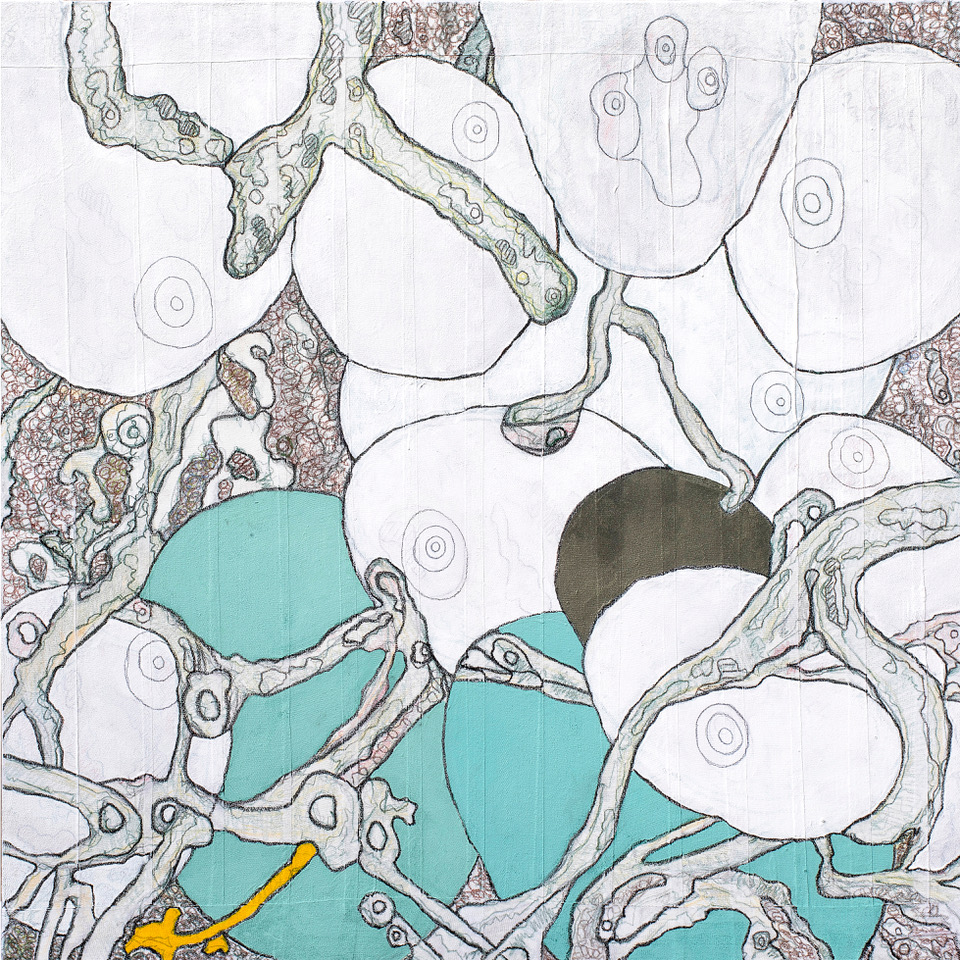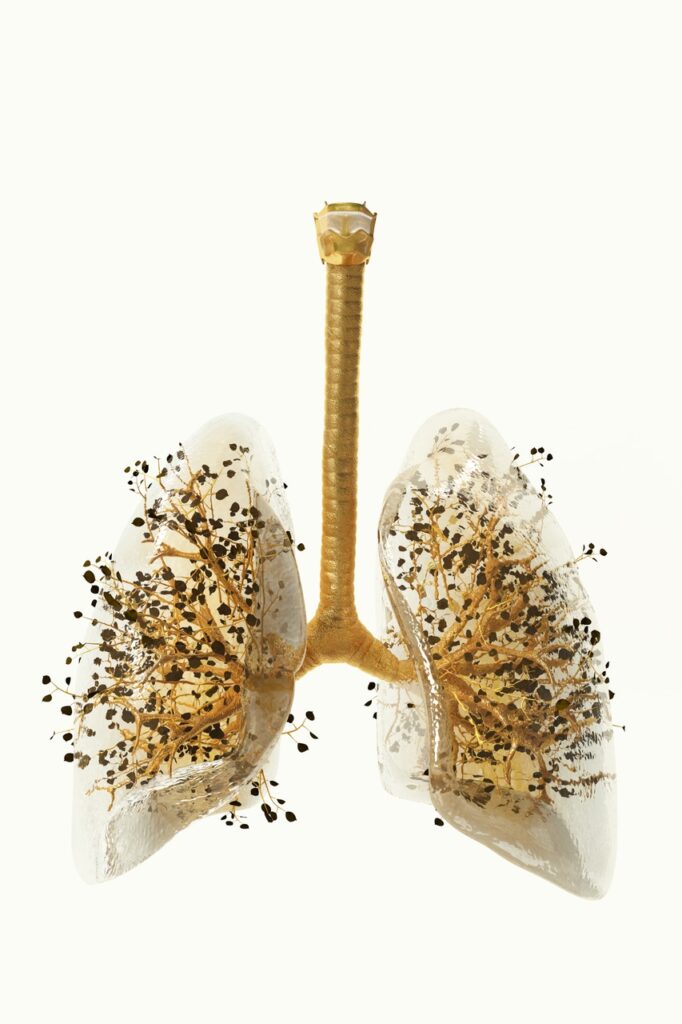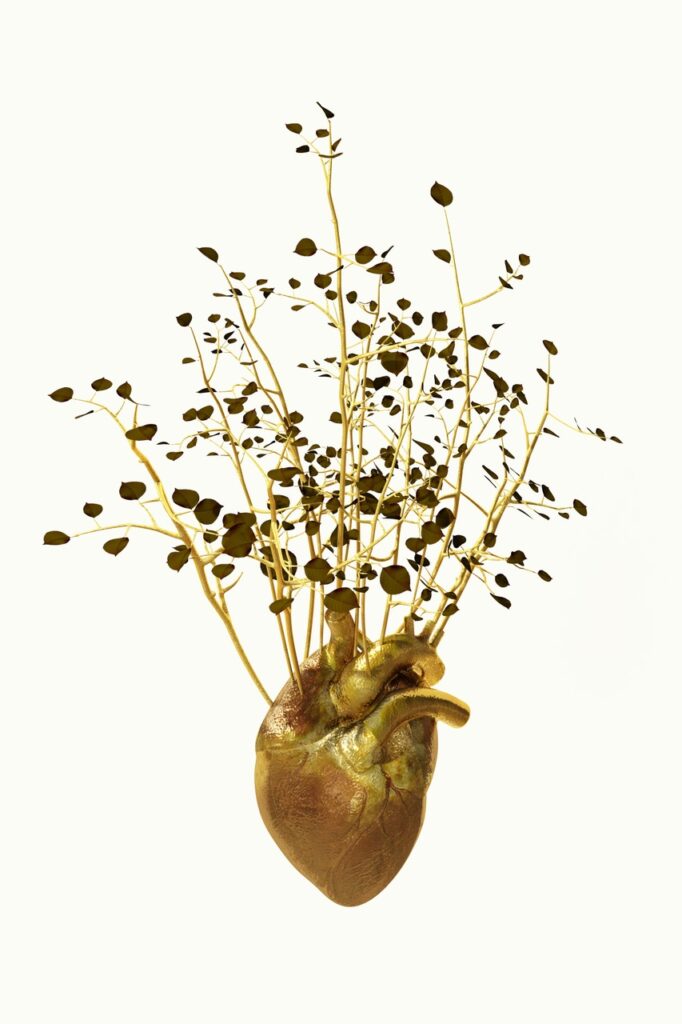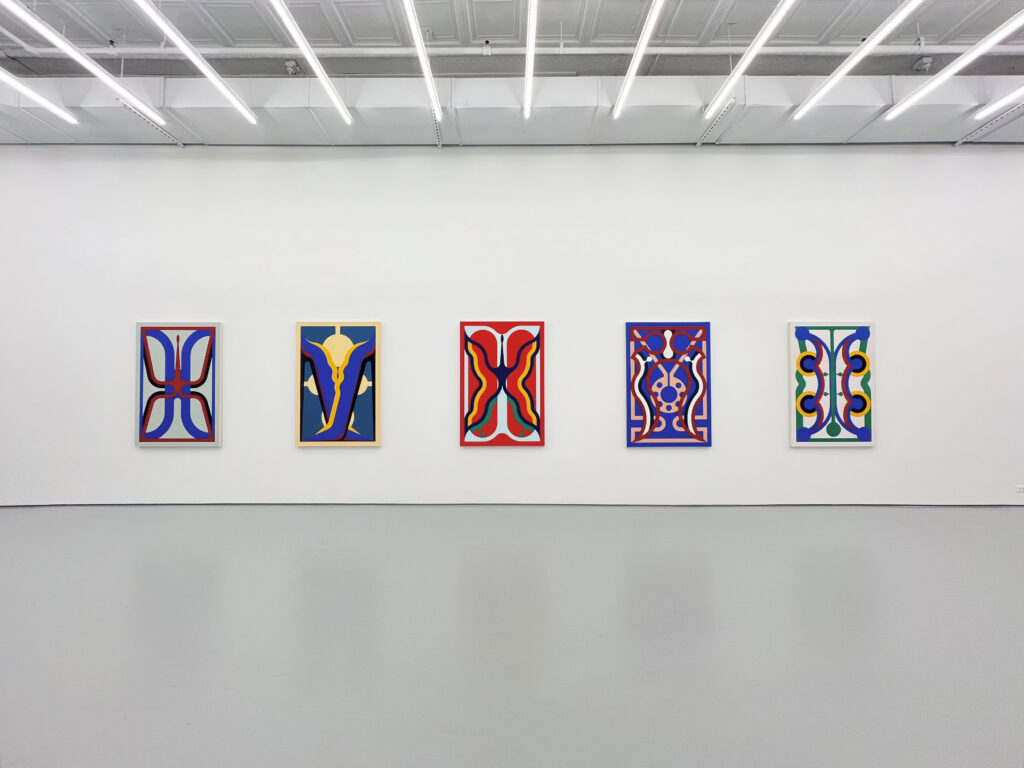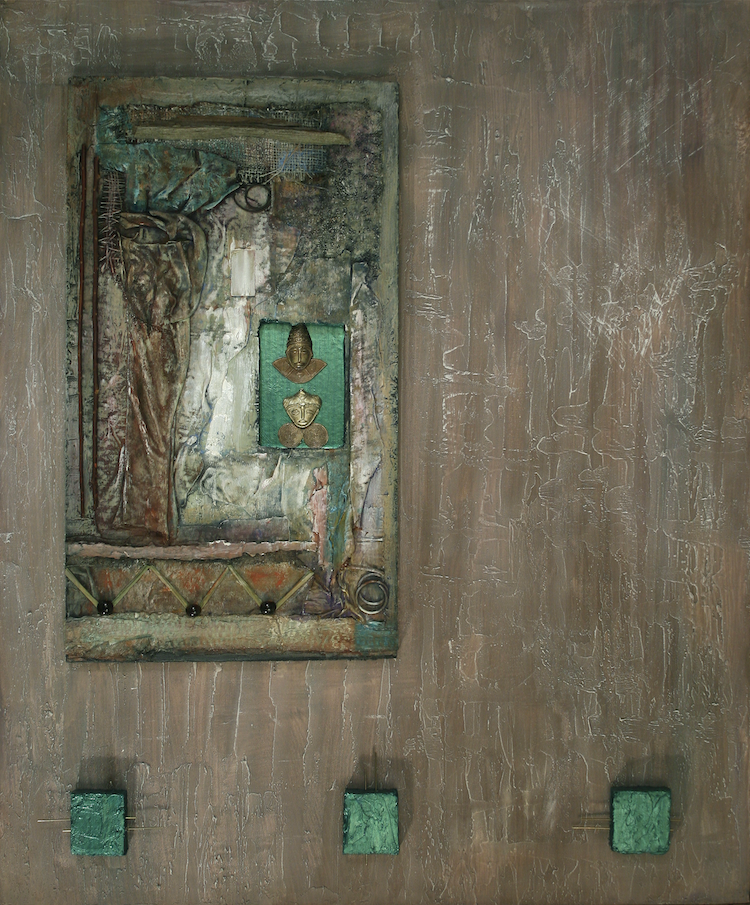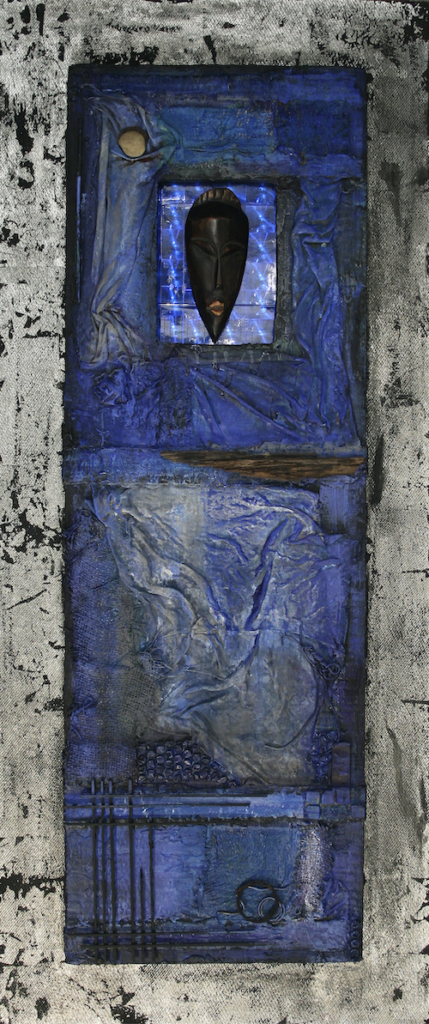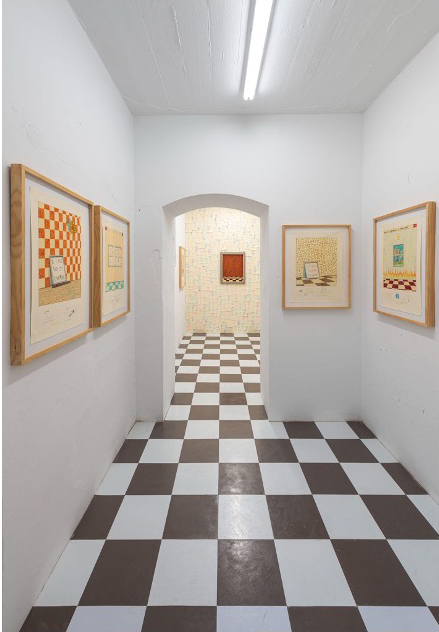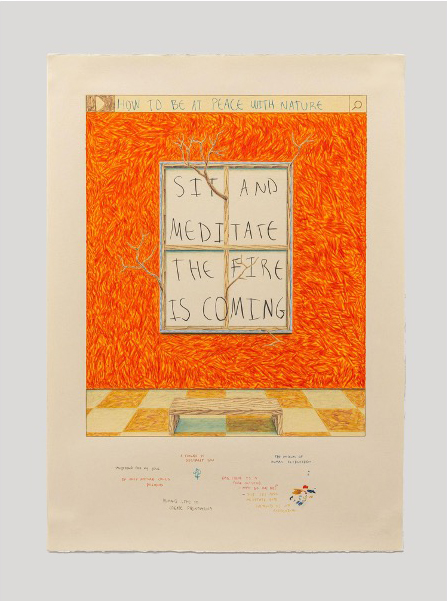
Ford Crull’s paintings are known for their symbology, gestural forms and kaleidoscopic spaces. Originally from Seattle, Crull emerged in the Lower East Side in the early ‘80s and has continued to exude the rugged spirit of that explosive cultural era in New York City. In his latest solo exhibition, Many Rivers to Cross, recently at the Happy Hour Gallery, Crull embraces an abstract musicality in artworks that have been, for the most part, painted during the Pandemic.
Along with his embrace of prismatic colors and profound lights and darks, Ford Crull presents a quiet spiritualism that has only deepened with time. Hearts dissolve into faces, crosses become clovers and stars, butterflies merge with hearts, and stars melt into astral light. Incomplete asemic phrases, as random as a thought but as profound as an incantation float in and out of the painting straddling both form and meaning. In Now Not Seen a flock of hearts flutters into a blue field while the words “Now Not Seen” float brokenly down about them.
The largest of the paintings, (and the namesake of the show), Many Rivers to Cross has the epic proportions and drama of a true romantic painting as it emanates a glowing musicality. The shimmering golden light through the brushwork of a burning red field has a power and hopefulness as fierce as a bonfire creating the ultimate transformation. It is the ecstasy of space and being, the power of light and dark, and the passage of day to night that is the paradoxical twilight/dawn world of Ford Crull.
Some works from Many Rivers to Cross are curated into the current group exhibition, The Living Water, through September 15 at the Happy Hour Gallery 670 Mtk Hwy, Water Mill. NY 11976
A Matter of Perspective exhibition installation view
A way to describe the exhibition of work at the Lonsdale Gallery in Toronto featuring Andrew Ooi and Tyler Matheson might be a study in two-point perspective. The viewer will tend to structure the gallery’s “A matter of Perspective” show around a common focal point. If Matheson speaks to the individual and their private journey of discovery, then Ooi addresses society in a holistic sense. Nevertheless, both artists in their own way arrive at a cosmology.
Tyler Matheson, Oblivion 8, 2022, mixed media on canvas,, 12 x 10 inches. Image courtesy of Matthew Zse
The “Oblivion” half of Matheson’s contribution grapples with image and identity of the self in a game of hide-and-seek. There is a sense that the thickly troweled grout elements are engaged in a chase with the reflective looking glass portions of the canvas, motivated somehow by a wish to bury any fugitive reflection, thereby extinguishing or annihilating them. These iridescent islands themselves are effectively a pulverization of the familiar seven colours of the rainbow. Is it this threat of entombment to which the “Oblivion” titles refer?
The tiling grout in Matheson’s “Parallax” series is devoid of reflective properties, but possesses an iridescence that appears to have transitioned or migrated from the “Oblivion” works. The formerly lifeless grey concrete breathes iridescence, a beneficiary of the now departed reflected self. I read this dynamic of pitching one medium against another as a measured psycho drama, not different in kind to the musings of Shakespeare’s Hamlet in the soliloquy, “To be, or not to be,” apprehensive as the prince was about “the sleep of death” and “what dreams may come” in its wake.
Left: Tyler Matheson, Oblivion 8, 2022, mixed media on canvas,, 12 x 10 inches. Right: Tyler Matheson, Parallax (Red, Blue, Geen), 2020, tiling grout and spray paint on board, 12 x 10 inches
Playing one line of sight against another is the optical law described by “parallax,” the everyday feature of vision that allows for depth-perception. Astronomers use its principles to measure relative distances between planets and stars. “Parallax” brings us to the doorstep of cosmology, the signifier through which our convergent lines of perspective must necessarily pass. Grinding out the etymological derivatives of cosmology furnishes us with enough links to deliver the universe and its order down to the level of the individual self with the words: cosmic, cosmos, cosmopolitan, and cosmetics.
Left: Andrew Ooi, Scale Study, 2022, ink, paper, cord, 15.75 x 15.75 x 2.5 inches. Right: Andrew Ooi, Scale 1, 2022, ink, paper, cord, 21 x 21 x 2 inches
Ooi’s meticulously obsessive art is a blueprint for something much larger than the less than two by two-foot paper constructions in the “A Matter of Perspective” exhibition. The artist introduces the notion of scale with his titles without delivering their literal specifications as architects might do in their plans. Each Gampi paper cube, one of 49 in “Scale 2” for instance, is a unit of time and space within which the artist has, in some respects, inhabited quite literally. “Scale 2” is a compressed set of ordered forms that viewers may magnify to an indeterminate size through their imagination, much like the film projection to a screen of a film strip.
Andrew Ooi, Scale 1, 2022, ink, paper, cord, 21 x 21 x 2 inches (unframed). Image courtesy of Matthew Zse
Similarly, the seven by seven cube composition stands in for the 49 days that a wall calendar of seven weeks might represent – a way of storing time spent, and now made visible in the intricacy of its fabrication. As Gampi paper is used in paper screens, windows, and lanterns, its particular sheen and lustre, the 49 cubes serve to sift and reflect their light energy, the ambient illumination displaying the inherent beauty of a Japanese paper perfected over the centuries.
It is in the making of Ooi’s “Scale” series of art that the finer tissues of meaning are revealed. Ooi’s “anthropology” is holistic in the purest sense – the parts of a whole are intimately interconnected, to the extent that the cubes of its composition are knotted together with cords. In that respect each “Scale” work is a living skeleton held back from potential fragmentation by its sinews, no single cube being independent from the next. This perspective applies broadly to the human condition in that the individual within society interpenetrate their environment, each playing an essential role towards a harmony within the whole. Whether we like or not, each of us are mountaineers roped together.
Matheson and Ooi, as it might be said of artists generally, address life energy, and how we choose to expend it. Steppenwolf in their “Born to Be Wild” song saw it as “Fire all your guns at once and explode into space.” The boosters of many of our life rockets may already have been spent. As capsules begin their descent, as it did at the launch, their countdown is meted out in seconds. Light years may, of course, separate the landing at a point, somewhere between Oblivion and Kingdom Come.
A Matter of Perspective continues through August 13, 2022. Lonsdale Gallery, 410 Spadina Road, Toronto, Ontario, Canada M5P 2W2. info@lonsdalegallery.com www.lonsdalegallery.com
YoAhn Han, Merman’s Dream (2022), acryla gouache, watercolor, yupo paper collage and resin on panel (all images courtesy of the artist)
The exhibition title, Hyperphantasia, refers to the capability of experiencing vivid mental pictures. Opening on September 1st at Artego gallery in Queens, NY, artists YoAhn Han and D. Dominick Lombardi will present works that feature some of those visual flashes that often occur during the creative process, where subconscious elements can end up on a painting, drawing or sculpture. YoAhn Han has many sources of imagery, most notably his fluctuating health issues, homosexuality compared with his strict Catholic upbringing, and the fact that he has roots in two very different cultures: South Korea and the US. For most of D. Dominick Lombardi’s career, he has relied on the collective unconscious for guidance and inspiration, resulting in loosely wound drawings, various responses to materials and colors, and visual alternatives received when working. Together, they bring a broad spectrum of what can result with such conditioning, from the powerful and poetic paintings of Han, to the darkly comedic socio-political observations of Lombardi.
D. Dominick Lombardi, CCWSI 126 (2022), alkyd and oil on linen previously painted in 1981 and 2007, 25″ x 26″
With Han and Lombardi, the swings in the content of their narratives are multi-layered and visually complex, wound around a strong pull from the past. Han refers to his paintings, which are composed of a variety of painting media, cut paper and resin as an “intersection of the imagery of my homeland Korea, together with Boston, in my own aesthetical conversion.” Han grew up in Chuncheon, South Korea, and maintains a strong bond with that culture. This results in a tendency to fold into his art, representations of the landscape and architecture, mixed with sexual references such as flowers, phallic symbols and the female praying mantis that consumes its male partner after mating – haunting elements that give his art its otherworldly, dreamy feel. In addition, his medical condition, which often causes temporary paralysis, has prompted Han’s obsession with the limitations of being. As a result of all these prompts, Han is clearly reaching for truth, enlightenment and a place where all of the aspects of his life can coalesce in a beautiful and brilliant dreamscape.
D. Dominick Lombardi, CCWS 99 (2020), acrylic, ink and charcoal on paper on canvas, 24″ x 38″
Lombardi utilizes past prompts too, but in a more physical sense, as he often repurposes old paintings and drawings to create his multi-layered narratives. His process includes past life drawings done as classroom demonstrations, subconscious thoughts that inspire the lines of his ‘stickers’, old studies for paintings and sculptures, and previously painted canvases to help him to resolve or reimagine his past. Working often with flashes of shape suggestions, colors and compositional changes, Lombardi is also driven by the fleetness of life. However, what triggers most of Lombardi’s art is reliving past thoughts and experiences through repurposing, the utilization of input from the collective unconscious, and the sway of creative editing. Repurposing also occurs in his sculptures, as all of the objects in his work are found. However, subject to gravity, the structure and result of each sculpture is a bit more preplanned.
Yoahn Han, Taboo (2021), mica, Acryla gouache, watercolor, paper pulp, yupo paper and resin on panel, 36” x 60”
The exhibition dates for Hyperphantasia are September 1 – September 30, with an artist reception on Saturday, September, 10. Artego is located at 32-88 48Th Street, Queens, NY 11103.
There are some of us, who can move from one art form to another and always find footing. Those individuals have a natural ability to respond to the challenges, find those inner voices they trust, and overcome every bump and detour in their journey. One of those genuine, passionate and dedicated individuals is Yul Vazquez, who credits much of his success to his mother, and a childhood filled with spiritual, social, and supportive experiences. Vazquez recalls with fondness those “ mystics and spiritualists” who were his mother’s friends, and he sees Cuba as a most significant part of his being.
At the age of three, Vazquez traveled with his mother, sister and grandmother to America from Cuba, which at the time, would have been an incredibly dangerous journey (this was 1969, after the Cuban Missile Crisis in ‘63, and the Bay of Pigs in ‘61). By the time his family fled Cuba, the Cold War was raging, travel to and from Cuba was forbidden, and the US placed an embargo of all goods flowing back and forth, virtually isolating the island. Growing up, Vazquez was exposed to a rich history of Afro-Caribbean Religions and Deities, an exposure to the occult that would follow him throughout his life, and one that would eventually appear as cryptic signs, mysterious symbols and bold sentences in his visual art.
Student protest against the Fidel Castro government in Havana’s central park. January 8, 1960, Photo: Wikimedia Commons
His creative journey began when his mother noticed his interest in music, especially the drums. Since it was the four of them living in a small efficiency apartment in Miami Beach, it was not the easiest commitment to make, but the drum set was there, in the corner of their all-purpose room by the time Vazquez was eight years old. His musical tipping point came when he was twelve, when he heard Whole Lotta Love for the first time. By then he had switched to guitar, and when he heard Led Zeppelin’s iconic song it shook him to his core, “I was stunned, stopped in my tracks thinking ‘What is This?’”. Instantly, the die was cast for Vazquez and soon, with a lot of hard work and ingenuity, the self taught musician was earning upwards of $90 per gig!
Even though music will always play a key role in Vazquez’s life, his fate would change when he got his first acting role as Flaco in The Mambo Kings. Since then, he has appeared in countless movies and television series that most recently includes Severance, Promised Land and the soon to be released The White House Plumbers.
Yul Vazquez, Fingers Freddy (2021), mixed media on printed canvas, 37 x 37 inches, courtesy of Red Fox Enterprises, Inc
Most recently, Vazquez has added a career in the visual arts, creating striking images that shifts between arresting black & white photography, fantastical mixed media paintings and stream of consciousness drawings. Opening July 16th at Red Fox Contemporary Art in Pound Ridge, NY, Vazquez will offer a variety of his works in a solo exhibition titled Bruce, which promises to add quite a substantial amount of heat to mid-summer. Among his wizardry of works will be Fingers Freddy, a work prompted by an x-ray of a six-fingered hand he spotted on the internet. Blown up and placed in a field of black, the image becomes haunting and mystical as Vazquez adds a frenzy of words, symbols and small sympathetic characters. His keen eye, especially when observing social behavior, helps Vazquez to elucidate both his observations and his emotions, which can stem from anywhere in his personal history to his current experiences.
If anyone has ever spent time on a movie set, it would be crystal clear how grueling the lives of actors and filmmakers are, where the 12-16 hour days waffle between endless waiting and pressure packed performing. Knowing this little detail would give you a better picture of what a wonderful, cleansing and fulfilling time Vazquez has in the solitude of his studio. In a recent conversation, he mentioned the alarm on his phone set for 3pm, which reminds him to take a “moment of gratitude” for his good life and the great people he has to share it with. I believe that gratification, his acknowledgement of his circumstance clearly comes through in his art.
Yul Vazquez, Mother (2022), mixed media on printed canvas, 52 x 52 inches, courtesy of Red Fox Enterprises, Inc
Vazquez often references his mother in his art, focusing on her light, love and strength. One example is Mother, where Vazquez uses a B-movie photograph of an obscure actress in a playful pose, with lightning bolts coming out of her fingers and costume. This combination of power and poise captured his attention, just like it did with the six-fingered x-ray, only this time, a weirdly iconic image of a female space alien became the center of his attention. Tags of “Where r u mother when I am so lost?” and “Your heart was always so full” crosses the upper portion of the picture plane, while on the bottom left appears a kid with a guitar who is clearly loving and cherishing her presence.
The exhibition, which is titled Bruce, refers to an omnipresent ‘being’ that symbolizes all, the entire universe, including the most important human traits in the artist’s mind: “kindness, never malevolence, and always having a heart of gold.” Bruce appears in a painting of the same name, as a buoyant bunny who sports a huge grin and hopeful eyes. The figure eight seen here, which surfaces from time to time in Vazquez’s work, signifies infinity, or no end to Bruce’s positive and all encompassing positive energy.
Yul Vazquez, Joker (2022), mixed media on printed canvas, 75 x 52 inches, courtesy of Red Fox Enterprises, Inc
The multimedia work Joker began as a collage of bits and pieces of playing cards that happened to have the compelling distinction of a skull and crossbones on the back. Vazquez tags the blown up version of that collage with animated hearts, stars, squiggles and sprays, which are partnered with various phrasings like “Memento Mori,” “Love is the Law,” “Traveler” and “Mi Reina” (My Queen). Taken in all at once, a voodoo vibe breaks through the layers of iconic images, passionate declarations and whirlwinds of emotion that leave us with a potent and mesmerizing visual.
The formidable photography of Vazquez, which is the basis of many of his multimedia paintings, can be overtly cinematic at times, especially when his night scenes shift unmistakably toward the Noir. Conversely, his more ‘candid’ images taken in Miami and New York, where pretty much anything goes, capture everything from bold decadence and pure self indulgence to desolation and despair. That feeling of hopelessness, which at times can reach surreal heights, can best be seen and felt in his photographs taken in Cuba, where time has virtually stood still, as only the strength and ingenuity of the Cuban people can offer light and life.
Yul Vazquez, Untitled (2011),digital photograph printed on paper, 13 x 31 inches, edition ⅔, courtesy of the artist
Vazquez, the visual artist, is like a diarist, except his tale is told through impactful phrases and images, brilliant color and iconic symbols. Fueled by an innate ability to see through the haze of the mundane, Vazquez continually takes us to a place where life can truly be enlightening.
Bruce, a solo exhibition of the works of Yul Vazquez, opens July 16 at Red Fox gallery, 55 Westchester Avenue, Pound Ridge NY 10576. For more information, please refer to https://www.redfoxartgallery.com/
Nora Griffin, Empire State (Zebra), 2022, oil on canvas, modeling paste, Flashe, epoxy, spray paint, artist frame, 69 1/2h x 69 1/2w inches, 176.53h x 176.53w cm
Nora Griffins’s paintings are scrappy, high-spirited, improvised works that feel like visual diaries of life on the run. Saturated color, woozy pattern, and images of fish, animals, and art pile up and jostle for a place in the sun. Surrounded by artist frames, which serve as shelves for a variety of objects, the four nearly six-foot square paintings and four smaller works are a kind of declaration of independence for this artist. They bring together ideas and motifs of her earlier work, but here with an expansive, imaginative panache and free-wheeling energy.
Nora Griffin, Koi, 2022, oil on canvas, modeling paste, Flashe, epoxy, spray paint, artist frame, 69 1/2h x 69 1/2w inches, 176.53h x 176.53w cm
In the painting Koi, zones of blues and purples are set off by free-form areas of cadmium red, creating a patchwork pool for the swimming goldfish. This painting shares with Empire State (Zebra) a kind of psychedelic intensity, with each form or space between becoming a place to record an impression of the fleeting world or a painterly sensation. A series of cascading, irregular blocks in green are echoed in a variety of smaller grids, all of which contrast with sections of yellow and aqua animated by daubed speckles. At the center of all the antic activity is a serene, multi-colored zebra.
Nora Griffin, Liquid Days (zzz Cat), 2022, oil on canvas, modeling paste, Flashe, epoxy, spray paint, artist frame, 69 1/2h x 69 1/2w inches, 176.53h x 176.53w cm
Liquid Days (zzz Cat) is a painting dominated by a looping lattice in Grannie Smith apple green and lavender, with flashes of purplish red. On top of this field, lounges a tabby cat in tones of purple. A crenelated outline in yellow haunts like a phantom presence, along with the sculpted palm prints that hang on the gesturally painted frame. Altogether, the result is an immersion in trippy high-jinx, a feeling of crazy, ordinary freedom.
Nora Griffin, Glass Flute, 2022, oil on canvas, modeling paste, Flashe, epoxy, spray paint, artist frame, 69 1/2h x 69 1/2w inches, 176.53h x 176.53w cm
The fourth large painting, Glass Flute, has a water-like rippling pattern in yellow and yellow-orange, overlaid by three images: two outlined ducks, an inset that looks like a quotation from one of the artist’s earlier works, and a detail from the Manet painting, The Fifer, here in grisaille. The combination of all these elements is cryptic, evoking the kind of mental conundrum that David Salle has specialized in. But here, the loosely rendered images and the funky abstract squiggles and dottings reveal the artist’s idiosyncratic touch, suggesting a receptive spirit that is open to the multifarious gifts that the world is continually offering.
In Griffin’s paintings, large-scale visual exuberance carries in its wake signs of the artist’s personal affinities. Together they create a theater of the artist’s inner world, made accessible and public-facing. Her impromptu, reckless works convey a feeling of charged avidity for a life that she wants to share with us.
The sense of Griffin’s personal stake in these paintings is embodied in their every aspect, including the objects lodged in the frames, suggesting both private revelation and a guarding of the extraordinary act of self-exposure that painting entails. The objects surrounding the canvases, à la Jasper Johns, include painted eyeglasses, turtles, palm prints, the artist’s initials, and souvenir Statues of Liberty, which give the whole enterprise a rakish New York City vibe.
In these works, Nora Griffin melds a number of different impulses: a devil-may-care rawness, using paint as a blunt instrument of sensation, a desire to create a personal dream-logic from juxtaposed color and image, and an affirmation that painting can be a poetic art that is on the street, in the museum, and in the heart, all at once.
Nora Griffin / Liquid Days at Fierman West, 19 Pike Street, New York, NY from June 3 to July 2, 2022.